October 8-9, 2009
Air Temperatures – The following maximum temperatures were recorded across the state of Hawaii Thursday afternoon:
Lihue, Kauai – 87
Honolulu, Oahu – 87
Kaneohe, Oahu – 86
Kahului, Maui – 88
Hilo, Hawaii – 86
Kailua-kona – 88
Air Temperatures ranged between these warmest and coolest spots near sea level around the state – and on the highest mountains…at 5 p.m. Thursday evening:
Port Allen, Kauai – 86F
Hilo, Hawaii – 79
Haleakala Crater – 55 (near 10,000 feet on Maui)
Mauna Kea summit – 41 (near 14,000 feet on the Big Island)
Precipitation Totals – The following numbers represent the largest precipitation totals (inches) during the last 24 hours on each of the major islands, as of Thursday afternoon:
0.03 Mount Waialeale, Kauai
0.02 Kahuku Training Area, Oahu
0.00 Molokai
0.00 Lanai
0.09 Kahoolawe
0.24 Kaupo Gap, Maui
3.16 Pali 2, Big Island
Marine Winds – Here’s the latest (automatically updated) weather map showing a 1031 millibar high pressure system far to the northeast of the islands. A cold front to the northwest is keeping this high’s ridge down near Kauai Thursday. Our local winds will remain light into Saturday.
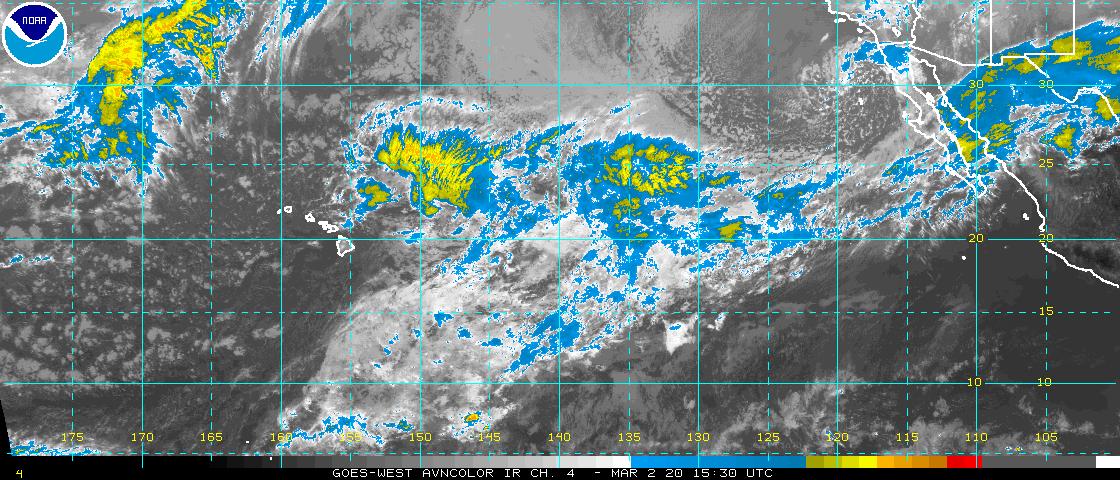
Satellite and Radar Images: To view the cloud conditions we have here in Hawaii, please use the following satellite links, starting off with this Infrared Satellite Image of the islands to see all the clouds around the state during the day and night. This next image is one that gives close images of the islands only during the daytime hours, and is referred to as a Close-up visible image. This next image shows a larger view of the Pacific…giving perspective to the wider ranging cloud patterns in the Pacific Ocean. Finally, here’s a Looping IR satellite image, making viewable the clouds around the islands 24 hours a day. To help you keep track of where any showers may be around the islands, here’s the latest animated radar image.
Hawaii’s Mountains – Here’s a link to the live webcam on the summit of near 14,000 foot Mauna Kea on the Big Island of Hawaii. The tallest peak on the island of Maui is the Haleakala Crater, which is near 10,000 feet in elevation. These two webcams are available during the daylight hours here in the islands…and when there’s a big moon rising just after sunset for an hour or two! Plus, during the nights and early mornings you will be able to see stars, and the sunrise too…depending upon weather conditions.
Tropical Cyclone activity in the eastern and central Pacific – Here’s the latest weather information coming out of the National Hurricane Center, covering the eastern north Pacific. You can find the latest tropical cyclone information for the central north Pacific (where Hawaii is located) by clicking on this link to the Central Pacific Hurricane Center. Here’s a tracking map covering both the eastern and central Pacific Ocean. A satellite image, which shows the entire ocean area between Hawaii and the Mexican coast…can be found here.
Aloha Paragraphs

Beautiful beach…Kauai
The fairly typical early autumn light winded convective weather pattern remains in place as we approach the weekend. Our trade wind producing high pressure system is a long ways off Thursday evening, as it has been the last several days. This high’s associated ridge is now over the state, as shown on this latest weather map. At the same time, there are two dynamic low pressure systems to the north-northwest of our islands. The closest low has developing hurricane force winds, while the second is further north, getting ready to cross the Aleutian Islands…into the Bering Sea.
The combination of these two low pressure cells, will not only help to keep our light winds in place, but also send us a fairly large northwest swell train of waves this weekend. The winds blowing across the ocean to our northwest, called a fetch, is long and straight, which will make our surfing community happy later Saturday into Sunday. It looks likely to cause high surf advisory level waves on our north and west facing shores then.
This light wind condition, is keeping muggy conditions in place, along with some haze…some of which is volcanic in origin. This vog isn’t occurring statewide, as it sometimes does. Our winds aren’t exclusively from the southeast, which is the infamous wind direction, for occasions when we often see the thickest voggy weather episodes. There’s also some manmade pollutants too, which will stick around for the next several days as well. It will take the returning trade winds to disperse this pollution.
The latest computer forecast models show the high pressure ridge edging northward enough, to coax the trade wind breezes back in our direction later Saturday. This ventilating trade wind flow won’t last long though, hopefully long enough to clear our atmosphere. This hazy weather won’t take much of a vacation however, as yet another light wind event will take place as we movetowerds the middle of next week. It should be pointed out, as was the case in yesterday’s narrative, that these light wind patterns are quite common during the autumn season.
Looking a bit closer at the synoptic pattern for the islands, we still have a fairly ripe atmosphere in regards possible showers. These upcountry interior showers will persist over the islands through Friday afternoon, or until the light to moderate trade winds return this weekend. As these trades show up, we’re apt to see the return of a few windward biased showers then for a couple of days. Once we get into next week, computer models show a cold front digging southward, from its parent low pressure system to our northwest.
The approach of this next cold front will once again push our high pressure ridge down over the islands. The models don’t show the front getting close enough, at least at this time, to break through the ridge to carry us any rainfall. Speaking of rainfall and cold fronts though, the models go on to show a second frontal boundary actually intruding into the Kauai end of the island chain next weekend…although that’s still a long ways out into the future.
It’s early Thursday evening here in Kihei, Maui, as I begin writing this last section of today’s narrative update. Looking out the window here before I take the drive back upcountry to Kula, I see lots clouds, and quite a bit of vog (volcanic haze) too. This is often the case during the afternoons, under the influence of a convective weather pattern…such as we have going on now. As we move past the sunset hour, the clouds will quickly disappear, as the breezes that that came inland during the day, head back down towards the coasts. I expect mostly clear skies overnight and into Friday morning, although I also would expect hazy skies to prevail as well. During the day Friday, with the daytime heating, and the resultant onshore flowing sea breezes, clouds will form again during the afternoons. These clouds may drop some upcountry showers again then. ~~~ I’ll be back again early Friday morning with your next new weather narrative from paradise. I hope you have a great Thursday night until then! Aloha for now…Glenn.
Interesting: The US will cut its greenhouse gas emissions by 20 per cent by 2020. That is the idea, at least. After weeks of delay, a climate-change bill has finally been introduced into the Senate. It will face stiff opposition. Most Republicans are almost certain to vote against the bill, citing concern for US industry.
Even some with a track record of action on climate change are opposed: former presidential candidate John McCain told Reuters that he would "never, never, never" vote for the bill. Dissent also comes from Democrats representing coal-rich or farming states. Debates are scheduled for later this month, leaving little decision time before the crucial climate summit in Copenhagen, Denmark, in December.
"It is very important to get a vote before December," says Jennifer Morgan, climate and energy programme director at the World Resources Institute in Washington DC. "It would give credibility to the US delegation at the talks."
Interesting2: In today’s world of complex supply chains, international supermarkets and big agribusiness, it has become more and more difficult for small farms to sell their produce directly to local consumers at a reasonable price. But one farm in Germany, Peter-und-Paul-Hof, thinks they may have found a solution: set up vending machines which distribute produce instead of junk food.
The idea is unconventional, to be sure, but it isn’t unprecedented. Back in 2007, a Spanish company based in Barcelona– Lof– also used vending machines to distribute healthy food such as nuts, prepared fruit, ready meals and even gazpacho soup. But the application of vending machines by Peter-und-Paul-Hof is the first time they have been used to deliver local produce.
The effort is part of a collaboration between the farm and vending manufacturer Stuewer, and currently the specialty machines (labeled Regiomats) are set up to dispense fresh milk, eggs, butter, cheese, potatoes and sausage. What more could a hungry German ask for?
Interesting3: Chaotic behavior is the rule, not the exception, in the world we experience through our senses, the world governed by the laws of classical physics. Even tiny, easily overlooked events can completely change the behavior of a complex system, to the point where there is no apparent order to most natural systems we deal with in everyday life.
The weather is one familiar case, but other well-studied examples can be found in chemical reactions, population dynamics, neural networks and even the stock market. Scientists who study "chaos" — which they define as extreme sensitivity to infinitesimally small tweaks in the initial conditions — have observed this kind of behavior only in the deterministic world described by classical physics.
Until now, no one has produced experimental evidence that chaos occurs in the quantum world, the world of photons, atoms, molecules and their building blocks. This is a world ruled by uncertainty: An atom is both a particle and a wave, and it’s impossible to determine its position and velocity simultaneously. And that presents a major problem.
If the starting point for a quantum particle cannot be precisely known, then there is no way to construct a theory that is sensitive to initial conditions in the way of classical chaos. Yet quantum mechanics is the most complete theory of the physical world, and therefore should be able to account for all naturally occurring phenomena.
"The problem is that people don’t see [classical] chaos in quantum systems," said Professor Poul Jessen of the University of Arizona. "And we believe quantum mechanics is the fundamental theory, the theory that describes everything, and that we should be able to understand how classical physics follows as a limiting case of quantum physics."
Astronomers from The University of Western Ontario have released footage of a meteor that was approximately 100 times brighter than a full moon. The meteor lit up the skies of southern Ontario two weeks ago and Western astronomers are now hoping to enlist the help of local residents in recovering one or more possible meteorites that may have crashed in the area of Grimsby, Ontario.
Interesting4: A new report, launched by the UK Energy Research Centre (UKERC), argues that conventional oil production is likely to peak before 2030, with a significant risk of a peak before 2020. The report concludes that the UK Government is not alone in being unprepared for such an event – despite oil supplying a third of the world’s energy.
The report finds that we are entering an era of slow and expensive oil as resources get harder to find, extract and produce. Major new discoveries, such as those announced recently in the Gulf of Mexico, will only delay the peak by a matter of days or weeks. Simply maintaining global production at today’s level would need the equivalent of a new Saudi Arabia every three years.
According to the report’s chief author, Steve Sorrell, senior researcher at UKERC, "In our view, forecasts which delay a peak in conventional oil production until after 2030 are at best optimistic and at worst implausible. And given the world’s overwhelming dependence upon oil and the time required to develop alternatives, 2030 isn’t far away.
The concern is that rising oil prices will encourage the rapid development of carbon-intensive alternatives which will make it difficult or impossible to prevent dangerous climate change." The report defends more optimistic estimates of the size of oil resources but notes that much of this is in smaller less accessible fields which may only be produced relatively slowly and at high cost.
It also highlights the accelerating decline in production from existing fields; more than two thirds of current crude oil production capacity may need to be replaced by 2030 to prevent production from falling.
Interesting5: Can the idea of ‘green motorsport’ actually work? Yes, according to EPSRC funded researcher, Dr Kerry Kirwan at the University of Warwick, who led the research team which designed and built the worldfirst fully sustainable Formula 3 racing car. The car is made from woven flax, recycled carbon fibre, recycled resin and carrot pulp for the steering wheel. It runs on biofuel made from chocolate and animal fats and is lubricated with plant oils. But it’s not just an environmentally friendly car, it is also fast.
The car has a top speed of 135 mph, can achieve 0-60 in 2.5 seconds and is turbo charged to give it more torque. Having got the seal of approval from drivers such as Lewis Hamilton and Adam Carroll as well as F1 team boss Ross Brawn, the car will make its first competitive debut in the Formula 3 Championship final at Brands Hatch on 17th October.
The team hope to prove that high performance, competitive cars can be built from sustainable materials. According to Dr Kirwan the idea behind the project is to show that: "being sustainable and green can be incredibly sexy, fun and fast." He goes on to say that even though people’s perception of motorsport is that it’s wasteful, this project is "aiming to show ways for the future, for people to race and be green."
 Email Glenn James: