











October 7-8, 2009
Air Temperatures – The following maximum temperatures were recorded across the state of Hawaii Wednesday afternoon:
Lihue, Kauai – 85
Honolulu, Oahu – 87
Kaneohe, Oahu – 84
Kahului, Maui – 87
Hilo, Hawaii – 82
Kailua-kona – 88
Air Temperatures ranged between these warmest and coolest spots near sea level around the state – and on the highest mountains…at 5 p.m. Wednesday evening:
Port Allen, Kauai – 88F
Hilo, Hawaii – 79
Haleakala Crater – 54 (near 10,000 feet on Maui)
Mauna Kea summit – 41 (near 14,000 feet on the Big Island)
Precipitation Totals – The following numbers represent the largest precipitation totals (inches) during the last 24 hours on each of the major islands, as of Wednesday afternoon:
1.69 Mount Waialeale, Kauai
0.25 Poamoho 2, Oahu
0.00 Molokai
0.00 Lanai
0.00 Kahoolawe
0.01 Oheo Gulch, Maui
1.40 Kahuku Ranch, Big Island
Marine Winds – Here’s the latest (automatically updated) weather map showing a 1030 millibar high pressure system far to the northeast of the islands. A cold front to the northwest is keeping this high’s ridge down near Kauai at mid-week. Our local winds will remain light into Friday.
Satellite and Radar Images: To view the cloud conditions we have here in Hawaii, please use the following satellite links, starting off with this Infrared Satellite Image of the islands to see all the clouds around the state during the day and night. This next image is one that gives close images of the islands only during the daytime hours, and is referred to as a Close-up visible image. This next image shows a larger view of the Pacific…giving perspective to the wider ranging cloud patterns in the Pacific Ocean. Finally, here’s a Looping IR satellite image, making viewable the clouds around the islands 24 hours a day. To help you keep track of where any showers may be around the islands, here’s the latest animated radar image.
Hawaii’s Mountains – Here’s a link to the live webcam on the summit of near 14,000 foot Mauna Kea on the Big Island of Hawaii. The tallest peak on the island of Maui is the Haleakala Crater, which is near 10,000 feet in elevation. These two webcams are available during the daylight hours here in the islands…and when there’s a big moon rising just after sunset for an hour or two! Plus, during the nights and early mornings you will be able to see stars, and the sunrise too…depending upon weather conditions.
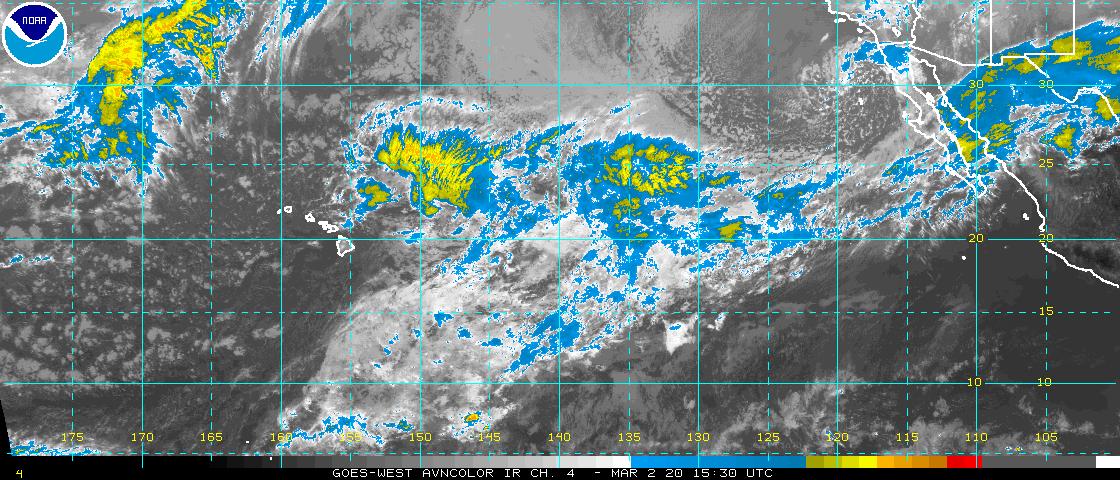
Tropical Cyclone activity in the eastern and central Pacific – Here’s the latest weather information coming out of the National Hurricane Center, covering the eastern north Pacific. You can find the latest tropical cyclone information for the central north Pacific (where Hawaii is located) by clicking on this link to the Central Pacific Hurricane Center. Here’s a tracking map covering both the eastern and central Pacific Ocean. A satellite image, which shows the entire ocean area between Hawaii and the Mexican coast…can be found here.
Aloha Paragraphs

Iao Needle…West Maui Mountains
We’re finding another early sign of our autumn season here in the islands, as our local trade winds remain light and variable in direction for the time being. This would be quite unusual during the summer months, although becomes more common as me move towards winter. We can tell quite a bit about what’s happening, by checking out this weather map. We find our trade wind producing high pressure system far to the northeast, offshore from the British Columbian coast of
There have been, and will continue to be several influences involved with this light wind episode. The most striking, and the one that most people would notice first, is the hot and muggy conditions that prevail at low elevations of the islands. High temperatures will remain about as they have been, from about 85F to 90 degrees…but will feel a couple of degrees higher than that! The afternoon shower activity that we’ve seen the last couple of days, has calmed down quite a bit today. This is due to the passage of an upper level trough of low pressure, and its triggering of locally heavy showers…with that flash flood watch which ended yesterday. The air mass is still shower prone enough, that we saw several heavy showers, and even a couple of thunderstorms during afternoon hours on the slopes of the Big Island.
There is relief on the horizon though, but we will have to wait until later this week. This tempering of the hot and sultry weather will occur as the cooling and refreshing trade wind breezes kick in…likely by this weekend. There seems to be at least some light haze building up over some parts of the island chain at mid-week. The two sources of this haze of course are man made, and the volcanic emission from the vent on the
It’s early Wednesday evening here in Kihei, Maui, as I begin writing this last section of today’s narrative update. Today, at least in most places around the state, had drier weather, in terms of rainfall…but not in terms of humidty however. The Big Island was the one exception, where there were still some generous downpours here and there on the volcanic slopes. Looking out the window here in Kihei, before I jump in my car for the drive upcountry to Kula, I see almost totally clear skies, with a bit of haze in the air too. Besides the sultry conditions, our weather should be pretty good through the rest of this work week, before the trade winds return this weekend. ~~~ I’ll be back early Thursday morning with your next new weather narrative, I hope you have a great Wednesday night until then! Aloha for now…Glenn.
Interesting: With just 60 days left before world leaders meet in Copenhagen to thrash out a new global climate deal, how do the chips that are on the table tally up? Not very well. According to the latest estimate of the carbon cuts offered by rich nations, the pledges fall well short of the reductions that climate scientists say are needed to avoid dangerous climate change.
Experts at the World Resources Institute, an environmental think-tank based in Washington, D.C., today published their analysis of pledges that have been made so far by developed nations, and their impact on global emissions. These include commitments from Russia, Australia and the European Union to cut their emissions by up to 15, 25 and 30 per cent respectively by 2020.
The researchers also included estimates of what the US may be able to offer in Copenhagen, based on 20 per cent cuts outlined in a bill due to be discussed in the Senate this month, and other figures mentioned, for instance, in Obama’s election campaign. They found that pledged cuts would result in emissions from the developed world dropping by 10 to 24 per cent below 1990 levels by 2020.
But the Intergovernmental Panel on Climate Change (IPCC) estimates that the same nations need to cut emissions by 25 to 40 per cent by 2020, if atmospheric carbon levels are to stay within 450 parts per million. Many scientists argue that concentrations above this level will trigger severe environmental impacts, including drought and sea level rises that will displace millions of people.
"The reductions will not be enough to meet IPCC recommendations," says Jennifer Morgan, director of the WRI’s climate and energy program. "We urge industrialized countries to bring forward more ambitious pledges to reduce their greenhouse gas emissions." Malte Meinshausen of the Potsdam Institute for Climate Impact Research in Germany says that the gloomy picture painted by the WRI may actually be overly optimistic.
He points out that the WRI’s figure includes the impact of US policies on issues like energy efficiency. These policies will probably result in emissions reductions, but they are not the same as a pledge to meet a specific emissions target. Analyses that consider only specific targets suggest that the developed world will cut its emission by no more than 16 per cent by 2020. There is a "clear gap" between the level of ambition of the developed nations and the IPCC recommendations, says Meinshausen.
Interesting2: Most tropical forests – from Himalayan hill forests to the Madagascan jungle – are controlled by local and national governments. Forest communities own and manage little more than a tenth. They have a reputation for trashing their trees – cutting them for timber or burning them to clear land for farming.
In reality the opposite is true, according to Ashwini Chhatre of the University of Illinois at Urbana-Champaign. In the first study of its kind, Chhatre and Arun Agrawal of the University of Michigan in Ann Arbor compared forest ownership with data on carbon sequestration, which is estimated from the size and number of trees in a forest.
Hectare-for-hectare, they found that tropical forest under local management stored more carbon than government-owned forests. There are exceptions, says Chhatre, "but our findings show that we can increase carbon sequestration simply by transferring ownership of forests from governments to communities".
One reason may be that locals protect forests best if they own them, because they have a long-term interest in ensuring the forests’ survival. While governments, whatever their intentions, usually license destructive logging, or preside over a free-for-all in which everyone grabs what they can because nobody believes the forest will last.
The authors suggest that locals would also make a better job of managing common pastures, coastal fisheries and water supplies. They argue that their findings contradict a long-standing environmental idea, called the "tragedy of the commons", which says that natural resources left to communal control get trashed. In fact, says Agrawal, "communities are perfectly capable of managing their resources sustainably".
Interesting3: The windswept deserts of northern China might seem an odd destination for studying the heavy monsoon rains that routinely drench the more tropical regions of Southeast Asia. But the sandy dune fields that mark the desert margin between greener pastures to the south and the Gobi Desert to the north are a rich source of information about past climates in Asia, says University of Wisconsin-Madison geographer Joseph Mason.
Wetter periods allow vegetation to take root on and stabilize sand dunes. During dry spells, plants die off and the dunes are more active, constantly shifting as sand is blown away and replenished. Such patterns of dune activity provide a history of the area’s climate — if one can read them, Mason says. "When did those periods of stability or activity occur and from that, what can we infer about climate change?"
As reported in a new paper in the October issue of the journal Geology, Mason and colleagues mapped sand dune activity across northern China and found unexpectedly high levels of mobility and change 8,000 to 11,500 years ago, a time period generally thought to have a wetter climate. The result challenges existing ideas about the monsoon’s regional influence and could impact future climate predictions.
Today, the dunes are at the edge of the monsoon region and the scientists expected to find close correlation between precipitation in the dune fields and the strength of the monsoon. What they found instead was rather surprising. "They turn out to be almost completely out of phase," Mason says. "Where we find lots of active dunes turns out to be a time when the monsoon system is supposed to have been stronger in southern and central China."
Part of the explanation may lie in local patterns of atmospheric circulation. At the peak of the summer monsoon, central China experiences both heavy summer rainfall and strong upward airflow. That upward flow tends to be balanced out by more downward air motion — which suppresses precipitation — in areas north and west of the monsoon core.
Give tropical forests back to the people who live in them – and the trees will soak up your carbon for you. Above all, keep the forests out of the hands of government. So concludes a study that has tracked the fate of 80 forests worldwide over 15 years.
Interesting4: How far you can reach beyond your toes from a sitting position – normally used to define the flexibility of a person’s body – may be an indicator of how stiff your arteries are. A study in the American Journal of Physiology has found that, among people 40 years old and older, performance on the sit-and-reach test could be used to assess the flexibility of the arteries.
Because arterial stiffness often precedes cardiovascular disease, the results suggest that this simple test could become a quick measure of an individual’s risk for early mortality from heart attack or stroke. “Our findings have potentially important clinical implications because trunk flexibility can be easily evaluated,” said one of the authors, Kenta Yamamoto.
“This simple test might help to prevent age-related arterial stiffening.” It is not known why arterial flexibility would be related to the flexibility of the body in middle age and older people. But the authors say that one possibility is that stretching exercises may set into motion physiological reactions that slow down age-related arterial stiffening.
Healthy blood vessels are elastic, and elasticity helps to moderate blood pressure. Arterial stiffness increases with age and is a risk factor for cardiovascular disease and death. Previous studies have established that physical fitness can delay age-related arterial stiffness, although exactly how that happens is not understood.
The authors noted that people who keep themselves in shape often have a more flexible body, and they hypothesized that a flexible body could be a quick way to determine arterial flexibility. The researchers studied 526 healthy, non-smoking adults, 20 to 83 years old, with a body mass index of less than 30. They wanted to see whether flexibility of the trunk, as measured with the sit and reach test, is associated with arterial stiffness.
The researchers divided the participants into three age groups:
• young (20-39 years old)
• middle aged (40-59 years old)
• older (60-83 years old)
The researchers asked participants to perform a sit-and-reach test. The volunteers sat on the floor, back against the wall, legs straight. They slowly reached their arms forward by bending at the waist. Based on how far they could reach, the researchers classified the participants as either poor- or high-flexibility.
Interesting5: NYTimes Environmental groups hailed a decision this week by four of the world’s largest meat producers to ban the purchase of cattle from newly deforested areas of Brazil’s Amazon rain forest. At a conference on Monday in São Paulo organized by Greenpeace, the four cattle companies — Bertin, JBS-Friboi, Marfrig and Minerva — agreed to support Greenpeace’s call for an end to the deforestation.
Brazil has the world’s largest cattle herd and is the world’s largest beef exporter, but it is also the fourth largest producer of greenhouse gas emissions. Destruction of tropical forests around the world is estimated to be responsible for about 20 percent of global greenhouse gas emissions. Greenpeace contends that the cattle industry in the Amazon is the biggest driver of global deforestation.
But the Brazilian government, while pushing ambitious goals to slow deforestation in the Amazon, is also a major financer and shareholder in global beef and leather processors that profit from cattle raised in areas of the Amazon that have been destroyed, often illegally, according to Greenpeace. The four cattle producers agreed on Monday to monitor their supply chains and set clear targets for the registration of farms that supply cattle, both directly and indirectly.
They also said they would devise measures to end the purchase of cattle from indigenous and protected areas, and from farms that use slave labor. Environmental groups called the decision a major step forward for climate protection. “This agreement shows that in today’s world someone that wants to be a global player cannot be associated with deforestation and with slave labor,” said Marcelo Furtado, executive director of Greenpeace in Brazil.
The agreement came after the release in June of a report by Greenpeace, “Slaughtering the Amazon,” which detailed the link between forest destruction and the expansion of cattle ranching in the Amazon. The report led some multinational companies, including shoe manufacturers like Adidas, Nike and Timberland, to pledge to cancel contracts unless they received guarantees that their products were not associated with cattle or slave labor in the Amazon.
Beef customers like McDonald’s and Wal-Mart also pressed producers to change their practices in the Amazon, Mr. Furtado said. Blairo Maggi, the governor of Mato Grosso, the Brazilian state with the highest rate of deforestation in the Amazon and the country’s largest cattle herd, said Monday that he would support efforts to protect the Amazon and provide high-resolution satellite imagery to help monitor the region.
Interesting6: The dusty hoop lies some eight million miles from the planet, about 50 times more distant than the other rings and in a different plane. Scientists tell the journal Nature that the tenuous ring is probably made up of debris kicked off Saturn’s moon Phoebe by small impacts. They think this dust then migrates towards the planet where it is picked up by another Saturnian moon, Iapetus.
The discovery would appear to resolve a longstanding mystery in planetary science: why the walnut-shaped Iapetus has a two-tone complexion, with one side of the moon significantly darker than the other. "It has essentially a head-on collision.
The particles smack Iapetus like bugs on a windshield," said Anne Verbiscer from the University of Virginia, US. Observations of the material coating the dark face of Iapetus indicate it has a similar composition to the surface material on Phoebe. The scale of the new ring feature is astonishing. Nothing like it has been seen elsewhere in the Solar System.
The more easily visible outlier in Saturn’s famous bands of ice and dust is its E-ring, which encompasses the orbit of the moon Enceladus. This circles the planet at a distance of just 240,000km. The newly identified torus is not only much broader and further out, it is also tilted at an angle of 27 degrees to the plane on which the more traditional rings sit.
This in itself strongly links the ring’s origin to Phoebe, which also takes a highly inclined path around Saturn. Scientists suspected the ring might be present and had the perfect tool in the Spitzer space telescope to confirm it.
Interesting7: Earth attacks the moon tomorrow, bent on plundering that most precious of resources: water. "Things are looking great. We’re headed right for the target," says Daniel Andrews of NASA’s Ames Research Center, head of the $79 million Lunar Crater Observation and Sensing Satellite (LCROSS) mission. "The very latest data suggest we are headed for one of the very wettest spots on the moon."
If all goes well, on Friday about 7:30 a.m. ET, the two parts of the LCROSS spacecraft will smack into the lunar surface at nearly 6,000 mph, sending up plumes of moon dust — perhaps full of ice — 6.2 miles high above the moon’s Cabeus crater. "There is a very good chance we will see results," says planetary scientist Bernard Foing of the European Space Agency, who is not part of the mission.
"Cabeus crater is perfect. Some areas are always in shadow, so we are quite certain these are some of the coldest places for ice in the solar system," as low as minus 360 degrees Fahrenheit. Tonight, the LCROSS "shepherd" spacecraft should drop its booster rocket and turn to observe its descent. After the booster hits the crater, blasting out a hole 90 feet deep, the shepherd will pass through the plume.
After analyzing the plume, the shepherd then blasts into the crater itself four minutes later, creating a second hole 60 feet deep. "We are trimming the trajectory as we go," Andrews says. Dating back at least to 1999, when a lunar mission detected water signatures from the supposedly bone-dry moon, NASA scientists have pondered whether ice left from comet impacts may have pooled and cooled in the permanently shaded potholes — probably strangers to sunlight for billions of years — dotting the lunar poles. In 2004, when the Bush administration pushed for moon bases, glaciers hidden in those craters looked attractive as water and fuel sources for future moon colonists.
Last month, Science magazine reported evidence of water migrating out of the lunar soil in the solar wind, or streams of gas particles from the sun, and perhaps some of the water ended up in those shaded craters. "What’s still not clear is whether there is enough water there to be meaningful," Andrews says; "meaningful" could be anything from 1% to 10% of the plume containing water. "Water on the moon has haunted us for years," says William Hartmann of the Planetary Science Institute.
"It’s all part of humanity’s quest to understand our nearby cosmic environment." LCROSS should detect whether at least 0.5% of the plume contains water. If the results point to water deposits, Foing says, a next step would be a lander drilling about 6 feet deep into the crater, enough to reveal whether veins of ice lie in exploitable layers on the moon.
The 1967 Outer Space Treaty forbids spacefaring nations from claiming lunar territory but allows research bases while calling for avoiding "harmful contamination." NASA’s Lunar Reconnaissance Orbiter, which launched with LCROSS June 18, will observe the plumes, as will the Hubble Space Telescope and observatories on Earth. Amateur astronomers with a view of the moon should be able to see the impacts with telescopes 10 inches wide or larger.
 Email Glenn James:

Jack Weber Says:
“High temperatures will remain about as they have been, from about 85F to 90 degrees…but will feel a couple of degrees higher than that!”
Loving it, while it lasts! ~~~ Jack, glad this early fall weather suits you, I can handle it, but it’s a little boring for this cooler weather liking guy. If I’m gonna be hot, then I like to get in the ocean. Enjoy! Aloha, Glenn
Dave G. Says:
Hi Glenn, curious why the fairly large tsunami that hit Samoa and Tonga didn’t generate high waves anywhere else. Seems that something that big would have propagated out further into the Pacific. ~~~ That’s a good question Dave, and the truth is that I don’t have a good answer. I suppose there would be several factors, the depth of the earthquake, the orientation of the tsunami waves, etc. If I hear from any of my tsunami expert friends why, I’ll write you a personal email on Thursday. The main thing is of course, that there wasn’t a big tsunami! Aloha, Glenn
Anna Samu Says:
Is there a tsunami warning for the neighboring islands of Vanuatu because of the earthquake that occurred today? ~~~ Anna, the tsunami warning/watch has been cancelled for the entire Pacific. Aloha, Glenn