











October 6-7, 2009
Air Temperatures – The following maximum temperatures were recorded across the state of Hawaii Tuesday afternoon:
Lihue, Kauai – 85
Honolulu, Oahu – 87
Kaneohe, Oahu – 84
Kahului, Maui – missing
Hilo, Hawaii – 82
Kailua-kona – 88
Air Temperatures ranged between these warmest and coolest spots near sea level around the state – and on the highest mountains…at 5 p.m. Tuesday evening:
Port Allen, Kauai – 86F
Hilo, Hawaii – 80
Haleakala Crater – 46 (near 10,000 feet on Maui)
Mauna Kea summit – 32 (near 14,000 feet on the Big Island)
Precipitation Totals – The following numbers represent the largest precipitation totals (inches) during the last 24 hours on each of the major islands, as of Tuesday afternoon:
0.51 Hanalei River, Kauai
0.68 Waimanalo, Oahu
0.01 Molokai
0.00 Lanai
0.00 Kahoolawe
1.09 West Wailuaiki, Maui
0.95 Piihonua, Big Island
Marine Winds – Here’s the latest (automatically updated) weather map showing a 1032 millibar strong high pressure system far to the northeast of the islands…moving away towards the northeast. An approaching cold front is pushing this high’s ridge down near Kauai now. Our local winds will remain light into Thursday.
Satellite and Radar Images: To view the cloud conditions we have here in Hawaii, please use the following satellite links, starting off with this Infrared Satellite Image of the islands to see all the clouds around the state during the day and night. This next image is one that gives close images of the islands only during the daytime hours, and is referred to as a Close-up visible image. This next image shows a larger view of the Pacific…giving perspective to the wider ranging cloud patterns in the Pacific Ocean. Finally, here’s a Looping IR satellite image, making viewable the clouds around the islands 24 hours a day. To help you keep track of where any showers may be around the islands, here’s the latest animated radar image.
Hawaii’s Mountains – Here’s a link to the live webcam on the summit of near 14,000 foot Mauna Kea on the Big Island of Hawaii. The tallest peak on the island of Maui is the Haleakala Crater, which is near 10,000 feet in elevation. These two webcams are available during the daylight hours here in the islands…and when there’s a big moon rising just after sunset for an hour or two! Plus, during the nights and early mornings you will be able to see stars, and the sunrise too…depending upon weather conditions.
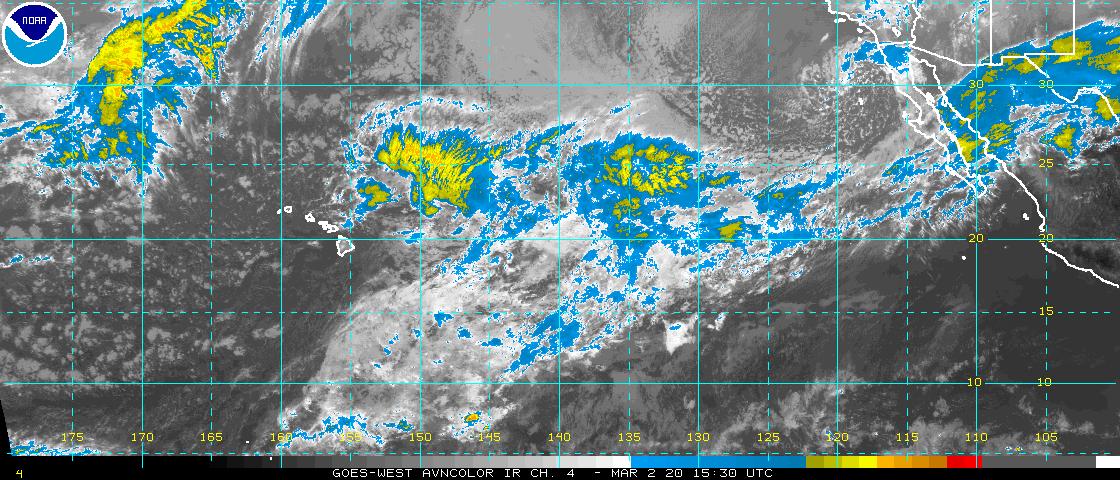
Tropical Cyclone activity in the eastern and central Pacific – Here’s the latest weather information coming out of the National Hurricane Center, covering the eastern north Pacific. You can find the latest tropical cyclone information for the central north Pacific (where Hawaii is located) by clicking on this link to the Central Pacific Hurricane Center. Here’s a tracking map covering both the eastern and central Pacific Ocean. A satellite image, which shows the entire ocean area between Hawaii and the Mexican coast…can be found here.
Aloha Paragraphs

Waimanalo Beach…Oahu
We’ll find another couple of days of light winds here in the islands, before the trade winds return lightly by Friday…continuing into the weekend. Our trade wind producing high pressure system, now far to the northeast, continues to move further away. Meanwhile, we find a cold front approaching the islands from the northwest. This frontal boundary has pushed our high pressure ridge down near Kauai, ensuring the light wind conditions through mid-week, plus a day or two beyond that.
The overlying atmosphere remains moist and unstable, conditions that may prompt more localized heavy showers for the time being. The instability that’s around now, due to the close proximity of a trough of low pressure, will keep the threat of locally heavy showers around into Wedneday. The NWS forecast office in
The greatest threat for those localized heavier showers Wednesday, will remain generally over the interior sections…during the afternoon hours. This looping IR satellite image shows the heaviest showers to the south of the Big Island, and to the north of Kauai and Oahu Tuesday night. Those images show lots of high cirrus clouds coming up over the Big Island, although has cleared Maui County Tuesday evening. Here’s a looping radar image, which will show where the showers are falling.
It’s early Tuesday evening here in Kula, Maui, as I begin writing this last section of today’s narrative update. Despite the discontinuance of the flash flood watch across the state this evening, there’s still the chance of more locally generous showers over the next few days, perhaps even into the first part of the upcoming weekend. All of the necessary ingredients are still in place, like low level moisture, light winds, and all that very warm daytime sunshine. These features may still work together to prompt some showers around, some of which may become locally heavy. ~~~ Meanwhile, the winds have become at least locally southeast. This is certainly happening over Maui County, as our islands have become hazy with vog. As the winds remain light for a couple more days, this volcanic haze is likely to increase a bit more, and may become quite thick. The returning trade winds, which may wait until this weekend to return, will blow this stuff away then. ~~~ I’ll be back early Wednesday morning with your next new weather narrative, I hope you have a great Tuesday night until then! Aloha for now…Glenn.
Interesting: An earthquake measuring 5.6 in magnitude struck at a depth of 6.2 miles some 175 miles southwest of Puerto Vallarta off Mexico’s Pacific Coast on Tuesday, the United States Geological Survey said. There were no immediate reports of damage or injuries from the quake, and the Pacific Tsunami Warning Center in Hawaii did not issue a tsunami warning.
The United States today sent the first installment of a multi-million dollar assistance package to the Indonesian Island of Sumatra, to aid victims of the recent earthquake. Other international organizations and the government of Indonesia have also been providing assistance. However infrastructure damage caused by the earthquake is making it hard to access and distribute aid to some remote villages.
Interesting2: The United States brought in 45 metric tons of plastic sheeting, hygiene kits, and generators to help victims of the Indonesian earthquake. The items will be distributed by the Red Cross. The U.S. has also been using military planes to transport rescue workers and supplies. The United States is one of many countries providing humanitarian assistance.
Australia sent a warship carrying a full medical team. France sent two aircraft with about 23 metric tons of relief supplies. And teams from a number of countries have been assisting in rescue and relief efforts. The United Nations is also involved.
It constructed the first of 250 classroom tents to be built in the city of Padang. Other organizations like World Vision are also focusing on the needs of children. It is setting up 13 centers they call Child-Friendly Spaces, where children can play with other children, and get counseling.
World Vision’s Amelia Merrick, says getting schools back up and running quickly is a top priority, particularly in areas like Pariaman where entire villages were buried by landslides caused by the quake. "In many of other schools we’ve been seeing in Pariaman, the schools were absolutely flat," Merrick said.
"There won’t be any desks we can salvage there. There are no books we can salvage. That would be another quite challenge. But we do hope that the school can resume within the next couple of weeks." Indonesian Search and Rescue Agency spokesman, Gagah Prakoso says infrastructure damage is also hampering efforts to bring aid to some rural areas.
He says mud and rocks are blocking some roads, others are torn up, making it difficult to distribute aid. Authorities are using helicopters to drop aid to isolated areas. But heavy rains are complicating further efforts to reach these areas by land and the weather forecast for the region calls for more storms in the coming days.
Interesting3: The volcano on the Caribbean island of Montserrat shot a plume of ash more than two miles (three kilometers) into the sky Monday, lightly dusting the small Caribbean island. The venting by the Soufriere Hills volcano has been accompanied by more than 30 tiny earthquakes since Sunday night, according to Paul Cole, director of the Montserrat Volcano Observatory.
He said it was the volcano’s first sign of activity in 10 months. "It’s just a reminder that the volcano is still active," said James White Jr., acting director of the Disaster Management Coordination Agency. "It isn’t something for us to panic over."
Ash released in several bursts from the volcano passed south of Old Town and Olveston, leaving only a light coating in the island’s inhabited areas. But the observatory said more ash could fall depending on the wind direction. Soufriere Hills became active in 1995 and killed 19 people when it erupted two years later, burying much of the British territory and prompting half its 12,000 inhabitants to leave.
Interesting4: Volcanologists in Vanuatu are closely monitoring the Gaua volcano to consider whether to move its alert to level two. The volcano located in the centre of the Gaua Island in northern Vanuatu has been spitting gasses and ash since late September and has been on alert level one since the 29th. The highest volcano alert level is five.
A senior vulcanologist at the geohazards department, Douglas Charley, says his team has recorded more activity since last night. “Very late yesterday the team started to observe an increase of a high volcanic high frequency.
The level remains at one and we’ll be trying to observe this until the next 48 hours. If it’s increasing [further], then we’ll be putting it [up] to level two.” Douglas Charley says they have one monitoring station in the field, but are now requesting more to get more reliable data.
Interesting5: Filling rooftops with plants and dirt can help pull a modest amount of heat-trapping carbon dioxide out of the atmosphere, found a new study. While green roofs certainly won’t solve the global warming problem, their ability to sop up greenhouse gases — even just a little bit — bolsters the case for planting them on city buildings, despite extra costs on the front end, said lead researcher Kristin Getter, of Michigan State University in East Lansing.
"The key to fighting global warming is capturing carbon from the atmosphere and storing it in new reservoirs that weren’t storing carbon before," Getter said. "In the whole scheme of things, green roofs are not the one answer to sequestering carbon, but they will certainly help." Green roofs offer a long list of known benefits.
They lower air-conditioning costs in the summer by absorbing and reflecting heat. They lower heating costs in the winter by adding extra insulation. Green roofs appeal to cities because they soak up rainwater, making excess storm water less likely to flood sewage systems and inflate sewage treatment costs. Plant-filled rooftops make urban areas less likely to become heat islands.
They reduce air pollution and noise pollution. And vegetation, even when it’s several stories up, provides habitat for animals. Like any forested or vegetation-covered area, a patch of green on top of a roof should theoretically lower levels of carbon dioxide in the air, as well. Plants breathe in the greenhouse gas like we breathe in oxygen, and they store carbon in their leaves and other tissues. Until now, however, no one had measured how much carbon a green roof could actually take in.
Interesting6: A dorm outfitted with composting toilets and kitchen cabinets made from recycled fence-posts is bringing new meaning to the concept of living "green" at college. The EcoDorm, home to 36 undergraduates at Warren Wilson College in Swannanoa, N.C., was designed to be sustainable from top to bottom, or in this case, from its rainwater-collection system to a permaculture garden.
Residents — who have sworn off hair dryers and gravitate toward acoustic music — see "an integration between their actions and their values," Margo Flood, the executive director of Warren Wilson’s Environmental Leadership Center, told The New York Times Magazine. Across the country, colleges have been looking to become more sustainable and more than 600 schools have already pledged to become carbon neutral. Nationwide, some 90 dorms are LEED certified, but EcoDorm is one of two dorms that have LEED’s platinum rating.
 Email Glenn James:
Amanda Says:
When should we start to expect heavy regular rainfall again? It seems to happen every year for a period of time. I really enjoy those rainy days, even when Kahului floods. ~~~ Amanda, maybe today would be a chance for locally heavy showers, keep an eye out this afternoon. Aloha, Glenn