











October 14-15, 2009
Air Temperatures – The following maximum temperatures were recorded across the state of Hawaii Wednesday afternoon:
Lihue, Kauai – 81
Honolulu, Oahu – 84
Kaneohe, Oahu – 82
Kaunakakai, Molokai – 84
Kahului, Maui – 87
Hilo, Hawaii – 83
Kailua-kona – 86
Air Temperatures ranged between these warmest and coolest spots near sea level around the state – and on the highest mountains…at 5 p.m. Wednesday evening:
Barking Sands, Kauai – 84F
Hilo, Hawaii – 78
Haleakala Crater – 54 (near 10,000 feet on Maui)
Mauna Kea summit – 43 (near 14,000 feet on the Big Island)
Precipitation Totals – The following numbers represent the largest precipitation totals (inches) during the last 24 hours on each of the major islands, as of Wednesday afternoon:
0.16 Mount Waialeale, Kauai
0.38 Oahu Forest NWR, Oahu
0.00 Molokai
0.00 Lanai
0.00 Kahoolawe
0.24 West Wailuaiki, Maui
0.48 Kealakekua, Big Island
Marine Winds – Here’s the latest (automatically updated) weather map showing a high pressure ridge located just to the north of the islands. This ridge will be pushed down over Kauai or Oahu by a low and cold front moving by to our north. The trade winds will remain light Thursday into Friday.
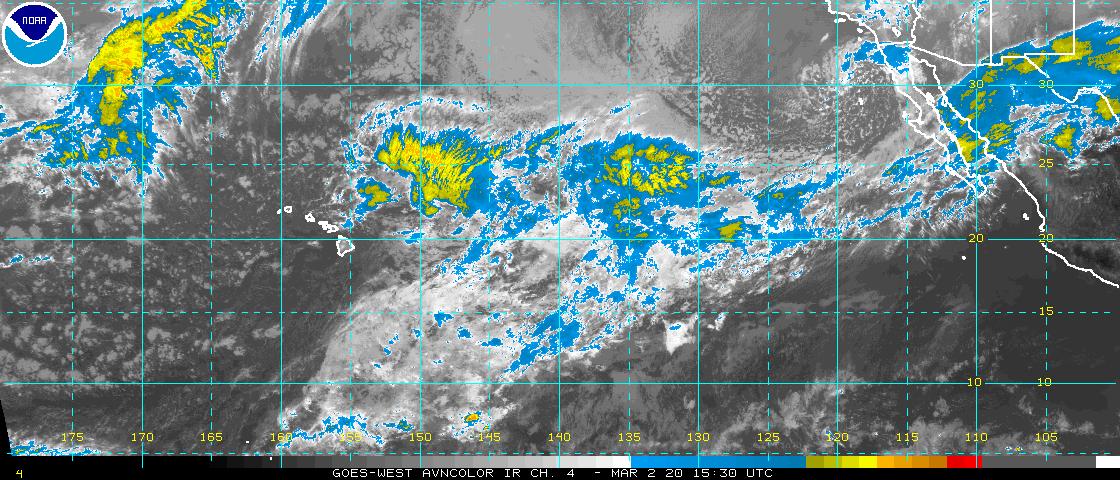
Satellite and Radar Images: To view the cloud conditions we have here in Hawaii, please use the following satellite links, starting off with this Infrared Satellite Image of the islands to see all the clouds around the state during the day and night. This next image is one that gives close images of the islands only during the daytime hours, and is referred to as a Close-up visible image. This next image shows a larger view of the Pacific…giving perspective to the wider ranging cloud patterns in the Pacific Ocean. Finally, here’s a Looping IR satellite image, making viewable the clouds around the islands 24 hours a day. To help you keep track of where any showers may be around the islands, here’s the latest animated radar image.
Hawaii’s Mountains – Here’s a link to the live webcam on the summit of near 14,000 foot Mauna Kea on the Big Island of Hawaii. The tallest peak on the island of Maui is the Haleakala Crater, which is near 10,000 feet in elevation. These two webcams are available during the daylight hours here in the islands…and when there’s a big moon rising just after sunset for an hour or two! Plus, during the nights and early mornings you will be able to see stars, and the sunrise too…depending upon weather conditions.
Tropical Cyclone activity in the eastern and central Pacific – Here’s the latest weather information coming out of the National Hurricane Center, covering the eastern north Pacific. You can find the latest tropical cyclone information for the central north Pacific (where Hawaii is located) by clicking on this link to the Central Pacific Hurricane Center. Here’s a tracking map covering both the eastern and central Pacific Ocean. A satellite image, which shows the entire ocean area between Hawaii and the Mexican coast…can be found here.
Aloha Paragraphs

Beautiful ocean…Hawaii
Our trade winds are shifting south of the islands for a couple of days…although they’ll return later Friday, at least on the
It will take until later Friday for the cold front to move by, which will allow the ridge of high pressure to migrate northward…bringing back our trade winds into the weekend. These light to moderately strong trade winds will ventilate our stagnant air mass beginning Saturday. The trade winds will usher in pleasant autumn weather conditions. For the time being, the emphasis for showers, while we have the light winds around, will be over and around the mountains during the afternoon hours. The air mass will remain quite dry and stable however, so that we shouldn’t see much rain falling. As the trade winds return, the bias for showers will shift back to the windward sides again. The trade winds will remain active into the beginning of next week, although the latest models show a tropical system, moving by to the south of the state after Monday…which may shift our winds to the southeast. Southeast winds of course are infamous for carrying volcanic emissions up from the
It’s that time of the year again, when I’ll be taking my annual vacation to the mainland…once again to California. I’ll be leaving next Monday, and be gone for about three weeks. I’ll be visiting my good friends, and also spending some quality time with my family in Long Beach as well. This will be a time when I renew my batteries, and spend time away from my weather schedule here in the islands. I’ll have more to say about this going forward, but just wanted to give you a heads up ahead of time. I’ll probably leave this paragraph here, so that those who drop by every few days, will know of my plans, and won’t be surprised. As usual, I will likely add a few notes when I can, to keep you abreast of what I’m up to while in California.
It’s early Wednesday evening here in Kihei, Maui, as I begin writing the last section of today’s narrative update. Wednesday turned out to be quite a cloudy day, although due to the relatively dry and stable atmosphere, we didn’t see all that many showers. I spend the entire day in a closed room here at the Pacific Disaster Center, involved in a Climate Change and Variability Risk Reduction workshop. The subject was: Climate Variability and Water: Shifting risks for Agriculture and Energy. There were participants from around the world who attended, with many of the top climate change experts in attendance. I enjoyed the presentations very much, and I got exposed to lots and lots of information pertaining to this very interesting topic. ~~~ It kept me from going outside once today, so that at times I totally lost track of what was happening in the overhead skies! It was an unusual day in that regard, and Thursday will be the same. ~~~ At any rate, I’m heading out to my car now, to take the drive back upcountry to Kula. I hope you had a good day, and that you have a good Wednesday night. I’ll be back again early Thursday morning with your next new weather narrative from paradise. Aloha for now…Glenn.
Interesting: It’s one of the most active volcanoes in the world, but now Kilauea — on the big island of Hawaii — is making headlines for something else. It’s called vog, it’s a mix of sulfur dioxide and other chemicals, which when combined with sunlight and dust, forms a thick soupy haze similar to smog. Although the volcano has been spitting out vog for more than two decades now, a new vent that opened near the summit in March of 2008 has made things, well — more "voggy."
And it’s giving some people a headache — literally and financially. In addition to causing health problems like itchy and watery eyes and noses, vog is harmful for the exotic plant industry. When the sulfur dioxide hits the moisture inside the beloved protea flower, it turns to sulfuric acid, and burns the plant to a crisp. It has become a major problem for residents who make their living growing these exotic Hawaiian flowers. Toni and Sam Bayaoa lost 90 percent of their crop last year.
Fortunately they were able to come up what seems like a solution. A friend of theirs in South Africa told them to burn the spoiled flowers with a flame and use the ash to protect the new buds. Oddly enough it worked, but the Bayaoas are still working hard at making up their losses from last year, and always trying to stay one step ahead of the vog.
Health concerns surrounding the vog have public schools creating a separate air conditioned "safe" room for kids who experience breathing problems on days when the air is particularly thick with the sulfur dioxide. The state hasn’t been able to do much about the problem, but Sens. Daniel Akaka and Daniel Inouye have been able to secure some federal grants for protea growers like the Bayoas’ crops.
Those affected note the trade winds are blowing the vog towards Oahau, where the state legislature presides. Their hope is that lawmakers will be able to see and smell the problem a little bit more clearly. Residents remember that, afterall, there wouldn’t be a Hawaiian Islands Chain without volcanic activity — it’s what formed and shaped the tropical islands.
 Email Glenn James:

Tony Ray Says:
Thanks so much for your very knowledgeable meteorology! Great site!! Aloha, Tony ~~~ Thanks for your positive feedback Tony! Aloha, Glenn
Sue Says:
Thanks for posting “interesting #4. It’s about time the truth started getting out. Unfortunately we live in a day where our govt. officials are making up ways to over burden and over tax the people. People really need to be aware that we are actually in a cooling cycle, beyond our control, not the warming debacle as they would like us to believe. And for anyone’s information, the polar bears are doing quite well.
Sue Napier
Illinois ~~~ Hi Sue, I try and post all sides to the debate, whatever that may be. I appreciate your comment! Aloha, Glenn
Teresa Brock Says:
How can I find out what the weather story was on Maui on June 21,2009? My Mom and I arrived that day from California and ended up “stuck” from going to our condo (just north of Lahaina) due to the fire that closed the road at Ma’alaea. The wind was really the strongest I have experienced there and I would like to know the strength of it and details of the fire for a scrapbooking album I am doing of our trip.
Thank you for your time and knowledge,
Teresa Brock
Clayton, CA
Hi Teresa, you can find out about the weather on that date by going to the left hand side of this page, up the page towards the top, and clicking on the Archived Narratives link. Then scroll down to the bottom, where it says Previous Entries…and keep going back until you arrive on the narrative for June 21, 2009. Aloha, Glenn