











Hawaiian Islands weather details & Aloha paragraphs
Posted by GlennOctober 4-5, 2009
Air Temperatures – The following maximum temperatures were recorded across the state of Hawaii Sunday afternoon:
Lihue, Kauai – 85
Honolulu, Oahu – 89
Kaneohe, Oahu – 84
Kahului, Maui – missing
Hilo, Hawaii – 79
Kailua-kona – 87
Air Temperatures ranged between these warmest and coolest spots near sea level around the state – and on the highest mountains…at 4 p.m. Sunday afternoon:
Kahului, Maui – 87F
Hilo, Hawaii – 75
Haleakala Crater – 50 (near 10,000 feet on Maui)
Mauna Kea summit – 41 (near 14,000 feet on the Big Island)
Precipitation Totals – The following numbers represent the largest precipitation totals (inches) during the last 24 hours on each of the major islands, as of Sunday afternoon:
6.01 Mount Waialaele, Kauai
1.67 Oahu Forest NWR, Oahu
0.04 Molokai
1.51 Lanai
0.03 Kahoolawe
5.91 Puu Kukui, Maui
2.12 Pahoa, Big Island
Marine Winds – Here’s the latest (automatically updated) weather map showing a 1031 millibar strong high pressure system to the northeast of the islands…moving away towards the northeast. Our wind speeds will become lighter Monday into Tuesday.
Satellite and Radar Images: To view the cloud conditions we have here in Hawaii, please use the following satellite links, starting off with this Infrared Satellite Image of the islands to see all the clouds around the state during the day and night. This next image is one that gives close images of the islands only during the daytime hours, and is referred to as a Close-up visible image. This next image shows a larger view of the Pacific…giving perspective to the wider ranging cloud patterns in the Pacific Ocean. Finally, here’s a Looping IR satellite image, making viewable the clouds around the islands 24 hours a day. To help you keep track of where any showers may be around the islands, here’s the latest animated radar image.
Hawaii’s Mountains – Here’s a link to the live webcam on the summit of near 14,000 foot Mauna Kea on the Big Island of Hawaii. The tallest peak on the island of Maui is the Haleakala Crater, which is near 10,000 feet in elevation. These two webcams are available during the daylight hours here in the islands…and when there’s a big moon rising just after sunset for an hour or two! Plus, during the nights and early mornings you will be able to see stars, and the sunrise too…depending upon weather conditions.
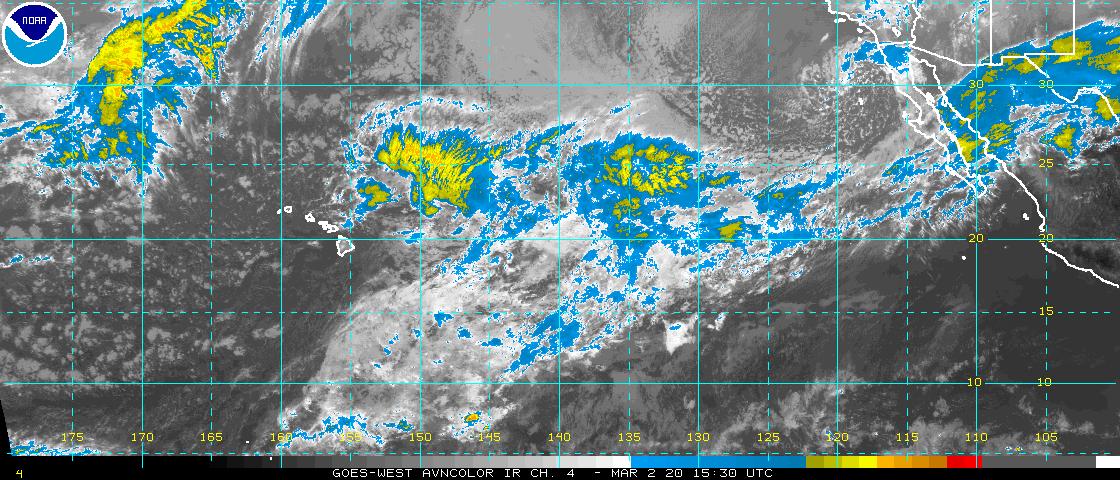
Tropical Cyclone activity in the eastern and central Pacific – Here’s the latest weather information coming out of the National Hurricane Center, covering the eastern north Pacific. You can find the latest tropical cyclone information for the central north Pacific (where Hawaii is located) by clicking on this link to the Central Pacific Hurricane Center. Here’s a tracking map covering both the eastern and central Pacific Ocean. A satellite image, which shows the entire ocean area between Hawaii and the Mexican coast…can be found here.
Aloha Paragraphs

Ocean-side Hula, steady gaze into the mountains, receiving and giving appreciation of Hawaii’s beauty…deep nature so close to the watery environment below.
Our trade winds have dropping in strength today, which will continue in that direction into the new work week ahead…returning around next Thursday or Friday. The NWS forecast office in
As this trade wind producing high pressure cell gets pushed northeast, by an approaching low pressure system, and its associated cold front…our winds will come down in strength. Our recent strong and gusty trade winds will give way to a light winded convective weather pattern during the upcoming week. As this happens, our winds will gradually turn east-southeast, and eventually southeast locally. This wind direction puts the smaller islands in the wind shadow of the
The best chance for some moisture during the new week will be from afternoon convective clouds, which will drop showers in the upcountry areas…while the light winds prevail. Otherwise, as the trade winds fade, our sense of the early autumn heat will increase during the days, becoming sultry…with cooler early morning hours at the same time. The trade winds are expected to return by Friday or so, into next weekend. As these trade wind breezes move back into our area, we will likely see them begin to carry showers in the direction of the windward sides.
The transition day for our diminishing trade winds, and the lighter winds ahead, was Sunday…with notably lighter winds as we enter the new week. Meanwhile, we see the recent area of high cirrus clouds moving away to our east, with a new batch to the west taking aim on the Big Island and Maui…as shown on this looping IR satellite image. Clouds have been more persistant than usual the last several days, and with more high clouds approaching we may not be out of the woods just yet. Typically, when we have a convective weather pattern, like the one we’re about to move into, we see lots of sunshine during the mornings, giving way to mountain clouds during the afternoons.
It’s late Sunday afternoon here in Kula, as I begin typing out this last paragraph of today’s narrative. The windward sides have been wet lately, very wet in places! Satellite imagery, and local radar images both show an end in all this wet weather. As the trade winds relax, we should see the showers shifting over to the interior sections during the afternoons…some of which may be locally heavy. The main thing, besides that precipitation, will be the muggy conditions that prevail through at least the first half of the new week, and perhaps a day or two longer than that. Depending just where the high pressure ridge ends up, after being pushed over us by an approaching cold front, will help determine how much voggy weather we may have in a couple of days. I expect some, but I’m unsure of how much, and exactly where it will end up just yet. ~~~ Looking out the windows of my weather tower now, I still see quite a few clouds, but it’s generally less cloudy than the last several days at this same time (5pm). ~~~ I just bbq’d some organic chicken thighs, and sauteed organic okra, zucchini, red onion, mushrooms, red pepper, and egg plant, which I’ll plate together for my dinners during the upcoming work week, at least through Thursday night. ~~~ During this work week period, I’ll open a bottle of Cartlidge & Browne 2007 Cabernet Sauvignon, Paso Robles, and have four glasses stretched out through Thursday night…along with dinner. I don’t usually go for Cabernet’s grown that far south, but the person where I buy my wine (Alan) recommended it, and he is almost always right on, and knows my taste. It says on the back of the bottle: Lush and softly textured, it’s brimming with ripe blackberry fruit accentuated by oak spice. I’ll let you know what I think of this particular bottle when I open it after work tomorrow. ~~~ I hope you have a great Sunday night, and that you can join me here again on Monday, when I’ll have your next new narrative waiting. By the way, at 640pm Sunday evening, the rain just started to pelt down, right after some single handed ping pong out on my weather deck, leading up to dark. Aloha for now…Glenn.
Interesting: Efforts to convince rich nations to toughen emissions cuts have failed to make much headway at climate talks in the Thai capital, the U.N. said. Delegates from about 180 nations are meeting in Bangkok to try to narrow differences on ways to broaden and deepen the fight against climate change.
The September 28-October 9 talks are the last major negotiating session before environment ministers meet in Copenhagen to try to seal a tougher global pact to replace the Kyoto Protocol "Progress toward high industrialized world emissions cuts remains disappointing during these talks.
We’re not seeing real advances there," Yvo de Boer, the head of the U.N. Climate Change Secretariat, told reporters. "Movement on the ways and means and institutions to raise, manage and deploy financing support for the developing world climate action also remains slow."
The U.N. climate panel says rich nations should cut emissions between 25-40 percent from 1990 levels by 2020 to avoid dangerous climate change. But the aggregate cuts pledged by industrialized states remains well below this level.
Interesting2: Tiny organisms that covered the planet more than 250 million years ago appear to be a species of ancient fungus that thrived in dead wood, according to new research published October 1 in the journal Geology. The researchers behind the study, from Imperial College London and other universities in the UK, USA and The Netherlands, believe that the organisms were able to thrive during this period because the world’s forests had been wiped out.
This would explain how the organisms, which are known as Reduviasporonites, were able to proliferate across the planet. Researchers had previously been unsure as to whether Reduviasporonites were a type of fungus or algae. By analysing the carbon and nitrogen content of the fossilized remains of the microscopic organisms, the scientists identified them as a type of wood-rotting fungus that would have lived inside dead trees.
Fossil records of Reduviasporonites reveal chains of microscopic cells and reflect an organism that lived during the Permian-Triassic period, before the dinosaurs, when the Earth had one giant continent called Pangaea. Geological records show that the Earth experienced a global catastrophe during this period. Basalt lava flows were unleashed on the continent from a location centered on what is present day Siberia.
Up to 96 per cent of all marine species and 70 per cent of land species became extinct. Traditionally, scientists had thought that land plants weathered the catastrophe without much loss. Today’s findings suggest that much of the vegetation on Pangaea did not survive and that the world’s forests were wiped out, according to the researchers.
Geological records show that there was a massive spike in the population of Reduviasporonites across Pangea as the Permian period came to an end. The scientists suggest that this means that there was in increase in the supply of wood for them to decay.
Professor Mark Sephton, one of the authors of the study from the Department of Earth Science and Engineering at Imperial College London, comments: "Our study shows that neither plant nor animal life escaped the impact of this global catastrophe. Ironically, the worst imaginable conditions for plant and animal species provided the best possible conditions for the fungi to flourish."
The team suggest that the basalt lava, which flowed during Permian-Triassic catastrophe, unleashed toxic gases into the air. The gases had a dual effect, producing acid rain and depleting the ozone layer. The outcome was the destruction of forests, providing enough rotting vegetation to nourish Reduviasporonites so that they could proliferate across Pangaea.
Interesting3: Insecticide treated mosquito nets reduce the chances of developing life-threatening malaria in Africa, however recent research shows that older children are the least well protected by nets in the community. The research, published in the open access journal BMC Public Health, has found that parents and their young children were much more likely to have malaria nets than older children.
"5-19 years olds are a particularly important group for two reasons," said lead researcher Abdisalan M Noor, from the Kenyan Medical Research Institute-Wellcome Trust Research Program and the University of Oxford, "Firstly, they represent a large fraction of the population in most developing African communities. Secondly, while they may have developed a functional immune response against clinical disease before their fifth birthday, they will not have developed an immunity to the Malaria parasite and continue to contribute transmission in the community."
Noor and his colleagues report that, as an unintended consequence of attempting to achieve the targets of the Abuja declaration and Millennium Development Goals, children and adolescents over five are being put at risk. They said: "An estimated 80% of human-mosquito transmission comes from over-fives, with young adolescents and older children the peak age group. As a result, ensuring this age demographic is sufficiently protected from malaria should be viewed as important."
Noor concludes: "Where school attendance is high, the delivery of nets through schools should be considered an approach to reach universal coverage and improve the likelihood of impacting upon parasite transmission."
Interesting4: The devastation of the 1918-1919 influenza pandemic is well known, but a new article suggests a surprising factor in the high death toll: the misuse of aspirin. Appearing in the November 1 issue of Clinical Infectious Diseases and available online now, the article sounds a cautionary note as present day concerns about the novel H1N1 virus run high.
High aspirin dosing levels used to treat patients during the 1918-1919 pandemic are now known to cause, in some cases, toxicity and a dangerous build up of fluid in the lungs, which may have contributed to the incidence and severity of symptoms, bacterial infections, and mortality.
Additionally, autopsy reports from 1918 are consistent with what we know today about the dangers of aspirin toxicity, as well as the expected viral causes of death. The motivation behind the improper use of aspirin is a cautionary tale, said author Karen Starko, MD. In 1918, physicians did not fully understand either the dosing or pharmacology of aspirin, yet they were willing to recommend it.
Its use was promoted by the drug industry, endorsed by doctors wanting to “do something,” and accepted by families and institutions desperate for hope. “Understanding these natural forces is important when considering choices in the future,” Dr. Starko said. “Interventions cut both ways. Medicines can save and improve our lives. Yet we must be ever mindful of the importance of dose, of balancing benefits and risks, and of the limitations of our studies.”
Interesting5: In 1980, Luis Alvarez and his collaborators stunned the world with their discovery that an asteroid impact 65 million years ago probably killed off the dinosaurs and much of the world’s living organisms. But ever since, there has been an ongoing debate about how long it took for life to return to the devastated planet and for ecosystems to bounce back.
Now, researchers from MIT and their collaborators have found that at least some forms of microscopic marine life — the so called "primary producers," or photosynthetic organisms such as algae and cyanobacteria in the ocean — recovered within about a century after the mass extinction. Previous research had indicated the process might have taken millions of years.
It has taken so long to uncover the quick recovery because previous studies looked mostly at fossils in the layers of sediment from that period, and apparently the initial recovery was dominated by tiny, soft-bodied organisms such as cyanobacteria, which do not have shells or other hard body parts that leave fossil traces.
The new research looked instead for "chemical fossils" — traces of organic molecules (compounds composed of mostly carbon and hydrogen) that can reveal the presence of specific types of organisms, even though all other parts of the organisms themselves are long gone.
The new research, published in the Oct. 2 issue of Science, was led by Julio Sepúlveda, an MIT postdoc who carried out part of the work while still a graduate student at the University of Bremen, Germany, and MIT Professor of Geobiology Roger Summons, among others. The team had two major advantages that helped to make the new findings possible.
One was a section of the well-known cliff face at Stevns Klint, Denmark, that happens to have an unusually thick layer of sediment from the period of the mass extinction — about 40 centimeters thick, compared to the few cm thickness of the layers that Alvarez originally studied from that period at Gubbio (Italy) and Stevns Klint (Denmark).
And team members tapped one of the most powerful Gas Chromatograph-Mass Spectrometers (GC-MS) in the world, a device that can measure minute quantities of different molecules in the rock. MIT’s advanced GC-MS is one of only a few such powerful instruments currently available at U.S. universities.
When people look at microfossils in the sediments from the period but are unable to detect the chemical biomarkers with the level of sensitivity the MIT team was able to achieve, they "miss a big part of the picture," Sepúlveda says. "Many of these microorganisms" that were detected through molecular signatures "are at the base of the food chain, but if you don’t look with biochemical techniques you miss them."
The analysis clarified the sequence of events after the big impact. Immediately after the impact, certain areas of the ocean were devoid of oxygen and hostile to most algae, but close to the continent, microbial life was inhibited for only a relatively short period: in probably less than 100 years, algal productivity showed the first signs of recovery.
In the open ocean, however, this recovery took much longer: previous studies have estimated that the global ocean ecosystem did not return to its former state until 1 to 3 million years following the impact. Because of the rebound of primary producers, Sepúlveda says "very soon after the impact, the food supply was not likely a limitation" for other organisms, and yet "the whole ecology of the system remained disrupted" and took much longer to recover.
The findings provide observational evidence supporting models suggesting that global darkness after the impact was rather short. "Primary productivity came back quickly, at least in the environment we were studying," says Summons, referring to the near-shore environment represented by the Danish sediments. "The atmosphere must have cleared up rapidly," he says. "People will have to rethink the recovery of the ecosystems.
It can’t be just the lack of food supply" that made it take so long to recover. The team hopes to be able to study other locations with relatively thick deposits from the extinction aftermath, to determine whether the quick recovery really was a widespread phenomenon after the mass extinction.
These findings seem to rule out one theory about how the global ecosystem responded to the impact, which held that for more than a million years there was a "Strangelove ocean" — a reference to the post-apocalyptic scenario in the movie Dr. Strangelove — in which all the primary producers remained absent for a prolonged period, Summons says.
 Email Glenn James:

Jack Weber Says:
3 things:
1) it is just lovely to have only mild wind here now. it is so much more peaceful and grounding. a maxim in chinese medicine states, “wind is carrier of a thousand diseases.” the first of those diseases in my book is the bloody wind itself!
2) i want to hear about the wine.
3) i love ping pong and we’ll have to bat it out one day!
enjoy the peaceful, settled atmosphere this week.
aloha! J* ~~~ Hi Jack, yes you should be happy with the lack of wind this week, until the trade winds return around Friday that is. Ok, will write about my impression of the wine. Ping Pong is a very good game, love it. This week is starting off with flash floods overnight Sunday! Aloha, Glenn
cloud Says:
Mon dieu, Glenn, lucky you! Life is Good…Glad you’re feeling well in these trying times & hope you enjoyed the sights at Mana…with luscious descriptions like that, we’ll all rush over to your deck for dinner! I’d bring dessert–that last piece of Mana’s sachertorte with Lady Grey tea (great flavors), but just ate it while reading your site minutes after you’d posted them at 5pm. Seems you’re on ‘flash forward’, while I’m on rewind: I was just going to say how beautiful your orchid photo and Simply Red song was on yesterday’s page, when you’ve already topped that w/sizzling blackberries & spice. there was an Estancia CabSav from Paso Robles, not bad; I wouldn’t call myself knowledgeable, but nice to learn. I admire your organized discipline…on the creative end, yes, I thought the book ended well in a tidy pairing off of complementary forces & people. Esp. Antonia & Ian, and Tom & Liilian. If anyone were to ask, yeah, I’d take a walk to hear a story, while Helen’s chocolate inspired memories towards the end had this cloud shedding more than a few raindrops, as Whittier’s lines hauntingly remind me: “For all sad words of tongue & pen, the saddest are these, ‘it might have been.’
Ever too serious, I found this quote by a W.M. Lewis that sums it up well–“The tragedy of life is not that it ends so soon, but that we wait so long to begin it.” But if you watch the exquisite film “Enchanted April” (avail on netflix) & you simply must, if you haven’t & tell me what you think of it, I’d say the surprise joy of life is that it’s never too late to reach out & grab it…Have a great week! Cloud. Hello Cloud, thanks for your long sharing of thoughts…I enjoyed reading your impressions, glad you liked the book! Just starting out my work week, it’s 5am something Monday morning, so that to leave it as this. I hope you enjoy your new week too! Aloha, Glenn.
Wendy Ward Says:
Hi Glenn. I’ve been told your website offers the most accurate weather forecasts for Hawaii. I was wondering if you could offer some advice? My husband and I are scheduled to travel to Maui (Napili/Lahaina) Thurs Oct. 8th-17th. Many of the weather forecast sites are predicting rain for at least 5 of those days. I know it rains daily on certain areas of the island but often times not near the west and south sides. We’re coming to celebrate our 1st wedding anniversary and were hoping to enjoy sunshine, surfing and relaxing on the beach. We are considering canceling our trip (reluctantly) and rescheduling for next year. Do you think we’re jumping to conclusions or do you expect the weather to be rainy and gloomy next week and the following? Any help/insight you can give is appreciated. Mahalo. Wendy ~~~ Hi Wendy, first off, congratulations on your first year of marriage, I hope it was a good start for a forever lasting relationship. As for the weather during your stay, and especially while you are in Lahaina, I wouldn’t worry too much. Napili may have some showers, but that’s to be expected, as it keeps the tropical vegetation green up that way. I wouldn’t cancel your trip, I’d say come ahead and have a wonderful time! Aloha, Glenn
Eliza Says:
Glenn – OMI! With the amount of rains falling here in the past 12+ hours, I would say we are having remnants of a tropical storm dump on us here in Ha`iku. I know that is not the case yet… egads! This is just wild. The cat is bored, the birds are silent and hiding… and I have standing water in the west yard. Wheeeee! Bet the small streams are just running like crazy. Where *is* this coming from?? Mahalo ~ Eliza, I had originally thought, last week, that we would see the remnant moisture from retired tropical storm Nora arriving this weekend, which was coming our way from the eastern Pacific. I lost track of that source of showers on its journey westward, but it sounds to me like Nora may be the culprit. Aloha, Glenn