











September 28-29, 2009
Air Temperatures – The following maximum temperatures were recorded across the state of Hawaii Monday afternoon:
Lihue, Kauai – 84
Honolulu, Oahu 89
Kaneohe, Oahu – 84
Kahului, Maui – 86
Hilo, Hawaii – 85
Kailua-kona – 88
Air Temperatures ranged between these warmest and coolest spots near sea level around the state – and on the highest mountains…at 5 p.m. Monday evening:
Barking Sands, Kauai – 86F
Hilo, Hawaii – 78
Haleakala Crater – 61 (near 10,000 feet on Maui)
Mauna Kea summit – 48 (near 14,000 feet on the Big Island)
Precipitation Totals – The following numbers represent the largest precipitation totals (inches) during the last 24 hours on each of the major islands, as of Monday afternoon:
0.35 Mount Waialaele, Kauai
0.08 South Fork Kaukonahua, Oahu
0.03 Molokai
0.00 Lanai
0.00 Kahoolawe
0.38 Puu Kukui, Maui
0.17 Piihonua, Big Island
Marine Winds – Here’s the latest (automatically updated) weather map showing a 1040 millibar strong high pressure system far to the north. Our trade wind speeds will maintain moderate to fresh levels Tuesday and Wednesday…locally stronger in those typically windiest marine zones around Maui County and the Big Island.
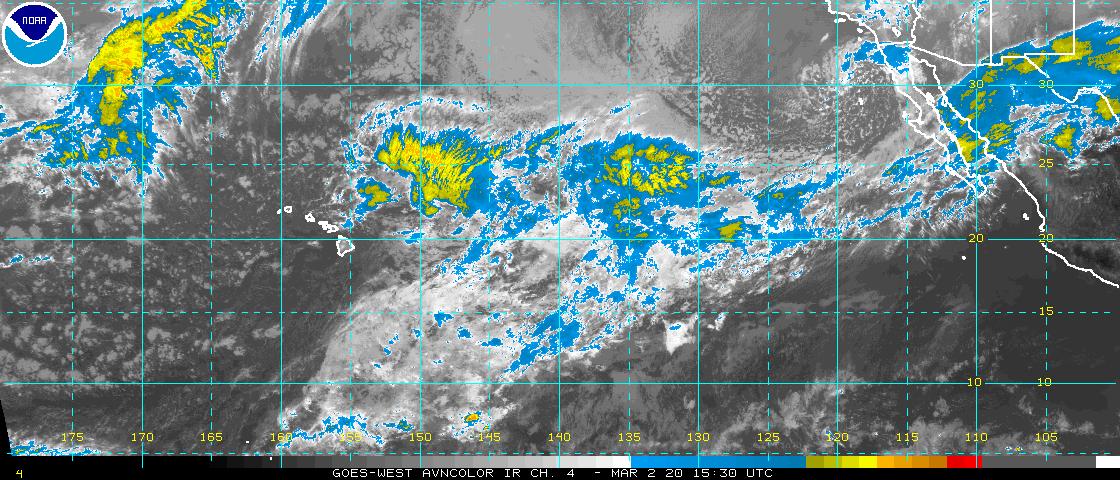
Satellite and Radar Images: To view the cloud conditions we have here in Hawaii, please use the following satellite links, starting off with this Infrared Satellite Image of the islands to see all the clouds around the state during the day and night. This next image is one that gives close images of the islands only during the daytime hours, and is referred to as a Close-up visible image. This next image shows a larger view of the Pacific…giving perspective to the wider ranging cloud patterns in the Pacific Ocean. Finally, here’s a Looping IR satellite image, making viewable the clouds around the islands 24 hours a day. To help you keep track of where any showers may be around the islands, here’s the latest animated radar image.
Hawaii’s Mountains – Here’s a link to the live webcam on the summit of near 14,000 foot Mauna Kea on the Big Island of Hawaii. The tallest peak on the island of Maui is the Haleakala Crater, which is near 10,000 feet in elevation. These two webcams are available during the daylight hours here in the islands…and when there’s a big moon rising just after sunset for an hour or two! Plus, during the nights and early mornings you will be able to see stars, and the sunrise too…depending upon weather conditions.
Tropical Cyclone activity in the eastern and central Pacific – Here’s the latest weather information coming out of the National Hurricane Center, covering the eastern north Pacific. You can find the latest tropical cyclone information for the central north Pacific (where Hawaii is located) by clicking on this link to the Central Pacific Hurricane Center. Here’s a tracking map covering both the eastern and central Pacific Ocean. A satellite image, which shows the entire ocean area between Hawaii and the Mexican coast…can be found here.
Aloha Paragraphs

Green Sea Turtle…coming into a Hawaiian beach
The blustery trade winds will remain the most notable weather influence here in the Hawaiian Islands this week. This weather map shows a strong 1040 millibar high pressure cell far to the north of the Hawaiian Islands Monday evening. The presence of this robust high pressure cell will keep moderate to strong trade winds blowing this week. The NWS is keeping the small craft wind advisory in those windiest areas from Molokai down through the Big Island. As the trade winds increase another notch going forward, we could see that advisory extended up through the other major channels…later this week.
Despite the off and on passing showers along the windward sides, our weather will remain generally on the dry side through the next several days. The computer forecast models continue to point out a chance of some increase in windward showers towards the end of the week. The source of these showers will at least partly be the remnant moisture associated with former tropical cyclone Nora…which was active in the eastern Pacific last week. This will leave pretty typical weather conditions in place across the state until then, with generally dry conditions along the leeward sides. Air temperatures will remain fairly seasonable, with maximum’s reaching well up into the 80F’s…dropping back into the 70’s at night near sea level.
It’s early Monday evening here in Kihei, Maui, as I begin writing this last paragraph of today’s narrative. As noted above, our upcoming week will be filled with gusty trade winds, a few windward showers, and dry conditions along our leeward sides. These locally strong and gusty trade winds, in combination with the dry conditions, could lead to fires, so please be careful. The NWS could issue a red flag warning along these south and west facing leeward areas at various times this week. Meanwhile, the larger surf we saw along our north and west facing beaches recently, is now just about gone. We may see another larger than normal swell, this time coming in from the northeast direction later this week. ~~~ Looking out the window here in Kihei, before I head upcountry to Kula, I see lots of clear blue skies out there, along with those usual partly cloudy conditions that often prevail during a trade wind episode like this. I’ve been noticing that the sun is setting earlier these days, which has become more apparent recently. ~~~ I’ll be back online again early Tuesday morning, at which point I’ll have your next new weather narrative waiting for you. I hope you have a great Monday night until then! Aloha for now…Glenn.
Interesting: Australian researchers have discovered a huge number of new species of invertebrate animals living in underground water, caves and "micro-caverns" amid the harsh conditions of the Australian outback. A national team of 18 researchers has discovered 850 new species of invertebrates, which include various insects, small crustaceans, spiders, worms and many others.
The team – led by Professor Andy Austin (University of Adelaide), Dr Steve Cooper (South Australian Museum) and Dr Bill Humphreys (Western Australian Museum) – has conducted a comprehensive four-year survey of underground water, caves and micro-caverns across arid and semi-arid Australia.
"What we’ve found is that you don’t have to go searching in the depths of the ocean to discover new species of invertebrate animals – you just have to look in your own ‘back yard’," says Professor Austin from the Australian Center for Evolutionary Biology & Biodiversity at the University of Adelaide.
"Our research has revealed whole communities of invertebrate animals that were previously unknown just a few years ago. What we have discovered is a completely new component to Australia’s biodiversity. It is a huge discovery and it is only about one fifth of the number of new species we believe exist underground in the Australian outback."
Only half of the species discovered have so far been named. Generically, the animals found in underground water are known as "stygofauna" and those from caves and micro-caverns are known as "troglofauna". Professor Austin says the team has a theory as to why so many new species have been hidden away underground and in caves.
"Essentially what we are seeing is the result of past climate change. Central and southern Australia was a much wetter place 15 million years ago when there was a flourishing diversity of invertebrate fauna living on the surface. But the continent became drier, a process that last until about 1-2 million years ago, resulting in our current arid environment. Species took refuge in isolated favorable habitats, such as in underground waters and micro-caverns, where they survived and evolved in isolation from each other.
Interesting2: Europe, particularly northern Europe, is far more environmentally conscious than the United States, despite Americans’ sincere and passionate resolution to be green. Per capita CO2 emissions in the U.S. were 19.78 tons according to the Union of Concerned Scientists, which used 2006 data, compared to 9.6 tons in the U.K., 8.05 tons in Italy, and 6.6 tons in France.
Why have Americans made so little headway on an issue that so many of us feel so strongly about? As a U.S. journalist traveling around Europe for the last few years reporting on the environment, I’ve thought a lot about this paradox.
There is a fair bit of social pressure to behave in an environmentally responsible manner in places like Sweden, where such behavior is now simply part of the social contract, like stopping at a stop sign or standing in line to buy a ticket.
But more important, perhaps, Europe is constructed in a way that it’s pretty easy to live green. You have to be rich and self-absorbed, as well as environmentally reckless and impervious to social pressure, not to take the Arlanda Express.
Interesting3: Remember the smell of burning fall leaves wafting through the air? Good memories, indeed, but best that they remain just memories. Burning leaves is bad news. This practice is now illegal — or at least highly discouraged — in most areas. Burning leaves releases airborne particulates like dust and soot, mold, and other allergens that were tamped down with rain and decomposition.
According to the environmental Protection Agency (EPA): "the total health, financial, and environmental costs of leaf-burning can be quite high. These costs include higher incidences of health problems and increased heath care costs; forest fires and property loss and need for increased fire protection; and the clean-up costs associated with soiling of personal property."
So basically, burning leaves is an environmental no-no. Leaf blowers, especially gas powered ones, are also a bad idea, at least if you care at all about the environment, your pocketbook or your neighbors’ sanity.
Nearly 2.5 million of those gas-guzzling gadgets will be sold this year, according to U.S News, and in a single year they will emit as much pollution as 80 cars. Speaking of pollution, the noise pollution created by leaf-blowers has caused many communities to ban them with noise levels exceeding 70 decibels.
Leaf-blowers can be as bad for your health as they are for the environment. They circulate mold, allergens and particulate matter that irritate the lungs — especially for those who suffer from asthma. A better solution is the rake and mulcher.
By turning your leaves into mulch and spreading them over your lawn and garden you can improve the soil quality, fertilize your lawn and protect your garden from the upcoming frigid winter weather. There are a variety of green mulchers to choose from as well. Mulching fallen leaves is the greenest and healthiest way to get rid of fall foliage while you rake in the benefits of your new organic mulch.
Interesting4: A newly released paper from NASA shows something astronomers have long postulated, but never observed. Astronomers witnessed odd behavior around a young star. Something, perhaps another star or a planet, appears to be pushing a clump of planet-forming material around. The observations, made with NASA’s Spitzer Space Telescope, offer a rare look into the early stages of planet formation.
Planets form out of swirling disks of gas and dust. Spitzer observed infrared light coming from one such disk around a young star, called LRLL 31, over a period of five months. To the astronomers’ surprise, the light varied in unexpected ways, and in as little time as one week. Planets take millions of years to form, so it’s rare to see anything change on time scales we humans can perceive.
One possible explanation is that a close companion to the star — either a star or a developing planet — could be shoving planet-forming material together, causing its thickness to vary as it spins around the star.
"We don’t know if planets have formed, or will form, but we are gaining a better understanding of the properties and dynamics of the fine dust that could either become, or indirectly shape, a planet," said James Muzerolle of the Space Telescope Science Institute, Baltimore, Md. Muzerolle is first author of a paper accepted for publication in the Astrophysical Journal Letters.
"This is a unique, real-time glimpse into the lengthy process of building planets." One theory of planet formation suggests that planets start out as dusty grains swirling around a star in a disk. They slowly bulk up in size, collecting more and more mass like sticky snow.
As the planets get bigger and bigger, they carve out gaps in the dust, until a so-called transitional disk takes shape with a large doughnut-like hole at its center. Over time, this disk fades and a new type of disk emerges, made up of debris from collisions between planets, asteroids and comets.
Ultimately, a more settled, mature solar system like our own forms. Before Spitzer was launched in 2003, only a few transitional disks with gaps or holes were known. With Spitzer’s improved infrared vision, dozens have now been found.
The space telescope sensed the warm glow of the disks and indirectly mapped out their structures. NASA’s Jet Propulsion Laboratory, Pasadena, Calif., manages the Spitzer Space Telescope mission for NASA’s Science Mission Directorate, Washington. Science operations are conducted at the Spitzer Science Center at the California Institute of Technology, also in Pasadena. Caltech manages JPL for NASA.
Interesting5: The federal government is considering taking the humpback whale off the endangered species list in response to data showing the population of the massive marine mammal has been steadily growing in recent decades. Known for their acrobatic leaps from the sea and complex singing patterns, humpback whales were nearly hunted to extinction for their oil and meat by industrial-sized whaling ships well through the middle of the 20th century.
But the species has been bouncing back since an international ban on their commercial whaling in 1966. "Humpbacks by and large are an example of a species that in most places seems to be doing very well, despite our earlier efforts to exterminate them," said Phillip Clapham, a senior whale biologist with the National Oceanic and Atmospheric Administration (NOAA).
The government is required by law to review the endangered species status of an animal or plant if it receives "significant new information." The National Marine Fisheries Service, a NOAA agency, received results last year from an extensive study showing that the North Pacific humpback population has been growing 4 to 7 percent a year in recent decades.
Public comment is being accepted until Oct. 13 on the upcoming review, which is expected to take less than a year. It’s the first review for humpbacks since 1999. A panel of scientists will then study the data and produce a scientific report on their analysis in late spring or early summer. It’s unclear what the decision on delisting the humpback will be.
"I don’t know where the humpback people are going to come out," said David Cottingham, who heads the marine mammal and sea turtle conservation division at the Fisheries Service. "It would be premature to talk about it." Some environmental groups are already opposing the possibility of a delisting.
Miyoko Sakashita, the ocean programs director at the Center for Biological Diversity, said that ongoing climate change and ocean acidification are emerging threats that may hurt humpback whales. "Ocean conditions are changing so rapidly right now that it would probably be hasty to delist the humpbacks," Sakashita said.
Interesting6: Savvy business sometimes requires only a flip of a lid. When Stonyfield Farm switched from plastic to foil lids six years ago, the organic yogurt company avoided 16 percent of the energy costs associated with producing its containers. Similar savings have been discovered throughout Stonyfield’s manufacturing, transportation, and packaging divisions since the company began measuring its carbon footprint in the early 1990s, according to Chairman Gary Hirshberg.
"Our carbon footprint is everywhere we look. It’s our transportation. It’s our waste," Hirshberg told a conference of business executives in Boston, Massachusetts, earlier this month. "We’re sending our money into the dark sky. That’s clearly dollars to be reclaimed." For many companies, sustainability improvements such as energy and water efficiency were at first reactions to public criticism.
Nowadays, as rising energy costs, water scarcity, and climate changed threaten the affordability and availability of global inputs, corporations are recognizing that a more sustainable product has a better chance of remaining competitive in a resource-constrained world. But a product’s environmental or economic sustainability rarely depends on the actions of a single company.
As a result, many corporations are pressuring their suppliers to become more efficient as well. "Everyone is scrutinizing for higher sustainability efforts because companies are asking for it," said Paul Baier, a vice president with the consulting firm Groom Energy. "Clearly, it’s become mainstream business." Walmart represents the most dramatic example of efforts to "green" corporate supply chains.
The world’s largest retailer announced in July that many of its suppliers would need to assess and report on the environmental and social sustainability of their products. The responses may eventually be combined into an index of a product’s lifecycle impact, the company said.
Since Walmart notified its suppliers about the request – asking whether the companies had evaluated environmental impacts such as greenhouse gas emissions, water use, and product recyclability – several suppliers have increased their investments in measuring carbon emissions and energy efficiency, Baier said.
The motivation for corporations like Walmart to improve the efficiency of supplier industries is in part financial. Improved efficiency can be an important component of business deals between suppliers and retailers. Depending on the agreement, the avoided energy costs are shared between the two companies. Both supplier and buyer increase profits while the overall supply chain becomes more efficient.
 Email Glenn James:

Andy Rosenblum Says:
Dear Glenn,
Do you have any predictions about North Pacific storm tracks this fall/winter based on the projected EL NiÑO?
Your website remains no ka oi.
Thanks,
Andy Rosenblum
Ann Arbor, Michigan ~~~ Hi Andy, thanks for your positive feedback. You know, until very recently, I was under the impression that this upcoming El Nino was going to be fairly strong. I just read something today that suggested that it might not as strong as previously expected. This suggests to me that the north Pacific storm track could drop a bit further south, sending more cold fronts out way down here in the tropics. I’d like to wait until the October El Nino Discussion by the NWS…and have another run at your good question. I’ll try and remember to write something about this then. I’ll be going on vacation next month so, that might have some bearing on all this too! Be well there in Michigan, as your weather gradually becomes cooler going forward. Aloha, Glenn
Jules Bernard Says:
In the weather map, there are the H and L symbols (of course). But what is the X for in the the L? I can’t seem to find the answer to this question anywhere–probably because it’s too obvious to mention.
Still: could you please spell it out for me?
Thanks,
Jules Bernard
Lahaina ~~~ That’s a good question, and the truth is that those little X’s near the L’s, should be only used when they are referring to tropical cyclones. I called the NWS marine desk in Honolulu, and was told that they are misusing it on their maps. I’ve always just seen them as being the exact spot where the L is, which is what the marine specialist at the NWS used it for, for himself too. Thanks for looking so closely, it was a good exercise for me, the NWS, and now I hope that you are feeling more complete. Aloha, Glenn