September 27-28, 2009
Air Temperatures – The following maximum temperatures were recorded across the state of Hawaii Sunday afternoon:
Lihue, Kauai – 85
Honolulu, Oahu 89
Kaneohe, Oahu – 84
Kahului, Maui – 86
Hilo, Hawaii – 83
Kailua-kona – 86
Air Temperatures ranged between these warmest and coolest spots near sea level around the state – and on the highest mountains…at 3 p.m. Sunday afternoon:
Honolulu, Oahu – 88F
Hilo, Hawaii – 80
Haleakala Crater – 59 (near 10,000 feet on Maui)
Mauna Kea summit – 52 (near 14,000 feet on the Big Island)
Precipitation Totals – The following numbers represent the largest precipitation totals (inches) during the last 24 hours on each of the major islands, as of Sunday afternoon:
0.15 Mount Waialaele, Kauai
0.35 Poamoho 2, Oahu
0.03 Molokai
0.00 Lanai
0.00 Kahoolawe
1.14 Puu Kukui, Maui
0.73 Glenwood, Big Island
Marine Winds – Here’s the latest (automatically updated) weather map showing robust high pressure systems far to the north and northeast. Our trade wind speeds will maintain moderate to fresh levels Monday and Tuesday…locally stronger in those typically windiest marine zones around Maui County and the Big Island.
Satellite and Radar Images: To view the cloud conditions we have here in Hawaii, please use the following satellite links, starting off with this Infrared Satellite Image of the islands to see all the clouds around the state during the day and night. This next image is one that gives close images of the islands only during the daytime hours, and is referred to as a Close-up visible image. This next image shows a larger view of the Pacific…giving perspective to the wider ranging cloud patterns in the Pacific Ocean. Finally, here’s a Looping IR satellite image, making viewable the clouds around the islands 24 hours a day. To help you keep track of where any showers may be around the islands, here’s the latest animated radar image.
Hawaii’s Mountains – Here’s a link to the live webcam on the summit of near 14,000 foot Mauna Kea on the Big Island of Hawaii. The tallest peak on the island of Maui is the Haleakala Crater, which is near 10,000 feet in elevation. These two webcams are available during the daylight hours here in the islands…and when there’s a big moon rising just after sunset for an hour or two! Plus, during the nights and early mornings you will be able to see stars, and the sunrise too…depending upon weather conditions.
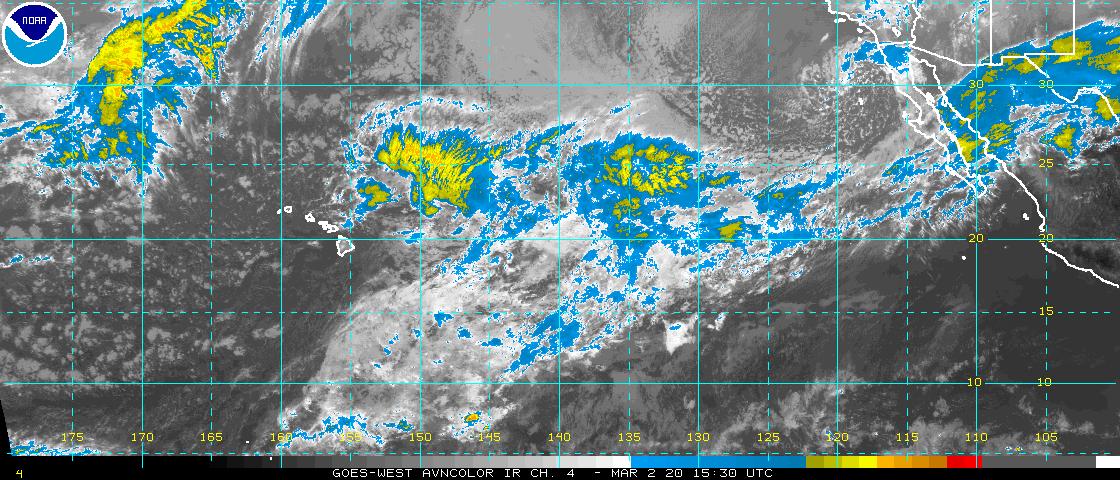
Tropical Cyclone activity in the eastern and central Pacific – Here’s the latest weather information coming out of the National Hurricane Center, covering the eastern north Pacific. You can find the latest tropical cyclone information for the central north Pacific (where Hawaii is located) by clicking on this link to the Central Pacific Hurricane Center. Here’s a tracking map covering both the eastern and central Pacific Ocean. A satellite image, which shows the entire ocean area between Hawaii and the Mexican coast…can be found here.
Aloha Paragraphs

Beautiful scenery…Kauai
The trade winds will continue well into the future. This weather map shows a very strong 1043 millibar high pressure cell far to the north of the Hawaiian Islands. As a result of the presence of this robust high pressure cell, and another high far to the northeast…we’ll find moderate to strong trade winds going into the new work week ahead. The NWS is keeping the small craft wind advisory in those windiest areas from Molokai down through the Big Island Sunday. As the trade winds may increase another notch over the next couple of days, we could see that advisory extended up further into the state with time. Meanwhile, dry weather along the leeward sides has triggered a red flag warning, indicating the danger of wild fires.
The blustery trade winds will carry some moisture onto our windward sides, leaving the leeward sides generally dry…through the next several days. The computer forecast models show another chance of increased showers, generally along the windward sides after mid-week coming up. This will leave pretty typical weather conditions in place across the state until around Thursday, discounting the substantial trade wind flow that is. The leeward sides will have less wind, although even there, especially during the afternoon hours, it will be windy enough to put white caps on the ocean surface. Air temperatures will remain fairly seasonable, with maximum’s reaching well up into the 80F’s…dropping back into the 70’s at night near sea level.
It’s late Sunday afternoon here in Kula, Maui, as I begin writing this last paragraph of today’s narrative. Sunday was the kind of day that allowed me to wash my clothes, and hang them out to dry in the warm breeze…on the line. I was able to bring them in at mid-afternoon, which is at least one chore that I have finished. I started to change my spark plugs on my car, but after checking the plugs, they were clean and so I just put them back in…and will take the plugs back to the store and get my money back. Today has been the perfect blend of a little work, and some rest too, just the way I like my Sunday’s to be. I’m finishing this update a little earlier than usual, which gives me the rest of the day to do whatever I feel like, which I like. I’ll be back again early Monday morning with your next new weather narrative. I hope you have a great Sunday evening/night, until then! Aloha for now…Glenn.
Interesting: A network of floating docks could harness clean energy for New York City and provide new space for parks, researchers now propose. Each dock could generate power off the city’s river currents. Three vertical turbines fastened out of sight to the underside of each station would harness the 4 mph currents, with each module generating up to 24 kilowatts of constant energy from the Hudson and East Rivers.
These stations would plug into the conventional piers of the city, extending them into the rivers. They could alleviate the need for conventional power to light the city streets, with each module supporting 350 LED street lamps.
These docks could eventually get extended further up the rivers to both generate power and increase recreational green space and tidal pools for wildlife, said researchers at the New Jersey Institute of Technology and at GRO Architects in New York.
They currently have a provisional patent on the idea. The designers came up with the concept as an entry for this year’s Metropolis Magazine Next Generation Design Competition. "Since then, a lot of people have come out of the woodwork who put together clean energy deals for cities, or even in some cases developing countries," said researcher Richard Garber at the New Jersey Institute of Technology, co-founder of the firm GRO Architects.
Although officials from New York have not contacted the researchers yet, "people from other cities internationally have." There are already turbines harnessing power off tides in the waters of New York City. The Roosevelt Island Tidal Energy project could generate up to 10 megawatts, enough to power nearly 8,000 homes, according to its developer, New York-based company Verdant Power.
However, the new docks that Garber and his colleagues propose could generate a similar amount of energy while creating new public spaces. "If you think historically, cities developed around waterways based on a need for trade," Garber said. "As trading changed, the need for water as a preexisting requirement for urban development went away.
What’s funny is that all of a sudden, water can become uber-important again in terms of development." At the heart of the proposal, the researchers want to reinforce the relationship between the city and its rivers and help reclaim access to its 578 miles of waterfront.
"Many times, you can stand on the corner of 42nd St. and Park Ave. in Manhattan and have no idea you’re on an island, with the idea of the waterfront lost," Garber said. "A big picture goal here is that via clean energy, one can heighten awareness of the water."
Interesting2: The riot of color that erupts in forests every autumn looks different depending on which side of the ocean you’re on. While the fall foliage in North America and East Asia takes on a fiery red hue, perplexingly, autumn leaves in Europe are mostly yellow in color.
A team of researchers has a new idea as to why the autumnal colors differ between the continents, one that involved taking a step back 35 million years in time. The green color of leaves during the spring and summer is a result of the presence of the pigment chlorophyll, which allows plants to capture sunlight and produce energy by the process of photosynthesis.
When the weather begins to turn cool in the fall, chlorophyll, which is sensitive to the cold, stops being produced. As the green fades, yellow and orange pigments called carotenoids (also responsible for the orange color of carrots) take over. These pigments were always present in the background of the leaves’ color, but can finally shine through as the green diminishes.
While this process has long been known to scientists, the mechanism that results in red hues has proved trickier to understand, particularly because of the energy the tree must use to produce them at a time when the leaves are about to die anyway. The red color comes from anthocyanins, which unlike carotenoids are produced only in the fall.
These red pigments act as sunscreen for the trees by blocking out harmful radiation and preventing overexposure to light. They also act as an antifreeze, preventing leaf cells from freezing easily in the autumn chill. Some scientists have even suggested that the red colors ward off pests that would munch on the leaves if they were a more appetizing-looking yellow.
It’s from this premise that scientists figured out what might be going on. Until 35 million years ago, the idea goes, large areas of the globe were covered with evergreen jungles or forests composed of tropical trees, say Simcha Lev-Yadun of the University of Haifa-Oranim in Israel and Jarmo Holopainen of the University of Kuopio in Finland.
During this phase, a series of ice ages and dry spells transpired, and many tree species evolved to become deciduous, dropping their leaves for winter. Many of these trees also began an evolutionary process of producing red deciduous leaves in order to ward off insects, the researchers say. In North America, as in East Asia, north-to-south mountain chains enabled plant and animal ‘migration’ to the south or north with the advance and retreat of the ice according to the climatic fluctuations.
And, of course, along with them migrated their insect ‘enemies’. Thus the war for survival continued there uninterrupted. In Europe, on the other hand, the mountains – the Alps and their lateral branches – reach from east to west, and therefore no protected areas were created. Many tree species that did not survive the severe cold died, and with them the insects that depended on them for survival.
At the end of the repeated ice ages, most tree species that had survived in Europe had no need to cope with many of the insects that had become extinct, and therefore no longer had to expend efforts on producing red warning leaves.
To back up this theory, the researchers offer an example of the exception that proves the rule: Dwarf shrubs, which grow in Scandinavia, still color their leaves red in autumn. Unlike trees, dwarf shrubs have managed to survive the ice ages under a layer of snow that covered them and protected them from the extreme conditions above.
Under the blanket of snow, the insects that fed off the shrubs were also protected – so the battle with insects continued in these plants, making it necessary for them to color their leaves red, the thinking goes.
Interesting3: Flu season in the northern hemisphere can range from as early as November to as late as May. The peak month usually is February. However, this coming season is expected to be unpredictable because of the emergence of the H1N1 influenza virus or swine flu. The H1N1 has caused the first global outbreak — pandemic — of influenza in more than four decades.
There is concern that the 2009 H1N1 virus may make the season worse than a regular flu season. It is feared that there will be many more hospitalizations and fatalities this season. The 2009 H1N1 virus caused illness in the U.S. during the summer months when influenza is very uncommon. The 2009-10 flu vaccine protects against the three main flu strains that research indicates will cause the most illness during the flu season.
The seasonal vaccine is not expected to protect against the 2009 H1N1 virus. A vaccine for 2009 H1N1 is being produced and may be ready for the public in the fall. The 2009-10 vaccine can be administered anytime during flu season. However, the best time to get inoculated is October-November. The protection provided by the vaccine lasts about a year.
Adults over 50 are prime candidates for the vaccine because the flu can be fatal for people in this age group. The CDC reports vaccination rates are better for those over 65. About 7 in 10 seniors get their flu shots. You can get the flu vaccine from your doctor, at public health centers, senior centers, pharmacies and supermarkets.
For more than four decades, the flu vaccine has been strongly recommended for older people, but now some scientists say the vaccine probably doesn’t work well for those over 70. About 75 percent of flu deaths happen to people in this age group. Flu is a contagious illness of the respiratory system caused by the influenza virus. Flu can lead to pneumonia, bronchitis, sinusitis, ear problems and dehydration.
Droplets from coughing and sneezing spread the flu. An adult with flu can infect others beginning one day before symptoms develop and up to five days after becoming sick. Children may spread flu for more than seven days. The best way to combat the bug is to get the flu vaccine. You have to get inoculated annually because new vaccines are prepared every year to combat new versions of the virus.
When you battle the flu, you develop antibodies to the invading virus, but those antibodies don’t work on new strains. The vaccine does not prevent flu in all people; it works better in younger recipients than older ones. Contrary to rumor, you can’t catch the flu from the vaccine. The flu vaccine is not made from a live virus. The recovery time for the flu is about one to two weeks. However, in seniors, weakness may persist for a longer time.
The common scenario for flu is a sudden onset of symptoms, which include chills, fatigue, fever, cough, headache, sore throat, nasal congestion, muscle aches and appetite loss. While nausea, vomiting and diarrhea can be related to the flu, these are rarely the primary flu symptoms. The flu is not a stomach or intestinal disease.
The term stomach flu is inaccurate. When symptoms strike, get to a doctor as soon as possible; the faster the better. There are prescription antiviral drugs to treat flu. Over-the-counter medicines can help relieve symptoms of the flu. You should also drink liquids to prevent dehydration, and sleep to bolster your immune system.
 Email Glenn James: