September 22-23, 2009
Air Temperatures – The following maximum temperatures were recorded across the state of Hawaii Tuesday afternoon:
Lihue, Kauai – 84
Honolulu, Oahu 89
Kaneohe, Oahu – 85
Kahului, Maui – 86
Hilo, Hawaii – 84
Kailua-kona – 87
Air Temperatures ranged between these warmest and coolest spots near sea level around the state – and on the highest mountains…at 5 p.m. Tuesday evening:
Port Allen, Kauai – 86F
Hilo, Hawaii – 78
Haleakala Crater – 55 (near 10,000 feet on Maui)
Mauna Kea summit – 45 (near 14,000 feet on the Big Island)
Precipitation Totals – The following numbers represent the largest precipitation totals (inches) during the last 24 hours on each of the major islands, as of Tuesday afternoon:
0.02 Poipu, Kauai
0.03 Kahuku, Oahu
0.00 Molokai
0.00 Lanai
0.00 Kahoolawe
0.01 Puu Kukui, Maui
0.40 Waiakea Uka, Big Island
Marine Winds – Here’s the latest (automatically updated) weather map showing a weak 1019 millibar high pressure system to the northeast, with its ridge extending southwest to a point just north of the islands. This will keep our trade winds on the light side, increasing later Wednesday into Thursday.
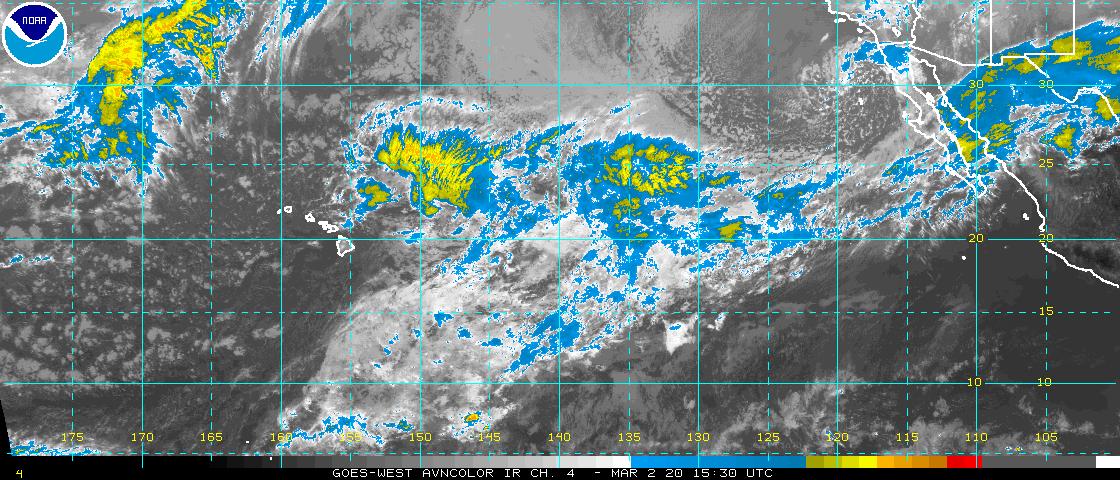
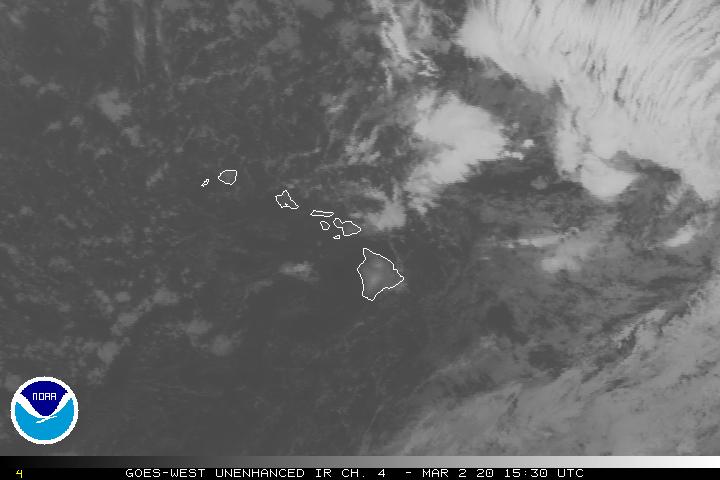
Satellite and Radar Images: To view the cloud conditions we have here in Hawaii, please use the following satellite links, starting off with this Infrared Satellite Image of the islands to see all the clouds around the state during the day and night. This next image is one that gives close images of the islands only during the daytime hours, and is referred to as a Close-up visible image. This next image shows a larger view of the Pacific…giving perspective to the wider ranging cloud patterns in the Pacific Ocean. Finally, here’s a Looping IR satellite image, making viewable the clouds around the islands 24 hours a day. To help you keep track of where any showers may be around the islands, here’s the latest animated radar image.
Hawaii’s Mountains – Here’s a link to the live webcam on the summit of near 14,000 foot Mauna Kea on the Big Island of Hawaii. The tallest peak on the island of Maui is the Haleakala Crater, which is near 10,000 feet in elevation. These two webcams are available during the daylight hours here in the islands…and when there’s a big moon rising just after sunset for an hour or two! Plus, during the nights and early mornings you will be able to see stars, and the sunrise too…depending upon weather conditions.
Tropical Cyclone activity in the eastern and central Pacific – Here’s the latest weather information coming out of the National Hurricane Center, covering the eastern north Pacific. You can find the latest tropical cyclone information for the central north Pacific (where Hawaii is located) by clicking on this link to the Central Pacific Hurricane Center. Here’s a tracking map covering both the eastern and central Pacific Ocean. A satellite image, which shows the entire ocean area between Hawaii and the Mexican coast…can be found here.
Aloha Paragraphs

Today is the first day of Autumn 2009!
Light winds prevailed Tuesday, which will begin rebounding again later Wednesday into Thursday. As the trade winds pick up in strength later on Wednesday, we’ll continue the pleasant start to our autumn season. These trade winds will remain active through the rest of this week, right on into the first part of next week.
There will be a few showers around, falling along the windward sides generally. As we grade back into a typical trade wind weather pattern later on Wednesday going forward, most of the showers that fall, will end up along the windward sides. An upper level trough of low pressure may keep above average showers falling Friday into the upcoming weekend.
There’s an area of showery clouds just to the east of the state…as they have been the last 24+ hours. This area will bring an increase in showers to our windward sides later on Wednesday. Here’s a satellite image which shows these patches of clouds. As the trade winds kick up later Wednesday into Thursday…they will help to carry these showers to us. By the way, that same satellite picture shows lots of high cirrus clouds down to our south, which could easily shift northward over us with time.
The big news this week will be the arrival of an early season swell along our north and west facing beaches. The source of this swell was super-typhoon Chai-won, which whipped the north western Pacific into a fury last week. This tropical cyclone has moved out of the tropics, having gone through what we call an extratropical transition, into a storm low pressure system in the northern latitudes. All of this strong wind, blowing on the surface of the ocean up there, has generated a swell train of large waves…driving southeast in our direction.
This higher than normal, early autumn surf will begin arriving late Wednesday evening, into Thursday. This in turn will prompt NWS issued high surf advisories for our north and west facing beaches. It will take several days of pounding on our local beaches, before this surf’s influence will gradually weaken during the upcoming weekend. Our local surfing community will love to see this early season surf coming. All that would be needed to have this surf event qualify as classic…would be some light to moderately strong offshore winds. The trade winds will be blowing instead, adding chop to the wave faces.
It’s early Tuesday evening here in Kihei, Maui, as I begin writing this last paragraph of today’s narrative. Looking out the window here on the south coast, there’s just the usual partly cloudy conditions, although with lots of blue around too. The trade winds are beginning to blow already it looks like, but will gain a further toe hold in our Hawaiian Island weather picture tomorrow into Thursday. I’ll be back early Wednesday morning with your next new weather narrative, I hope you have a great Tuesday night until then! Aloha for now…Glenn.
Interesting: Public smoking bans appear to significantly reduce the risk of heart attacks, particularly among younger individuals and nonsmokers, according to a new study published in the September 29, 2009, issue of the Journal of the American College of Cardiology. Researchers find that smoking bans can reduce the number of heart attacks by as much as 26 percent per year.
"Even breathing in low doses of cigarette smoke can increase one’s risk of heart attack," said David Meyers, M.D., M.P.H., professor of Cardiology and Preventive Medicine, University of Kansas School of Medicine and lead investigator of the study, which is the most comprehensive analysis of related studies to date.
"Public smoking bans seem to be tremendously effective in reducing heart attack and, theoretically, might also help to prevent lung cancer and emphysema, diseases that develop much more slowly than heart attacks.
The cardiac benefits increased with longer ban duration." According to projections by the authors, a nationwide ban on public smoking could prevent as many as 154,000 heart attacks each year.
These findings are particularly important in light of mounting evidence that second-hand smoke exposure is nearly as harmful to the heart as chronic active smoking. Direct smoking doubles the risk of heart attack. Second hand smoke increases the risk by 30 percent.
"Interestingly, public smoking bans had a stronger effect in reducing heart attacks among women and younger individuals, which may be explained, in part, because younger people tend to frequent clubs, restaurants and bars where smoking is a likely part of the social scene," said Dr. Meyers.
"Heavily exposed people like those working in the entertainment or hospitality industries are likely to accrue the greatest benefit from smoking bans." Dr. Meyers adds that smoking remains the leading preventable risk factor for heart attack.
Secondhand smoke is thought to increase the likelihood of a heart attack by making the blood "sticky" and more prone to clotting, reducing the amount of "good" (HDL) cholesterol in the body, and putting individuals at greater risk for dangerous heart rhythms, among other factors.
Interesting2: Thin friends who eat a lot could put your waistline at risk, according to a new study in the Journal of Consumer Research, which examines how other peoples’ weight and food choices influence how much we eat. "Obesity is obviously a tremendous public health concern," write authors Brent McFerran, Darren W. Dahl (both University of British Columbia), Gavan J. Fitzsimons (Duke University), and Andrea C. Morales (Arizona State University).
"We decided to investigate how someone’s size and food choices could influence how much the people around them eat." The researchers recruited 210 college students to participate in a study that was ostensibly about movie watching.
The participants were told they would be paired with another student taking place in the study. The other student was actually a member of the research team whose natural build was thin (size 0, 105 pounds). But at times this same researcher donned an "obesity prosthesis," which made her appear to be a size 16 and 180 pounds.
All of the students were offered snacks while viewing film clips. The undercover researcher was served first, and helped herself to either a large or small serving before the student participant was offered the same bowl of food.
In all cases, the amount of food the students accepted was influenced by the portion size chosen by the undercover researcher, regardless of her size. "Most participants took a portion similar to what the researcher served herself," the authors explain.
"However, it is clear that how much food each person took, and how much they ate depended on whether their companion was thin or obese." Participants tended to mimic the thin companion’s portion sizes.
But when they presumed the researcher to be obese, the participants adjusted the amounts they ate. "This indicates that people are influenced, even without being aware of it, by other people’s portion choices," the authors write.
"Our findings indicate that the size of the person you dine with matters much less than the size of the meal they order," the authors write. "If a heavy-set colleague eats a lot, you are likely to adjust your behavior and eat less. But a thin friend who eats a lot may lead you to eat more than you normally would."
Interesting3: Scientists from six European countries have developed a new computer system, called DRIVSCO, that allows vehicles to learn from the behavior of their drivers at the wheel, in such a way that they can detect if a driver presents an “unusual behavior” in a curve or an obstacle on the road and generates signals of alarm which warn him in time to react. Unlike other similar projects, DRIVSCO goes far beyond a computer vision system for driving assistance.
The concept investigated was how to get that a car learns from the user’s driving facing a curve or an approaching intersection, a pedestrian or another vehicle. Regardless the type of driving of the driver, sporty or conservative (as it adapts to his driving), the system obtains a driving behavior pattern.
Thus, during night driving, if the vehicle detects a deviation in his way of driving in face of a curve, it interprets that it is due t the lack of visibility of the driver (as the driver has a limited visibility of the low beams field, whereas the car’s night vision system is much more powerful and has a longer range).
Therefore, it generates signals of alarm to warn the driver of his “unusual behavior when approaching a curve”, or the detection of a potentially dangerous object, for instance.
The persons in charge of this project state that 42 per cent of fatal traffic accidents happen at night, according to the data of the European Car Council, “an extremely worrying figure if we consider that traffic drops about a 60% during night hours”.
This is due, among other factors, to the reduced visibility during night driving. The Spanish representation in this project fell on a research group of the Department of Computer Architecture and Technology of the University of Granada (Spain) led by professor Eduardo Ros Vidal.
DRIVSCO also has the participation of scientists from Germany (University of Göttingen, University of Münster and the company Hella & Hueck), Denmark (University of Southern Denmark), Lithuania (University Vytautas Magnus), Belgium (Catholic University of Leuven) and Italy (University of Geneva).
The research group of the University of Granada has developed a system of artificial vision (analysis of the scenario) in an only chip. Such device receives input pictures and produces a first “interpretation of the scenario” in terms of depth (3D vision), local movement, image lines, etc, everything in an only electronic chip.
This system can be assembled in different types of vehicles in future. In addition, they have used a “reconfigurable hardware”, so that the system can adapt itself to new field of application.
Interesting4: This Saturday, Sept. 26, is the 16th annual National Public Lands Day, a day to celebrate our nation’s parks and join the effort to make them even better. To celebrate this historic day, entrance to all 391 national parks around the country is free for the day! National Public Lands Day is the nation’s largest hands-on volunteer effort to improve and enhance the public lands that we all enjoy (and so often take for granted.)
In 2008, about 120,000 volunteers built trails and bridges, removed trash and invasive plants, and planted over 1.6 million trees in parks around the country. More efforts are underway this year.
Check out the National Park Service listings to find out what programs will be going on at your local national park. Most are offering volunteer opportunities as well as a sneak peek of the new PBS film by Ken Burns, "The National Parks – America`s Best Idea" premiering Sunday on PBS.
You don’t have to volunteer to enjoy the free fees. So if volunteering is not an option, don’t worry, just grab the kids and head out to your favorite national park this weekend. It’s a free, fun and green activity you can all enjoy as a family.
But remember, volunteering is not just good for you and for the park, it’s good for your health, too. So there’s never been a better time to get out there!
Interesting5: A federal district court ruling in Montana today returned Endangered Species Act protections to the Yellowstone grizzly bear population. In the case, brought by the Greater Yellowstone Coalition, Judge Donald Molloy ruled that inadequate regulatory mechanisms were put in place to manage the bears after federal protections were dropped in early 2007, and that U.S. Fish and Wildlife Service (FWS) failed to address the loss of an essential food source for the bears, whitebark pine seeds.
The Natural Resources Defense Council (NRDC) and six other groups, represented by Earthjustice, have a similar case pending in Idaho. For years, NRDC has been vigorously engaged in efforts to protect Yellowstone’s grizzly bears and whitebark pine.
Whitebark pine forests are being decimated throughout their range by an array of threats that have emerged in high elevation environments as a result of climate change.
Researchers worry that the trees are being driven to functional extinction, radically altering some of the continent’s most iconic landscapes and eliminating a crucial food source for Yellowstone’s grizzly bears. NRDC petitioned to have the tree added to the federal Endangered Species List in December 2008.
Following is a statement from Louisa Willcox, senior wildlife advocate for NRDC: "This is a chance to hit the reset button and get the right policies in place before it’s too late. As we lose whitebark pine, we need to redouble efforts to anticipate and reduce conflicts with people: that means making sure people keep clean camps and yards, carry bear spray, and are prepared to stay safe in grizzly country."
 Email Glenn James: