











September 21-22, 2009
Air Temperatures – The following maximum temperatures were recorded across the state of Hawaii Monday afternoon:
Lihue, Kauai – 81
Honolulu, Oahu 89
Kaneohe, Oahu – 85
Kahului, Maui – 85
Hilo, Hawaii – 84
Kailua-kona – 87
Air Temperatures ranged between these warmest and coolest spots near sea level around the state – and on the highest mountains…at 5 p.m. Monday evening:
Honolulu, Oahu – 86F
Hilo, Hawaii – 78
Haleakala Crater – 52 (near 10,000 feet on Maui)
Mauna Kea summit – 48 (near 14,000 feet on the Big Island)
Precipitation Totals – The following numbers represent the largest precipitation totals (inches) during the last 24 hours on each of the major islands, as of Monday afternoon:
0.43 Mount Waialaele, Kauai
0.91 Oahu Forest NWR, Oahu
0.01 Molokai
0.04 Lanai
0.14 Kahoolawe
0.46 Ulupalakua, Maui
0.03 Glenwood, Big Island
Marine Winds – Here’s the latest (automatically updated) weather map showing high pressure systems far to the northwest and northeast, with a ridge still north of the state…which translates to light trade winds Monday into Tuesday.
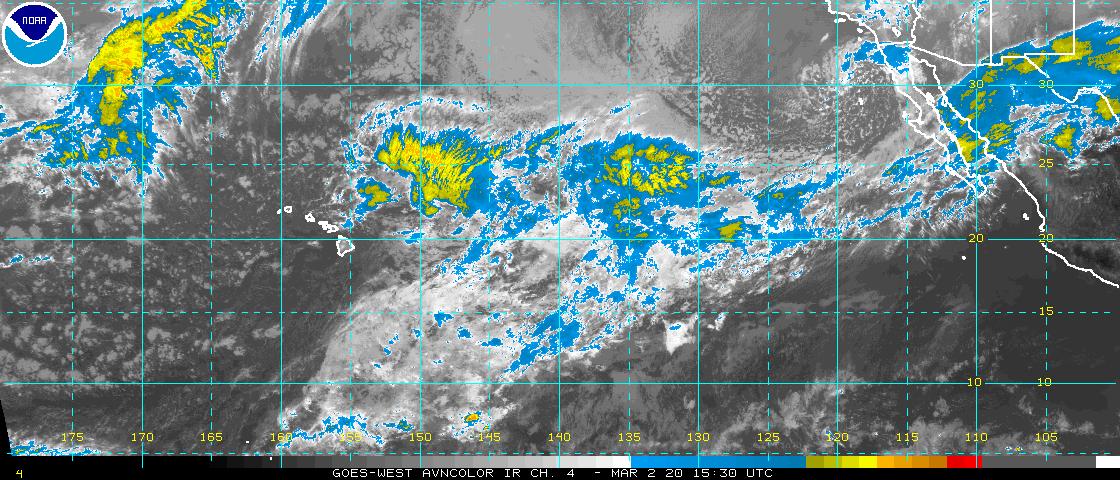
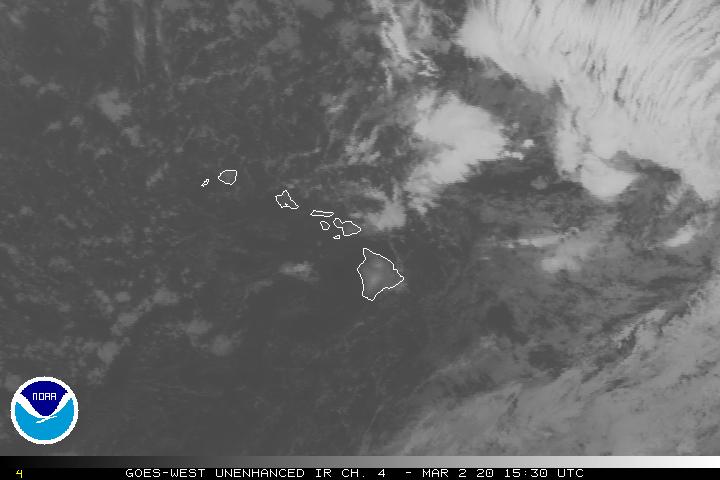
Satellite and Radar Images: To view the cloud conditions we have here in Hawaii, please use the following satellite links, starting off with this Infrared Satellite Image of the islands to see all the clouds around the state during the day and night. This next image is one that gives close images of the islands only during the daytime hours, and is referred to as a Close-up visible image. This next image shows a larger view of the Pacific…giving perspective to the wider ranging cloud patterns in the Pacific Ocean. Finally, here’s a Looping IR satellite image, making viewable the clouds around the islands 24 hours a day. To help you keep track of where any showers may be around the islands, here’s the latest animated radar image.
Hawaii’s Mountains – Here’s a link to the live webcam on the summit of near 14,000 foot Mauna Kea on the Big Island of Hawaii. The tallest peak on the island of Maui is the Haleakala Crater, which is near 10,000 feet in elevation. These two webcams are available during the daylight hours here in the islands…and when there’s a big moon rising just after sunset for an hour or two! Plus, during the nights and early mornings you will be able to see stars, and the sunrise too…depending upon weather conditions.
Tropical Cyclone activity in the eastern and central Pacific – Here’s the latest weather information coming out of the National Hurricane Center, covering the eastern north Pacific. You can find the latest tropical cyclone information for the central north Pacific (where Hawaii is located) by clicking on this link to the Central Pacific Hurricane Center. Here’s a tracking map covering both the eastern and central Pacific Ocean. A satellite image, which shows the entire ocean area between Hawaii and the Mexican coast…can be found here.
Aloha Paragraphs

It won’t be long before the whales return
Once again, storminess in the middle latitudes of the north Pacific is having some bearing in our local weather picture here in
The cold front best in line to take care of this, has actually split the ridge, and may push a bit further southward into the northern tropics. This in turn will weaken the ridge, and shove it down closer to the
Before we get to the larger surf that will arrive by Thursday, let’s explore what we might find in terms of precipitation this week. It goes without saying that while the trade winds are blowing, we’ll continue to see some passing shower activity along our windward coasts and slopes. This shouldn’t be particularly heavy, although we could use the water, as there aren’t any significant upper level troughs of low pressure…which would enhance these showers.
Meanwhile, with the lighter wind flow, we can expect the islands to heat up, along with those localized onshore flowing sea breezes. These will carry moisture up the leeward slopes, where that invisible moisture condenses out into afternoon convective cumulus clouds. These clouds too, will likely provide a few showers, as they began to do Sunday afternoon. Then, later in the week, as the ridge migrates northward, we’ll find strengthening trade winds returning to
Taking another look at that weather map above, we see a big ol’ storm spinning far to the northwest. This of course is what’s left of supertyphoon Chai-won, which whipped the north western Pacific into a fury last week. This tropical cyclone has moved out of the tropics, having gone through what we call an extratropical transition into a storm low pressure system in the northern latitudes…checking in at a very low 962 millibars early Monday afternoon. There have been hurricane force winds revolving around this storm during the last 24+ hours. All of this strong wind, blowing on the surface of the ocean up there…has generated a swell train of large waves driving southeast in our direction.
This higher than normal, early autumn surf will begin arriving late Wednesday evening, or Thursday. This in turn will definitely prompt NWS issued high surf advisories for our north and west facing beaches. It will take several days of pounding on our local beaches, before this surf’s influence will gradually weaken during the upcoming weekend. Our local surfing community will love to see this early season surf coming. All that would be needed to have this surf event qualify as classic…would be some light to moderately strong offshore winds. The trade winds will be blowing instead, adding some chop to the wave faces though.
It’s early Monday evening here in Kihei, Maui, as I begin writing this last paragraph of today’s narrative. Looking out the window here in Kihei, before I take the drive back upcountry to Kula, it’s almost totally clear…like in no clouds! It’s one of those unique days when clouds remain missing in action. The only clouds that I see at around 530pm are a few up on the slopes of the Haleakala Crater…and a couple of minor ones over the West Maui Mountains. ~~~ I’m pretty clear about everything in terms of the outlook above, except for this one cloud area, having to do with a weak trough of low pressure out to the east of Hawaii. This satellite image shows it well, and I’ll have more to say about it early Tuesday morning, when I return with your next new weather narrative then. I hope you have a great Monday night until then! Aloha for now…Glenn.
Monday is World Peace Day 2009…here’s a nice website acknowledging it.
Interesting: As world leaders gather for key climate talks here, small island nations Monday warned they were running out of time with rising seas threatening to wipe them off the map. Spread across the Earth’s oceans, the planet’s tiniest members grouped as part of the Alliance of Small Islands States (AOSIS) are hoping to make their voices heard 100 days before UN-hosted climate talks in Copenhagen.
Climate negotiators have spent the last two years working toward a make-or-break summit in Copenhagen this December, expected to ink new targets for global emissions beyond 2012, when the Kyoto Protocol expires.
AOSIS has dubbed itself the "moral voice of the negotiations" while the European Union prides itself on taking the lead, with member states agreeing to make 20 percent cuts in CO2 emissions by 2020 from 1990 levels.
EU leaders have said they are ready to commit to 30 percent cuts if the rest of the world does likewise to attain the overall goal of restricting global warming to two degrees Celsius. But such a cut in rising temperatures is still too warm for many low-lying and island nations.
"Small island countries need to say that it is tantamount to declaring their extinction, because the consequences of going to a two degree Celsius increase are such that whole nations are to disappear," UN climate negotiator Yvo de Boer told AFP.
Instead AOSIS is demanding that the new Copenhagen climate agreement limit temperature increases to as far below 1.5 degrees Celsius as possible, drumming home their mantra "1.5 to stay alive."
The group’s president, Dessima Williams, who is also the permanent representative for Grenada to the United Nations, said last week: "More recent science shows that we are on track for a sea level rise of at least one and maybe two meters by the end of the century.
"That would spell disaster, even disappearance, for some of our islands."She said even just a 0.8 rise on the world thermometer was having dire consequences for island nations already witnessing severe coastal erosion, floods, dying coral reefs and extreme weather.
The alliance is urging industrialized nations to cut gas emissions by 2020 by 45 percent compared with 1990 levels. "Sometimes in this debate like in many others you forget what is all about; people forget the main driver for ecosystem losses and for the disappearance of species is climate change," de Boer told AFP Monday in an interview.
UN chief Ban Ki-moon on Monday joined other politicians and celebrities to formally launch New York climate week, which will Tuesday host a major UN climate summit he has convened. Last week Ban pressed world leaders to publicly commit here on Tuesday to reaching a global climate change deal in Copenhagen.
"The current slow pace of the negotiations is a matter of deep concern," Ban said. "We want world leaders to show they understand the gravity of climate risks, as well as the benefits of acting now."De Boer said he was eagerly awaiting what Chinese President Hu Jintao would have to say about climate change on Tuesday.
"I have very high expectations on what President Hu will be announcing in the UN tomorrow; it’s going to be ambitious," he said. He predicted that China could unveil policy measures that would make Beijing a "world leader in addressing climate change."
The United States, which consumes 25 percent of the world’s energy and is the world’s biggest polluter, is also in the dock with many fearing Washington is too preoccupied with other problems to devote much time to battling global warming.
Climate negotiators from the world’s 17 largest developing and developed economies met in Washington on Thursday and Friday for talks described by the top US climate envoy as a "pretty full ventilation of views." "I think there was some narrowing of differences," said Todd Stern, the US special envoy for climate change. But he acknowledged "there are plenty of differences that remain."
Interesting2: A new study led by the University of Colorado at Boulder indicates most of the world’s low-lying river deltas are sinking from human activity, making them increasingly vulnerable to flooding from rivers and ocean storms and putting tens of millions of people at risk. While the 2007 Intergovernmental Panel on Climate Change report concluded many river deltas are at risk from sea level rise, the new study indicates other human factors are causing deltas to sink significantly.
The researchers concluded the sinking of deltas from Asia and India to the Americas is exacerbated by the upstream trapping of sediments by reservoirs and dams, man-made channels and levees that whisk sediment into the oceans beyond coastal floodplains, and the accelerated compacting of floodplain sediment caused by the extraction of groundwater and natural gas.
Scientists have found the "Rosetta Stone" of supervolcanoes, those giant pockmarks in the Earth’s surface produced by rare and massive explosive eruptions that rank among nature’s most violent events. The eruptions produce devastation on a regional scale — and possibly trigger climatic and environmental effects at a global scale.
Interesting3: A fossil supervolcano has been discovered in the Italian Alps’ Sesia Valley by a team led by James E. Quick, a geology professor at Southern Methodist University. The discovery will advance scientific understanding of active supervolcanoes, like Yellowstone, which is the second-largest supervolcano in the world and which last erupted 630,000 years ago.
A rare uplift of the Earth’s crust in the Sesia Valley reveals for the first time the actual "plumbing" of a supervolcano from the surface to the source of the magma deep within the Earth, according to a new research article reporting the discovery.
The uplift reveals to an unprecedented depth of 25 kilometers the tracks and trails of the magma as it moved through the Earth’s crust. Supervolcanoes, historically called calderas, are enormous craters tens of kilometers in diameter.
Their eruptions are sparked by the explosive release of gas from molten rock or "magma" as it pushes its way to the Earth’s surface. Calderas erupt hundreds to thousands of cubic kilometers of volcanic ash.
Explosive events occur every few hundred thousand years. Supervolcanoes have spread lava and ash vast distances and scientists believe they may have set off catastrophic global cooling events at different periods in the Earth’s past.
Sesia Valley’s caldera erupted during the "Permian" geologic time period, say the discovery scientists. It is more than 13 kilometers in diameter.
"What’s new is to see the magmatic plumbing system all the way through the Earth’s crust," says Quick, who previously served as program coordinator for the Volcano Hazards Program of the U.S. Geological Survey.
"Now we want to start to use this discovery. We want to understand the fundamental processes that influence eruptions: Where are magmas stored prior to these giant eruptions? From what depth do the eruptions emanate?"
Sesia Valley’s unprecedented exposure of magmatic plumbing provides a model for interpreting geophysical profiles and magmatic processes beneath active calderas. The exposure also serves as direct confirmation of the cause-and-effect link between molten rock moving through the Earth’s crust and explosive volcanism.
"It might lead to a better interpretation of monitoring data and improved prediction of eruptions," says Quick, lead author of the research article reporting the discovery. The article, "Magmatic plumbing of a large Permian caldera exposed to a depth of 25 km.," appears in the July issue of the peer-reviewed journal "Geology."
Calderas, which typically exhibit high levels of seismic and hydrothermal activity, often swell, suggesting movement of fluids beneath the surface. "We want to better understand the tell-tale signs that a caldera is advancing to eruption so that we can improve warnings and avoid false alerts," Quick says.
Interesting4: In the open ocean, species of large predatory fish will swim and hunt for food at various depths, which leads to unique diets in these fish. Oceanographers and geologists in the School of Ocean and Earth Science and Technology (SOEST) at the University of Hawaii at M?noa (UHM) and colleagues have found that those fish that hunt deeper in the open ocean have higher mercury concentrations than those that feed near the surface of the ocean because their deep water food has higher mercury.
This research was detailed in the August 18th early edition of the prestigous journal the Proceedings of the National Academy of Sciences. Mercury is a naturally-occurring trace element distributed throughout the Earth’s oceans, land and air.
The general public is interested in mercury levels in fish because the organic form, methylmercury, can be toxic at elevated levels if ingested by humans and animals. Mercury enters open ocean food webs, where it bio-accumulates, leading to higher levels in large predatory animals.
Researchers looking at mercury levels in the open ocean have indicated that deeper waters have elevated levels relative to the surface waters. "Building on this information, we thought that deeper-dwelling open ocean animals might have more mercury, as well as the predatory fishes that feed on them," says Anela Choy, a Department of Oceanography Graduate Student at UHM and lead author in this study.
This was indeed the case, and the results of their work show that large pelagic fish like bigeye tuna and swordfish that feed deeper in the ocean have elevated total mercury levels relative to their shallower-dwelling counterparts like yellowfin tuna and mahi-mahi.
"We show that this is because the food items that they eat also have varying levels of mercury", continues Choy. "Deeper-living micro-nekton prey (small fishes, squids, and crustaceans) have higher mercury levels relative to more surface-dwelling prey animals.
This is important knowledge for scientists studying animals in the open ocean because it helps them to understand how energy and matter cycle, as well as show who is eating who in the vast, blue water environment. Although not the focus of this study, the results may also help provide information to the fish-consuming public on mercury levels in popular commercial species."
Interesting5: The widespread idea that Mars is red due to rocks being rusted by the water that once flooded the red planet may not be correct. Recent laboratory studies show that red dust may be formed by ongoing grinding of surface rocks and liquid water need not have played any significant role in the formation process.
These findings, which open up the debate about the history of water on Mars and whether it has ever been habitable, have been presented at the European Planetary Science Congress by Dr Jonathan Merrison.
“Mars should really look blackish, between its white polar caps, because most of the rocks at mid-latitudes are basalt. For decades we assumed that the reddish regions on Mars are related to the water-rich early history of the planet and that, at least in some areas, water-bearing heavily oxidized iron minerals are present,” said Dr. Merrison, of the Aarhus Mars Simulation Laboratory, Denmark.
Accurate knowledge of the composition and mineralogy of the planet is vital in understanding the structure and evolution of the near-surface environment and its interaction with the atmosphere, as well as in searching for potential habitats on Mars.
Fine red dust covers Mars’s surface and is even present in Mars’s atmosphere, dominating the weather and sometimes becoming so thick that it plunges the planet into darkness. Even though dust is ubiquitous, we do not fully understand its physical, chemical and geological properties.
In their recent laboratory study, scientists at the Mars Simulation Laboratory have pioneered a novel technique to simulate the sand transport on Mars. They hermetically sealed sand (quartz) samples in glass flasks and mechanically “tumbled” them for several months, turning each flask ten million times.
After gently tumbling pure quartz sand for seven months, almost 10% of the sand had been reduced to dust. When scientists added powdered magnetite, an iron oxide present in Martian basalt, to the flasks they were surprised to see it getting redder as the flasks were tumbled.
“Reddish-orange material deposits, which resemble mineral mantles known as desert varnish, started appearing on the tumbled flasks. Subsequent analysis of the flask material and dust has shown that the magnetite was transformed into the red mineral hematite, through a completely mechanical process without the presence of water at any stage of this process,” said Dr Merrison.
The scientists suspect that, as the quartz sand grains are tumbled around, they get quickly eroded and an alteration of minerals through contact ensues. How exactly this happens needs to be further investigated through more experimental and analytical work.
However, the first experiments show that this process occurs not only in air but also in a dried carbon dioxide atmosphere, i.e. in conditions that perfectly resemble those occurring on Mars. It may also imply that the reddish Martian dust is geologically recent.
Scientists at a new interdisciplinary research institute in Austria are working to uncover how life might evolve with “exotic” biochemistry and solvents, such as sulphuric acid instead of water.
 Email Glenn James:

Eliza Says:
Peace events start at Ka`ahumanu Center at Noon, today, Glenn.
Various presenters for quite a few hours. Sorry, the event is not posted on their website to show who’s doing what when.
Sunny, bright, light light breezes here in upper Ha`iku.~~~Thanks Eliza! Aloha, Glenn