September 2-3, 2009
Air Temperatures – The following maximum temperatures were recorded across the state of Hawaii Wednesday afternoon:
Lihue, Kauai – 83
Honolulu, Oahu – 90
Kaneohe, Oahu – 84
Kahului, Maui – 87
Hilo, Hawaii – 84
Kailua-kona – 87
Air Temperatures ranged between these warmest and coolest spots near sea level – and on the highest mountains…at 5 p.m. Wednesday evening:
Barking Sands, Kauai – 89F
Princeville, Kauai – 79
Haleakala Crater – 52 (near 10,000 feet on Maui)
Mauna Kea summit – 54 (near 14,000 feet on the Big Island)
Precipitation Totals – The following numbers represent the largest precipitation totals (inches) during the last 24 hours on each of the major islands, as of Wednesday afternoon:
0.40 Mount Waialaele, Kauai
0.10 Nuuanu Upper, Oahu
0.01 Molokai
0.00 Lanai
0.00 Kahoolawe
0.01 Puu Kukui, Maui
0.15 Hakalau, Big Island
Marine Winds – Here’s the latest (automatically updated) weather map showing a 1024 millibar high pressure system to the north of the islands. Trade winds will be active through Friday.
Satellite and Radar Images: To view the cloud conditions we have here in Hawaii, please use the following satellite links, starting off with this Infrared Satellite Image of the islands to see all the clouds around the state during the day and night. This next image is one that gives close images of the islands only during the daytime hours, and is referred to as a Close-up visible image. This next image shows a larger view of the Pacific…giving perspective to the wider ranging cloud patterns in the Pacific Ocean. Finally, here’s a Looping IR satellite image, making viewable the clouds around the islands 24 hours a day. To help you keep track of where any showers may be around the islands, here’s the latest animated radar image.
Hawaii’s Mountains – Here’s a link to the live webcam on the summit of near 14,000 foot Mauna Kea on the Big Island of Hawaii. The tallest peak on the island of Maui is the Haleakala Crater, which is near 10,000 feet in elevation. These two webcams are available during the daylight hours here in the islands…and when there’s a big moon rising just after sunset for an hour or two! Plus, during the nights and early mornings you will be able to see stars, and the sunrise too…depending upon weather conditions.
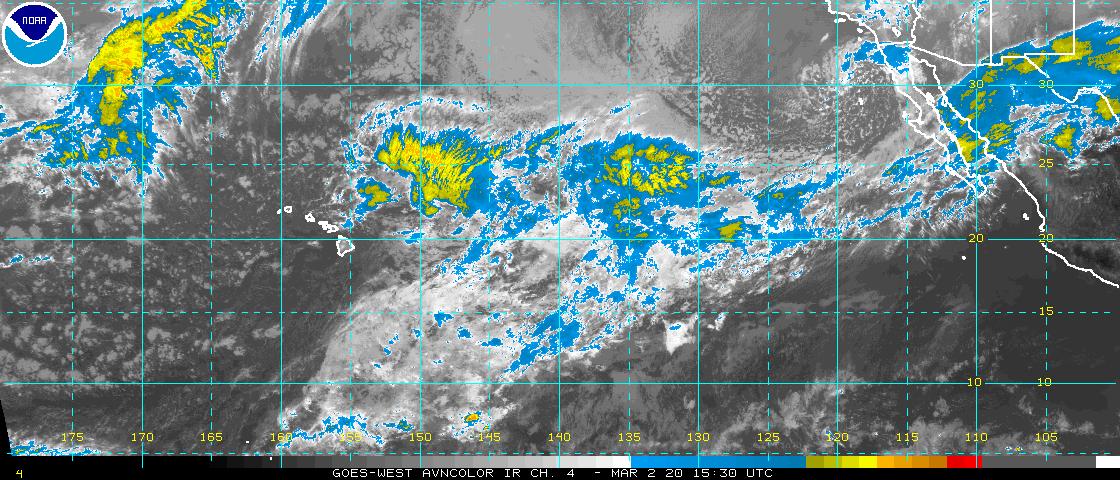
Tropical Cyclone activity in the eastern and central Pacific – Here’s the latest weather information coming out of the National Hurricane Center, covering the eastern north Pacific. You can find the latest tropical cyclone information for the central north Pacific (where Hawaii is located) by clicking on this link to the Central Pacific Hurricane Center. Here’s a tracking map covering both the eastern and central Pacific Ocean. A satellite image, which shows the entire ocean area between Hawaii and the Mexican coast…can be found here.
Aloha Paragraphs

Paradise painting
Breezy trade winds will prevail through the rest of this week…into next week. As a high pressure system to our north moves closer into Thursday, our local trade wind speeds should gain a little more strength, with somewhat stronger trade winds occurring into Friday and Saturday. These trade winds will likely soften beginning on Sunday, going into the Labor Day holiday early next week. Small craft wind advisories remain active across all the major channels between the Big island and Oahu…including those windiest coastal waters as well.
The windward sides will find some cloudy periods, with a few showers falling at times…while the leeward sides remain generally dry. There will likely be just the usual amount of incoming shower activity, carried our way on the fresh trade winds. The computer models show a high pressure ridge overhead this holiday weekend…which will keep generally dry weather around then. There are no organized areas of showers in our area of the central Pacific now, so that our pleasant late summer weather conditions will continue.
As noted above, the trade winds will be on the rise, occurring along-side dry weather conditions. As a precaution, the NWS office in Honolulu has issued a red flag warning, which remains in effect for the leeward sides through Thursday afternoon. The criteria for the issuance of a red flag warning include sustained winds of 20 mph or greater and relative humidity values of 45 per cent or lower, as measured at the Honolulu airport. With a relatively dry and breezy day on tap, all criteria are expected to be met…indicating critical fire weather conditions that could lead to rapid fire growth.
It’s Wednesday evening here in Kihei, Maui, as I begin writing this last section of today’s narrative update. Day after day after day, of the most lovely trade wind weather continues! Lots of warm sunshine, with just a minimum amount of incoming clouds carried by the fresh trade winds. This is a good time to remember those days in winter, when it sometimes seems like for spells we just can’t shake the cloudy skies and passing showers. This is just the opposite of that, with no real end in sight! ~~~ I’m about ready to hop in my car for the drive back upcountry to Kula. Looking out the window here in Kihei before I go, it’s mostly clear, as it has been for the last many, many days at this time…as we head towards the sunset hour. I’ll be back online early Thursday morning with your next new weather narrative from paradise. I hope you have a great Wednesday night, and by the way, don’t forget to check out this last full moon, or near full moon of summer 2009, beaming down on us tonight – accompanied by the planet Jupiter just up to the moon’s right! Aloha for now…Glenn.
Extra: A youtube video of the beautiful Kalalau Valley, Kauai, with Chopin classical music.
Interesting: Get out the coats, boots, and shovels; people in some parts of the country are in for it this winter, according to the Farmer’s Almanac. The longtime periodical, published since 1818 and famous for its long-range weather predictions, is out with its annual winter forecast, which says Old Man Winter is really going to hammer folks in the Midwest and upper Great Lakes region with very cold and very snowy conditions. The almanac puts it this way:
"A large area of numbingly cold temperatures will predominate from roughly east of the Continental Divide to west of the Appalachians. The coldest temperatures will be over the northern Great Lakes and the Upper Peninsula of Michigan. "But acting almost like the bread of a sandwich, to this swath of unseasonable cold will be two regions with temperatures that will average closer to normal — the West Coast and the East Coast."
But don’t let your guard down if you live along the East or West coasts. Farmer’s Almanac managing editor Sandi Duncan says no one will be immune to the rough weather this winter. "Even the areas that we say are going to be like the bread of the ice-cold sandwich are going to have bouts of stormy conditions. There’s no way it’s going to be that mild of a winter," she says.
Nasty weather is also in the forecast for late in the season as winter moves toward spring. "We’re actually predicting a possible blizzard in the northeast to the mid-Atlantic states sometime in February," Duncan says. "And it does look like the cool temperatures to the cold temperatures are going to hang on. And spring does look kind of rainy."
The Farmers’ Almanac gets pretty specific about that late-season blizzard forecast. According to Duncan, "February 12th-15th looks very stormy with blizzard conditions possible especially in New England but also going down to the mid-Atlantic coast."
The periodical says, "While three-quarters of the country is predicted to see near- or below-average precipitation this winter, that doesn’t mean there won’t be any winter storms! On the contrary, significant snowfalls are forecast for parts of every zone."
Interesting2: Music is one of the surest ways to influence human emotions; most people unconsciously recognize and respond to music that is happy, sad, fearful or mellow. But psychologists who have tried to trace the evolutionary roots of these responses usually hit a dead end. Nonhuman primates scarcely respond to human music, and instead prefer silence.
A new report by Charles Snowdon, a professor of psychology at the University of Wisconsin-Madison, and musician David Teie of the University of Maryland shows that a monkey called the cotton-top tamarin indeed responds to music. The catch?
These South American monkeys are essentially immune to human music, but they respond appropriately to "monkey music," 30-second clips composed by Teie on the basis of actual monkey calls.
The music was inspired by sounds the tamarins make to convey two opposite emotions: threats and/or fear, and affiliation, a friendly, safe and happy condition. The study, published this week (Sept. 1) in the journal Biology Letters, reported that the monkeys could tell the difference: For five minutes after hearing fear music, the monkeys displayed more symptoms of anxiety and increased their movement.
In contrast, monkeys that heard "affiliative" music reduced their movements and increased their feeding behavior — both signs of a calming effect. Snowdon, a longtime researcher into primate behavior, says the project began with an inquiry from Teie, who plays cello in the National Symphony Orchestra: Had Snowdon ever tested the effects of music on monkeys?
When Teie listened to recordings made in Snowdon’s monkey colony at the psychology department at UW-Madison, he readily discerned the animal’s affective state, Snowdon says. "He said, ‘This is a call from an animal that is very upset; this is from an animal that is more relaxed.’ He was able to read the emotional state just by the musical analysis."
Teie composed the music using specific features he noticed in the monkeys’ calls, such as rising or falling pitches, and the duration of various sounds, says Snowdon, who notes that monkeys are not the only ones who use musical elements to convey emotional content in speech. Studies show that babies that are too young to understand words can still interpret a long tone and a descending pitch as soothing, and a short tone as inhibiting.
"We use legato (long tones) with babies to calm them," Snowdon says. "We use staccato to order them to stop. Approval has a rising tone, and soothing has a decreasing tone. We add musical features to speech so it will influence the affective state of a baby. If you bark out, ‘PLAY WITH IT,’ a baby will freeze. The voice, the intonation pattern, the musicality can matter more than the words." Snowdon, who has sung in choirs for most of his life, adds,
"My talking does not necessarily tell you about my emotional state. When I add extra elements, change the tone of voice, the rhythm, pitch or speed that is where the emotional content is contained." Monkeys interpret rising and falling tones differently than humans. Oddly, their only response to several samples of human music was a calming response to the heavy-metal band Metallica.
Interesting3: People want to save the planet but are unwilling to make radical lifestyle changes like giving up air travel or red meat to reduce the effects of climate change, a straw poll by Reuters showed. As leaders gear up for another round of climate change talks later this month in New York, motivating people to change their lifestyles will be crucial in ensuring cuts in planet-warming greenhouse gases, experts say.
Over 40 percent of Britain’s carbon dioxide (CO2) emissions, the main greenhouse gas causing climate change, come from the energy we use at home and in traveling.
Interesting4: The U.S. Fish and Wildlife Service has announced in a 90 day status review that the Sonoran population of desert tortoise is a distinct population segment under the Endangered Species Act and that listing, as threatened or endangered, under the Act may be warranted. As a result the Service will begin a 12 month status review at the conclusion of which it will publish a proposal to list or not to list the Sonoran desert tortoise under the Act.
The Service encourages the public to comment on a listing decision and to provide background material on the biology, life cycle and populations of the tortoise. The tortoise survives the 140 degree heat of the desert by digging burrows where it spends 95 per cent of its life protected from heat in summer and frost in winter.
The population of Sonoran tortoises has declined by nearly 90 percent since the 1980s mostly as the result of habitat destruction and over population of ravens that prey on juvenile tortoises.
Interesting5: Fifty-five million years ago, the world was a much warmer place. The poles were ice-free year-round. Palm trees grew in Alaska. Forests stretched right into the Arctic Circle. There, swamps like those in today’s southeastern United States hosted alligators, snakes, and giant tortoises. Scientists call this time in Earth’s history the Eocene, the dawn of the age of mammals.
And climatologists have naturally taken a keen interest in how it began. They know that a dramatic spike in carbon dioxide associated with rapid climate change kicked off the epoch — called the "Paleocene-Eocene Thermal Maximum" (PETM). But what scientists don’t understand about the PETM may hold the most relevant lessons for where the world’s climate is headed today.
So far, scientists have been unable to reproduce the PETM in a climate model. In order to get the climate they suspect existed, they have to crank up carbon dioxide far beyond what they think was actually the case.
They’re missing something — and that something may be key to understanding what happens after atmospheric CO2 increases beyond an unknown threshold. At some point, rising CO2 may trigger something else that further warms the climate. In other words, we may have significantly underestimated the effects of the CO2 now being released into the atmosphere.
If the Eocene is any indication, the world is probably in for more warming than suspected. A new study in the journal Nature highlights the mystery. Just before the PETM, CO2 levels were already gradually rising. Then, in a geological instant — a few thousand years — average global temperatures rose about 13 degrees F.
 Email Glenn James: