September 18-19, 2009
Air Temperatures – The following maximum temperatures were recorded across the state of Hawaii Friday afternoon:
Lihue, Kauai – 85
Honolulu, Oahu 90
Kaneohe, Oahu – 85
Kahului, Maui – 89
Hilo, Hawaii – 84
Kailua-kona – 87
Air Temperatures ranged between these warmest and coolest spots near sea level around the state – and on the highest mountains…at 5 p.m. Friday evening:
Barking Sands – 86F
Hilo, Hawaii – 80
Haleakala Crater – 59 (near 10,000 feet on Maui)
Mauna Kea summit – 59 (near 14,000 feet on the Big Island)
Precipitation Totals – The following numbers represent the largest precipitation totals (inches) during the last 24 hours on each of the major islands, as of Friday afternoon:
1.75 Mount Waialeale, Kauai
0.88 Oahu Forest NWR, Oahu
0.45 Molokai
0.08 Lanai
0.08 Kahoolawe
1.72 Puu Kukui, Maui
0.74 Glenwood, Big Island
Marine Winds – Here’s the latest (automatically updated) weather map showing high pressure systems to the northeast, and far northwest. Ridges that are connecting these high pressure cells, to our north…will keep breezy trade winds blowing through Sunday.
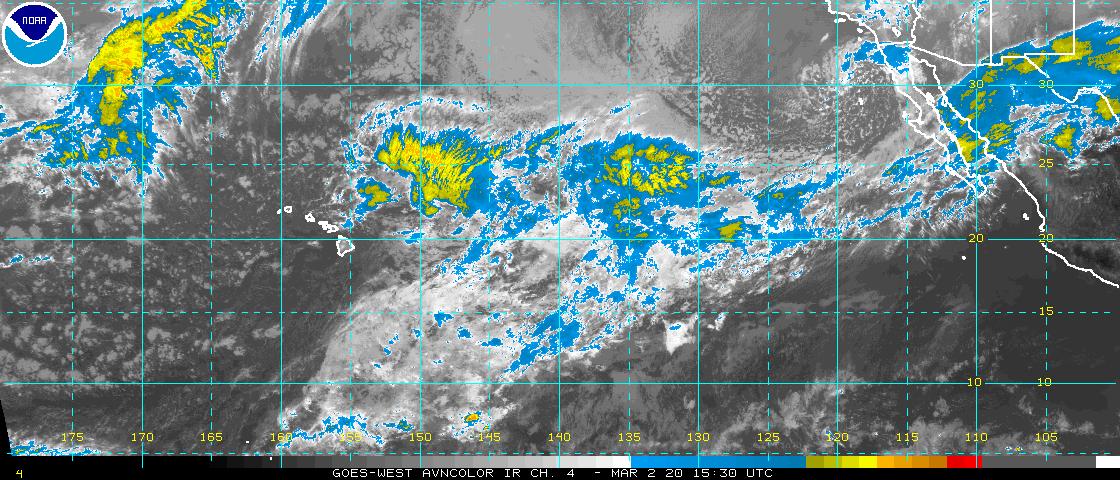
Satellite and Radar Images: To view the cloud conditions we have here in Hawaii, please use the following satellite links, starting off with this Infrared Satellite Image of the islands to see all the clouds around the state during the day and night. This next image is one that gives close images of the islands only during the daytime hours, and is referred to as a Close-up visible image. This next image shows a larger view of the Pacific…giving perspective to the wider ranging cloud patterns in the Pacific Ocean. Finally, here’s a Looping IR satellite image, making viewable the clouds around the islands 24 hours a day. To help you keep track of where any showers may be around the islands, here’s the latest animated radar image.
Hawaii’s Mountains – Here’s a link to the live webcam on the summit of near 14,000 foot Mauna Kea on the Big Island of Hawaii. The tallest peak on the island of Maui is the Haleakala Crater, which is near 10,000 feet in elevation. These two webcams are available during the daylight hours here in the islands…and when there’s a big moon rising just after sunset for an hour or two! Plus, during the nights and early mornings you will be able to see stars, and the sunrise too…depending upon weather conditions.
Tropical Cyclone activity in the eastern and central Pacific – Here’s the latest weather information coming out of the National Hurricane Center, covering the eastern north Pacific. You can find the latest tropical cyclone information for the central north Pacific (where Hawaii is located) by clicking on this link to the Central Pacific Hurricane Center. Here’s a tracking map covering both the eastern and central Pacific Ocean. A satellite image, which shows the entire ocean area between Hawaii and the Mexican coast…can be found here.
Aloha Paragraphs

Red lava and sunset…on the Big Island
We remain in a well established trade wind weather pattern, with moderately strong winds prevailing…becoming lighter next week. The trade winds are still strong enough to keep small craft wind advisories active across the southern channels, and the Maalaea Bay on Maui too. These trade winds will persist for the time being, although relax in strength once we get into the new work week ahead. The trade winds are expected to increase in strength again towards the end of next week.
The locally gusty trade winds will carry a few showers our way, although nothing serious is expected in terms of precipitation through the weekend. The trade winds will pick up showers at times from over the ocean to our east, carrying them towards the windward sides of the islands. The leeward sections will remain dry for the most part.
As we move into the upcoming new week, we’ll find one or two early season cold fronts trying to push southward, although they won’t reach our islands. They will come close enough though, that our trade wind producing ridge of high pressure will move south towards Hawaii. This in turn will soften our trade winds, and probably give us a few afternoon upcountry showers. Otherwise, there will be just those usual windward biased showers in the lighter trade wind flow at times.
I’m going to see a film this evening at the Maui Arts and Cultural Center, called The Girl from Monaco (2009). It looks like a good one, and this is what’s being written about it: set in the photogenic principality of Monaco, this uncommonly shrewd and funny farce about a famous defense lawyer, whose life is turned upside-down as a result of his infatuation with a stunning blonde beauty played by newcomer Louise Bourgoin-who is undeniably the most mouthwatering cinematic eye-candy from France since Catherine Deneuve first graced the silver screen-is a "pitch perfect treat for movie-goers who appreciate story, character and crisp dialogue" according to The Hollywood Reporter. I’ll let you know what I think about this film Saturday morning, when I return online. Here’s a trailer in case you are interested.
It’s early Friday evening here in Kihei, Maui, as I begin writing this last paragraph of today’s narrative. Looking out the window before I leave Kihei for the drive over to Kahului, to the Maui Arts and Cultural Center, I see generally clear skies outside. The trade winds are blowing briskly, but I know the air temperature is in the 80F’s. I have a plan to drive over to Hookipa Beach Park Saturday morning, to help out on a beach clean up…conducted by the Surfrider Foundation. Surfrider Maui has joined the coalition of Maui marine conservation
and community groups in support of the International Coastal Cleanup Day event, Get the Drift and Bag It, scheduled for 8 to 11 a.m. Saturday, September 19, 2009 at both Honolua Bay and Hookipa Beach Park. I’ll be back early Saturday morning with your next new weather narrative. I hope you have a great Friday night wherever you happen to be spending it! Aloha for now…Glenn.
Interesting: Earthquakes, volcanic eruptions, giant landslides and tsunamis may become more frequent as global warming changes the earth’s crust, scientists said recently. Climate-linked geological changes may also trigger "methane burps", the release of a potent greenhouse gas, currently stored in solid form under melting permafrost and the seabed, in quantities greater than all the carbon dioxide (CO2) in our air today.
"Climate change doesn’t just affect the atmosphere and the oceans but the earth’s crust as well. The whole earth is an interactive system," Professor Bill McGuire of University College London told Reuters, at the first major conference of scientists researching the changing climate’s effects on geological hazards.
"In the political community people are almost completely unaware of any geological aspects to climate change." The vulcanologists, seismologists, glaciologists, climatologists and landslide experts at the meeting have looked to the past to try to predict future changes, particularly to climate upheaval at the end of the last ice age, some 12,000 years ago.
"When the ice is lost, the earth’s crust bounces back up again and that triggers earthquakes, which trigger submarine landslides, which cause tsunamis," said McGuire, who organised the three-day conference. David Pyle of Oxford University said small changes in the mass of the earth’s surface seems to affect volcanic activity in general, not just in places where ice receded after a cold spell.
Weather patterns also seem to affect volcanic activity – not just the other way round, he told the conference. Behind him was a slide of a dazzlingly bright orange painting, "London sunset after Krakatau, 1883" – referring to a huge Asian volcanic eruption whose effects were seen and felt around the world.
Volcanoes can spew vast amounts of ash, sulphur, carbon dioxide and water into the upper atmosphere, reflecting sunlight and sometimes cooling the earth for a couple of years. But too many eruptions, too close together, may have the opposite effect and quicken global warming, said U.S. vulcanologist Peter Ward.
"Prior to man, the most abrupt climate change was initiated by volcanoes, but now man has taken over. Understanding why and how volcanoes did it will help man figure out what to do," he said. Speakers were careful to point out that many findings still amounted only to hypotheses, but said evidence appeared to be mounting that the world could be in for shocks on a vast scale.
Tony Song of NASA’s Jet Propulsion Laboratory in California warned of the vast power of recently discovered "glacial earthquakes" — in which glacial ice mass crashes downwards like an enormous landslide. In the West Antarctic, ice piled more than one mile (1.5 km) above sea level is being undermined in places by water seeping in underneath.
"Our experiments show that glacial earthquakes can generate far more powerful tsunamis than undersea earthquakes with similar magnitude," said Song. "Several high-latitude regions, such as Chile, New Zealand and Canadian Newfoundland are particularly at risk." He said ice sheets appeared to be disintegrating much more rapidly than thought and said glacial earthquake tsunamis were "low-probability but high-risk".
McGuire said the possible geological hazards were alarming enough, but just one small part of a scary picture if man-made CO2 emissions were not stabilised within around the next five years."Added to all the rest of the mayhem and chaos, these things would just be the icing on the cake," he said. "Things would be so bad that the odd tsunami or eruption won’t make much difference."
Interesting2: In the Fall of 2007, tens of thousands of small arctic geese called Pacific brant (Branta bernicla nigricans) decided not to go south for the winter. For these long-haul migratory birds, it was a dramatic choice — they usually spend the cold months munching their favorite eel grass in the waters off Mexico’s Baja peninsula.
But changes in Earth’s climate have so affected them that the barren windswept lagoons of western Alaska are looking more and more appealing. The trend is likely to continue, according to a new study, affecting not only brant but a host of migratory birds around the globe.
David Ward of the United States Geological Survey in Anchorage has been studying brant behavior for nearly three decades. When he began back in the 1970s, only around 4000 birds toughed out the winter in Izembek Lagoon, a 25-mile long stretch of protected water on the Alaska Peninsula.
Two autumns ago, the number had climbed to 40,000 — nearly 30 percent of the total population. "The birds normally wait for a storm system to come down through the Aleutians," Ward said. "They catch the tail winds down south. But the track of storm systems is a little different now."
Changing winds have been accompanied by warmer weather, which means less ice covering Izembek’s eel grass-rich waters. It’s a buffet for the brant, which can feast through the winter without having to make the arduous journey several thousand miles south and back.
Come spring they are the first birds back to the breeding grounds, and often the most successful at raising their young. In fact, conditions are so good that the geese run the risk of overpopulating, according to Robert Trost of the U.S. Fish and Wildlife Service in Portland, Ore.
The Pacific brant population hasn’t grown much in size over the years, but an increasing food supply could lead to an explosion of birds in the next few years. "Throughout North America and parts of Asia, geese are most influenced by springtime conditions," he said. As spring thaws creep earlier in the calendar, geese will be able to raise larger clutches of young.
The honeymoon isn’t likely to last. Brant and many other species that live on coastlines could soon see their habitats flooded by sea level rise and swallowed by rampant erosion, two consequences of human-induced global warming. "Right now it’s conjecture to say what the long-term impact will be, but the prognosis is not so good," Trost said.
Interesting3: In the late 1920s, people intentionally introduced birds known as Japanese white-eyes into Hawaiian agricultural lands and gardens for purposes of bug control. Now, that decision has come back to bite us. A recent increase in the numbers of white-eyes that live in old-growth forests is leaving native bird species with too little to eat, according to a report published online on September 17th in Current Biology, a Cell Press publication.
The findings show that introduced species can alter whole communities in significant ways and cause visible harm to the birds that manage to survive. "Native Hawaiian songbirds cannot rear normal-size offspring in the presence of large numbers of introduced Japanese white-eyes," said Leonard Freed of the University of Hawaii at Manoa.
"Their growth is stunted." "Just as there are permanent effects of stunted growth in human children, there are permanent effects in adult birds," added Rebecca Cann, also of the University of Hawaii at Manoa. "Birds cannot use their shorter bills to feed efficiently for themselves or when feeding their young.
Stunted birds have higher death rates than normal size birds. The Japanese white-eye is causing this problem for native Hawaiian birds by depleting the food available for growth, survival, and breeding." Undernourished birds are left more susceptible to other threats, including infectious diseases.
"Birds can only tolerate malaria if they have adequate nutrition to mount an immune response," Freed said. "They can only tolerate chewing lice if they have adequate nutrition to replace heat lost through plumage degraded by the lice." The threat posed by the white-eyes came as a surprise to the researchers.
That’s because over more than a decade of study, it had seemed as though the white-eyes were living in peaceful coexistence with other birds, including the endangered Hawaii akepa. But sometime after the year 2000, the researchers began to notice that young akepa were disappearing.
The akepa fledglings that were seen were noticeably underweight. Other native birds had many broken wing and tail feathers—a sign of malnutrition—and suffered from a major increase in chewing lice. The researchers sounded an alarm, alerting the US Fish and Wildlife Service of the problem, but nothing was done, and two-thirds of the akepa in their long-term study site had disappeared by 2006.
Although Hawaiian birds face many threats, such as malaria, yellow-jacket wasps, and parasitoid wasps escaped from biological control of insects, the researchers were able to show that the white-eyes are most likely responsible for the decline of 7 of 8 native forest birds in a major portion of a national wildlife refuge.
Young birds in a site with fewer white-eyes continued to grow normally, they found, despite potentially greater challenges from malaria and parasitoids. In other parts of Hawaii where white-eyes are flourishing, native species are suffering a similar fate. The white-eyes are yet another example of the threats that introduced species can pose.
When white-eyes were introduced, "no one at that time could have imagined that they would invade native forests," Cann said. "This is a problem with all introduced species. It is impossible to predict how they will respond to the new environment.
The white-eye is a member of a bird family famous for expanding its range and consuming new types of prey, even to the point that individuals that colonize a new habitat may vary among themselves in the prey items they consume. But that was not known in 1929." Even today, Freed said, foreign species continue to be put to work in risky ways.
"Right now, realtors are using alien catfish to clean up the algae-ridden swimming pools of abandoned foreclosed houses in Florida. What if some escape during a flood into streams and lakes?" The researchers include Leonard A. Freed, and Rebecca L. Cann, of the University of Hawaii at Manoa, Honolulu, Hawaii.
Interesting5: Poor Pluto. First it gets kicked out of the planet club, now it’s not even the coldest place in the solar system. Dark craters near the moon’s south pole have snatched that title – which is good news for the prospects of finding water ice on Earth’s companion. The craters’ towering rims block the sun from reaching their centers, like the long shadows cast by tall buildings at dusk.
In this permanent darkness, they stay at a constant -240 °Celsius – more than 30 °C above absolute zero and 10 °C cooler than Pluto, which was measured at -230 °C in 2006. "The lunar south pole is among the coldest parts of the solar system and may be in fact colder than what we expect from places like Pluto," NASA scientist Richard Vondrak said at a press conference on Thursday.
The cold temperature bodes well for the prospect of finding water ice deposits in the moon’s shadowy pockets. Previous calculations had shown that water and other volatile gases would dissipate into space at temperatures above about -220 °C. The measurements come from NASA’s Lunar Reconnaissance Orbiter (LRO), which launched in June.
The satellite’s temperature sensor, DIVINER, measures the amount of emitted and reflected radiation given off by the surface. LRO has a number of other instruments designed to map properties such as topography and neutron levels – another possible indicator of water.
In July, the satellite sent back pictures of the Apollo landing sites to commemorate the 40th anniversary of humans on the moon. On Thursday, LRO’s primary mission began to collect data that could be used to plan a possible return to the moon.
The temperature finding raises hopes that NASA’s other current lunar satellite mission, LCROSS, the Lunar Crater Observation and Sensing Satellite, will find evidence of water when it crashes into a crater near the moon’s south pole on 9 October.
 Email Glenn James: