September 17-18, 2009
Air Temperatures – The following maximum temperatures were recorded across the state of Hawaii Thursday afternoon:
Lihue, Kauai – 85
Honolulu, Oahu 90
Kaneohe, Oahu – 85
Kahului, Maui – 87
Hilo, Hawaii – 85
Kailua-kona – 86
Air Temperatures ranged between these warmest and coolest spots near sea level around the state – and on the highest mountains…at 5 p.m. Thursday evening:
Port Allen, Kauai – 88F
Kapalua, Maui – 79
Haleakala Crater – 57 (near 10,000 feet on Maui)
Mauna Kea summit – 63 (near 14,000 feet on the Big Island)
Precipitation Totals – The following numbers represent the largest precipitation totals (inches) during the last 24 hours on each of the major islands, as of Thursday afternoon:
0.07 Mount Waialeale, Kauai
0.50 Oahu Forest NWR, Oahu
0.11 Molokai
0.02 Lanai
0.02 Kahoolawe
0.53 Puu Kukui, Maui
0.24 Pahoa, Big Island
Marine Winds – Here’s the latest (automatically updated) weather map showing high pressure systems to the northeast, and far northwest. Ridges that are connecting these high pressure cells, to our north…will keep breezy trade winds blowing through Friday.
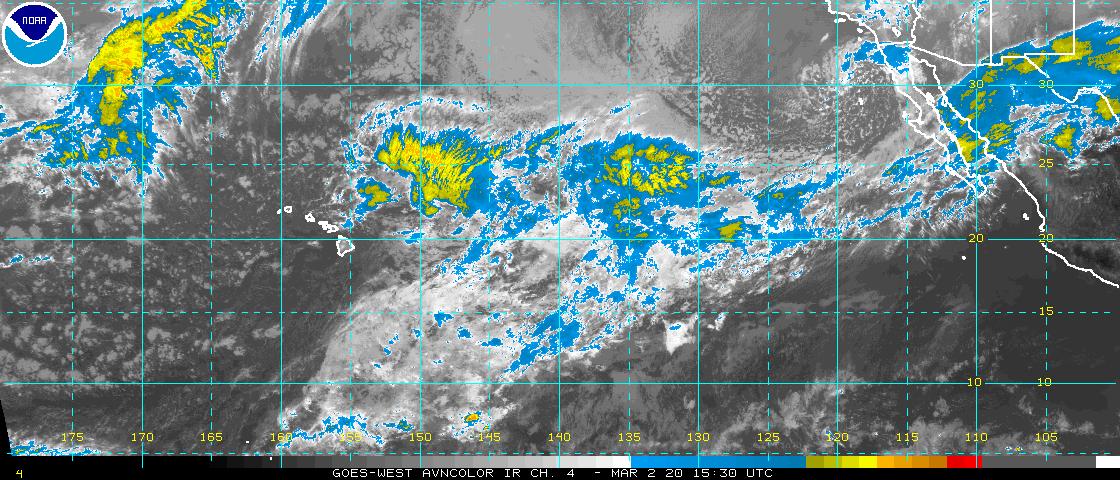
Satellite and Radar Images: To view the cloud conditions we have here in Hawaii, please use the following satellite links, starting off with this Infrared Satellite Image of the islands to see all the clouds around the state during the day and night. This next image is one that gives close images of the islands only during the daytime hours, and is referred to as a Close-up visible image. This next image shows a larger view of the Pacific…giving perspective to the wider ranging cloud patterns in the Pacific Ocean. Finally, here’s a Looping IR satellite image, making viewable the clouds around the islands 24 hours a day. To help you keep track of where any showers may be around the islands, here’s the latest animated radar image.
Hawaii’s Mountains – Here’s a link to the live webcam on the summit of near 14,000 foot Mauna Kea on the Big Island of Hawaii. The tallest peak on the island of Maui is the Haleakala Crater, which is near 10,000 feet in elevation. These two webcams are available during the daylight hours here in the islands…and when there’s a big moon rising just after sunset for an hour or two! Plus, during the nights and early mornings you will be able to see stars, and the sunrise too…depending upon weather conditions.
Tropical Cyclone activity in the eastern and central Pacific – Here’s the latest weather information coming out of the National Hurricane Center, covering the eastern north Pacific. You can find the latest tropical cyclone information for the central north Pacific (where Hawaii is located) by clicking on this link to the Central Pacific Hurricane Center. Here’s a tracking map covering both the eastern and central Pacific Ocean. A satellite image, which shows the entire ocean area between Hawaii and the Mexican coast…can be found here.
Aloha Paragraphs

Hawaiian Art…Rebecca Lowell
Moderately strong trade winds will prevail through the rest of the week, becoming locally stronger and gusty in those typically windier places going into Friday and Saturday. As the trade winds accelerate a bit more now, we see that small craft wind advisories are going up in the southern channels, and the Maalaea Bay on Maui too. These trade winds will persist for the time being, although mellow out once we get into the new work week ahead.
The computer forecast models continue to show early season cold fronts approaching the state next week. As these cold fronts approach our islands, they will weaken our local trade wind flow. The models are now suggesting that one of these fronts will actually push down into the islands. This wouldn’t be the most unusual thing to happen this time of year…but would buck climatology at least to some extent. We’ll have to keep an eye on this situation over the next several days.
Now that the trade winds are more active, it goes hand in hand to begin seeing some increase in windward showers…which has begun to happen already. The trade winds will pick up showers from over the ocean to our east, carrying them towards the windward sides of the islands. The leeward sections will remain dry for the most part, although could see a few showers here and there too. Our leeward beaches will be in pretty good shape, especially during the mornings…when the trade winds will be lightest as usual.
It’s early Thursday evening here in Kihei, Maui, as I begin writing this last paragraph of today’s narrative. The exceptionally clear weather that we saw during the first part of this work week, is now long gone. The trade winds have carried lots of moisture in our direction, with showers falling more regularly along the windward coasts and slopes. As this looping radar image shows, this certainly isn’t too exaggerated at this point. Most of the showers heading our way, at around 530pm Thursday evening…were taking aim on the east side of the Big Island.
~~~ Looking out the windows of my office here in Kihei, I see generally cloudy skies, with just little windows of blue here and there. The trade winds are blowing nicely, with many area’s of Maui County gusting up over 30 mph. The top gust was 35 mph at both Maalaea Bay, and also at Kahoolawe. I’m about ready to take the drive back upcountry now, and am looking forward to getting away from this computer screen, and out for my evening walk. I’ll be back here early Friday morning with your next new weather narrative. I hope you have a great Thursday night! Aloha for now…Glenn.
Extra: The Big Picture…Antarctica
Interesting: The chance that a person in cardiac arrest will survive increases when rescuers doing cardiopulmonary resuscitation (CPR) spend more time giving chest compressions, according to a multi-center study reported in Circulation: Journal of the American Heart Association. “Chest compressions move blood with oxygen to the heart and the brain to save the brain and prepare the heart to start up its own rhythm when a shock is delivered with a defibrillator,” said Jim Christenson, M.D., lead author of the study and clinical professor of emergency medicine at the University of British Columbia.
“We found that even short pauses in chest compressions were quite detrimental.” The proportion of time during CPR that rescuers spend giving chest compressions during each minute of CPR, called the chest compression fraction (CCF), is extremely variable.
Prior to 2005, interruptions to chest compressions resulted in less than 50 percent of total CPR time being spent on chest compressions.
However, the 2005 American Heart Association Guidelines for Cardiopulmonary Resuscitation and Emergency Cardiovascular Care emphasized the importance of minimizing interruptions in chest compressions. This resulted in some emergency medical services (EMS) agencies achieving a CCF between 60 percent and 85 percent, Christenson said.
Interesting2: Other vitamins and nutrients may get more headlines, but experts say as many as two billion people around the world have diets deficient in zinc – and studies at Oregon State University and elsewhere are raising concerns about the health implications this holds for infectious disease, immune function, DNA damage and cancer. One new study has found DNA damage in humans caused by only minor zinc deficiency. Zinc deficiency is quite common in the developing world.
Even in the United States, about 12 percent of the population is probably at risk for zinc deficiency, and perhaps as many as 40 percent of the elderly, due to inadequate dietary intake and less absorption of this essential nutrient, experts say. Many or most people have never been tested for zinc status, but existing tests are so poor it might not make much difference if they had been.
"Zinc deficiencies have been somewhat under the radar because we just don’t know that much about mechanisms that control its absorption, role, or even how to test for it in people with any accuracy," said Emily Ho, an associate professor with the Linus Pauling Institute at OSU, and international expert on the role of dietary zinc.
However, studies have shown that zinc is essential to protecting against oxidative stress and helping DNA repair – meaning that in the face of zinc deficiency, the body’s ability to repair genetic damage may be decreasing even as the amount of damage is going up.
Two studies recently published, in the Journal of Nutrition and the American Journal of Clinical Nutrition, found significant levels of DNA damage both with laboratory animals and in apparently healthy men who have low zinc intake.
Zinc depletion caused strands of their DNA to break, and increasing the intake of zinc reversed the damage back to normal levels. "In one clinical study with men, we were able to see increases in DNA damage from zinc deficiency even before existing tests, like decreased plasma zinc levels, could spot the zinc deficiency," Ho said.
"An inadequate level of zinc intake clearly has consequences for cellular health." Many zinc studies, Ho said, have focused on prostate cancer – the second leading cause of cancer deaths in American men – because the prostate gland has one of the highest concentrations of zinc in the body, for reasons that are not clearly known.
When prostate glands become cancerous, their level of zinc drops precipitously, and some studies have suggested that increasing zinc in the prostate may at least help prevent prostate cancer and could potentially be a therapeutic strategy.
There are concerns about the relationship of zinc intake to esophageal, breast, and head and neck cancers. And the reduced zinc status that occurs with aging may also contribute to a higher incidence of infection and autoimmune diseases, researchers said in one study in the Journal of Nutrition.
Interesting3: Countries can develop while curtailing climate change if they are ‘climate-smart’, the World Bank has said in a major new report. The world need not make a decision between growth and prosperity or preservation, it argues in the latest edition of the authoritative World Development Report, so long as it takes action immediately, works together, and transforms its energy systems.
The report, ‘Development and Climate Change’, was launched at the Overseas Development Institute in London, United Kingdom, this week (14 September). The authors say that climate change should not be seen as an insurmountable problem.
"We talk about a climate-smart world as opposed to a climate-resilient world because resilience is a fairly passive concept, it assumes that there’s a big bad threat out there that we need to protect ourselves against and there’s not much we can do to avoid that threat," said Marianne Fay, co-director of the report and incoming chief economist of the World Bank’s Sustainable Development Network, at the launch.
Countries can continue to develop by employing climate-smart policies that reduce vulnerability to climate change while pursuing low-carbon growth, says the report. "Climate change will affect the comparative advantage of a number of nations, particularly if those nations are first-movers.
Therefore there will be opportunities as well as costs," said Fay. "We will need to call on all the ingenuity and innovation that we are capable of," she added. Lord Anthony Giddens, professor emeritus at the London School of Economics said: "This is a huge intellectual task that we face, of thinking what kind of society will have to come into being… if we are to have a chance of containing climate change within reasonable limits".
"It’s not just a matter of on-the-ground facts, it’s also a matter of imagination… [the society] has to look different from the current one. We’re at the beginning of a long intellectual road." Creating new and distributing existing technologies is a major part of achieving a climate-smart world, says the report.
Investment in R&D needs to be drastically increased, from a total of US$53—73 billion per year to several hundreds of billions. Increasing public funding — from US$13 billion a year — will not be enough, they say. Incentives need to be created for both the public and private sectors to pursue innovative solutions.
"The energy sector invests 0.5 per cent of its revenue in R&D. That’s in contrast to innovative industries such as telecommunications which spend eight per cent and pharmaceutical sector which spend 15 per cent. Clearly the energy sector is not an innovative industry today." Developing countries are vital to this innovation process.
"You don’t just go and helicopter-drop a new technology into a country. You need that country to have developed the ability to have identified the technology they need, to adopt it and to implement it," Fay told SciDev.Net.
The report acknowledges that low-carbon technology transfer to developing countries has so far been modest. Technology transfer could be boosted, by including joint production and sharing agreements for technology in any new climate deal — thus ensuring developing countries are part of the innovation process.
Interesting4: Today the Obama Administration released a 1,200 page document of proposed regulation changes that will drastically alter the fuel economy and emissions standards that auto manufacturers are required to meet in the US. Although it could be an incredibly contentious topic, it seems that so far the proposal has gained wide support from all sides of the spectrum including environmental organizations and industry lobby groups.
The changes — which would alter both the Department of Transportation’s and the Environmental Protection Agency’s rules — call for what amounts to about a 5% increase in fuel economy standards per year from 2011 to 2016 starting with 27.3 mpg in 2011 and ending with 35.5 mpg in 2016.
In addition to the new economy standards, the White House has outlined the first ever greenhouse gas emissions limits for new cars sold in the US. Starting with model year 2016, each manufacturer’s new car fleet would have to meet an average limit of 250 grams of carbon emitted per mile driven.
The administration said that altogether the new rules would save the average car buyer $3,000 in fuel costs over the life of a vehicle, reduce emissions of carbon dioxide by about 950 million metric tons, and reduce the US’ dependence on foreign oil by about 1.8 billion barrels.
Environmental organizations quickly got in on dousing praise on the proposal. The Natural Resources Defense Council called the new rules "unprecedented" and the Sierra Club’s Ann Mesnikoff said "Taking fuel economy out of the 1970s and into the 21st century is a big step."
Interesting5: American producers are struggling to meet robust demand for organic foods despite dire predictions for the organic sector during the economic downturn. Some market researchers claim that consumers have increasingly turned to less expensive options that still tap into their ethical concerns, such as local, Fairtrade and free range.
But, in this latest review, the USDA said that the organic market has proved resilient, with "double-digit growth for well over a decade", and that organic consumers have become "increasingly main stream".
The USDA’s Agricultural Marketing Service said: "Organic products have shifted from being a lifestyle choice for a small share of consumers to being consumed at least occasionally by a majority of Americans."
And while concerns have been raised that consumers may not be prepared to pay steep premiums for organic foods, Economic Research Service (ERS) data has shown that consumers are buying organic foods at significantly higher prices than conventional.
The ERS said that the 2006 price for a half-gallon container of milk ranged from 60 percent above non-organic milk for private label organic milk, to 109 percent above non-organic for branded organic milk.
Barcs, Hungary 17 September 2009 — Croatia and Hungary signed today a declaration to establish a Trans-Boundary UNESCO Biosphere Reserve that will protect their shared biodiversity hotspot along the Mura, Drava and Danube Rivers.
This paves the way to create Europe’s largest river protection area. The ceremony in the presence of the Prime Ministers of Croatia and Hungary, Mrs Jadranka Kosor and Mr Gordon Bajnai, took place in the border city of Barcs, Hungary.
Given the global significance of this agreement, WWF has highlighted the leading role of the Governments of Croatia and Hungary with a "Leaders for a Living Planet" award, handed over by Lifeng Li, Director of WWF Global Freshwater Program.
"This cross border agreement to protect an area of great natural importance will foster regional cooperation, international understanding and peace keeping — 20 years after the fall of the ‘Iron Curtain’", said James P. Leape, Director General of WWF International. "It is not only a significant advance for the region but can serve as an example of how nature conservation visions can bring countries together".
Interesting6: Writing in The Lancet and the British Medical Journal, they urge doctors to "take a lead" on the climate issue. In a separate editorial, the journals say that people in poor tropical nations will suffer the worst impacts. They argue that curbing climate change would have other benefits such as more healthy diets and cleaner air.
December’s UN summit, to be held in Copenhagen, is due to agree a new global climate treaty to supplant the Kyoto Protocol. But preparatory talks have been plagued by lack of agreement on how much to cut greenhouse gas emissions and how to finance climate protection for the poorest countries.
 Email Glenn James: