September 15-16, 2009
Air Temperatures – The following maximum temperatures were recorded across the state of Hawaii Tuesday afternoon:
Lihue, Kauai – 84
Honolulu, Oahu – 89
Kaneohe, Oahu – 85
Kahului, Maui – 86
Hilo, Hawaii – 82
Kailua-kona – 87
Air Temperatures ranged between these warmest and coolest spots near sea level around the state – and on the highest mountains…at 5 p.m. Tuesday evening:
Port Allen, Kauai – 88F
Hilo, Hawaii – 79
Haleakala Crater – missing (near 10,000 feet on Maui)
Mauna Kea summit – 63 (near 14,000 feet on the Big Island)
Precipitation Totals – The following numbers represent the largest precipitation totals (inches) during the last 24 hours on each of the major islands, as of Tuesday afternoon:
0.03 Kapahi, Kauai
0.03 Kahuku training area, Oahu
0.00 Molokai
0.00 Lanai
0.00 Kahoolawe
0.00 Maui
0.02 Glenwood, Big Island
Marine Winds – Here’s the latest (automatically updated) weather map showing high pressure systems to the northeast, moving eastward. As this happens, our winds will be increasing in strength.
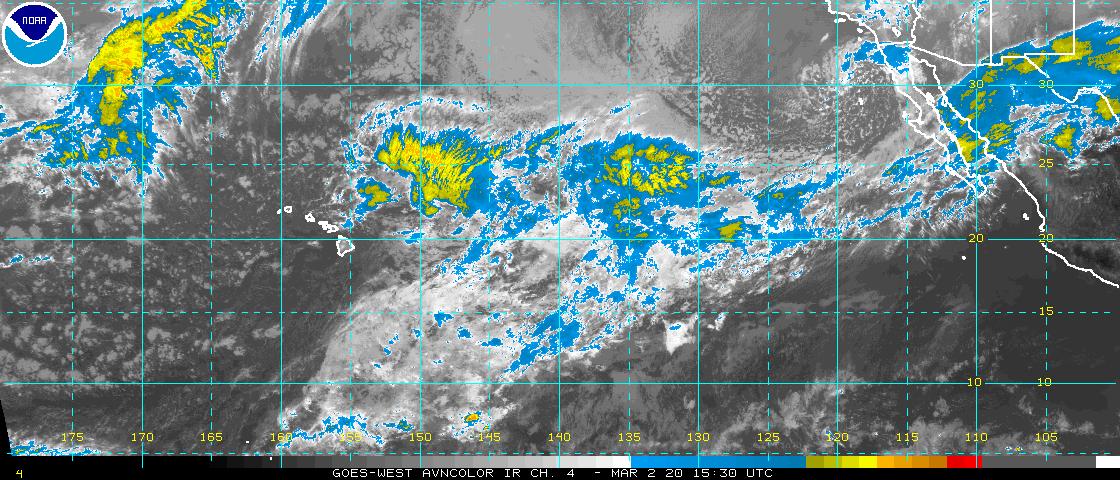
Satellite and Radar Images: To view the cloud conditions we have here in Hawaii, please use the following satellite links, starting off with this Infrared Satellite Image of the islands to see all the clouds around the state during the day and night. This next image is one that gives close images of the islands only during the daytime hours, and is referred to as a Close-up visible image. This next image shows a larger view of the Pacific…giving perspective to the wider ranging cloud patterns in the Pacific Ocean. Finally, here’s a Looping IR satellite image, making viewable the clouds around the islands 24 hours a day. To help you keep track of where any showers may be around the islands, here’s the latest animated radar image.
Hawaii’s Mountains – Here’s a link to the live webcam on the summit of near 14,000 foot Mauna Kea on the Big Island of Hawaii. The tallest peak on the island of Maui is the Haleakala Crater, which is near 10,000 feet in elevation. These two webcams are available during the daylight hours here in the islands…and when there’s a big moon rising just after sunset for an hour or two! Plus, during the nights and early mornings you will be able to see stars, and the sunrise too…depending upon weather conditions.
Tropical Cyclone activity in the eastern and central Pacific – Here’s the latest weather information coming out of the National Hurricane Center, covering the eastern north Pacific. You can find the latest tropical cyclone information for the central north Pacific (where Hawaii is located) by clicking on this link to the Central Pacific Hurricane Center. Here’s a tracking map covering both the eastern and central Pacific Ocean. A satellite image, which shows the entire ocean area between Hawaii and the Mexican coast…can be found here.
Aloha Paragraphs

Sea turtle basking…Big Island’s lava beaches
The trade winds began picking up Tuesday afternoon, returning a bit earlier than expected. These refreshing trade winds will continue blowing right into the weekend. It appears that the trade winds may break down again as we move into early next week…as a deep upper level trough of low pressure, with its associated cold front, dips southward towards the tropics.
Clouds and showers remain at an absolute minimum Tuesday evening, as our overlying atmosphere continues to be dry and stable. As the trade winds pick up going forward, we’ll begin to see a few showers carried towards the windward sides of the islands. The leeward sections will remain dry. This pleasant weather will carry forward right into the upcoming weekend.
It’s early Tuesday evening here in Kihei, Maui, as I begin writing this last paragraph of today’s narrative. As mentioned above, the trade winds came back a bit earlier than forecast, which is just fine. We saw winds gusting to 30 mph at a couple of places this afternoon, like Maalaea Bay here on Maui. At around 5pm, Port Allen on Kauai was having a 30 mph gust too, with 27 mph on Kahoolawe, 23 on Lanai, and 29 mph at Maalaea Bay. We should see the trade winds get an even tighter hold in our Hawaiian Island weather picture on Wednesday into Thursday.
~~~ Looking out the windows of my office here in Kihei at around 530pm, I see 95% clear skies in all directions! Our weather this week has just been fantastic, some of the best of the year perhaps. As the trade winds return, I don’t see any untoward changes on the horizon, although the windward sides may begin to see a few showers eventually. I’m about ready to take the drive back upcountry to Kula, and I can hardly wait to get out there on my evening walk. I’ll be back early Wednesday morning with your next new weather narrative from paradise, I hope you have a great Tuesday night! Aloha for now…Glenn.
Interesting: Italian authorities have found the wreck of a ship sunk by the mafia with 180 barrels of toxic waste on board, one of more than 30 such vessels believed to lie off Italy’s southern coast, officials said on Tuesday. Following a lead from a mafia turncoat, investigators used a remote-controlled submersible to film the 360-feet long vessel on Saturday, around 18 miles from the coast of the southwestern Italian region of Calabria.
The ship, which officials say may even contain radioactive elements, lay in 500 meters (yards) of water in the Tyrrhenian sea. TV images showed at least one barrel had fallen from its damaged hull and lay empty on the seabed. "There could be problems of toxins and heavy metals … this is an issue for the whole international community," said Silvestro Greco, head of Calabria’s environment agency.
The ship’s location was revealed by Francesco Fonti, an ex-member of Calabria’s feared ‘Ndrangheta crime group, who confessed to using explosives to sink this vessel and two others.
Greco said investigators believed there were 32 ships carrying toxic waste sunk by the mafia since the introduction of tighter environmental legislation in the 1980s made illegal waste disposal a lucrative business for crime groups.
"The Mediterranean is 0.7 percent of the world’s seas. If in this tiny portion there are more than 30 (toxic waste) shipwrecks, imagine what there could be elsewhere," he said.
Interesting2: Over 4 billion people in the world have cell phones. They’re handy, portable, inexpensive and we wonder how we even got along with out them before we had one. Cell phones are here to stay, there’s no doubt about that.
But there are mounting concerns about the adverse health affects from radiation emitted from your cell phone. Nothing has been proven, but considering that a cell phone operates by sending out radio waves made up of electromagnetic radiation, it’d be wise to be conscious and make smart choices.
All phones release radiation, but some release more than others, so one way to make smarter choices is to choose a phone that emits less. The Environmental Working Group has just provided a new online Cell Phone Radiation Guide providing the radiation levels for about 1,000 cell phones.
What’s your cell phone’s radiation level? Cell phones all have a Specific Absorption Rate (SAR), which is a way of measuring the amount of radio-frequency energy that is absorbed by the human body.
As of 1996, this exposure limit was set by the FCC, and no phone can have a SAR level greater than 1.6 watts per kilogram (W/kg). As of 2000, the Cellular Telecommunications & Internet Association (CTIA) mandated that all cell phone manufacturers disclose radiation levels to consumers by placing a label on the phone.
We have never seen a SAR rating disclosed for cell phones, so if the rating is listed, the manufacturers are certainly not advertising that information.
Interesting3: The composition of some of our nation’s forests may be quite different 200 to 400 years from today according to a recent study at the University of Illinois. The study found that temperature and photosynthetic active radiation were the two most important variables in predicting what forest landscapes may look like in the future.
The uncertainties became very high after the year 2200. Approximately 100,000 acres of forested area west of Lake Superior which make up the Boundary Waters Canoe Area was used for the study.
Using computer models PnET-II and LANDIS-II, the researchers were able to simulate 209 possible scenarios, including 13 tree species and 27 possible climate profiles to predict how the landscape will look over time.
"The tools that we developed and we’re using for the research project can be applied to any discipline dealing with risk and uncertainty in decision making," said U of I researcher George Gertner.
"We were dealing with the uncertainties in global change predictions using the projections established by the United Nations Intergovernmental Panel of Climate Change.
These projections were based on different CO2 reduction scenarios and global circulation models. "The study found that the most important source of uncertainty in the forest composition prediction is from the uncertainty in temperature predictions.
The second most important source is photosynthetic active radiation, the third is carbon dioxide, and the fourth is precipitation. "The Boundary Waters Area is significant because it’s a transitional area between boreal forests – like those in Canada, Russia, Sweden, and Norway – and temporal forests," Gertner said.
"So, if there are changes in the climate you’ll see the changes – if it gets warmer, the temporal forests will move north. Because of its proximity to Lake Superior, rainfall is not so critical there. It’s very moist.
So, if you were to do a similar sort of study, say, in Illinois, temperature may not cause so much uncertainty; rainfall might." The research was done by a team consisting of George Gertner, a statistician and quantitative ecologist; Chonggang Xu, his Ph.D. student; and Robert Scheller, a landscape ecologist at the Conservation Biology Institute in Corvallis, Oregon.
They drew from the disciplines of statistics and ecology to interpret the data collected to predict the future of the forest landscape. "You have to have an understanding of the biology, physiology, as well as statistics as it relates to uncertainty.
If you don’t, then the results might not mean anything. You have to be able to interpret everything and make sure it all makes sense." Gertner explained that in traditional uncertainty analysis, the variables are considered to be independent of one another.
"But in reality, they are all interrelated. We try to account for the actual correlation of these inputs – these relationships. And that’s where the methodology is new, because of that." The relationships of the variables are more complicated than just raising the temperature and lowering the amount of rainfall.
"One scenario might be if we establish a policy to reduce CO 2 greenhouse gas emissions by a certain level," Gertner said. "If we have agencies around the world who adopt these policies to make these reductions, over time the scenarios predict what will happen, but with uncertainty."
The question is what to do about it? How to adapt? How to manage the forest for global change? "The bottom line is that we have to have very robust systems that can handle this variability. It can’t be rigid. If we have robust systems, whatever happens, it can handle it. Sustainability comes into play in the robustness. You try to manage those areas by having more diversity, not monocultures."
Interesting4: UK scientists have warned that UN negotiations aimed at tackling climate change are based on substantial underestimates of what it will cost to adapt to its impacts. The real costs of adaptation to climate change are likely to be two-to-three times greater than estimates made by the UN Framework Convention on Climate Change (UNFCCC), the researchers say.
In a study published by the International Institute for Environment and Development and the Grantham Institute for Climate Change, they add that costs will be even more when the full range of climate impacts on human activities is considered.
The UNFCCC has estimated annual global costs of adapting to climate change to be $40–170 billion, or the cost of about three Olympic Games per year. But the report’s authors – including Dr Pam Berry from the Environmental Change Institute at Oxford University – say that these estimates were produced too quickly and did not include key sectors such as energy, manufacturing, retailing, mining, tourism and ecosystems.
Dr Berry led the work on estimating the costs of protecting ecosystems and the services they can provide for human society, which were excluded from the UNFCCC estimates. She found that this is an important source of under-estimation, and will cost over $350 billion, including both protected and non-protected areas.
‘The costs of adaptation for ecosystems are potentially huge, the largest of any sector,’ says Dr Berry. ‘This is not only because of the projected future losses of species, but also because of the immense value of ecosystems for human health and well-being through the provision of food, fuel and fiber.
The worrying feature is that our report has identified how little is known about this, the biggest elephant in the room. Even worse, uncertainty is leading to its omission from the overall figures, which will compound the underestimate.’
Interesting5: Research conducted at Texas A&M University casts doubts on the notion that El Niño has been getting stronger because of global warming and raises interesting questions about the relationship between El Niño and a severe flu pandemic 91 years ago. The findings are based on analysis of the 1918 El Niño, which the new research shows to be one of the strongest of the 20th century. El Niño occurs when unusually warm surface waters form over vast stretches of the eastern Pacific Ocean and can affect weather systems worldwide.
Using advanced computer models, Benjamin Giese, a professor of oceanography who specializes in ocean modeling, and his co-authors conducted a simulation of the global oceans for the first half of the 20th century and they find that, in contrast with prior descriptions, the 1918-19 El Niño was one of the strongest of the century.
Giese’s work will be published in the current Bulletin of the American Meteorological Society, and the research project was funded by NOAA (National Oceanic and Atmospheric Administration) and the National Science Foundation.
Giese says there were few measurements of the tropical Pacific Ocean in 1918, the last year of World War I, and the few observations that are available from 1918 are mostly along the coast of South America. "But the model results show that the El Niño of 1918 was stronger in the central Pacific, with a weaker signature near the coast," Giese explains.
"Thus the limited measurements likely missed detecting the 1918 El Niño." Giese adds, "The most commonly used indicator of El Niño is the ocean temperature anomaly in the central Pacific Ocean. By that standard, the 1918-19 El Niño is as strong as the events in 1982-83 and 1997-98, considered to be two of the strongest events on record, causing some researchers to conclude that El Niño has been getting stronger because of global warming.
Since the 1918-19 El Niño occurred before significant warming from greenhouse gasses, it makes it difficult to argue that El Niño s have been getting stronger." The El Niño of 1918 coincided with one of the worst droughts in India, he adds.
"It is well known that there is a connection between El Niño and the failure of the Indian monsoon, just as there is a well-established connection between El Niño and Atlantic hurricane intensity," Giese says.
In addition to drought in India and Australia, 1918 was also a year in which there were few Atlantic hurricanes. The research also raises questions about El Niño and mortality from the influenza pandemic of 1918.
By mid-1918, a flu outbreak – which we now know was the H1N1 strain that is of great concern today – was sweeping the world, and the resulting fatalities were catastrophic: At least 25 million people died worldwide, with some estimates as high as 100 million deaths. India was particularly hard hit by the influenza.
"We know that there is a connection between El Niño and drought in India," Giese notes. "It seems probable that mortality from influenza was high in India because of famine associated with drought, so it is likely that El Niño contributed to the high mortality from influenza in India."
The flu epidemic of 1918, commonly called the "Spanish Flu," is believed to be the greatest medical holocaust in history. It lasted from March of 1918 to June of 1920, and about 500 million people worldwide became infected, with the disease killing between 25 million to 100 million, most of them young adults.
An estimated 17 million died in India, between 500,000 to 675,000 died in the U.S. and another 400,000 died in Japan. Could the events of 1918 be a harbinger of what might occur in 2009? Giese says there are some interesting parallels.
The winter and spring in 1918 were unusually cold throughout North America, just at the time influenza started to spread in the central U.S. That was followed by a strengthening El Niño and subsequent drought in India. As the El Niño matured in the fall of 1918, the influenza became a pandemic.
With a moderate to strong El Niño now forming in the Pacific and the H1N1 flu strain apparently making a vigorous comeback, the concerns today are obvious, Giese adds.
Interesting6: Air quality has improved to "good" and "moderate" levels in Los Angeles County after clouds of smoke from the nearly three-week Station fire prompted health officials to caution residents and warn against strenuous outdoor activities. The South Coast Air Quality Management District has not issued a smoke advisory since Thursday and has since reported that most unhealthy air in the Los Angeles Basin is not attributed to the fire, said spokesman Sam Atwood.
"There is a small possibility where there could be some unhealthy air quality in areas that are directly impacted by smoke, but we just haven’t seen that occurring in the San Gabriel or San Fernando valleys the last couple of days," Atwood said. He said that air quality levels, particularly in some of the foothill areas, had reached hazardous levels at the outset of the blaze.
"I think we’re essentially back to the normal air quality situation for this time of year," he said. An AQMD map forecasting today’s air quality in Los Angeles and surrounding counties shows mostly green and yellow, correlating to "good" and "moderate" levels.
Nonetheless, Los Angeles County’s top public health official warned that air quality in the immediate vicinity of the Station fire could still be dangerous.
"In any area of visible smoke or where there is an odor of smoke, all individuals are urged to be cautious and to avoid unnecessary outdoor activities," said Jonathan E. Fielding of the Department of Public Health.
The Station fire, which began late last month, has burned more than 160,500 acres and is 87% contained, fire officials said. Crews are mostly working on its eastern edge in the San Gabriel Wilderness, and full containment is expected Saturday.
Interesting7: Sea levels rose as much as 2 feet higher than predicted this summer along the U.S. East Coast, surprising scientists who forecast such periodic fluctuations. The immediate cause of the unexpected rise has now been solved, U.S. officials say in a new report (hint: it wasn’t global warming). But the underlying reason remains a mystery.
A new report from NOAA has identified the two major factors behind the high sea levels—a weakened Gulf Stream and steady winds from the northeastern Atlantic. The Gulf Stream is a northward-flowing superhighway of ocean water off the U.S. East Coast.
Running at full steam, the powerful current pulls water into its "orbit" and away from the East Coast. But this summer, for reasons unknown, "the Gulf Stream slowed down," Edwing said, sending water toward the coasts—and sea levels shooting upward. Adding to the sustained surge, autumn winds from the northeastern Atlantic arrived a few months early, pushing even more water coastward.
 Email Glenn James: