August 5-6, 2009
Air Temperatures – The following maximum temperatures were recorded across the state of Hawaii Wednesday afternoon:
Lihue, Kauai – 82
Honolulu, Oahu – 88
Kaneohe, Oahu – 84
Kahului, Maui – 87
Hilo, Hawaii – 83
Kailua-kona – 87
Air Temperatures ranged between these warmest and coolest spots near sea level – and on the highest mountains…at 5 p.m. Wednesday evening:
Barking Sands, Kauai – 87F
Hilo, Hawaii- 77
Haleakala Crater – 57 (near 10,000 feet on Maui)
Mauna Kea summit – 61 (near 14,000 feet on the Big Island)
Precipitation Totals – The following numbers represent the largest precipitation totals (inches) during the last 24 hours on each of the major islands, as of Wednesday afternoon:
0.80 Mount Waialaele, Kauai
0.12 Manoa Valley, Oahu
0.03 Molokai
0.00 Lanai
0.00 Kahoolawe
0.25 Puu Kukui, Maui
0.51 Glenwood, Big Island
Marine Winds – Here’s the latest (automatically updated) weather map showing a 1029 millibar high pressure system to the north-northeast of the islands. This high pressure cell, along with its associated ridge to our north, will keep the trade winds blowing through Friday.
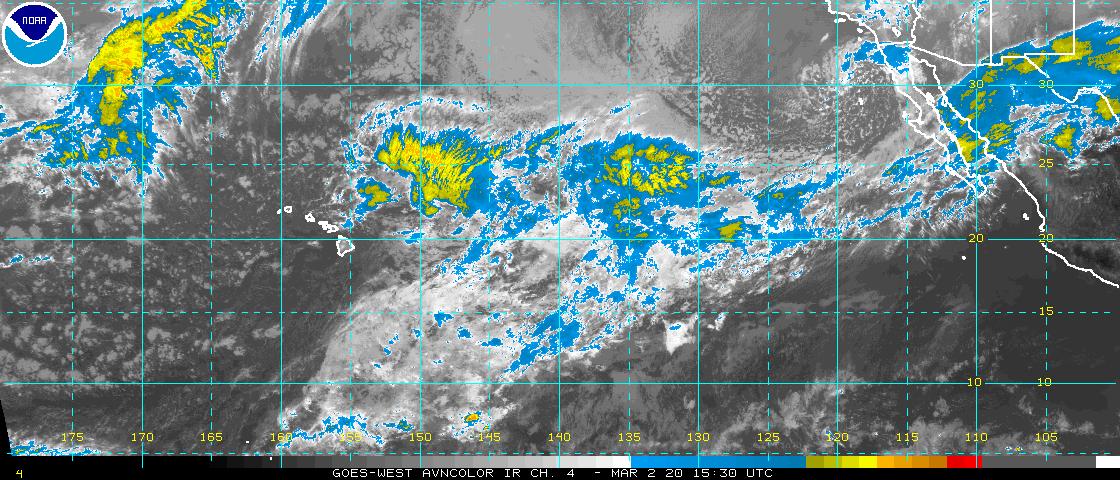
Satellite and Radar Images: To view the cloud conditions we have here in Hawaii, please use the following satellite links, starting off with this Infrared Satellite Image of the islands to see all the clouds around the state during the day and night. This next image is one that gives close images of the islands only during the daytime hours, and is referred to as a Close-up visible image. This next image shows a larger view of the Pacific…giving perspective to the wider ranging cloud patterns in the Pacific Ocean. Finally, here’s a Looping IR satellite image, making viewable the clouds around the islands 24 hours a day. To help you keep track of where any showers may be around the islands, here’s the latest animated radar image.
Hawaii’s Mountains – Here’s a link to the live webcam on the summit of near 14,000 foot Mauna Kea on the Big Island of Hawaii. The tallest peak on the island of Maui is the Haleakala Crater, which is near 10,000 feet in elevation. These two webcams are available during the daylight hours here in the islands…and when there’s a big moon rising just after sunset for an hour or two! Plus, during the nights and early mornings you will be able to see stars, and the sunrise too…depending upon weather conditions.
Tropical Cyclone activity in the eastern and central Pacific – Here’s the latest weather information coming out of the National Hurricane Center, covering the eastern north Pacific. You can find the latest tropical cyclone information for the central north Pacific (where Hawaii is located) by clicking on this link to the Central Pacific Hurricane Center. Here’s a tracking map covering both the eastern and central Pacific Ocean. A satellite image, which shows the entire ocean area between Hawaii and the Mexican coast…can be found here.
Aloha Paragraphs

Hurricane Felicia approaches from the east
The trade winds will continue to blow across our Hawaiian Islands, remaining blustery through the next couple of days. A 1029 millibar high pressure system to the north-northeast of Hawaii has moved southwest towards our islands a bit…thus the increase in our local trade wind speeds. This trade wind producing high pressure cell is shown on this weather map. The small craft wind advisory remains active Wednesday evening, and has been increased in coverage to include the channel between Kauai and Oahu, then down through Maui County…to the Big Island.
Showers, being carried our way on the gusty trade winds…will fall generally along our windward sides. The leeward beaches will remain mostly dry. This should allow abundant sunshine to be available along our south and west facing shores. There’s a slight chance of finding increased showers along the windward sides as we move into Friday and the weekend. If tropical cyclone Felicia pushes into the state of Hawaii early next week…we could see very rainy weather arrive.
Hurricane Felicia and tropical storm Enrique continue to churn the waters of the eastern Pacific Ocean Wednesday evening. Enrique will be dissipating quickly over the next day or so. The main event will be the threat from major hurricane Felicia…as it moves into our central Pacific Friday night or Saturday morning. Here’s a tracking map, showing hurricane Felicia heading towards the Aloha state. Here’s a satellite image showing Felicia (east-southeast of Hawaii), and tropical storm Enrique, in relation to the
Hurricane Felicia remains strong enough Wednesday night to qualify as a Major Hurricane. This means that sustained winds around the center are blowing at 120 knots, or 138 mph…with gusts to 145 knots…or 167 mph. The hurricane shouldn’t attain any further strength, and gradually begin to weaken throughout the rest of its life cycle. Nonetheless, it’s forecast to still be a tropical storm as it nears our Hawaiian Islands. It’s still too early to know exactly what shape the storm will be in early next week, and may arrive as an even less imposing tropical depression.
Projecting the forecast track into the state, perhaps as a weakening tropical storm, or an even weaker tropical depression…we could see several influences. The first thing we would find would be rising surf along our east facing shores, perhaps as early as later Saturday into Sunday…which could be large and dangerous. Depending upon the strength of the storm at its entry into the state, if it doesn’t veer off in some other direction, we could see breezy to blustery weather…again depending upon the storm’s strength then. If the storm where to head up to our north, it would knock off our trade winds, and our winds could become very light. Finally, if the system were to come in right over the state, we would see increasing clouds, and potentially heavy flooding rainfall early next week.
It’s Wednesday evening here in Kihei, Maui, as I begin writing this last part of today’s narrative. No doubt about it, we have a very strong hurricane moving in the direction of the Hawaiian Islands. Despite that fact, we continue to expect significant weakening of this tropical cyclone, as it nears the Aloha state. Perhaps the biggest threat now would be for potentially heavy rainfall. I’m personally less worried about the associated winds, than I am about the chance of flooding precipitation. We still have many days to work out the details, and we will likely have to make many more fine adjustments to the track and strength before Felicia finally makes contact with our islands.
As the NWS forecast office in Honolulu is saying on their website today: "At this time, it is too early to determine the exact track and intensity Felicia will be as it approaches the Hawaiian islands late Sunday or Monday. That said, we are heading into the climatological peak of the central Pacific hurricane season, and Felicia serves as a reminder to always have a hurricane preparedness plan in place during the official central north Pacific hurricane season, which continues through November 30."
~~~ I’ll be back again early Thursday morning with your next new weather narrative from paradise. We will continue to see fine weather, despite the locally windy trade winds, which are pretty usual for this time of year. We have many more days to fine tune exactly what will be happening with the hurricane, although it would be wise to keep an eye on the progress of this tropical cyclone as it moves in our direction. Don’t forget to check out the full moon tonight! Aloha for now…Glenn.
Dedicated to all you cat lovers…of which I’m one – lovely!
Interesting: There is mounting evidence that omega-3 fatty acids from fish or fish oil supplements not only help prevent cardiovascular diseases in healthy individuals, but also reduce the incidence of cardiac events and mortality in patients with existing heart disease. A new study, published in the August 11, 2009, issue of the Journal of the American College of Cardiology, extensively reviews data from a broad range of studies in tens of thousands of patients and sets forth suggested daily targets for omega-3 consumption.
"This isn’t just hype; we now have tremendous and compelling evidence from very large studies, some dating back 20 and 30 years, that demonstrate the protective benefits of omega-3 fish oil in multiple aspects of preventive cardiology," said Carl Lavie, M.D., F.A.C.C., medical director of Cardiac Rehabilitation and Prevention, Ochsner Medical Center, New Orleans, LA, and lead author of the article.
"The strongest evidence of a cardio-protective effect of omega-3s appears in patients with established cardiovascular disease and following a heart attack with up to a 30 percent reduction in CV-related death."
Dietary intake of fish oil can also decrease the risk of atherosclerosis, arrhythmias, heart attack, sudden cardiac death and even health failure.
Dr. Lavie adds that although there is a smaller benefit in reducing heart failure death—9 percent mortality benefit in a major recent randomized controlled trial—this is still very impressive given patients’ grave prognosis.
"If we translate this finding, it means that we only need to treat 56 patients for four years to prevent one death," he said. "And we are talking about a very safe and relatively inexpensive therapy."
Interesting2: Geckos are very adept at climbing through difficult terrain using an intricate adhesive system. Until now it has not been known when and how they switch on their unique system of traction. Scientists at the University of Calgary and Clemson University in South Carolina have discovered that the geckos’ amazing grip is triggered by gravity.
"Geckos use microscopic, hair-like filaments to attach to surfaces. Only at certain angles do they switch on their traction system, however," says Russell, a biological sciences professor at the U of C. "We are trying to understand this process, which will help in mimicking it for application to robotics."
Geckos have long been known for their remarkable abilities to move on smooth surfaces such as glass. This study adds a new angle to previous research: geckos must be on an incline in order to trigger the deployment of their adhesive system.
"Much has been learned in recent years about the mechanism by which clinging takes place, but little is known about how geckos determine when to use this ability," says Higham, a former U of C student and now an assistant professor of biological sciences at Clemson.
"We show that perception of body orientation determines when the adhesive system is switched on." The scientists discovered that the tipping point which turns on the gecko’s adhesive system is 10 degrees.
Three of the six geckos studied applied their adhesive system on a 10 degree slope. At 30 degrees all six applied the system. The three that applied the traction at 10 degrees slowed down, the three that didn’t were much quicker.
"There are costs, in terms of speed, and benefits, in terms of traction, associated with this switch just as there are for Formula 1 cars when rain tires are employed instead of slicks when circumstances place a premium on grip over outright speed," says Russell. In the case of the geckos, the intricate way that the toes are used in order to achieve the grip necessary to climb is responsible for slowing them.
Interesting3: Researchers the world over are striving to develop organic solar cells that can be produced easily and inexpensively as thin films that could be widely used to generate electricity. But a major obstacle is coaxing these carbon-based materials to reliably form the proper structure at the nano-scale (tinier than 2-millionths of an inch) to be highly efficient in converting light to electricity.
The goal is to develop cells made from low-cost plastics that will transform at least 10 percent of the sunlight that they absorb into usable electricity and can be easily manufactured. A research team headed by David Ginger, a University of Washington associate professor of chemistry, has found a way to make images of tiny bubbles and channels, roughly 10,000 times smaller than a human hair, inside plastic solar cells.
These bubbles and channels form within the polymers as they are being created in a baking process, called annealing, that is used to improve the materials’ performance.
The researchers are able to measure directly how much current each tiny bubble and channel carries, thus developing an understanding of exactly how a solar cell converts light into electricity. Ginger believes that will lead to a better understanding of which materials created under which conditions are most likely to meet the 10 percent efficiency goal.
Interesting4: Automobile owners around the world may some day soon be driving on tires that are partly made out of trees – which could cost less, perform better and save on fuel and energy. Wood science researchers at Oregon State University have made some surprising findings about the potential of microcrystalline cellulose – a product that can be made easily from almost any type of plant fibers – to partially replace silica as a reinforcing filler in the manufacture of rubber tires.
A new study suggests that this approach might decrease the energy required to produce the tire, reduce costs, and better resist heat buildup. Early tests indicate that such products would have comparable traction on cold or wet pavement, be just as strong, and provide even higher fuel efficiency than traditional tires in hot weather.
"We were surprised at how favorable the results were for the use of this material," said Kaichang Li, an associate professor of wood science and engineering in the OSU College of Forestry, who conducted this research with graduate student Wen Bai.
"This could lead to a new generation of automotive tire technology, one of the first fundamental changes to come around in a long time," Li said. Cellulose fiber has been used for some time as reinforcement in some types of rubber and automotive products, such as belts, hoses and insulation – but never in tires, where the preferred fillers are carbon black and silica.
Carbon black, however, is made from increasingly expensive oil, and the processing of silica is energy-intensive. Both products are very dense and reduce the fuel efficiency of automobiles.
Interestin5: Deforestation in Brazil’s Amazon rainforest in June was four times more devastating than the month before, further depleting what is seen as one of the biggest buffers against global warming, official data revealed Tuesday. Satellite imagery analyzed by Brazil’s National Institute for Space Research showed 578 square kilometers (223 square miles) of Amazon woodland was burned or cut down.
That was more than four times the devastation recorded in May, and roughly equivalent to the size of Switzerland’s Lake Geneva, or half the area of California’s biggest city of Los Angeles. Most of the destruction was concentrated in the Brazilian states of Para and Mato Grosso. Ranchers and farmers regularly encroach on the vast zone.
Interesting6: The U.S. Department of Agriculture has proposed a labeling system to identify products made with renewable plant, animal and other bio-based materials. The Bio-preferred labeling proposal is an outgrowth of the federal government’s Bio-preferred purchasing program, which was created in the 2002 Farm Bill.
The 2008 Farm Bill expanded the program to also promote the sale of bio-based products outside of the government. The proposal would set up a system in which companies could voluntarily apply the Bio-preferred label to their products. The USDA has already identified more than 15,000 bio-based products in about 200 categories.
 Email Glenn James: