August 3-4, 2009
Air Temperatures – The following maximum temperatures were recorded across the state of Hawaii Monday afternoon:
Lihue, Kauai – 83
Honolulu, Oahu – 89
Kaneohe, Oahu – 84
Kahului, Maui – 86
Hilo, Hawaii – 85
Kailua-kona – 88
Air Temperatures ranged between these warmest and coolest spots near sea level – and on the highest mountains…at 5 p.m. Monday evening:
Port Allen, Kauai – 86F
Hilo, Hawaii- 80
Haleakala Crater – 59 (near 10,000 feet on Maui)
Mauna Kea summit – 57 (near 14,000 feet on the Big Island)
Precipitation Totals – The following numbers represent the largest precipitation totals (inches) during the last 24 hours on each of the major islands, as of Monday afternoon:
0.36 Mount Waialaele, Kauai
0.02 Oahu Forest NWR, Oahu
0.00 Molokai
0.00 Lanai
0.00 Kahoolawe
0.06 West Wailuaiki, Maui
0.29 Mountain View, Big Island
Marine Winds – Here’s the latest (automatically updated) weather map showing a 1028 millibar high pressure system to the northeast of the islands. This high pressure cell, along with its associated ridge to our north, will keep the trade winds blowing through Wednesday.
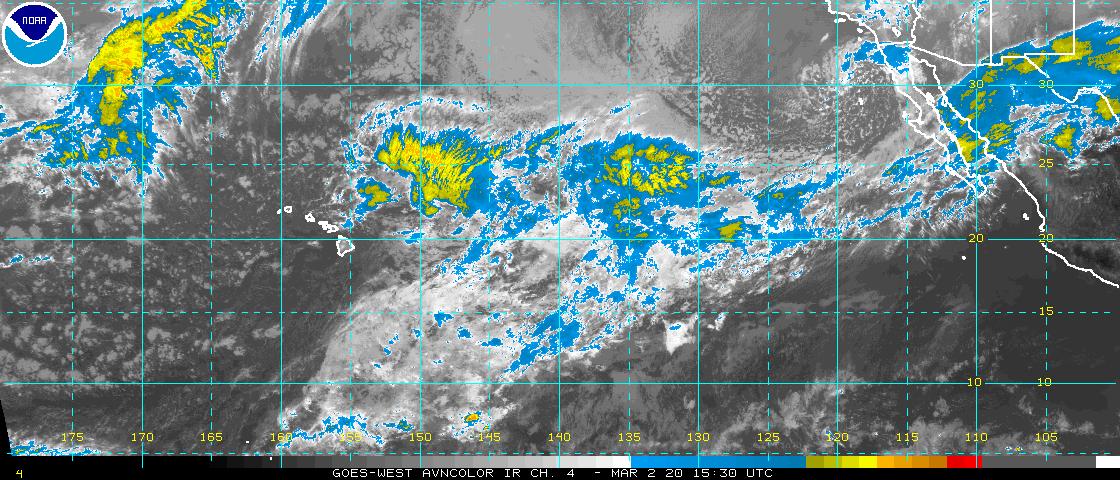
Satellite and Radar Images: To view the cloud conditions we have here in Hawaii, please use the following satellite links, starting off with this Infrared Satellite Image of the islands to see all the clouds around the state during the day and night. This next image is one that gives close images of the islands only during the daytime hours, and is referred to as a Close-up visible image. This next image shows a larger view of the Pacific…giving perspective to the wider ranging cloud patterns in the Pacific Ocean. Finally, here’s a Looping IR satellite image, making viewable the clouds around the islands 24 hours a day. To help you keep track of where any showers may be around the islands, here’s the latest animated radar image.
Hawaii’s Mountains – Here’s a link to the live webcam on the summit of near 14,000 foot Mauna Kea on the Big Island of Hawaii. The tallest peak on the island of Maui is the Haleakala Crater, which is near 10,000 feet in elevation. These two webcams are available during the daylight hours here in the islands…and when there’s a big moon rising just after sunset for an hour or two! Plus, during the nights and early mornings you will be able to see stars, and the sunrise too…depending upon weather conditions.
Tropical Cyclone activity in the eastern and central Pacific – Here’s the latest weather information coming out of the National Hurricane Center, covering the eastern north Pacific. You can find the latest tropical cyclone information for the central north Pacific (where Hawaii is located) by clicking on this link to the Central Pacific Hurricane Center. Here’s a tracking map covering both the eastern and central Pacific Ocean. A satellite image, which shows the entire ocean area between Hawaii and the Mexican coast…can be found here.
Aloha Paragraphs

Hamoa Beach, east Maui
The trade winds will continue to blow across our Hawaiian Islands…with no end in sight. The small craft wind advisory is active Monday evening across only those windiest areas around Maui County, and the Big Island. We find that the high surf advisory along our south facing leeward beaches was dropped Monday afternoon. A 1028 millibar high pressure system to the north-northeast, is the source of our trade winds.
Showers will be limited by a low trade wind inversion, with what few showers that do manage to fall…will arrive along our windward sides. The leeward beaches will remain generally dry, if not totally dry. This should allow lots of sunshine to beam down, especially along our leeward sides. Air temperatures will be warm to very warm at sea level.
Two new tropical cyclones have formed in the eastern Pacific Monday, neither of which are a threat to the Hawaiian Islands at the moment. We may need to keep an eye on these storms as they enter our central Pacific later on. Here’s a tracking map, showing these two tropical systems…along with now retired Lana to our southwest. Here’s a satellite image showing these tropical cyclones in relation to the Hawaiian Islands.
It’s Monday evening here in Kihei, Maui, as I begin writing this last part of this evening’s narrative. As mentioned in the paragraph above, we’ve lost former tropical cyclone Lana here in the central Pacific, but gained two new storms in the eastern Pacific. These storms will be named Enrique, and Felicia, and will become our focus through the next week…as they track more or less in our direction. I’ll have more to say about these two systems each day going forward. ~~~ Back to the present, we have great weather here in the islands now! Our air mass is dry and stable, and the trade winds are blowing, weather conditions that are absolutely normal for this time of year. I see no reason to believe that we’ll see great weather prevailing through the rest of this week, at least the work week. ~~~ I’ll be back here early Tuesday morning with your next new weather narrative from paradise! Aloha for now…Glenn.
Interesting: Seven out of ten U.S. children have low levels of vitamin D, raising their risk of bone and heart disease, according to a study of over 6,000 children by researchers at Albert Einstein College of Medicine of Yeshiva University. The striking findings suggest that vitamin D deficiency could place millions of children at risk for high blood pressure and other risk factors for heart disease.
Vitamin D deficiency was thought to be relatively rare in the U.S. However, recent studies have documented this growing problem in adults. With cases of rickets (a bone disease in infants caused by low vitamin D levels) on the rise, it became clear that many children were also not getting enough of this essential vitamin, which is needed for healthy bone growth, among other biological processes.
"Several small studies had found a high prevalence of vitamin D deficiency in specific populations of children, but no one had examined this issue nationwide," says study leader Michal L. Melamed, M.D., assistant professor of medicine and of epidemiology & population health at Einstein. Dr. Melamed has published extensively on the importance of vitamin D.
Interesting2: The potential for energy-efficiency improvements throughout the U.S. economy is huge and entirely within reach if annual investments increase fivefold, according to a new McKinsey & Company report. The global consulting firm estimates that $520 billion in investments would reduce U.S. non-transportation energy usage by 9.1 quadrillion BTUs by 2020 – roughly 23 percent of projected demand.
As a result, the U.S. economy would save more than $1.2 trillion and avoid the release of some 1.1 gigatons of annual greenhouse gases, an amount equal to replacing 1,000 conventional 500-megawatt coal-fired power plants with renewable energy. "There’s more potential for energy efficiency in this country than anywhere else in the world," said Kenneth Ostrowski, a senior partner at McKinsey.
"If we do nothing, we will waste $1.2 trillion." If the United States applied all available efficiency technologies, the country would save more energy by 2020 than is used annually by all of Canada’s homes, commercial buildings, and industries combined. Several McKinsey recommendations require simple changes.
For example, if all U.S. office buildings turned off their computers at night, or at least switched to standby mode, trillions of BTUs of energy would be unnecessary. Many measures would require substantial evaluations of the energy wastage from buildings or industries.
Potential responses, such as duct sealing, would add insulation to areas where heated and cooled air leaks outdoors. Applying duct sealing to all residential homes would save about 500 trillion BTUs, McKinsey estimates. McKinsey reached its conclusion after an analysis of 675 energy efficiency measures.
The study was supported by utilities, environmental organizations, and the U.S. government. U.S. Environmental Protection Agency (EPA) Administrator Lisa Jackson responded to the report by promoting the government’s appliance-efficiency standard program, Energy Star, and encouraging consumers to improve their own energy efficiency.
"The McKinsey report reveals new possibilities for energy efficiency, and will be instrumental in engaging consumers, businesses, and everyone else to cut energy consumption, reduce harmful emissions, and save money on electricity," Jackson said in a statement.
"The energy that most effectively cuts costs, protects us from climate change, and reduces our dependence on foreign oil is the energy that’s never used in the first place." The U.S. economy currently spends $10-12 billion each year on energy-efficiency measures, McKinsey said. This does not include federally funded programs authorized in the $787 billion economic stimulus act, which President Barack Obama signed in February.
Interesting3: China closed a chemical plant after local residents in central Hunan Province protested against cadmium pollution, which killed two people and affected hundreds of others, media reported on Monday. The closure follows a number of recent high profile "mass incidents" which turned violent and prompted media criticism of officials’ failure to respond quickly.
Two villagers near the Xianghe Chemical Factory, which had produced zinc sulfate for six years, died in May and June. Autopsies found high levels of cadmium in their bodies, the semi-official China News Agency said.
Tests conducted after their deaths found that over 500 out of nearly 3,000 local residents also had elevated levels of cadmium in their urine, it added. Around 30 people were admitted to hospital after checkups, Hong Kong media reported.
Interesting4: Nissan Motor Co took the wraps off its much-awaited electric car on Sunday, naming the hatchback "Leaf" and taking a step toward its goal of leading the industry in the zero-emissions field. Japan’s No.3 automaker and its French partner, Renault SA, have been the most aggressive proponents of pure electric vehicles in the auto industry, announcing plans to mass-market the clean but expensive cars globally in 2012.
Nissan will begin selling the first Leaf cars in the United States, Japan and Europe toward the end of 2010, adding two more models soon after. It expects production to start with around 200,000 units a year at the global roll-out in 2012.
Twinning the car’s unveiling with the inauguration of Nissan’s new global headquarters in Yokohama, south of Tokyo, Chief Executive Carlos Ghosn drove up to a stage in a sky-blue Leaf prototype, carrying former Japanese Prime Minister Junichiro Koizumi and two other guests to greet a throng of journalists who made the trip from all over the world.
"We celebrate today the start of a new chapter of our company’s life," Ghosn said. Nissan is returning to the port city of Yokohama, where it was founded in 1933, after being based in Tokyo’s posh Ginza district for the last 41 years.
Interesting5: The kelp, known as wakame (pronounced wa-KA-me), is on a list of "100 of the World’s Worst Invasive Alien Species," compiled by the Invasive Species Specialist Group. Since her discovery in May, Dr. Zabin and colleagues have pulled up nearly 140 pounds of kelp attached to pilings and boats in the San Francisco Marina alone.
Every year the damage wrought by aquatic invaders in the United States and the cost of controlling them is estimated at $9 billion, according to a 2003 study by a Cornell University professor, David Pimentel, whose research is considered the most comprehensive.
The bill for controlling two closely-related invasive mussels — the zebra and the quagga — in the Great Lakes alone is $30 million annually, says the United States Federal Aquatic Nuisance Species Task Force.
Many scientists say that San Francisco Bay has more than 250 nonnative species, like European green crab, Asian zooplankton and other creatures and plants that out compete native species for food, space and sunlight.
Interesting6: New research by a team of scientists from Scripps Institution of Oceanography at UC San Diego and the U.S. Geological Survey (USGS) offers new insight into the San Andreas Fault as it extends beneath Southern California’s Salton Sea. The team discovered a series of prominent faults beneath the sea, which transfer motion away from the San Andreas Fault as it disappears beneath the Salton Sea.
The study provides new understanding of the intricate earthquake faults system beneath the sea and what role it may play in the earthquake cycle along the southern San Andreas Fault.
"The stretch of the San Andreas Fault that extends into the Salton Sea is an important part of the overall fault system but it remains poorly understood," said Danny Brothers, a Scripps graduate student and lead author on the study.
"Our results provide crucial information on how deformation is transferred from the San Andreas Fault to the Imperial Fault and how young basins along strike-slip faults, such as the Salton Sea, evolve through time."
In a study published in the July 26 early online edition of the journal Nature Geoscience, the Scripps-led research team including Brothers, Neal Driscoll, Graham Kent, Alistair Harding, Jeff Babcock and Rob Baskin, from the USGS, used geophysical methods to image the faults beneath the Salton Sea.
This study offers new information on the location of faults and how they communicate tectonic deformation with neighboring faults located onshore. The Salton Sea is flanked by two major faults – the San Andreas and San Jacinto – and recent studies have revealed that the region has experienced magnitude-7 earthquakes roughly every 200 years for the last thousand years. Previous studies conducted by researchers at San Diego State University and Cal Tech indicate that it has been approximately 300 years since the last rupture.
Interesting7: A recent report published in July’s Nature Reviews Cancer reveals the consequences of improper disposal and dumping. According to "Wildlife Cancer: a conservation perspective," scientists are now concerned about humans’ contribution to carcinogenesis in wild animal habitats. "The more we contaminate the environment, the more we will see problems.
If you dump a pollutant, it doesn’t just go away," Frances Gulland, director of veterinary science at the Marine Mammal Center in Sausalito, Calif., tells Newsweek. According to Gulland, the problem is shockingly evident in the famous barking male sea lions on San Francisco’s Pier 39. He says he periodically receives calls about crippling tumors on the sea lions, and 17 percent of these sea lions die of renal failure or paralysis.
 Email Glenn James: