August 25-26, 2009
Air Temperatures – The following maximum temperatures were recorded across the state of Hawaii Tuesday afternoon:
Lihue, Kauai – 82
Honolulu, Oahu – 87
Kaneohe, Oahu – 84
Kahului, Maui – 87
Hilo, Hawaii – 82
Kailua-kona – 86
Air Temperatures ranged between these warmest and coolest spots near sea level – and on the highest mountains…at 5 p.m. Tuesday evening:
Barking Sands, Kauai – 86F
Kapalua, Maui – 77
Haleakala Crater – 55 (near 10,000 feet on Maui)
Mauna Kea summit – 66 (near 14,000 feet on the Big Island)
Precipitation Totals – The following numbers represent the largest precipitation totals (inches) during the last 24 hours on each of the major islands, as of Tuesday afternoon:
0.39 Mount Waialaele, Kauai
0.14 Manoa Lyon Arboretum, Oahu
0.03 Molokai
0.00 Lanai
0.00 Kahoolawe
0.10 West Wailuaiki, Maui
0.64 Piihonua, Big Island
Marine Winds – Here’s the latest (automatically updated) weather map showing high pressure systems to the northwest through northeast of the islands. Trade winds will be active through Wednesday.
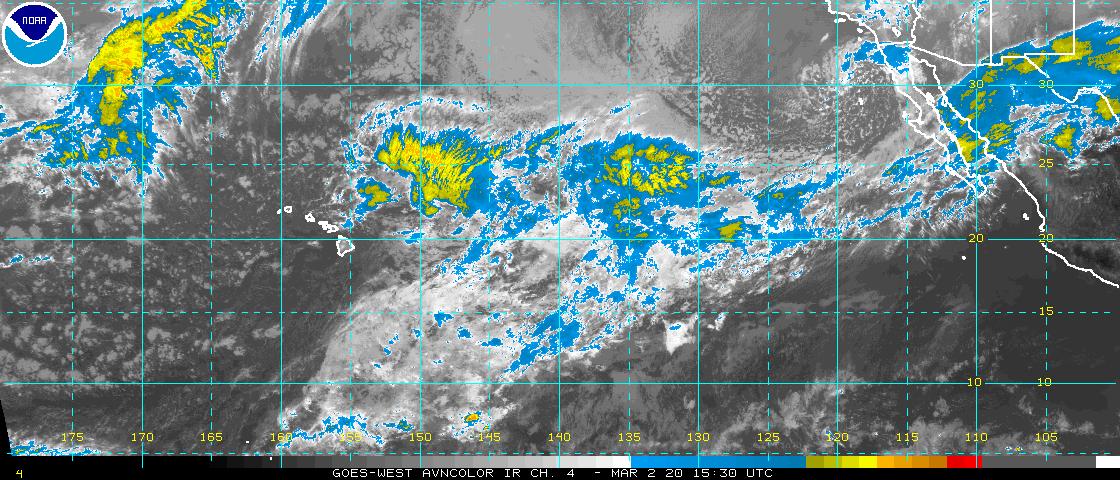
Satellite and Radar Images: To view the cloud conditions we have here in Hawaii, please use the following satellite links, starting off with this Infrared Satellite Image of the islands to see all the clouds around the state during the day and night. This next image is one that gives close images of the islands only during the daytime hours, and is referred to as a Close-up visible image. This next image shows a larger view of the Pacific…giving perspective to the wider ranging cloud patterns in the Pacific Ocean. Finally, here’s a Looping IR satellite image, making viewable the clouds around the islands 24 hours a day. To help you keep track of where any showers may be around the islands, here’s the latest animated radar image.
Hawaii’s Mountains – Here’s a link to the live webcam on the summit of near 14,000 foot Mauna Kea on the Big Island of Hawaii. The tallest peak on the island of Maui is the Haleakala Crater, which is near 10,000 feet in elevation. These two webcams are available during the daylight hours here in the islands…and when there’s a big moon rising just after sunset for an hour or two! Plus, during the nights and early mornings you will be able to see stars, and the sunrise too…depending upon weather conditions.
Tropical Cyclone activity in the eastern and central Pacific – Here’s the latest weather information coming out of the National Hurricane Center, covering the eastern north Pacific. You can find the latest tropical cyclone information for the central north Pacific (where Hawaii is located) by clicking on this link to the Central Pacific Hurricane Center. Here’s a tracking map covering both the eastern and central Pacific Ocean. A satellite image, which shows the entire ocean area between Hawaii and the Mexican coast…can be found here.
Aloha Paragraphs

Tropical storm Hilda southeast of the Big Island
The trade winds are expected to remain moderately strong through the week. The winds are strong enough Tuesday evening, so that the small craft wind advisory is active in most of the waters around Maui County and the Big Island. There’s no big change expected in our trade wind strengths through the next week…at least.
A normal trade wind weather pattern will continue for the time being, keeping whatever few showers that are around…falling along the windward sides. The leeward sides will generally be dry through this period, with fine beach weather expected. Later in the week, as tropical storm Hilda moves by well to the south of the state Thursday through Saturday, we’ll likely see tropical moisture arriving over the islands...generally along the windward sides.
Tropical storm Hilda remains active to the southeast of the Hawaiian Islands Tuesday evening. The hurricane models show Hilda staying well south of the Hawaiian Islands…as it passes by later this week. Here’s the latest Central Pacific Hurricane Center (CPHC) tracking map. Here’s an IR satellite image of Hilda…in relation to the Hawaiian Islands. You can see on that satellite picture huge tropical storm Ignacio over in the eastern Pacific, towards Mexico.
It’s Tuesday evening here in Kihei, Maui, as I begin writing this last section of today’s narrative update. It’s becoming more and more clear that tropical storm Hilda will have little influence on our local weather. We could see a decent increase in showers along our windward sides starting Friday…carried over us in the wake of Hilda. We may also see a modest increase in surf size along the Big Island’s south to southeast shores, although that’s a slight maybe at this point. I don’t think we’ll see much of a change in our local wind speeds.
~~~ The Hawaiian Islands seem to be dodging yet another bullet, remaining north of the inclement weather associated with tropical storm Hilda. The tropical storm in the eastern Pacific, name Ignacio, won’t be any problem for the Hawaiian Islands. He will remain a tropical storm for another couple of days, and then move northward over cooler waters…dissipating into a remnant low pressure system well before getting anywhere near our central Pacific. We could see some of the leftover showers carried in our direction on the trade winds in about a week.
~~~ I’m just getting ready to leave Kihei, and looking out the window, I see fair weather…although its definitely breezy. Looking at the strongest wind gusts around the state at 5pm, the peak was 36 mph at Maalaea Bay…where else! At any rate, I’ll meet you back here early Wednesday morning, when your next weather narrative from paradise will be here waiting for you. I hope you have a great Tuesday night until then! Aloha for now…Glenn.
Extra: Here’s a very wet helicopter ride into the Mount Wai’ale’ale Crater on Kauai…reputed to be the wettest…or one of the wettest places on the planet!
Interesting: Despite several weeks of tropical storms bringing heavy rain to China, northern China is facing a severe drought. Currently around 5,000,000 people are struggling to find drinking water as high temperatures and a lack of rainfall has prolonged drought conditions in northern China. Since late July, insufficient rainfall in an area spanning from Inner Mongolia to Jilin Province in the northeast has led to a worsening drought.
A total of 4.61 million people have been affected and more than 4,000,000 head of livestock are facing difficulty finding drinking water. According to reports from the State Flood Control and Drought Relief Headquarters, 8.67 million hectares of crops are also under threat.
There are renewed fears that the drought could spread south, as affected regions continue to experience high temperatures and less rainfall. It is being deemed the worst drought that Inner Mongolia has seen in five decades. Despite efforts to creating artificial rain to fight off the worst impacts, there is no relief in sight.
The drought agency also warned of possible water shortages in Hunan and Hubei provinces in the south because of low rainfall and high temperatures. Some good news, the country’s main soy producing region has seen very little rain, but a late harvest and rainfall in the next month could eliminate any risk of crop failure according to Vice-Minister for Agriculture Niu Duns in a press conference yesterday.
Interesting2: The Potter phenomenon has been blamed for a surge in the number of people buying owls, emulating the young magician who keeps a snowy owl called Hedwig as a pet. Now an animal sanctuary has opened on the Isle of Wight to help cope with the problem of owls dumped by owners who can no-longer care for them properly.
Animal expert Don Walser, who has opened Newport Owl and Monkey Sanctuary, said: "The problem is that no license is required, anyone can buy an owl." They might look great in the Harry Potter films, but it takes years to train them. Children read the books and see the films and say to their mums and dads they want one and parents don’t realize how much care it takes to look after them.
Interesting3: The land speed record for steam-powered cars has been broken for the first time in more than 100 years, after a British-built car achieved an average speed of 140 miles per hour on Tuesday. Many of the earliest road vehicles were powered by steam, which were easier and safer to start than early gas-powered cars, which had to be cranked by hand. But by the 1920s, the convenience of the internal combustion engine had essentially made steam cars obsolete.
Now, Charles Burnett III has driven them back into the spotlight. He reached speeds of 136 mph and 151 mph during two drives at California’s Edwards Air Force Base on Tuesday. That smashes the previous official record of 127 mph set in 1906 by Fred Marriott of the US in a modified version of the then-popular steam car known as the Stanley Steamer.
Officials from motor sport’s governing body, the Fédération Internationale de l’Automobile (FIA), are expected to ratify the new record shortly. Burnett drove a 7.6-metre-long, 3-ton car called "Inspiration" that grew out of a 1997 student project at Southampton University. The car’s engine burns liquid petroleum gas to heat water in 12 suitcase-sized boilers, creating steam heated to 400°C.
The steam then drives a two-stage turbine that spins at 13,000 revolutions per minute to power its wheels. The FIA requires two 1.6-km-long runs to be performed in opposite directions – to cancel out any effect from wind – within 60 minutes.
Inspiration made the first run at 0727 PDT (1427 GMT) and turned around for the return run with just eight minutes to spare. Before and after each timed run, it took 4 km to accelerate and another 4 km to slow down. The record-setting drives came after several earlier attempts had been thwarted by electrical faults, valve problems, a storm and a tire puncture the previous week.
But the team is planning another run on Wednesday, to try to get even closer to the car’s theoretical top speed of 170 mph. Various groups are trying to develop new steam cars, but none have yet found an efficient way to convert the fuel’s energy into forward motion.
Interesting4: Natural catastrophes such as asteroid impacts, massive volcanic eruptions or large-scale wildfires would have periodically plunged our planet into abnormal darkness. How did life survive without the sun’s life-giving rays during such episodes? With a little help from organisms that can switch to another source of energy while they wait for sunlight to pierce the darkness once more.
To figure out how organisms might have endured periods of so-called "catastrophic darkness", Charles Cockell of the Open University’s Centre for Earth, Planetary, Space and Astronomical Research in Milton Keynes, UK, and his team placed samples of both freshwater and marine microorganisms in darkness for six months – a period similar to what might be expected following a catastrophic event.
The samples included phototrophs, which convert sunlight into usable energy, and mixotrophs, which can use sunlight or consume dead organic matter. The team found that the phototrophic species struggled to survive, with the majority of individuals dying off. The few that survived in a dormant state managed to repopulate when light returned. Mixotrophs, however, seemed to thrive in the darkness.
They even offered a helping hand to their light-dependent cousins: when the lights went out, the mixotrophs were able to switch to getting their energy from dead creatures and plants, and in doing so they kept the nutrients turning over. This improved the conditions for phototrophic recovery when the samples were returned to light.
When the lights went out, the mixotrophs switched to getting their energy from dead creatures and plants. The results show that, contrary to common belief, catastrophic darkness does not completely destroy phototrophic organisms, says Cockell.
"The photosynthetic biosphere is much more robust than generally assumed." Warwick Vincent, director of aquatic ecosystem studies at Laval University in Quebec, Canada, says that "whilst mixotrophy has been known about for a long time, what is novel about this research is the context – that of catastrophic darkness".
 Email Glenn James: