August 24-25, 2009
Air Temperatures – The following maximum temperatures were recorded across the state of Hawaii Monday afternoon:
Lihue, Kauai – 83
Honolulu, Oahu – mm
Kaneohe, Oahu – 83
Kahului, Maui – 88
Hilo, Hawaii – 81
Kailua-kona – 88
Air Temperatures ranged between these warmest and coolest spots near sea level – and on the highest mountains…at 5 p.m. Monday evening:
Kailua-Kona – 86F
Hilo, Hawaii – 78
Haleakala Crater – 59 (near 10,000 feet on Maui)
Mauna Kea summit – 59 (near 14,000 feet on the Big Island)
Precipitation Totals – The following numbers represent the largest precipitation totals (inches) during the last 24 hours on each of the major islands, as of Monday afternoon:
0.86 Mount Waialaele, Kauai
0.12 Oahu Forest NWR, Oahu
0.00 Molokai
0.00 Lanai
0.00 Kahoolawe
0.08 West Wailuaiki, Maui
0.48 Piihonua, Big Island
Marine Winds – Here’s the latest (automatically updated) weather map showing high pressure systems to the northwest through northeast of the islands. Trade winds will be active through Wednesday.
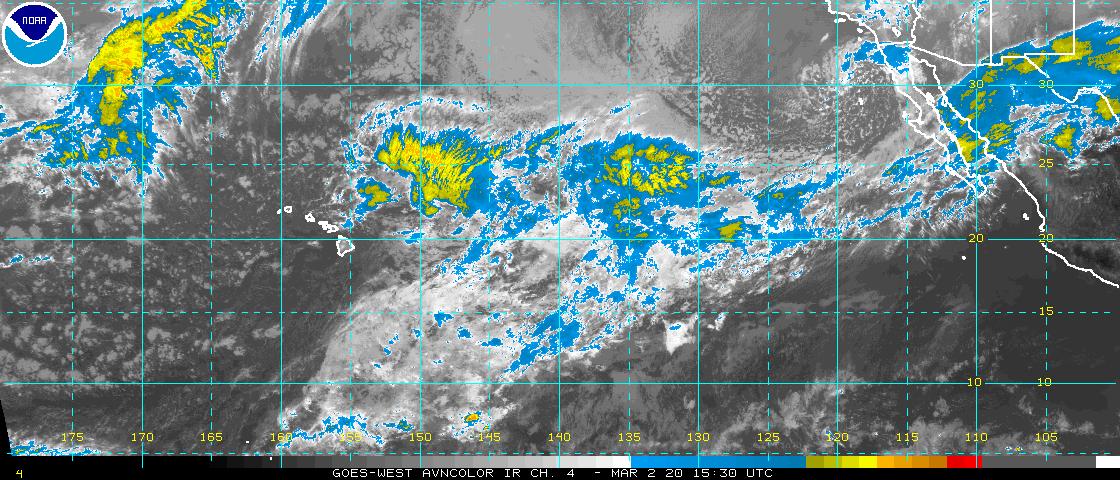
Satellite and Radar Images: To view the cloud conditions we have here in Hawaii, please use the following satellite links, starting off with this Infrared Satellite Image of the islands to see all the clouds around the state during the day and night. This next image is one that gives close images of the islands only during the daytime hours, and is referred to as a Close-up visible image. This next image shows a larger view of the Pacific…giving perspective to the wider ranging cloud patterns in the Pacific Ocean. Finally, here’s a Looping IR satellite image, making viewable the clouds around the islands 24 hours a day. To help you keep track of where any showers may be around the islands, here’s the latest animated radar image.
Hawaii’s Mountains – Here’s a link to the live webcam on the summit of near 14,000 foot Mauna Kea on the Big Island of Hawaii. The tallest peak on the island of Maui is the Haleakala Crater, which is near 10,000 feet in elevation. These two webcams are available during the daylight hours here in the islands…and when there’s a big moon rising just after sunset for an hour or two! Plus, during the nights and early mornings you will be able to see stars, and the sunrise too…depending upon weather conditions.
Tropical Cyclone activity in the eastern and central Pacific – Here’s the latest weather information coming out of the National Hurricane Center, covering the eastern north Pacific. You can find the latest tropical cyclone information for the central north Pacific (where Hawaii is located) by clicking on this link to the Central Pacific Hurricane Center. Here’s a tracking map covering both the eastern and central Pacific Ocean. A satellite image, which shows the entire ocean area between Hawaii and the Mexican coast…can be found here.
Aloha Paragraphs

Tropical storm Hilda east-southeast of Hawaii
The trade winds are expected to remain moderately strong through the upcoming week. The winds have calmed down enough Monday, so that the small craft wind advisories across the island chain have been completely dropped. There is little change expected in our local trade wind speeds…despite the passing of what will be hurricane Hilda south of the state later this week.
The windward sides will see off and on showers, although nothing heavy is expected. The leeward sides will be generally dry through this period, with fine weather expected. Later in the week, as what will then be hurricane Hilda moves by to the south of the state around Thursday and Friday into Saturday…we may see some tropical moisture arriving over the islands of Maui and the Big Island for a day or two then.
Tropical storm Hilda remains active to the east-southeast of the Hawaiian Islands Monday evening…likely reaching hurricane strength Wednesday night or early Thursday. The hurricane models show Hilda staying two to three hundred miles south of the Hawaiian Islands…as it passes by to our south later this week. Here’s the latest Central Pacific Hurricane Center (CPHC) tracking map. Here’s an IR satellite image of Hilda…in relation to the Hawaiian Islands. You can see on that satellite picture tropical storm Ignacio over in the eastern Pacific towards Mexico. The first direct influence from this strengthening tropical cyclone could perhaps be modestly larger surf arriving in the islands from the southeast direction about mid-week for a few days.
It’s Monday evening here in Kihei, Maui, as I begin writing this last section of today’s narrative update. As noted above, we have a tropical storm named Hilda to the east-southeast of the islands now. It’s being held at tropical storm force temporarily, but will likely be able to strengthen into a lower level hurricane by Thursday morning. Besides the chance of a rising southeast swell, generated by Hilda on Wednesday, there will be little influence here in the islands…hopefully! The two wild cards at this point, are…1.) the chance of increasing showers later Thursday into Friday…as the northern fringe of Hilda’s rain shield pushes northward to near the Big Island and Maui 2.) the chance that we could see our local trade winds enhanced, becoming stronger and gusty as Hilda moves by to our south. We will need to keep a fairly close eye on this strengthening storm…which is just what I plan on doing through the rest of this week.
~~~ Monday was a nice day, that is if you didn’t mind having a bit of air in a hurry mussing up your hairdo! At 5pm Monday evening the winds were still rather uppity around the state of Hawaii. The strongest gusts early in the evening included 33 mph at Port Allen, Kauai; 35 mph at Honolulu airport, and 40 mph at Maalaea Bay on Maui. The main thing though is all the tropical cyclone activity in the tropics of the world now, including tropical systems Vamco in the western Pacific; Hilda here in the central Pacific, and newly formed tropical storm Ignacio in the eastern Pacific…and finally slowly dissipating Bill in the Atlantic.
~~~ I’m leaving Kihei for the drive upcountry to Kula now. Looking out the window, I see almost totally blue skies, with just a few clouds in the normal places, like over the West Maui Mountains of course. Just at sunset, we saw thicker high cirrus clouds coming up over the islands from the southwest…as shown on this looping satellite image – which provided beautiful sunset colors! Tropical storm Hilda is down to the lower right on the picture. I’ll be back early Tuesday morning with more news on tropical storm Hilda, and the rest of our local weather information too. I hope you have a great Monday night until then! Aloha for now…Glenn.
Interesting: Almost half of the world’s farmland has at least 10 percent tree cover, according to a study on Monday indicating that farmers are far less destructive to carbon-storing forests than previously believed. "The area revealed in this study is twice the size of the Amazon, and shows that farmers are protecting and planting trees spontaneously," Dennis Garrity, Director General of the World Agro-forestry Center in Nairobi, said in a statement.
The Centre’s report, based on satellite images and the first to estimate tree cover on the world’s farms, showed tree canopies exceeded 10 percent on farmland of 3.9 million sq miles — 46 percent of all agricultural land and an area the size of Canada or China.
By one yardstick used by the U.N.’s Food and Agricultural Organization, a "forest" is an area in which tree canopies cover at least 10 percent of an area. The definition excludes, however, farmland or urban areas. The report said that farmers keep or plant trees for uses such as production of fruit, nuts, medicines, fuel, building materials, gums or resins.
Trees also provide shade for crops, work as windbreaks, boundary markers or to help avert erosion. Farms are often portrayed as enemies of forests — homes to a wide diversity of animals and plants. Forests are also giant stores of heat-trapping carbon dioxide, the main greenhouse gas. The report found that trees were integral to agricultural landscapes in all parts of the world, with the exceptions of arid North Africa and West Asia.
Interesting2: Heavy investment in high-speed train networks is not a viable strategy for fighting climate change and could place an excessively heavy burden on taxpayers, a report by a Swedish expert group has found. The report, published by the Expert Group for Environmental Studies, an independent state body under the auspices of the Swedish Department of Finance, argues that a "political consensus has emerged that investing in high-speed railways can contribute to economic growth and reduced carbon emissions".
However, following a lengthy quantitative investigation, the authors have concluded that in reality, the carbon-reducing impact of these networks is minimal, and should not be sold to EU citizens as a realistic ‘green’ policy.
Interesting3: California residents not living in permanent housing may no longer have to deal with the frustration of searching for recycling options. The state’s Integrated Waste Management Board (IWMB) is formulating a program meant to encourage businesses, apartment complexes and mobile home parks to institute recycling. The mandatory recycling directive would most likely set goals for cities and counties, allowing them to implement individual programs as long as they comply.
The San Diego Union-Tribune reports that if half of the 5.5 million tons of recyclable material dumped by large businesses, apartment complexes and mobile home parks were reused, the state could save space in landfills and reduce greenhouse-gas emissions by the equivalent of taking almost 1 million cars off the road.
Interesting4: California took the first step Thursday toward setting a drinking water standard for chromium 6 that could force cities and water districts to undertake costly treatment. Also known as hexavalent chromium, the heavy metal is one of a number of industrial contaminants in the San Fernando Valley aquifer, a source of drinking water for Los Angeles, Burbank and Glendale. The communities now cut chromium levels by blending local groundwater with imported supplies.
But the target concentrations proposed by the state are so low that sophisticated treatment would be necessary to meet them. "We’d have to treat for it or we can’t use the groundwater," said Bill Mace, an assistant general manager at Burbank Water and Power, which gets 40% to 50% of its supplies from the valley aquifer.
Interesting5: Removing oily smudges from mirrors, countertops or fabrics usually requires some elbow grease… and a strong soap or solvent. A new coating developed by researchers at Purdue University promises that grease stains can be wiped away with plain old water.
Incorporating this material into cleaning products, paints or sealants could reduce the need for environmentally damaging solvents and phosphate-containing detergents, the researchers say. Phosphate detergents can kill aquatic life by allowing algae and microbes to overgrow bodies of water, suffocating other animals by consuming the dissolved oxygen.
Interesting6: The news was mixed this week as the U.S. Fish and Wildlife Service announced that it would move forward on a review of 29 plant and animal species and assess their inclusion on the federal endangered species list. The fact that the agency is considering listing any species represents a change from the last eight years.
But the service also rejected petitions for nine species, including the ashy storm-petrel, a California seabird. For those who submitted petitions that were denied, the situation appeared dire.
"Secretary of the Interior Ken Salazar is continuing a Bush-era approach of denying protections to species based on an incomplete and selective interpretation of the science," said Shaye Wolf, a seabird biologist with the Center for Biological Diversity. "The decision reads like a laundry list of excuses to avoid acting to protect the ashy storm-petrel rather than a solid evaluation of the science."
 Email Glenn James: