August 19-20, 2009
Air Temperatures – The following maximum temperatures were recorded across the state of Hawaii Wednesday afternoon:
Lihue, Kauai – 83
Honolulu, Oahu – 90
Kaneohe, Oahu – 83
Kahului, Maui – 89
Hilo, Hawaii – 84
Kailua-kona – 87
Air Temperatures ranged between these warmest and coolest spots near sea level – and on the highest mountains…at 5 p.m. Wednesday evening:
Honolulu, Oahu – 87F
Lihue, Kauai – 77
Haleakala Crater – 54 (near 10,000 feet on Maui)
Mauna Kea summit – 72 (near 14,000 feet on the Big Island)
Precipitation Totals – The following numbers represent the largest precipitation totals (inches) during the last 24 hours on each of the major islands, as of Wednesday afternoon:
0.30 Mount Waialaele, Kauai
0.64 Oahu Forest NWR, Oahu
0.20 Molokai
0.65 Lanai
0.03 Kahoolawe
1.46 West Wailuaiki, Maui
0.49 Pohakuloa, Big Island
Marine Winds – Here’s the latest (automatically updated) weather map showing a 1026 millibar high pressure system to the northeast of the islands. Our trade winds will pick up in strength Thursday into Friday.
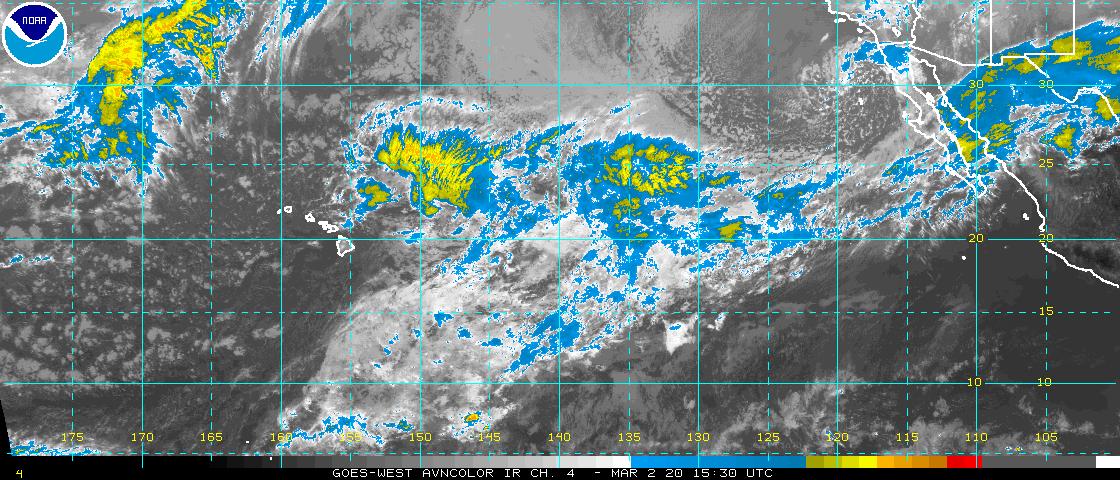
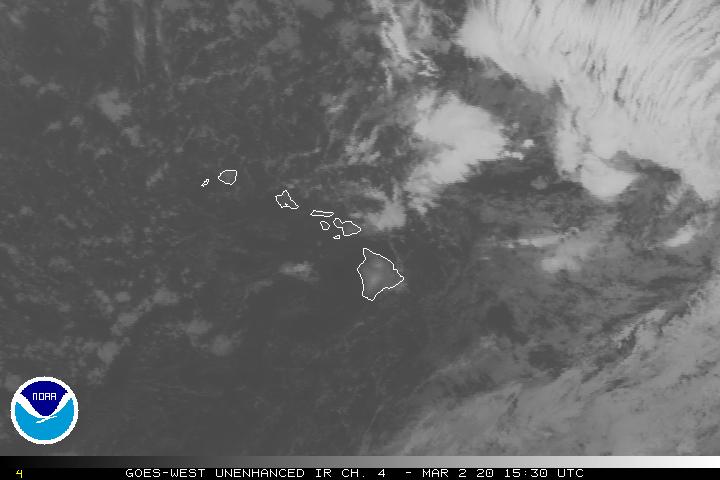
Satellite and Radar Images: To view the cloud conditions we have here in Hawaii, please use the following satellite links, starting off with this Infrared Satellite Image of the islands to see all the clouds around the state during the day and night. This next image is one that gives close images of the islands only during the daytime hours, and is referred to as a Close-up visible image. This next image shows a larger view of the Pacific…giving perspective to the wider ranging cloud patterns in the Pacific Ocean. Finally, here’s a Looping IR satellite image, making viewable the clouds around the islands 24 hours a day. To help you keep track of where any showers may be around the islands, here’s the latest animated radar image.
Hawaii’s Mountains – Here’s a link to the live webcam on the summit of near 14,000 foot Mauna Kea on the Big Island of Hawaii. The tallest peak on the island of Maui is the Haleakala Crater, which is near 10,000 feet in elevation. These two webcams are available during the daylight hours here in the islands…and when there’s a big moon rising just after sunset for an hour or two! Plus, during the nights and early mornings you will be able to see stars, and the sunrise too…depending upon weather conditions.
Tropical Cyclone activity in the eastern and central Pacific – Here’s the latest weather information coming out of the National Hurricane Center, covering the eastern north Pacific. You can find the latest tropical cyclone information for the central north Pacific (where Hawaii is located) by clicking on this link to the Central Pacific Hurricane Center. Here’s a tracking map covering both the eastern and central Pacific Ocean. A satellite image, which shows the entire ocean area between Hawaii and the Mexican coast…can be found here.
Aloha Paragraphs

Typical trade wind weather pattern back very soon
The atmosphere remains at least somewhat unstable, and this of course means that we may still see some heavy showers falling locally. There are clouds rising well into the higher atmosphere early Wednesday evening, especially over the offshore waters around the
~~~ The clouds in this band have tops, which have been reaching up towards 35,000 feet, so that there may be some embedded thunderstorms forming there. There are other areas of thunderstorms offshore as well. This looping radar image shows, at least early Wednesday evening, that there aren’t very many heavy showers around. This band of clouds however have been taking aim on the Big Island…so that we should begin seeing some locally heavy showers arriving along the east facing coasts and slopes of that island soon. This band may ride the freshening trade winds up to the other islands overnight into Thursday morning.
The interesting thing seems to be the arrival of brisk trade winds across the islands from Molokai down through the
~~~ The band looks like it could potentially bring some heavy rains with it, with the chance of a thunderstorm as well. When these windward biased showers arrive around the
Guillermo has dropped below the tropical depression threshold late Wednesday afternoon, as it ends of its long journey…which started in the eastern Pacific. Guillermo’s latest wind reports, as of 5pm Wednesday evening, showed 35 mph sustained winds…with gusts to 46 mph. The Central Pacific Hurricane Center (CPHC) issued its last advisory on Guillermo Wednesday evening, so that this long lived former tropical cyclone will finally go into the record books…as yet another storm that missed the Hawaiian Islands. Here’s the last CPHC tracking map.
It’s Wednesday evening here in Kihei, Maui, as I begin writing this last part of today’s narrative. The trade winds have rushed back into our Hawaiian Island weather picture today, starting first on the Big Island and Maui…and continuing westward to Oahu and Kauai. As we look at this looping radar image, we see the clouds and showers being carried along from an easterly direction. The atmosphere remains ripe for more showers on a temporary basis, some of which may be yet on the heavy side. Looking at this IR satellite image, we see those bright white spots, those cold cloud tops, which indicate heavy rain showers under them….heading towards the Big Island.
~~~ Looking out the window from my office here in Kihei early Wednesday evening, there are what I would describe as considerable clouds in all directions. I didn’t see any definite showers, although it looked like it was trying to work in that direction. If I experience anything unusual on the drive back upcountry to Kula, I’ll come back online and let you know. Otherwise, I’ll be up early Thursday morning, preparing your next new weather narrative…which will appear around 630am HST as usual on weekdays. Tomorrow is like a Friday, as Friday is a holiday here in the islands, called Admissions Day. I hope you have a great Wednesday night! Aloha for now…Glenn.
Extra: A nice youtube music video of Hawaiian beaches…with a relaxing and meditative focus, like a free trip to the islands…enjoy the warm ocean!
Interesting: They say there’s no place like home. But scientists are reporting some unsettling news about homes in the residential areas of California. The typical house there — and probably elsewhere in the country — is an alarming and probably underestimated source of water pollution, according to a new study reported today at the 238th National Meeting of the American Chemical Society.
In the study, Lorence Oki, Darren Haver and colleagues explain that runoff results from rainfall and watering of lawns and gardens, which winds up in municipal storm drains. The runoff washes fertilizers, pesticides and other contaminants into storm drains, and they eventually appear in rivers, lakes and other bodies of water.
"Results from our sampling and monitoring study revealed high detection frequencies of pollutants such as pesticides and pathogen indicators at all sites," Oki says of their study of eight residential areas in Sacramento and Orange Counties in California.
Graphic shows that polluted runoff originates from several sources, and has been linked to fish kills and a loss of aquatic species diversity. The study suggests current runoff models may underestimate pollution contributed by homes by up to 50 percent.
Interesting2: The population of the coffee-colored Asian clams has soared in the southeast portion of the lake, threatening to hog food sources and excrete nutrients that foster algae growth, according to an annual Lake Tahoe report by UC Davis researchers. Scientists worry that calcium in the clams’ shells could make the lake more hospitable to invasion by quagga or zebra mussels, which cluster onto boats and anything else that rests in the water.
Although the mussels have not been sighted at Tahoe, authorities at other lakes have spent millions of dollars trying to control them. "In a lake like Tahoe where a lot money and a lot of effort is being put into maintaining its pristine nature, the introduction or the threat of invasive species really pulls us away from that pristine condition," said John Reuter, associate director of UC Davis’ Tahoe Environmental Research Center, which released Tuesday’s "Tahoe: State of the Lake Report.
" No one is certain how the Asian clam first arrived at Lake Tahoe, whose famed clear waters lie at the center of a multimillion-dollar tourism economy.
Some authorities say that fishermen used the clams as bait and that surviving clams took root on the lake’s bottom, where they released tiny offspring that were carried by water currents to other parts of the lake. Visitors first noticed the white, partially oxidized shells on the shore seven years ago.
Interesting3: Some dogs are revered or pampered, with fancy clothes and loads of affection…others work for a living. David Blouin, a cultural sociologist at Indiana University South Bend, said relationships between dogs and their owners generally fall into three distinct categories, with some bestowing more canine benefits than others.
And while some dogs may live the high life, serving as surrogate children to their humans, their circumstances can change depending on their owner’s life course and experiences.
"I found it interesting that there are different ways to relate to and think about animals and that people are able to switch and latch onto a different way of thinking about and treating animals when other things happen in their lives, like having children," said Blouin, an assistant professor in the Department of Sociology and Anthropology.
Blouin conducted 28 in-depth interviews with dog owners from a Midwestern county. Dog ownership attitudes fell into three categories: Humanist, where dogs were highly valued and considered close companions, like pseudo people; protectionists might be vegetarians and they greatly valued animals in general, not just as pets; dominionists saw animals as separate, and less important than people, often using the dogs for hunting and pest control and requiring them to live outdoors.
Blouin said the distinct orientations toward animals were informed by multiple, competing cultural logics as well as personal experiences, demographic characteristics and family structure. Rural dog owners were more likely to leave their pets outside, for example.
Empty-nesters seemed to be the most attached to their pets. "People don’t make this stuff up themselves," Blouin said. "They learn how animals should be treated. There are different ideas out there and these ideas exist in little packages, which are promoted by different groups, like the Humane Society or kennel clubs." Blouin is presenting his findings at the annual meeting of the American Sociological Association.
Interesting4: If a lush, protected forest with a winding stream is considered luxury accommodation for a migratory bird, a Purdue University study shows that those birds would be just as happy with the equivalent of a cheap roadside motel. John Dunning, an associate professor of forestry and natural resources, found that migrating birds are just as likely to stop in small woodlots in the middle of an agricultural field for the night as long as there is adequate protection and food.
Dunning said the finding suggests that conservation efforts should extend to smaller forested lands to help stabilize declining migratory bird populations. "There are strategies for conserving forest for migratory birds, but those strategies emphasize the largest patches of forest," Dunning said.
"We found that even very small woodlots were filled with migratory birds at times. It makes us believe we also need to conserve the little patches of forest, not just the big ones."
Dunning and graduate student Diane Packett observed woodlots at three distances from Indiana’s Wabash River and its tributaries — within half a kilometer, between one and five kilometers and at about 20 kilometers. The woodlots were less than 20 acres and had row crops surrounding them on at least three sides.
Dunning and Packett made observations in both spring and fall and reported their findings in the current issue of The Auk, the journal of the American Ornithologists’ Union.
There were 76 different species of migratory birds found in the woodlots, with no statistical differences in the number of species or overall population of birds based on distance from streams. Packett said the birds, which travel thousands of miles between South and Central America and Canada twice each year, sometimes just need a place to stop along their journey.
As forests have been cleared for development, agriculture and other uses, those birds have to make do with whatever patches of forest they can find when they become tired or encounter bad weather. "They don’t make the trip all in one jump. It can be thousands of miles they have to fly," Packett said. "They need safe places to stop, eat and rest. If they don’t have that, they might not survive."
 Email Glenn James: