August 17-18, 2009
Air Temperatures – The following maximum temperatures were recorded across the state of Hawaii Monday afternoon:
Lihue, Kauai – 82
Honolulu, Oahu – 86
Kaneohe, Oahu – 83
Kahului, Maui – 86
Hilo, Hawaii – 83
Kailua-kona – 89
Air Temperatures ranged between these warmest and coolest spots near sea level – and on the highest mountains…at 5 p.m. Monday evening:
Kailua-kona – 85F
Honolulu, Oahu – 78
Haleakala Crater – 50 (near 10,000 feet on Maui)
Mauna Kea summit – 48 (near 14,000 feet on the Big Island)
Precipitation Totals – The following numbers represent the largest precipitation totals (inches) during the last 24 hours on each of the major islands, as of Monday afternoon:
0.53 Mount Waialaele, Kauai
0.10 Oahu Forest NWR, Oahu
0.00 Molokai
0.00 Lanai
0.00 Kahoolawe
0.11 Haiku, Maui
0.12 Pahoa, Big Island
Marine Winds – Here’s the latest (automatically updated) weather map showing a 1031 millibar high pressure system far to the northeast of the islands. As Guillermo passes between us and our trade wind producing high…our winds will lose strength into Thursday.
Satellite and Radar Images: To view the cloud conditions we have here in Hawaii, please use the following satellite links, starting off with this Infrared Satellite Image of the islands to see all the clouds around the state during the day and night. This next image is one that gives close images of the islands only during the daytime hours, and is referred to as a Close-up visible image. This next image shows a larger view of the Pacific…giving perspective to the wider ranging cloud patterns in the Pacific Ocean. Finally, here’s a Looping IR satellite image, making viewable the clouds around the islands 24 hours a day. To help you keep track of where any showers may be around the islands, here’s the latest animated radar image.
Hawaii’s Mountains – Here’s a link to the live webcam on the summit of near 14,000 foot Mauna Kea on the Big Island of Hawaii. The tallest peak on the island of Maui is the Haleakala Crater, which is near 10,000 feet in elevation. These two webcams are available during the daylight hours here in the islands…and when there’s a big moon rising just after sunset for an hour or two! Plus, during the nights and early mornings you will be able to see stars, and the sunrise too…depending upon weather conditions.
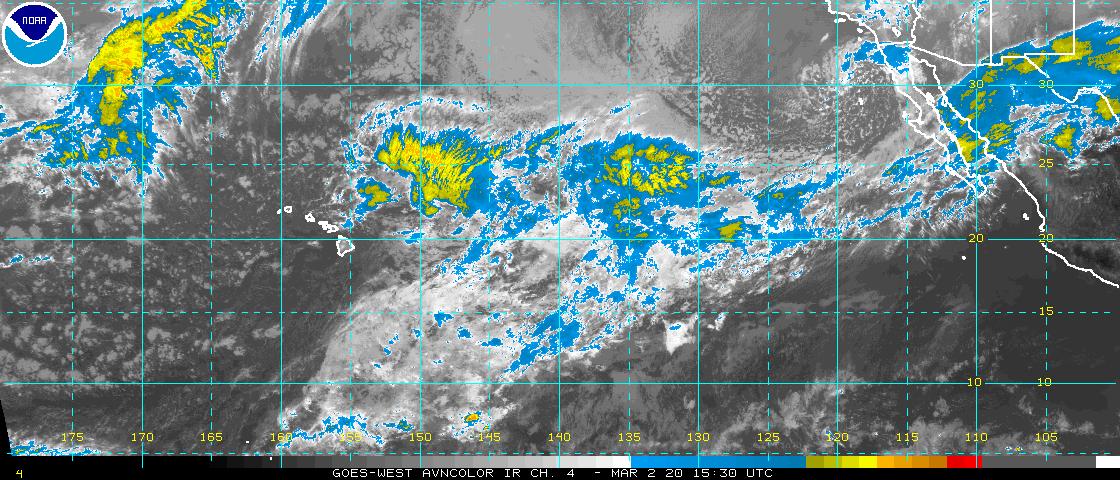
Tropical Cyclone activity in the eastern and central Pacific – Here’s the latest weather information coming out of the National Hurricane Center, covering the eastern north Pacific. You can find the latest tropical cyclone information for the central north Pacific (where Hawaii is located) by clicking on this link to the Central Pacific Hurricane Center. Here’s a tracking map covering both the eastern and central Pacific Ocean. A satellite image, which shows the entire ocean area between Hawaii and the Mexican coast…can be found here.
Aloha Paragraphs

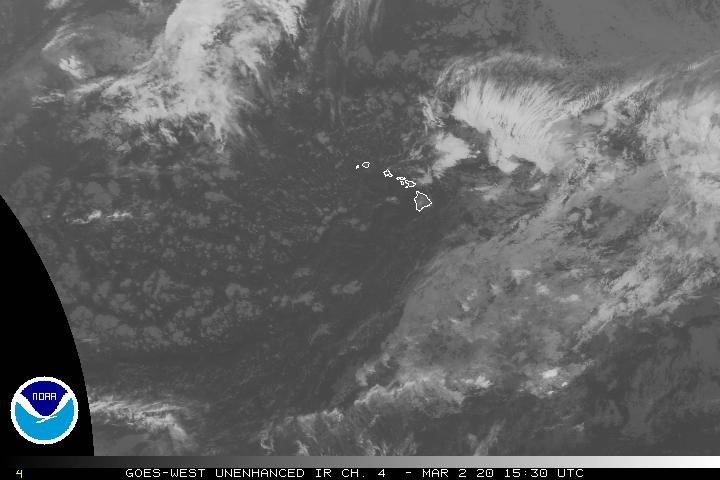
Tropical storm Guillermo…to the ENE of Hawaii
Our local trade winds will continue Monday evening, but then tumble in strength Tuesday and Wednesday, as rapidly weakening Guillermo moves between our islands…and the trade wind producing high pressure system to our northeast. Guillermo will act as a blocking force, causing our trade winds to become very light, with light sea breezes replacing them in certain locales. This will make our overlying atmsphere feel very warm and muggy for a few days. The trades will return at some point Thursday, bringing back refreshing breezes Friday into the weekend…and beyond.
Guillermo remains a rather weak tropical storm Monday evening…and will weaken further into just a remnant low pressure system later Tuesday. This dissipation is a result of cooler sea surf temperatures under the storm, and stronger upper level winds…which have sheared the storm at higher levels. Here’s a tracking map, showing the storm’s track heading up to the northeast and then north of the islands. Here’s a satellite image showing Guillermo in relation to the Hawaiian Islands. Here’s a close-up satellite image of Guillermo. Here’s a satellite presentation…showing the looping of Guillermo.
Guillermo’s latest wind report, early Monday evening, shows much reduced 46 mph sustained winds…with gusts to 58 mph. The current path of this dissipating tropical storm keeps it far enough to our north, that there will be no direct influence from the storm itself. Our faltering wind speeds, with the sultry atmosphere…will be a couple of the indirect effects however. A trough of low pressure aloft, with its destabilizing influence on our air mass, will prompt afternoon cloud buildups, especially over the interior sections. These clouds will likely dump localized generous rain for a couple of hours each afternoon Tuesday through Wednesday. The computer models suggest that Guillermo may drag some leftover cloud elements across the islands Wednesday night into Thursday. This rain should be focused more towards the windward sides…carried in by the returning trade winds. Oh, and let’s not forget the rising large surf along our east facing shores Tuesday into Wednesday…be careful of that!
It’s Monday evening here in Kihei, Maui, as I begin typing this last part of today’s narrative. Monday was yet another great day, in a good series of nice days…from a weather perspective. Even though we have a tropical storm in our general vicinity, there’s nothing to worry about. Nothing to worry about, as long you don’t mind a couple of hot and humid days…like Tuesday and Wednesday. The problem is that our trade winds will be faltering, which during the deep summer month of August, can be somewhat of a problem. Not a major problem, but it’s going to be feeling a little weird out there, without the trade winds blowing. Already by Thursday, those trades will be on the rise, and will reassert themselves through the rest of the week…into next week.
~~~ I’m out of here, as I’m getting ready to jump in my car for the drive home to Kula. I’m so ready to be outside, to be out of the office! I’ll be back with you early Tuesday morning, so here’s wishing you a most marvelous Monday night until then! Aloha for now…Glenn.
Extra: Great youtube video showing the Hubble Ultra Deep Field in 3D!
Interesting: University of Utah mathematicians developed a new cloaking method, and it’s unlikely to lead to invisibility cloaks like those used by Harry Potter or Romulan spaceships in "Star Trek." Instead, the new method someday might shield submarines from sonar, planes from radar, buildings from earthquakes, and oil rigs and coastal structures from tsunamis.
"We have shown that it is numerically possible to cloak objects of any shape that lie outside the cloaking devices, not just from single-frequency waves, but from actual pulses generated by a multi-frequency source," says Graeme Milton, senior author of the research and a distinguished professor of mathematics at the University of Utah.
"It’s a brand new method of cloaking," Milton adds. "It is two-dimensional, but we believe it can be extended easily to three dimensions, meaning real objects could be cloaked. It’s called active cloaking, which means it uses devices that actively generate electromagnetic fields rather than being composed of ‘meta-materials’ [exotic metallic substances] that passively shield objects from passing electromagnetic waves."
Milton says his previous research involved "just cloaking clusters of small particles, but now we are able to cloak larger objects." For example, radar microwaves have wavelengths of about four inches, so Milton says the study shows it is possible to use the method to cloak from radar something 10 times wider, or 40 inches.
That raises hope for cloaking larger objects. So far, the largest object cloaked from microwaves in actual experiments was an inch-wide copper cylinder. A study demonstrating the mathematical feasibility of the new cloaking technique – active, broadband, exterior cloaking – was published online today in the journal Optics Express.
A related paper was published online Aug. 14 in Physical Review Letters. Milton conducted the studies with Fernando Guevara Vasquez and Daniel Onofrei, both of whom are assistant professors-lecturers in mathematics. The research was funded by the National Science Foundation and the University of Utah.
Interesting2: You probably have cocaine in your wallet, purse, or pocket. Sound unlikely or outrageous? Think again! In what researchers describe as the largest, most comprehensive analysis to date of cocaine contamination in banknotes, scientists are reporting that cocaine is present in up to 90 percent of paper money in the United States, particularly in large cities such as Baltimore, Boston, and Detroit.
The scientists found traces of cocaine in 95 percent of the banknotes analyzed from Washington, D.C., alone. Presented at the 238th National Meeting of the American Chemical Society, the new study suggests that cocaine abuse is still widespread and may be on the rise in some areas.
It could help raise public awareness about cocaine use and lead to greater emphasis on curbing its abuse, the researchers say. The scientists tested banknotes from more than 30 cities in five countries, including the U.S., Canada, Brazil, China, and Japan, and found "alarming" evidence of cocaine use in many areas.
The U.S. and Canada had the highest levels, with an average contamination rate of between 85 and 90 percent, while China and Japan had the lowest, between 12 and 20 percent contamination. The study is the first report about cocaine contamination in Chinese and Japanese currencies, they say. "To my surprise, we’re finding more and more cocaine in banknotes," said study leader Yuegang Zuo, Ph.D., of the University of Massachusetts in Dartmouth.
Zuo says that the high percentage of contaminated U.S. currency observed in the current study represents nearly a 20 percent jump in comparison to a similar study he conducted two years ago. That earlier study indicated that 67 percent of bills in the U.S. contained traces of cocaine. "I’m not sure why we’ve seen this apparent increase, but it could be related to the economic downturn, with stressed people turning to cocaine," Zuo says.
Such studies are useful, he noted, because the data can help law enforcement agencies and forensic specialists identify patterns of drug use in a community. Scientists have known for years that paper money can become contaminated with cocaine during drug deals and directly through drug use such as snorting cocaine through rolled bills. Contamination can spread to banknotes not involved in the illicit drug culture because bills are processed in banks’ currency-counting machines.
Interesting3: When it comes to using climate models to assess the causes of the increased amount of moisture in the atmosphere, it doesn’t much matter if one model is better than the other. They all come to the same conclusion: Humans are warming the planet, and this warming is increasing the amount of water vapor in the atmosphere.
In new research appearing in the Aug. 10 online issue of the Proceedings of the U.S. National Academy of Sciences, Lawrence Livermore National Laboratory scientists and a group of international researchers found that model quality does not affect the ability to identify human effects on atmospheric water vapor.
“Climate model quality didn’t make much of a difference,” said Benjamin Santer, lead author from LLNL’s Program for Climate Modeling and Inter-comparison. “Even with the computer models that performed relatively poorly, we could still identify a human effect on climate.
It was a bit surprising. The physics that drive changes in water vapor are very simple and are reasonably well portrayed in all climate models, bad or good.” The atmosphere’s water vapor content has increased by about 0.4 kilograms per cubic meter (kg/m_) per decade since 1988, and natural variability alone can’t explain this moisture change, according to Santer.
“The most plausible explanation is that it’s due to human-caused increases in greenhouse gases,” he said. More water vapor – which is itself a greenhouse gas – amplifies the warming effect of increased atmospheric levels of carbon dioxide.
Interesting4: New research shows that air pollution in eastern China has reduced the amount of light rainfall over the past 50 years and decreased by 23 percent the number of days of light rain in the eastern half of the country. The results suggest that bad air quality might be affecting the country’s ability to raise crops as well as contributing to health and environmental problems.
The study links for the first time high levels of pollutants in the air with conditions that prevent the light kind of rainfall critical for agriculture. Led by atmospheric scientist Yun Qian at the Department of Energy’s Pacific Northwest National Laboratory, the study appears August 15 in the Journal of Geophysical Research-Atmospheres.
"People have long wondered if there was a connection, but this is the first time we’ve observed it from long-term data," said Qian. "Besides the health effects, acid rain and other problems that pollution creates, this work suggests that reducing air pollution might help ease the drought in north China."
China’s dramatic economic growth and pollution problems provide researchers an opportunity to study the connection between air quality and climate. Rain in eastern China — where most of the country’s people and pollution exist — is not like it used to be. Over the last 50 years, the southern part of eastern China has seen increased amounts of total rainfall per year.
The northern half has seen less rain and more droughts. But light rainfall that sustains crops has decreased everywhere. A group of climate researchers from the U.S., China and Sweden wanted to know why light rain patterns haven’t followed the same precipitation patterns as total rainfall.
 Email Glenn James: