August 13-14, 2009
Air Temperatures – The following maximum temperatures were recorded across the state of Hawaii Thursday afternoon:
Lihue, Kauai – 83
Honolulu, Oahu – 84
Kaneohe, Oahu – 84
Kahului, Maui – 90
Hilo, Hawaii – 84
Kailua-kona – 87
Air Temperatures ranged between these warmest and coolest spots near sea level – and on the highest mountains…at 5 p.m. Thursday evening:
Kailua-kona – 85F
Kaneohe, Oahu – 76
Haleakala Crater – 52 (near 10,000 feet on Maui)
Mauna Kea summit – 55 (near 14,000 feet on the Big Island)
Precipitation Totals – The following numbers represent the largest precipitation totals (inches) during the last 24 hours on each of the major islands, as of Thursday afternoon:
6.96 Mount Waialaele, Kauai
5.53 Oahu Forest NWR, Oahu
0.01 Molokai
0.00 Lanai
0.06 Kahoolawe
1.88 Kaupo Gap, Maui
0.31 Mountain View, Big Island
Marine Winds – Here’s the latest (automatically updated) weather map showing a 1024 millibar high pressure system to the northeast of the islands. The trough of low pressure, which was former tropical cyclone Felicia, is moving away towards the west. We’ll see returning trade winds into Saturday.
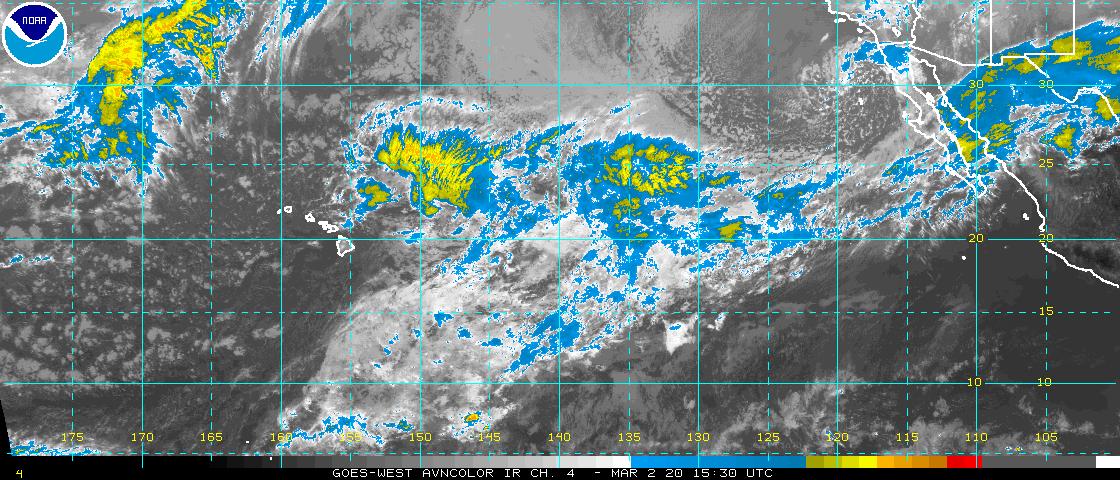
Satellite and Radar Images: To view the cloud conditions we have here in Hawaii, please use the following satellite links, starting off with this Infrared Satellite Image of the islands to see all the clouds around the state during the day and night. This next image is one that gives close images of the islands only during the daytime hours, and is referred to as a Close-up visible image. This next image shows a larger view of the Pacific…giving perspective to the wider ranging cloud patterns in the Pacific Ocean. Finally, here’s a Looping IR satellite image, making viewable the clouds around the islands 24 hours a day. To help you keep track of where any showers may be around the islands, here’s the latest animated radar image.
Hawaii’s Mountains – Here’s a link to the live webcam on the summit of near 14,000 foot Mauna Kea on the Big Island of Hawaii. The tallest peak on the island of Maui is the Haleakala Crater, which is near 10,000 feet in elevation. These two webcams are available during the daylight hours here in the islands…and when there’s a big moon rising just after sunset for an hour or two! Plus, during the nights and early mornings you will be able to see stars, and the sunrise too…depending upon weather conditions.
Tropical Cyclone activity in the eastern and central Pacific – Here’s the latest weather information coming out of the National Hurricane Center, covering the eastern north Pacific. You can find the latest tropical cyclone information for the central north Pacific (where Hawaii is located) by clicking on this link to the Central Pacific Hurricane Center. Here’s a tracking map covering both the eastern and central Pacific Ocean. A satellite image, which shows the entire ocean area between Hawaii and the Mexican coast…can be found here.
Aloha Paragraphs

Tropical storm Guillermo…approaching from the east
The remnant moisture from Felicia concentrated its efforts on Kauai and Oahu Thursday…with drier weather arriving Friday into the weekend. There was still lots of tropical moisture hanging over the islands of Kauai and Oahu Thursday. This kept localized on and off showers falling on those two western islands…a couple of which were heavy. As the moisture pulls away from the islands, we’ll see much less showery clouds around, with considerably less showers falling everywhere Friday into the weekend and beyond.
Tropical storm Guillermo may just be able to reach hurricane strength, before slipping back down into a tropical storm soon thereafter…as he moves generally towards our Hawaiian Islands. This storm will be traveling westward, or WNW into our central Pacific Ocean. Here’s a tracking map for Guillermo, with the Hawaiian Islands along the left hand border of the picture. Here’s a satellite image showing Guillermo, that big bright red and orange area of clouds in the eastern Pacific. Here’s a close-up satellite image of Guillermo. By the way, Guillermo is also referred to as 10E, the 10th tropical cyclone in the eastern Pacific this season. We saw 9E dissipate about a day or so ago, but that system is starting to show signs of regenerating, and would be given the name Hilda if it reached tropical storm strength. Here’s a picture of 9E…as it tries to regroup…close to the dividing line between the central and eastern Pacific.
At this point, it looks like Guillermo will pass from the eastern Pacific into our central Pacific this coming Sunday afternoon. If we project out from there, the track continues to point towards Hawaii. It’s too early to know exactly how Guillermo will influence the Hawaiian Islands. Although, it now approaches our islands as a tropical depression around the middle of next week, rather than a tropical storm…which makes it look less threatening to me. As a matter of fact, there’s a decent chance that it will pass us by to the north. If this were to happen, it would cut off our trade winds, and make us hot and steamy next Thursday and Friday. Here’s one more picture, a good one…showing the looping of Guillermo.
It’s around 530pm Thursday evening here in Kihei, Maui, as I begin typing this last paragraph of today’s narrative. It’s the end of another long day of weather work, and I must admit I’m tired. I feel like driving home to Kula, taking a nice early evening walk, have some dinner, and then just crash out. I’ll hit the bed, read my latest book by F. Scott Fitzgerald, and likely fall asleep shortly thereafter. I hope you have a great Thursday night! I’d like to invite you back on Friday, when I’ll have your next new weather narrative available for your inspection in the morning, at around 630am Hawaii Standard Time. Aloha for now…Glenn.
Extra – I found this youtube video very interesting…as Felicia moved over the island of Oahu recently!
Interesting: When word came in April that an entirely new, highly infectious disease–swine flu–was spreading beyond Mexico, this was the most paranoid city in the world. Land at the airport with a fever and runny nose, and you’d risk being quarantined for a week, just in case you’d brought the new disease with you.
People in this city, scarred by the SARS epidemic, still shudder when they hear someone cough. For Hong Kongers, the sound brings back memories of the scary time when the city nearly shut down and residents feared death from a new mystery disease.
Schools were closed. When people left their homes–which wasn’t often–many wore medical masks to reduce their exposure to anyone who might be sick. Fast-forward. If you catch the flu in Hong Kong today–or in most places–you won’t be rushed to the isolation ward just in case it proves to be the new swine flu.
You’ll be told to go home and rest and not cough on anyone. "Everyone has finally realized that this is going to spread," said Dr. Anthony Mounts, a flu specialist at the World Health Organization. What a change. That’s because SARS and swine flu are proving such opposites.
Both are new diseases, which means that none of the 6 billion people on the planet had immunity to them when they came on the scene. The World Health Organization feared that if they developed into full-blown pandemics and raced around the world, millions would die, defenseless against new strains.
Interesting2: When we burn fossil fuels, we are not just putting carbon dioxide into the atmosphere. A lot of it goes into the sea. There, carbon dioxide turns into carbonic acid. And that turns ocean water corrosive, particularly to shellfish and corals.
Biologists are now coming to realize that rising acid levels in the ocean can affect many other forms of sea life as well. Over the past half-dozen years, marine biologists studying ocean acidification have focused mostly on the animals they assume will be the most vulnerable, such as coral reefs and shellfish.
If acid levels in the ocean get too high, their shells can literally dissolve. Marine biologist Eric Pane is part of a second wave of research on ocean acidification as biologists try to understand the consequences for all the life in the sea.
Interesting3: For all its similarities to Earth—clouds that pour rain (albeit liquid methane not liquid water) onto the surface producing lakes and rivers, vast dune fields in desert-like regions, plus a smoggy orange atmosphere that looks like Los Angeles’s during fire season—Saturn’s largest moon, Titan, is generally "a very bland place, weatherwise," says Mike Brown of the California Institute of Technology (Caltech).
"We can watch for years and see almost nothing happen. This is bad news for people trying to understand Titan’s meteorological cycle, as not only do things happen infrequently, but we tend to miss them when they DO happen, because nobody wants to waste time on big telescopes—which you need to study where the clouds are and what is happening to them—looking at things that don’t happen," explains Brown, the Richard and Barbara Rosenberg Professor of Planetary Astronomy.
However, just because weather occurs "infrequently" doesn’t mean it never occurs, nor does it mean that astronomers, in the right place at the right time, can’t catch it in the act. That’s just what Emily Schaller—then a graduate student of Brown’s—and colleagues accomplished when they observed, in April 2008, a large system of storm clouds appear in the apparently dry mid-latitudes and then spread in a southeastward direction across the moon.
Eventually, the storm generated a number of bright but transient clouds over Titan’s tropical latitudes, a region where clouds had never been seen—and, indeed, where it was thought they were extremely unlikely to form.
Interesting4: Reconstructions of past hurricane activity in the Atlantic Ocean indicate that the most active hurricane period in the past was during the "Medieval Climate Anomaly" about a thousand years ago when climate conditions created a "perfect storm" of La Niña-like conditions combined with warm tropical Atlantic waters.
"La Niña conditions are favorable for hurricanes because they lead to less wind shear in the tropical Atlantic," said Michael E. Mann, professor of meteorology, Penn State. When combined with warm tropical Atlantic ocean temperatures, a requirement for hurricanes to form, conditions become ideal for high levels of activity."
During an El Niño, the more familiar half of the El Niño Southern Oscillation (ENSO), there is more wind shear in the Caribbean and fewer hurricanes. The low Atlantic hurricane activity so far during this current season is likely related to the mitigating effects of an emerging El Niño event.
"Hurricane activity since the mid-1990s is the highest in the historical record, but that only goes back a little more than a century and is most accurate since the advent of air travel and satellites in recent decades," said Mann.
"It is therefore difficult to assess if the recent increase in hurricane activity is in fact unusual." Mann, working with Jonathan D. Woodruff, assistant professor of geosciences, University of Massachusetts; Jeffrey P. Donnelly, associate scientist, Woods Hole Oceanographic Institution, and Zhihua Zhang, postdoctoral assistant, Penn State, reconstructed the past 1,500 years of hurricanes using two independent methods.
They report their results in the Aug. 13 issue of Nature. One estimate of hurricane numbers is based on sediment deposited during landfall hurricanes. The researchers looked for coastal areas where water breached the normal boundaries of the beaches and over-washed into protected basins.
Samples from Puerto Rico, the U.S. Gulf coast, the Southern U.S. coast, the mid-Atlantic coast and the southeastern New England coast were radiocarbon dated and combined to form a history of landfall hurricanes.
The other method used a previously developed statistical model for predicting hurricane activity based on climate variables. They applied the model to paleo-climate reconstructions of tropical Atlantic sea surface temperature, the history of ENSO and another climate pattern called the North Atlantic Oscillation (NAO), which is related to the year-to-year fluctuations of the jet stream.
Warm waters are necessary for hurricane development, ENSO influences the wind shear and the NAO controls the path of storms, determining whether or not they encounter favorable conditions for development.
The researchers compared the results of both hurricane estimates, taking into account that the sediment measurements only record landfall hurricanes, but that the relationship between landfall hurricanes and storms that form and dissipate without ever hitting land can be estimated. Both hurricane reconstructions indicate similar overall patterns and both indicate a high period of hurricane activity during the Medieval Climate Anomaly around AD 900 to 1100.
"We are at levels now that are about as high as anything we have seen in the past 1,000 years," said Mann. The two estimates of hurricane numbers do not match identically. The researchers note that they do not know the exact force of a storm that will breach the beach area and deposit sediments.
They are also aware that the relationship between land-falling hurricanes and those that remain at sea is not uniform through all time periods. However, they believe that key features like the medieval peak and subsequent lull are real and help to validate our current understanding of the factors governing long-term changes in Atlantic hurricane activity.
One thing the estimates show is that long periods of warm Atlantic ocean conditions produce greater Atlantic hurricane activity. "It seems that the paleo-data support the contention that greenhouse warming may increase the frequency of Atlantic tropical storms," said Mann. "It may not be just that the storms are stronger, but that there are there may be more of them as well." The National Science Foundation and the Bermuda Institute for Ocean Sciences supported this work.
 Email Glenn James: