August 12-13, 2009
Air Temperatures – The following maximum temperatures were recorded across the state of Hawaii Wednesday afternoon:
Lihue, Kauai – 82
Honolulu, Oahu – 84
Kaneohe, Oahu – 81
Kahului, Maui – 88
Hilo, Hawaii – 85
Kailua-kona – 86
Air Temperatures ranged between these warmest and coolest spots near sea level – and on the highest mountains…at 5 p.m. Wednesday evening:
Kahului, Maui – 84F
Princeville, Kauai – 75
Haleakala Crater – 54 (near 10,000 feet on Maui)
Mauna Kea summit – 61 (near 14,000 feet on the Big Island)
Precipitation Totals – The following numbers represent the largest precipitation totals (inches) during the last 24 hours on each of the major islands, as of Wednesday afternoon:
4.41 Mount Waialaele, Kauai
8.78 Oahu Forest NWR, Oahu
1.20 Molokai
0.69 Lanai
1.41 Kahoolawe
4.06 Kaupo Gap, Maui
3.32 Kealakekua, Big Island
Marine Winds – Here’s the latest (automatically updated) weather map showing two high pressure systems to the north and northeast of the islands. At the same time, we have the trough from retired Felicia over Kauai…and moving away to the west-northwest. Winds will be generally from the southeast Thursday, gradually turning towards the more typical easterly trade wind direction...first on the Big Island and Maui.
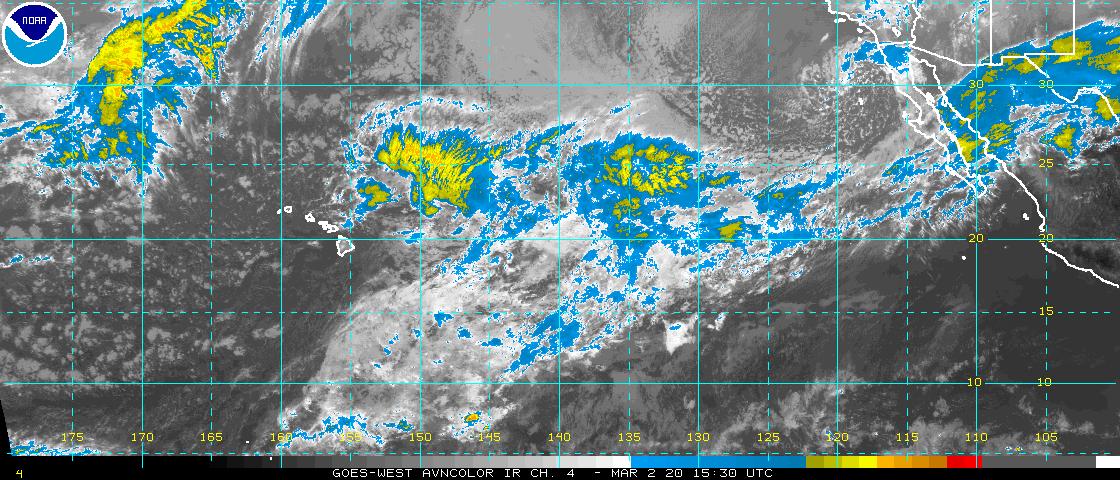
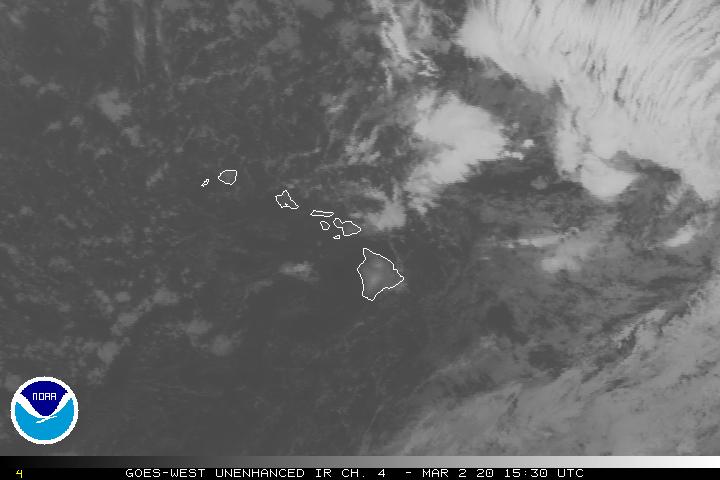
Satellite and Radar Images: To view the cloud conditions we have here in Hawaii, please use the following satellite links, starting off with this Infrared Satellite Image of the islands to see all the clouds around the state during the day and night. This next image is one that gives close images of the islands only during the daytime hours, and is referred to as a Close-up visible image. This next image shows a larger view of the Pacific…giving perspective to the wider ranging cloud patterns in the Pacific Ocean. Finally, here’s a Looping IR satellite image, making viewable the clouds around the islands 24 hours a day. To help you keep track of where any showers may be around the islands, here’s the latest animated radar image.
Hawaii’s Mountains – Here’s a link to the live webcam on the summit of near 14,000 foot Mauna Kea on the Big Island of Hawaii. The tallest peak on the island of Maui is the Haleakala Crater, which is near 10,000 feet in elevation. These two webcams are available during the daylight hours here in the islands…and when there’s a big moon rising just after sunset for an hour or two! Plus, during the nights and early mornings you will be able to see stars, and the sunrise too…depending upon weather conditions.
Tropical Cyclone activity in the eastern and central Pacific – Here’s the latest weather information coming out of the National Hurricane Center, covering the eastern north Pacific. You can find the latest tropical cyclone information for the central north Pacific (where Hawaii is located) by clicking on this link to the Central Pacific Hurricane Center. Here’s a tracking map covering both the eastern and central Pacific Ocean. A satellite image, which shows the entire ocean area between Hawaii and the Mexican coast…can be found here.
Aloha Paragraphs

Flash Flood Watch Thursday…Kauai to Oahu

A new tropical cyclone coming our way – Guillermo
The remnant moisture from Felicia has kept the threat of heavy rains over the islands Wednesday…which will continue into the night. As the two pictures above show, there’s still lots of tropical moisture hanging over the Aloha state at Wednsday night. This will keep localized on and off showers around for a while yet, a couple of which will be heavy…perhaps leading to some flash flooding. As former Felicia pulls away from the islands, we will see southeast breezes develop in its wake…potentially carrying volcanic haze up over the islands on Thursday. Putting a positive spin on all of this, we’ll be heading back into a normal summer weather pattern as we get into Friday and the weekend!
The atmosphere, especially from Maui County down to the Big Island, remained charged with tropical moisture…thanks to the unusual south to southwest Kona winds. The original moisture of course was carried over us by former tropical cyclone Felicia. Looking around the state Wednesday evening, we find relative humidities still at higher levels than we usually see, some as high as 100%. As we move into Thursday, the hot summer sunshine, will set the stage for more muggy and sultry weather for the Hawaiian Islands. It will be partly to mostly cloudy, and with daytime temperatures rising into the 80F’s…so that it’s going to be feeling very equatorial.
The western Islands of Kauai and Oahu, were finding localized gusty winds…while most of Maui and the Big Island found lighter Kona winds in general Wednesday. None of these winds are all that strong though, as we slip into what looks like a fairly slack wind condition for about another day or so. As what’s left of Felicia glides further to the west, we’ll gradually see the return of a normal trade wind weather pattern. It was interesting to see the jets taking off into the Kona winds Wednesday, which is something we rarely find during the summer months! When I was at lunch in Kihei, Maui this afternoon, the ocean surface there was all chalked-up with white caps…generated by these Kona winds.
Rainfall became generous as dissipated Felicia slipped over the islands Tuesday night into Wednesday. There were many reports of 3.00" – 4.00"+ amounts of tropical rainfall. The atmosphere remains ripe for more showers, a few of which could continue to be on the very generous side from Kauai down through Maui County. The largest precipitation report showed an impressive 8.78" in the mountains on Oahu! Looking at that satellite image above, and the radar loop too, we can see that there will be possibly more locally heavy rains during the night Wednesday. Thursday, with the light winds, and muggy air, along with the hot sunshine…could produce more of these showers.
Looking a bit further ahead, we’ll gradually find improving weather conditions Friday…into the weekend. The clouds and showers that surround us Wednesday evening, will finally nudge westward, and in the process we’ll dry out. As the trade winds come back, our atmosphere will become less humid, and we’ll begin to feel more comfortable. Speaking of the trade winds, they will become stronger and more gusty as we move into next week. They will carry some showers to the windward sides, although that is completely normal.
A new tropical depression formed in the eastern Pacific, which was called 10E...and quickly strengthed into tropical storm Guillermo. This will be the next storm that will be traveling westward into our central Pacific Ocean. Here’s a tracking map for Guillermo, with the Big Island along the left hand border of the picture. Here’s a satellite image showing Guillermo, that big bright red and orange glob of clouds in the eastern Pacific…which will be a hurricane soon. At this point, it looks like Guillermo will pass from the eastern Pacific into our central Pacific this coming Sunday afternoon. If we project out from there, the track continues to point towards Hawaii.
It’s around 6pm Wednesday evening here in Kihei, Maui, as I begin typing this last paragraph of today’s narrative. What an interesting time! To have a category 4 hurricane, which started out way over towards Mexico about two weeks ago, travel well over 2,000 miles across the ocean, and end up hitting us at just less than tropical depression strength – is amazing in my eyes! Felicia brought just what we needed, which was rainfall, and didn’t bring just what we didn’t want…which was strong winds. The remnant moisture from this retired tropical cyclone is what has kept us locally wet during the last 24 hours. The influence of this moisture, and the unusual wind directions, will still be around Thursday, although it should fade by Friday. This will make way for what looks like a great weekend coming up.
~~~ I’ll be back early Wednesday morning with more weather information, including what’s new with tropical storm Guillermo…again, our next approaching storm to watch. The NWS still has a flash flood watch in effect Wednesday evening, so we still aren’t quite out of the woods, so to speak. I’m heading up to Kula now, and will report back in here if I see anything too unusual along the way back upcountry. I hope you have a good night until we meet again, perhaps on Thursday, depending upon your particular interest level. Aloha for now…Glenn.
Interesting: Over 350 new species including the world’s smallest deer, a "flying frog" and a 100 million-year old gecko have been discovered in the Eastern Himalayas, a biological treasure trove now threatened by climate change. A decade of research carried out by scientists in remote mountain areas endangered by rising global temperatures brought exciting discoveries such as a bright green frog that uses its red and long webbed feet to glide in the air.
One of the most significant findings was not exactly "new" in the classic sense. A 100-million year-old gecko, the oldest fossil gecko species known to science, was discovered in an amber mine in the Hukawng Valley in the northern Myanmar.
"The good news of this explosion in species discoveries is tempered by the increasing threats to the Himalayas’ cultural and biological diversity," said Jon Miceler, Director of WWF’s Eastern Himalayas Program. "This rugged and remarkable landscape is already seeing direct, measurable impacts from climate change and risks being lost forever."
Interesting2: A new study, presented at the meeting of the Ecological Society of America in Albuquerque, found far more mosquitoes in sewage-contaminated streams than in clean ones. Sewage-bred mosquitoes were also bigger and faster than those in purer waters. Mosquitoes carry West Nile virus and other dangerous diseases. The new study suggests that sewage is a public health hazard in more ways than one.
"What it means for people is that we need to push to have cleaner streams in cities," said lead author Luis Fernando Chaves, an ecologist at Emory University in Atlanta. "One way to reduce these artificial problems is to ensure the water quality of these streams by not dumping sewage in them."
Interesting3: General Motors announced Tuesday that its forthcoming electric vehicle, the Chevrolet Volt, will get fuel economy of 230 miles per gallon in city driving, an achievement that both accelerates and befogs the industry’s race to produce more efficient cars. The Volt will become the first mass-produced vehicle to obtain a triple-digit mpg rating, the company said, and some industry analysts agreed that the car may put the company a step ahead of competitors building plug-in hybrids.
"The GM vehicle is the best one in the country based on what we’ve seen," said Don Hillebrand, director of transportation research at the Energy Department’s Argonne National Laboratory, the nation’s leading lab for plug-in vehicles. "But it’s hard to tell — other companies could be keeping theirs secret."
Interesting4: When Kay Helt moved into his superefficient home on the outskirts of Copenhagen two years ago, he felt as if he had just stepped into the lifestyle of the future. His high-tech house uses five times less energy for heating than his old one, and it recycles rainwater for the toilets and shower. Yet in only a few years, Helt’s house will already be obsolete.
With various degrees of urgency, E.U. countries are moving toward requiring new homes to only use clean energy and have zero net carbon emissions, despite some real estate developers’ complaints that such homes cost more to build and will be harder to sell.
The United Kingdom mandates all new homes be zero-carbon by 2016. France and Germany are debating stronger building requirements of their own. And Denmark will require all new houses to meet the "passive house" standard by 2020, meaning using 85 percent less energy and producing 95 percent less carbon dioxide than regular houses.
Interesting5: Annual U.S. emissions of the main greenhouse gas from the burning of coal, natural gas and petroleum should fall 5 percent in 2009 as the recession crimps demand, the government’s top energy forecaster said on Tuesday. "The economic downturn, combined with natural gas displacing some coal as a source of electricity generation, is projected to lead to a 5 percent decline in fossil-fuel based (carbon dioxide) emissions in 2009," the Energy Information Administration said in its monthly forecast.
Carbon dioxide emissions from energy sources represented about 81 percent of total U.S. greenhouse gas output in 2007, according to federal data. The EIA said "an improving economy" should raise annual carbon dioxide emissions from fossil fuels by 0.7 percent next year.
Interesting6: Is it just a coincidence that all the world’s tallest mountain ranges lie at low latitudes? Apparently not, as it seems warmer climates enhance mountain growth. Three things control how high a mountain range is likely to grow: the strength of the underlying crust, the magnitude of tectonic forces pushing upwards, and the amount of erosion wearing the mountains down.
All of the world’s highest ranges have strong underlying crust, but until now it wasn’t clear whether the world’s tallest peaks were dominated by strong uplift or minimal erosion. Using satellite images, David Egholm of Aarhus University in Denmark and colleagues mapped all the major mountain ranges between 60° north and 60° south, plotting their land surface area against elevation.
They compared this with the average altitude of the snowline and the latitude of each range. They also modeled the effects of glacial erosion. At low latitudes, the warmer climate tended to push the snowline higher, and the mountains grew taller, they found.
"Erosion processes are more effective above the snowline where glacial erosion dominates," says Vivi Pedersen of Aarhus University. Peaks are rarely more than 1500 meters above the snowline, meaning that low-latitude ranges like the Himalayas have a head start over high-latitude ranges because their snowline is much higher.
 Email Glenn James: