August 1-2, 2009
Air Temperatures – The following maximum temperatures were recorded across the state of Hawaii Saturday afternoon:
Lihue, Kauai – 83
Honolulu, Oahu – 90
Kaneohe, Oahu – 84
Kahului, Maui – 86
Hilo, Hawaii – 81
Kailua-kona – 88
Air Temperatures ranged between these warmest and coolest spots near sea level – and on the highest mountains…at 4 p.m. Saturday afternoon:
Honolulu, Oahu – 87F
Hilo, Hawaii – 77
Haleakala Crater – 57 (near 10,000 feet on Maui)
Mauna Kea summit – 66 (near 14,000 feet on the Big Island)
Precipitation Totals – The following numbers represent the largest precipitation totals (inches) during the last 24 hours on each of the major islands, as of Saturday afternoon:
0.97 Mount Waialaele, Kauai
2.06 Oahu Forest NWR, Oahu
0.26 Molokai
0.02 Lanai
0.05 Kahoolawe
2.57 West Wailuaiki, Maui
0.81 Kamuela upper, Big Island
Marine Winds – Here’s the latest (automatically updated) weather map showing a 1027 millibar high pressure system to the northeast of the islands. This high pressure cell, along with its associated ridge to our north, will keep the trade winds blowing through Sunday. Tropical storm Lana will move by to the south of the state.
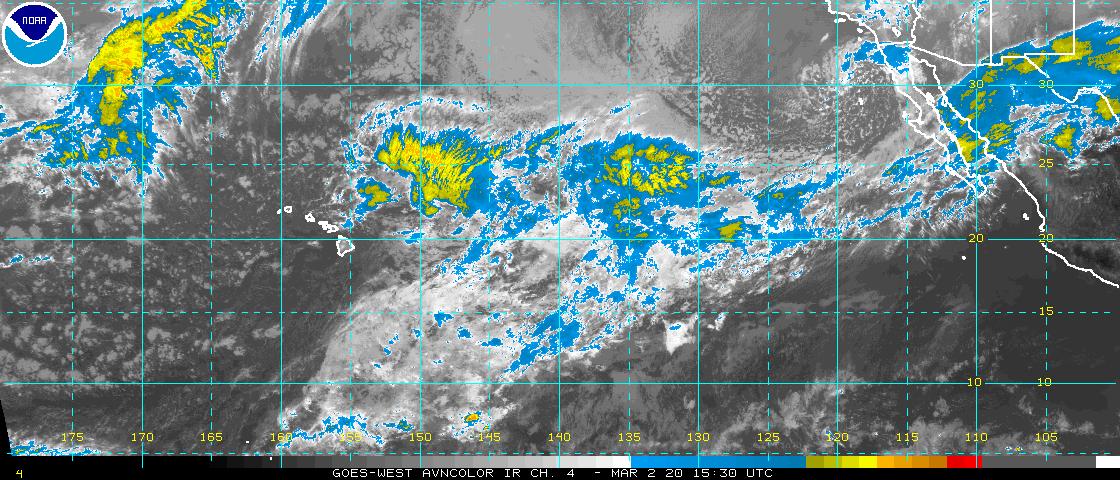
Satellite and Radar Images: To view the cloud conditions we have here in Hawaii, please use the following satellite links, starting off with this Infrared Satellite Image of the islands to see all the clouds around the state during the day and night. This next image is one that gives close images of the islands only during the daytime hours, and is referred to as a Close-up visible image. This next image shows a larger view of the Pacific…giving perspective to the wider ranging cloud patterns in the Pacific Ocean. Finally, here’s a Looping IR satellite image, making viewable the clouds around the islands 24 hours a day. To help you keep track of where any showers may be around the islands, here’s the latest animated radar image.
Hawaii’s Mountains – Here’s a link to the live webcam on the summit of near 14,000 foot Mauna Kea on the Big Island of Hawaii. The tallest peak on the island of Maui is the Haleakala Crater, which is near 10,000 feet in elevation. These two webcams are available during the daylight hours here in the islands…and when there’s a big moon rising just after sunset for an hour or two! Plus, during the nights and early mornings you will be able to see stars, and the sunrise too…depending upon weather conditions.
Tropical Cyclone activity in the eastern and central Pacific – Here’s the latest weather information coming out of the National Hurricane Center, covering the eastern north Pacific. You can find the latest tropical cyclone information for the central north Pacific (where Hawaii is located) by clicking on this link to the Central Pacific Hurricane Center. Here’s a tracking map covering both the eastern and central Pacific Ocean. A satellite image, which shows the entire ocean area between Hawaii and the Mexican coast…can be found here.
Aloha Paragraphs

Windward Oahu
We will see a modest surge in our trade winds speeds through the rest of this weekend…as tropical storm Lana moves by to the south of the Hawaiian Islands. The trade winds have increased some, enough to push the small craft wind advisory in those windiest areas between Oahu and the islands of Maui County, down into area around the Big Island Saturday evening. Speaking of advisories, we also have a high surf advisory along our south and west facing leeward beaches as well. The Central Pacific Hurricane Center in Honolulu has kept a live a tropical storm warning for the waters south of 17 degrees north latitude…or about 200+ miles south of Hawaii.
The majority of the showers falling here in the islands will remain over the windward coasts and slopes through Sunday into the new work week ahead. An upper level trough of low pressure has moved away Saturday evening…so that our overlying atmosphere has become more dry and stable. As this low moves away, and loses its influence, we will settle back into a fairly normal early August precipitation regime going forward. The leeward beaches should be quite sunny during the days, although locally breezy during the afternoon hours. The high clouds streaming off the tops of thunderstorms around Lana, will produce cloudier skies across the islands later Sunday into Monday.
Tropical storm Lana will pass by several hundred miles to the south of our Hawaiian Islands, with little if any direct influence on our local weather circumstances. Here’s a tracking map, showing her expected course of travel to our south. Perhaps the most pronounced effect will be a modest surge in our local trade wind speeds through this weekend into Monday. Here’s a satellite image showing this tropical cyclone to the south of the Hawaiian Islands. It would be wise to at least keep an eye on Lana, as we always do, when we have a tropical storm passing relatively close to our islands. This weakening tropical storm will pass by about 300 miles south of the Big Island of Hawaii Saturday evening.
It’s Saturday evening here in Kula, Maui, as I begin writing this last part of this morning’s narrative. Saturday was quite a nice day, despite all the talk about tropical storm Lana in our general area of the north central Pacific. The paragraph above gives the main points about Lana, in case you skipped over that section. Here’s a looping satellite image of this storm down to the south of Hawaii. You can see the clouds spreading north-northeast from the center of this complex of thunderstorms associated with Lana. This is a good sign, showing that the upper level winds are shearing the top portions of this storm…which in turn weakens the system. As this tropical system moves by to the south and southwest of our islands, our skies will become more cloudy, as those winds aloft carry the associated high level cirrus clouds from Lana over us. The latest forecast has this storm diminishing into a tropical depression, and then a remnant low pressure system soon thereafter. All of this is good news for our fragile islands, as we dodge this bullet, so to speak.
~~~ I’ll be back back Sunday morning with more updates, and additional information about tropical storm Lana. I hope you have a great Saturday night from wherever you happen to be reading! Aloha for now…Glenn.
Interesting: Next time you go for a dip in the sea, bear in mind that your deft front crawl is helping to mix up the waters. In fact, marine life may be stirring the oceans and moving nutrients around as much as winds or tides. According to a theory proposed by Darwin’s grandson, Charles Galton Darwin, a body moving through water drags some of the fluid with it.
In "Darwin drift", a high-pressure zone forms at the front of each swimming animal, leaving an area of lower pressure behind, which draws in adjacent water. This results in a net movement of fluid in the direction of the swimmer.
To test the idea, Kakani Katija and John Dabiri at the California Institute of Technology in Pasadena went to a lake in the Republic of Palau in the Pacific Ocean. Diving among swarms of jellyfish, the pair used suspended dyes and a newly designed laser velocimeter to measure the movement of water around the jellyfish.
They found that the animals did indeed drag water with them as they swam (Nature, vol 460, p 624). The researchers then estimated the total energy that all ocean swimmers impart on the water. They calculated that it was on a par with the mixing energy imparted by winds or tides. The findings suggest ocean swimmers can move water over long distances and that they could help run the vertical currents that push nutrients around between the sea floor and surface waters.
Interesting2: You probably hadn’t noticed — but the head shape and overall size of rodents has been changing over the past century. A University of Illinois at Chicago ecologist has tied these changes to human population density and climate change.
The finding is reported by Oliver Pergams, UIC research assistant professor of biological sciences, in the July 31 issue of PLoS One. Pergams said that such size-and-shape changes in mammals, occurring around the world in less than a century, are quite substantial.
He had done earlier studies on a century’s worth of anatomic changes between two geographically isolated rodents — Channel Island deer mice from coastal California and white-footed mice northwest of Chicago — and noted fast change among both.
"I suspected they weren’t unique examples," he said. "I wondered whether these changes were occurring elsewhere, whether they were global in nature, and what some of the causes may be."
Pergams examined specimen rodents from museums around the world, including the big collections held at Chicago’s Field Museum and the Smithsonian in Washington. Altogether, he recorded more than 17,000 body and skull measurements from 1,300 specimens from 22 locations in Africa, the Americas and Asia.
The animals were collected from 1892 to 2001, and Pergams compared those from before 1950 to those collected after. He also compared specimens gathered from sparsely populated islands to those from the mainland, where human populations were denser.
Pergams found both increases and decreases in the 15 anatomic traits he measured, with changes as great as 50 percent over 80 years. Ten of the 15 traits were associated with changes in human population density, current temperature, or trends in temperature and precipitation.
"Rapid change, contrary to previous opinion, really seems to be happening quite frequently in a number of locations around the world," Pergams said. "There seem to be significant correlations with ‘people-caused’ parameters, such as population density and anthropologically-caused climate change."
Interesting3: Comets have contained vast amounts of liquid water in their interiors during the first million years of their formation, a new study claims. The watery environment of early comets, together with the vast quantity of organics already discovered in comets, would have provided ideal conditions for primitive bacteria to grow and multiply.
So argue Professor Chandra Wickramasinghe and his colleagues at the Cardiff Centre for Astrobiology in a paper published in the International Journal of Astrobiology. The Cardiff team has calculated the thermal history of comets after they formed from interstellar and interplanetary dust approximately 4.5 billion years ago.
The formation of the solar system itself is thought to have been triggered by shock waves that emanated from the explosion of a nearby supernova. The supernova injected radioactive material such as Aluminium-26 into the primordial solar system and some became incorporated in the comets.
Professor Chandra Wickramasinghe together with Drs Janaki Wickramasinghe and Max Wallis claim that the heat emitted from radioactivity warms initially frozen material of comets to produce subsurface oceans that persist in a liquid condition for a million years. Professor Wickramasinghe said:
"These calculations, which are more exhaustive than any done before, leaves little doubt that a large fraction of the 100 billion comets in our solar system did indeed have liquid interiors in the past. Comets in recent times could also liquefy just below their surfaces as they approach the inner solar system in their orbits.
Evidence of recent melting has been discovered in recent pictures of comet Tempel 1 taken by the "Deep Impact" probe in 2005." The existence of liquid water in comets gives added support for a possible connection between life on Earth and comets. The theory, known as cometary panspermia, pioneered by Chandra Wickramasinghe and the late Sir Fred Hoyle argues the case that life was introduced to Earth by comets.
Interesting4: Scientists have joined forces in a groundbreaking assessment on the status of marine fisheries and ecosystems. The two-year study, led by Boris Worm of Dalhousie University and Ray Hilborn of the University of Washington and including an international team of 19 co-authors, shows that steps taken to curb overfishing are beginning to succeed in five of the ten large marine ecosystems that they examined.
The paper, which appears in the July 31 issue of the journal Science, provides new hope for rebuilding troubled fisheries. The study had two goals: to examine current trends in fish abundance and exploitation rates (the proportion of fish taken out of the sea) and to identify which tools managers have applied in their efforts to rebuild depleted fish stocks.
The work is a significant leap forward because it reveals that the rate of fishing has been reduced in several regions around the world, resulting in some stock recovery. Moreover, it bolsters the case that sound management can contribute to the rebuilding of fisheries elsewhere. It’s good news for several regions in the U.S., Iceland and New Zealand.
"These highly managed ecosystems are improving" says Hilborn. "Yet there is still a long way to go: of all fish stocks that we examined sixty-three percent remained below target and still needed to be rebuilt." "Across all regions we are still seeing a troubling trend of increasing stock collapse," adds Worm. "But this paper shows that our oceans are not a lost cause.
The encouraging result is that exploitation rate – the ultimate driver of depletion and collapse – is decreasing in half of the ten systems we examined in detail. This means that management in those areas is setting the stage for ecological and economic recovery. It’s only a start – but it gives me hope that we have the ability to bring overfishing under control."
The authors caution that their analysis was mostly confined to intensively managed fisheries in developed countries, where scientific data on fish abundance is collected. They also point out that some excess fishing effort is simply displaced to countries with weaker laws and enforcement capacity.
While most of the fisheries that showed improvement are managed by a few wealthy nations, there are some notable exceptions. In Kenya, for example, scientists, managers, and local communities have teamed up to close some key areas to fishing and restrict certain types of fishing gear.
This led to an increase in the size and amount of fish available, and a consequent increase in fishers’ incomes. "These successes are local – but they are inspiring others to follow suit," says Tim McClanahan of the Wildlife Conservation Society in Kenya.
"We know that more fish can be harvested with less fishing effort and less impact on the environment, if we first slow down and allow overfished populations to rebuild," adds co-author Jeremy Collie from the University of Rhode Island. "Scientists and managers in places as different as Iceland and Kenya, have been able to reduce overfishing and rebuild fish populations despite serious challenges."
Interesting5: Wild spider monkeys now have a new tool under their proverbial belt: a body scratcher that may release medicinal compounds, according to a study published in the latest issue of the journal Primates. The study is the first to report this spider monkey scratcher. Lead author Stacy Lindshield told Discovery News that two other instances of the use of objects as tools by the social monkeys have been documented.
"Spider monkeys have been observed rubbing crushed and chewed leaves on their bodies," said Lindshield, a researcher in Iowa State University’s Ecology and Evolutionary Biology Graduate Program. She explained that the smelly practice may "play a role in olfactory communication."
"Second, spider monkeys are known to break off branches and drop them on or near human observers," she added, "so it’s not a good idea to be directly beneath these guys!" She and co-author Michelle Rodrigues collected observational data on wild spider monkeys at El Zota Biological Field Station in northeastern Costa Rica.
They documented three instances where the monkeys used the scratcher tool. The first to scratch was an adult female. Holding a small, leafy branch in her hand, she scratched her chest and abdominal regions. The second, another adult female, used a detached stick lacking side branches and leaves to scratch her left side. She chewed the tool tip between bouts.
The third individual, a juvenile female, first chewed the distal tip of a stick before scratching the underside of her tail and her genital region. The scientists think that by modifying the scratcher tip, the monkeys could be providing "more relief and comfort during scratching."
The chewing alteration could "also be related to the chemical properties of the selected plant, as research on fur-rubbing and self-medication indicates that some primates select plants or invertebrates with chemical properties for this reason."
Like a human slathering on scented ointment, the plants may then be providing soothing compounds. Since the monkeys aren’t just scratching hard-to-reach spots, they could also be stimulating their own scent production glands, which are involved in nose-detecting communication.
Interesting6: There’s no question that the world’s fish are in trouble. Fishermen are pulling fish out of the seas far faster than these populations can grow back. Some fisheries are heading toward collapse or even extinction. But a major new analysis of this grim picture shows that fisheries aren’t doomed.
In fact, some are on the mend. This new study grew out of a raging controversy. Three years ago, Boris Worm and his colleagues at Dalhousie University in Canada sent shock waves through the world of fishing and fisheries science.
They published a paper in Science magazine showing that if current trends continued, the oceans would be essentially fished out by the middle of this century. Worm says this new analysis relies on much more scientific data to assess the state of the world’s fisheries.
And it is still not an upbeat report. Some of the good-news stories come from the United States. Strict federal fishing laws have cut back significantly on overfishing. And some stocks, such as haddock off New England, have rebounded so well, they are actually as healthy as they’ve ever been. Iceland, too, has rebuilt some of its fisheries.
 Email Glenn James: