July 8-9, 2009
Air Temperatures – The following maximum temperatures were recorded across the state of Hawaii Wednesday afternoon:
Lihue, Kauai – 84
Honolulu, Oahu – 87
Kaneohe, Oahu – 83
Kahului, Maui – 85
Hilo, Hawaii – 79
Kailua-kona – 86
Air Temperatures ranged between these warmest and coolest spots near sea level – and on the highest mountains…at 5 p.m. Wednesday evening:
Barking Sands, Kauai – 88F
Princeville, Kauai – 81
Haleakala Crater – 59 (near 10,000 feet on Maui)
Mauna Kea summit – 41 (near 14,000 feet on the Big Island)
Precipitation Totals – The following numbers represent the largest precipitation totals (inches) during the last 24 hours on each of the major islands, as of Wednesday afternoon:
0.28 Mount Waialaele, Kauai
0.33 Manoa Valley, Oahu
0.03 Molokai
0.00 Lanai
0.00 Kahoolawe
0.44 West Wailuaiki, Maui
0.48 Piihonua, Big Island
Marine Winds – Here’s the latest (automatically updated) weather map showing a 1028 millibar high pressure system to the northeast of the islands. This high pressure cell, with its associated high pressure ridge, will keep the trade winds blowing through Friday.
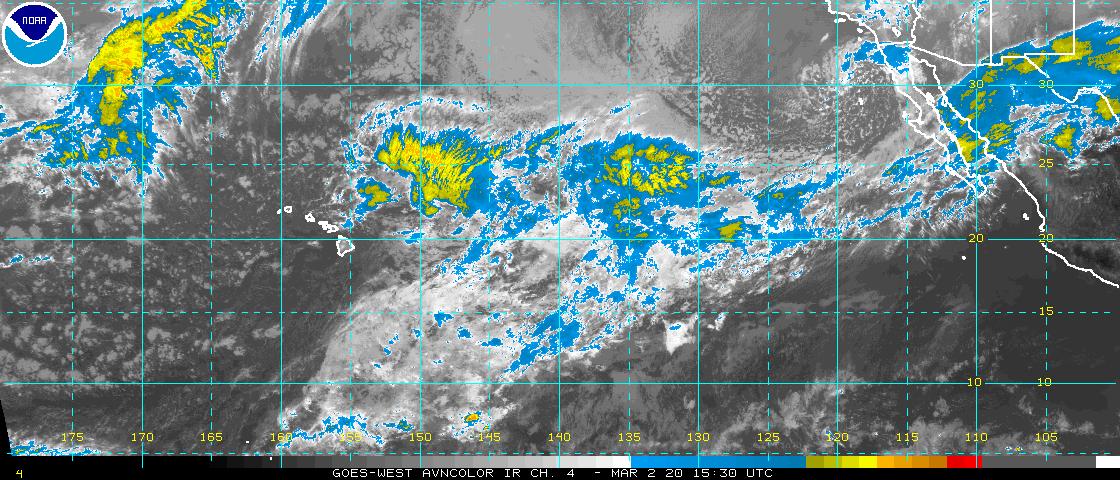
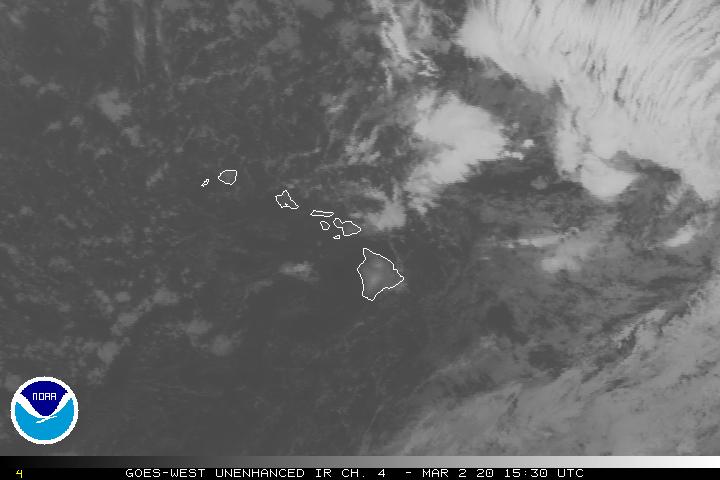
Satellite and Radar Images: To view the cloud conditions we have here in Hawaii, please use the following satellite links, starting off with this Infrared Satellite Image of the islands to see all the clouds around the state during the day and night. This next image is one that gives close images of the islands only during the daytime hours, and is referred to as a Close-up visible image. This next image shows a larger view of the Pacific…giving perspective to the wider ranging cloud patterns in the Pacific Ocean. Finally, here’s a looping IR satellite image, making viewable the clouds around the islands 24 hours a day. To help you keep track of where any showers may be around the islands, here’s the latest animated radar image.
Hawaii’s Mountains – Here’s a link to the live webcam on the summit of near 14,000 foot Mauna Kea on the Big Island of Hawaii. The tallest peak on the island of Maui is the Haleakala Crater, which is near 10,000 feet in elevation. These two webcams are available during the daylight hours here in the islands…and when there’s a big moon rising just after sunset for an hour or two! Plus, during the nights and early mornings you will be able to see stars, and the sunrise too…depending upon weather conditions.
Tropical Cyclone activity in the eastern and central Pacific – Here’s the latest weather information coming out of the National Hurricane Center, covering the eastern north Pacific. You can find the latest tropical cyclone information for the central north Pacific (where Hawaii is located) by clicking on this link to the Central Pacific Hurricane Center. Here’s a tracking map covering both the eastern and central Pacific Ocean. A satellite image, which shows the entire ocean area between Hawaii and the Mexican coast…can be found here.
Aloha Paragraphs

The upper west side…Maui
High pressure to our north-northeast, will keep the trade winds alive through the rest of this week…into next week. These common trades will blow in the moderately strong category, although those typically windier areas, and especially around Maui and the Big Island…will be a bit more blustery. Here’s a weather map showing the familiar 1029 millibar high pressure system anchored to the north-northeast of Hawaii Wednesday evening…the source of our breezy winds.
The windward sides will find the bulk of whatever showers that fall…leaving the leeward sides generally dry and warm. Some of those windward showers will be briefly heavy, but as they move quickly along in the trade wind flow, will end quickly. The leeward sides in contrast, will remain mostly dry, with warm to very warm daytime temperatures prevailing. We can see a fair amount of low clouds out over the oceans offshore from the islands, by glancing at this IR satellite image. We may see an increase in showers towards the upcoming weekend…especially on the windward sides.
The third tropical cyclone of the year remains active over in the eastern Pacific…called tropical cyclone Blanca. This storm won’t have any influence here in the islands however…just the way we like it. Here’s a tracking map, which shows it heading west…but it will dissipate well before getting anywhere near us. Here’s a satellite image giving a good perspective of how far away Blanca is from our Hawaiian islands Wednesday. Blanca has recently weakened into a tropical depression, losing strength from the recent tropical storm designation.
It’s Wednesday evening here in Kihei, Maui, as I begin writing this last part of today’s narrative. Wednesday was yet another great day, which is very common during our summer season…here in the tropics. As a result, with all that sunshine beaming down, Honolulu zoomed up to 87 degrees this afternoon. The trade winds blew rather strongly once again today, with a gust at around 5pm still topping out at 40 mph at Maalaea Bay, on Maui. Just behind that top gust, South Point, that southern most place in the islands, on the Big Island…had a gust of 39 mph. Looking out the window here in Kihei, before I take the drive back home upcountry, I see mostly sunny skies in all directions. Even the windward sides are uncharacteristically cloud free. ~~~ I’ll be back early Thursday morning with your next new weather narrative from paradise. I hope you have a great Wednesday night until then! Aloha for now…Glenn.
Interesting: Synthetic fertilizers have dramatically increased food production worldwide. But the unintended costs to the environment and human health have been substantial. Nitrogen runoff from farms has contaminated surface and groundwater and helped create massive "dead zones" in coastal areas, such as the Gulf of Mexico. And ammonia from fertilized cropland has become a major source of air pollution, while emissions of nitrous oxide form a potent greenhouse gas.
These and other negative environmental impacts have led some researchers and policymakers to call for reductions in the use of synthetic fertilizers. But in a report published in the June 19 issue of the journal Science, an international team of ecologists and agricultural experts warns against a "one-size-fits-all" approach to managing global food production.
"Most agricultural systems follow a trajectory from too little in the way of added nutrients to too much, and both extremes have substantial human and environmental costs," said lead author Peter Vitousek, a professor of biology at Stanford University and senior fellow at Stanford’s Woods Institute for the Environment.
"Some parts of the world, including much of China, use far too much fertilizer," Vitousek said. "But in sub-Saharan Africa, where 250 million people remain chronically malnourished, nitrogen, phosphorus and other nutrient inputs are inadequate to maintain soil fertility."
Interesting2: One fine day about 74,000 years ago, a giant volcano on Sumatra blew its top. The volcano named Toba, may have ejected 1000 times more rock and other material than Mount St. Helens in Washington state did in 1980. In the process, it cooled the climate by at least 10°C, causing a global famine. But could the aftermath have been even worse?
A new study puts to rest questions about whether Toba plunged Earth into a 1000-year deep freeze and whether an equivalent event today could jump-start a new, millennium-long ice age. Giant volcanic eruptions such as Toba briefly cause the opposite of global warming.
Although eruptions do emit greenhouse gases such as carbon dioxide, volcanoes also spew sulfur dioxide. Combined with water vapor, sulfur dioxide forms sulfate aerosols, which can spread around the globe, blocking solar radiation and chilling the air before becoming acid rain and snow.
Paleoclimate evidence suggests that the Toba eruption, which occurred during the last ice age, emitted lots of sulfur dioxide–vastly more than Mount St. Helens did. The eruption also seems to have coincided with the start of a 1000-year period of even colder temperatures.
Some scientists have suggested that Toba caused the deep freeze and that perhaps such an event happening today could bring on a new ice age. But models developed by NASA and the National Center for Atmospheric Research in Boulder, Colorado, argue otherwise.
Interesting3: The United States-Mexico border fence may block more wildlife border crossings than people crossings. The already limited populations of pygmy owls and bighorn sheep will likely be among those further threatened by the fence, says a new study.
"In some respects, it’s as obvious as the nose on your face: If you put up a 20-foot chunk of steel, things probably aren’t going to move across it, but we have to show it," said Paul Beier of Northern Arizona University in Flagstaff, who was not a part of the study.
"It’s kind of a shame that we need to prove the obvious, but we do. So this is an important paper in that regard." Since the U.S. government authorized construction of a fence along 700 miles of the border between the U.S. and Mexico in 2006, scientists have raised concerns that a person-tight fence would also exclude many species that rely on habitat on either side of the border. The new research suggests such concerns are valid.
Interesting4: The Amazon River and its current lengthy and transcontinental bed is about 11 million years old, according to a new study. Previously, the river’s exact age was unknown, researchers say. The Amazon, which starts in the Andes and flows easterly into the Atlantic Ocean, originated as a transcontinental river back in the Miocene Epoch between 11.8 million and 11.3 million years ago, and took its present shape about 2.4 million years ago, according to the study by Carina Hoorn of the University of Amsterdam, Jorge Figueiredo of the University of Liverpool, England, and colleagues. The new estimate won’t set any age records for rivers.
Earth’s oldest rivers are hundreds of millions of years old. In fact, while the Amazon is said by some to be Earth’s longest river, it is "quite a youngster among rivers," Hoorn told LiveScience. "For comparison, the New River in North America and the Nile in Africa are thought to be several hundred million years old. The reason for this is that rivers are controlled by their source area. Rivers are as old as the mountains in the hinterlands, one could say.
The Andes uplifted mostly in the past 12 million years and hence the formation and shifting of drainage patterns." The research, published in the July issue of the journal Geology, was undertaken by Petrobras, the national oil company of Brazil, in cooperation with the University of Amsterdam. The whole history of the fluvial drainage system that eventually became the transcontinental Amazon River that we know today is older than 11 million years, Figueiredo said.
The new estimate dates only the onset of the Amazon as a transcontinental river. A "proto-river" flowed much earlier in geologic time, but only on the eastern part of the Amazon Region, Figueiredo said. A more ancient predecessor to the Amazon actually flowed backward at times, from east to west, according to one unpublished study. The current study focused on samples taken from two boreholes drilled by Petrobras near the mouth of the Amazon.
One of the boreholes was 2.6 miles below sea level. Until recently, the Amazon Fan, a sediment column of around 6 miles thick, was difficult to age based on the jumble of local rocks, and scientific drilling expeditions could only reach a fraction of it, Hoorn said. The new analysis of the borehole samples allowed the researchers to reconstruct the history of the Amazon River, and provides insights into the history of the river and the fan.
This research also has implications for understandings of South American paleogeography and the evolution of aquatic organisms in Amazonia and the Atlantic coast, Hoorn said. Sediment aprons in the proximity of major rivers often hold continuous records of terrestrial material accumulated by the river over time, she said. These records can provide insights into the historic climate and geography of the land.
 Email Glenn James: