July 7-8, 2009
Air Temperatures – The following maximum temperatures were recorded across the state of Hawaii Tuesday afternoon:
Lihue, Kauai – 84
Honolulu, Oahu – 87
Kaneohe, Oahu – 83
Kahului, Maui – 85
Hilo, Hawaii – 80
Kailua-kona – 84
Air Temperatures ranged between these warmest and coolest spots near sea level – and on the highest mountains…at 4 p.m. Tuesday afternoon:
Port Allen, Kauai – 86F
Hilo, Hawaii – 80
Haleakala Crater – 63 (near 10,000 feet on Maui)
Mauna Kea summit – 43 (near 14,000 feet on the Big Island)
Precipitation Totals – The following numbers represent the largest precipitation totals (inches) during the last 24 hours on each of the major islands, as of Tuesday afternoon:
0.45 Mount Waialaele, Kauai
0.16 Manoa Valley, Oahu
0.10 Molokai
0.00 Lanai
0.02 Kahoolawe
0.54 West Wailuaiki, Maui
0.38 Mountain View, Big Island
Marine Winds – Here’s the latest (automatically updated) weather map showing a 1031 millibar high pressure system far to the north-northeast of the islands. This high pressure cell, with its associated high pressure ridge, will keep the trade winds blowing through Thursday.
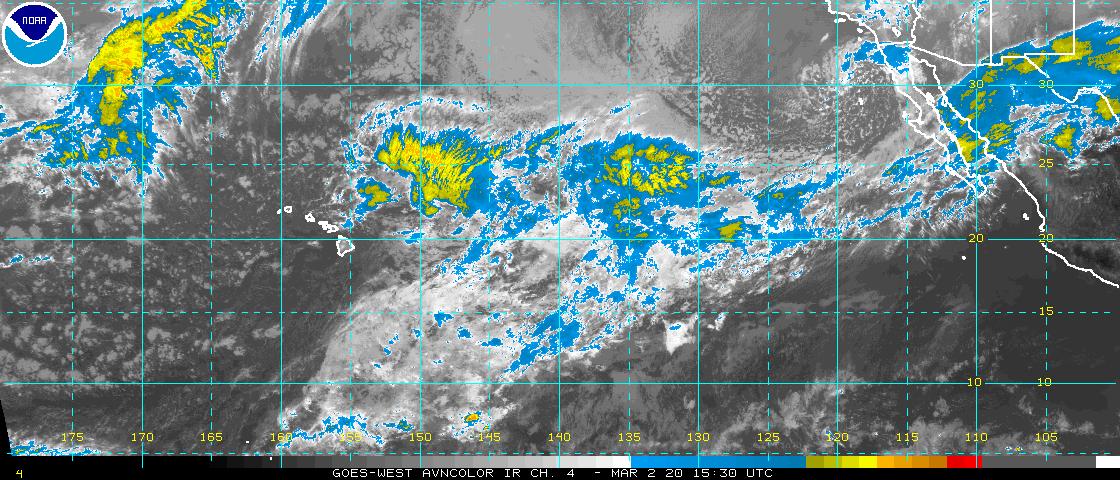
Satellite and Radar Images: To view the cloud conditions we have here in Hawaii, please use the following satellite links, starting off with this Infrared Satellite Image of the islands to see all the clouds around the state during the day and night. This next image is one that gives close images of the islands only during the daytime hours, and is referred to as a Close-up visible image. This next image shows a larger view of the Pacific…giving perspective to the wider ranging cloud patterns in the Pacific Ocean. Finally, here’s a looping IR satellite image, making viewable the clouds around the islands 24 hours a day. To help you keep track of where any showers may be around the islands, here’s the latest animated radar image.
Hawaii’s Mountains – Here’s a link to the live webcam on the summit of near 14,000 foot Mauna Kea on the Big Island of Hawaii. The tallest peak on the island of Maui is the Haleakala Crater, which is near 10,000 feet in elevation. These two webcams are available during the daylight hours here in the islands…and when there’s a big moon rising just after sunset for an hour or two! Plus, during the nights and early mornings you will be able to see stars, and the sunrise too…depending upon weather conditions.
Tropical Cyclone activity in the eastern and central Pacific – Here’s the latest weather information coming out of the National Hurricane Center, covering the eastern north Pacific. You can find the latest tropical cyclone information for the central north Pacific (where Hawaii is located) by clicking on this link to the Central Pacific Hurricane Center. Here’s a tracking map covering both the eastern and central Pacific Ocean. A satellite image, which shows the entire ocean area between Hawaii and the Mexican coast…can be found here.
Aloha Paragraphs

Full moon tonight
Trade winds, and more trade winds…a very common occurrence here in the islands during the summer season. These normal winds of summer are strong enough now, that we see small craft wind advisories in our coastal waters around Maui and the Big Island. Here’s a weather map showing the near 1030 millibar high pressure system to our north-northeast Tuesday evening…the source of our trades. As usual, they will blow strongest during the days, calming down at night in most areas.
Other than a few showers, mostly along the windward sides during the night and early morning hours…our local clouds will remain generally dry. Fairly dry conditions prevail, which isn’t unusual for this time of year. The high clouds, which have been around the last several days, providing great sunrise and sunset colors…have now drifted away. This will make for more sunny weather along our beaches through the next couple of days. Days will be warm to very warm, while nights at sea level will be warm.
The third tropical cyclone of the year remains active over in the eastern Pacific…called tropical storm Blanca. This storm won’t have any influence here in the islands however…just the way we like it. Here’s a tracking map, which shows it heading towards Hawaii…but it will dissipate well before getting anywhere near us. Here’s a satellite image giving a good perspective of how far away Blanca is from our Hawaiian islands Tuesday night.
As noted above, we’re well into the highly regular summer weather season now. This means that day after day, we will have little change in the weather conditions here in the tropics. It will come down to just a few degrees of difference in temperature, and just how strong the trade winds will be blowing. These two parameters will also include the amount of windward biased showers that may fall too. The one more dynamic element, would be any tropical cyclones that happen to bring change to us here in the Hawaiian Islands.
It’s Tuesday evening here in Kihei, Maui, as I begin writing this last part of this afternoon’s narrative. As noted above, the high cirrus clouds are gone now, at least temporarily. The trade winds remain the most pronounced weather feature, with gusty winds, especially during the afternoon hours. I noticed that once again the windy Maalaea Bay, on Maui, had a gust to 43 mph Tuesday afternoon…which is fast! At 5pm, the strongest gust was still at Maalaea, which was checking in at 37 mph. The warmest air temperature anywhere around the state, at the same time, was being being reported at Honolulu, which was still 85F degrees early in the evening. In contrast, the top of Mauna Kea, that near 14,000 summit on the Big Island…the temperature was a chilly 41 degrees at the same time.
~~~ I’m about ready to jump in the car for the drive back upcountry to Kula. I’ll take my walk, watch the sunset, eat dinner, go upstairs for some reading, and then fall asleep. Then it will be early Wednesday, when I’ll get up at around 430am, meditate, get back online to prepare the next weather narrative, and head back down to Kihei for the work day. This is my life during the week, which fortunately I enjoy very much. By the way, I just became aware of the fact that July 7th, today, is the full moon of the month…so that it will be a bright night out there! I hope you have a great Tuesday night, and that perhaps you’ll meet me back here on Wednesday for the next go around. Aloha for now…Glenn.
Interesting: Many offices, businesses and education establishments in Iran have closed for two days because of high pollution levels caused by desert storms. State television said air pollution in the capital, Tehran, had reached levels not seen for 30 years.
Visibility has been reduced to several hundred meters, while some domestic flights have been cancelled. The elderly, children and people with heart and respiratory problems have been told to stay indoors in west Iran.
"All administrative offices are closed because of the atmospheric pollution which has soared several times higher than the normal threshold," said Tehran governor Morteza Tamadon on state television.
In neighboring Iraq, officials described the last week of sandstorms as the worst in history. Hundreds of people were taken to hospital with respiratory problems. Reports say a reduction in the flow of the once-mighty Tigris and Euphrates rivers – from drought and upriver damming – has aggravated the situation.
Interesting2: Particulate air pollution during the 2008 Olympic Games in Beijing constantly exceeded levels considered excessive by the World Health Organization, was far worse than other recent Olympic Games, and was about 30 percent higher than has been reported by Chinese environmental experts – even though some favorable weather conditions helped reduce the problem. The weather, in fact, turned out to be more valuable in addressing this concern than major programs by the Chinese government to heavily restrict automobile use, close factories and slow construction during and before the Olympic games.
These findings are among the final results just published in Environmental Science and Technology, a professional journal, in the first comprehensive study of particulate air pollutants in Beijing and how they compared to past Olympics. The research was done before, during and after the 2008 Olympics by scientists from Oregon State University and Peking University, in work funded by the National Science Foundation in the United States and the National Science Foundation of China.
"Considering the massive efforts by China to reduce air pollution in and around Beijing during the Olympics, this was the largest scale atmospheric pollution experiment ever conducted," said Staci Simonich, an OSU associate professor of environmental and molecular toxicology. "Despite all that, it was some evening rains and favorable shifts in the winds that provided the most relief from the pollution.
"This demonstrates how difficult it is to solve environmental problems on a short-term, local basis," she added. And despite some favorable weather and the pollution control efforts, researchers said, the end result was some of the most severe particulate pollution that Olympic athletes have dealt with in recent games. The levels were about two to four times higher than that of Los Angeles on an average day.
Interesting3: According to the most recent report on the status of the world’s fisheries by the United Nations Food and Agriculture Organization, fisheries supply at least 15% of the animal protein consumed by humans, provide direct and indirect employment for nearly 200 million people worldwide and generate $US85 billion annually. This same report indicates that 28% of the world’s fisheries stocks are currently being overexploited or have collapsed and 52% are fully exploited.
A new study published in PLoS Biology provides the first global evaluation of how management practices influence fisheries’ sustainability. The study assessed the effectiveness of the world’s fisheries management regimes using evaluations from nearly 1,200 fisheries experts, analyzing these in combination with data on the sustainability of fisheries catches.
The results indicate that most fisheries management regimes are lagging far behind standards set by international organizations, and that the conversion of scientific advice into policy, through a participatory and transparent process, plays the most critical role in determining the sustainability of fisheries.
"The world’s fisheries are one of the most important natural assets to humankind," says lead author Camilo Mora, a Colombian researcher at Dalhousie University and the University of California San Diego. "Unfortunately, our use of the world’s fisheries has been excessive and has led to the decline or collapse of many stocks."
"The consequences of overexploiting the world’s fisheries are a concern not only for food security and socio-economic development but for ocean ecosystems," says Boris Worm, a professor at Dalhousie University and co-author of the paper. "We now recognize that overfishing can also lead to the erosion of biodiversity and ecosystem productivity."
Interesting4: A new way of processing rice husks for use in concrete could lead to a boom in green construction. Rice husks form small cases around edible kernels of rice and are rich in silicon dioxide (SiO2), an essential ingredient in concrete. Scientists have recognized the potential value of rice husks as a building material for decades, but past attempts to burn it produced an ash too contaminated with carbon to be useful as a cement substitute.
The world’s penchant for consuming concrete is a huge problem for climate change. Every ton of cement manufactured for use in concrete emits a ton of the greenhouse gas carbon dioxide (CO2) into the atmosphere. Worldwide, cement production accounts for about 5 percent of all CO2 emissions related to human activity.
Interesting5: Charlie Veron, former chief scientist of the Australian Institute of Marine Science, told The Times: "there is no way out, no loopholes. The Great Barrier Reef will be over within 20 years or so." Once carbon dioxide had hit the levels predicted for between 2030 and 2060, all coral reefs were doomed to extinction, he said.
"They would be the world’s first global ecosystem to collapse. I have the backing of every coral reef scientist, every research organization. I’ve spoken to them all. This is critical. This is reality."
Dr Veron’s comments came as the Zoological Society of London, the Royal Society and the International Program on the State of the Ocean (IPSO) held a crucial meeting on the future of coral reefs in London yesterday. In a joint statement they warned that by mid-century extinctions of coral reefs around the world would be inevitable.
Interesting6: The Sri Lankan government is threatening to jail people who do not clean up water puddles in an effort to combat a rise in cases of dengue fever. The disease is spread by mosquitoes, which breed on stagnant water. The authorities are also importing bacteria from Cuba to kill the larvae of the mosquitoes, and are spraying their breeding grounds.
The government says more than 160 people have died from dengue in 2009 – more than double last year’s figure. Dengue fever is a flu-like illness spread by the bite of an infected Aedes mosquito. The disease is most prevalent during the annual monsoons, when heavy rainfall leave puddles of stagnant water where the insects breed.
Government medical official Dr Sankalpa Marasinghe told the BBC Sinhala service that there is a sense of alarm about the disease. "This is because the mortality rate in relation to the infection rate is very high. There have been 163 deaths and 14,750 people infected this year. The spread of the disease is around Sri Lanka, not localised.
There are doubts of the strain of the virus and there could be mutations," he said. "That is why the government is taking various measures, imposing laws and regulations, to keep the environment clean and reduce mosquito breeding. There are direct interventions by the ministries of environment, health and education."
Health officials blame the spread of the disease on people’s carelessness in not properly cleaning their properties and eliminating mosquito breeding grounds. In recent weeks government inspectors have warned people in Colombo and outside the capital that they must get rid of mosquito breeding grounds within two weeks or face fines of up to 25,000 rupees ($220) or a six month jail term.
Dr Marasinghe said that the Cuban bacterium would be useful for large marshy areas. "But there is the problem of feasibility," he said, "since the majority of mosquito breeding occurs in as little as 5mm of water – such as in plant pots." Dengue fever usually begins suddenly with a high temperature, rash, severe headache, pain behind the eyes and in the muscles and joints.
The severity of the joint pain has given the disease the nickname "breakbone fever". Nausea, vomiting and loss of appetite are common. In January Austrian scientists said that people could be protected from dengue by infecting mosquitoes carrying the disease with a parasite which halves their lifespan.
They said that only older mosquitoes pass on dengue – so killing them could cut disease. Many thousands of cases of dengue fever occur worldwide each year, mainly in tropical countries.
The virus is passed to humans when mosquitoes carrying it feed on their blood, and while there have been efforts to eradicate them using insecticides, these have been fraught with problems, including the ability of the mosquito to become resistant to the chemicals used.
Interesting7: After one of the longest sunspot droughts in modern times, solar activity picked up quickly over the weekend. A new group of sunspots developed, and while not dramatic by historic standards, the spots were the most significant in many months. "This is the best sunspot I’ve seen in two years," observer Michael Buxton of Ocean Beach, Calif., said on Spaceweather.com. Solar activity goes in a roughly 11-year cycle.
Sunspots are the visible signs of that activity, and they are the sites from which massive solar storms lift off. The past two years have marked the lowest low in the cycle since 1913, and for a while scientists were wondering if activity would ever pick back up. During 2009 so far, the sun has been completely free of spots about 77 percent of the time.
NASA researchers last month said quiet jet streams inside the sun were responsible, and that activity would soon return to normal. The new set of spots, named 1024, is kicking up modest solar flares. Sunspots are cool regions on the sun where magnetic energy builds up. They serve as a cap on material welling up from below.
Often, that material is released in spectacular light shows called solar flares and discharges of charged particles known as coronal mass ejections. The ejections can travel as space storms to Earth within a day or so, and major storms can knock out satellites and trip power grids on the surface.
Prior to the low-activity period, astronomers had been predicting that the next peak in solar activity, expected in 2013, might be one of the most active in many decades. That forecast was recently revised, however, and scientists now expect the next peak to be modest.
All this matters because, as laid out in a report earlier this year by the National Academy of Sciences, a major solar storm nowadays could cause up to $2 trillion in initial damages by crippling communications on Earth and fueling chaos among residents and even governments in a scenario that would require four to 10 years for recovery.
Such a storm struck in 1859, knocking out telegraph communications and causing those lines to erupt in flames. The world then was not so dependent on electronic communication systems, however.
 Email Glenn James: