July 6-7, 2009
Air Temperatures – The following maximum temperatures were recorded across the state of Hawaii Monday afternoon:
Lihue, Kauai – 84
Honolulu, Oahu – 85
Kaneohe, Oahu – 82
Kahului, Maui – 87
Hilo, Hawaii – 82
Kailua-kona – 84
Air Temperatures ranged between these warmest and coolest spots near sea level – and on the highest mountains…at 4 p.m. Monday afternoon:
Port Allen, Kauai – 88F
Hilo, Hawaii – 80
Haleakala Crater – 63 (near 10,000 feet on Maui)
Mauna Kea summit – 46 (near 14,000 feet on the Big Island)
Precipitation Totals – The following numbers represent the largest precipitation totals (inches) during the last 24 hours on each of the major islands, as of Monday afternoon:
0.14 Mount Waialaele, Kauai
0.25 Munawili Oahu
0.06 Molokai
0.00 Lanai
0.00 Kahoolawe
0.19 West Wailuaiki, Maui
0.04 Kealakekua, Big Island
Marine Winds – Here’s the latest (automatically updated) weather map showing a 1030 millibar high pressure system far to the north-northeast of the islands. This high pressure cell, with its associated high pressure ridge, will keep the trade winds blowing through Wednesday.
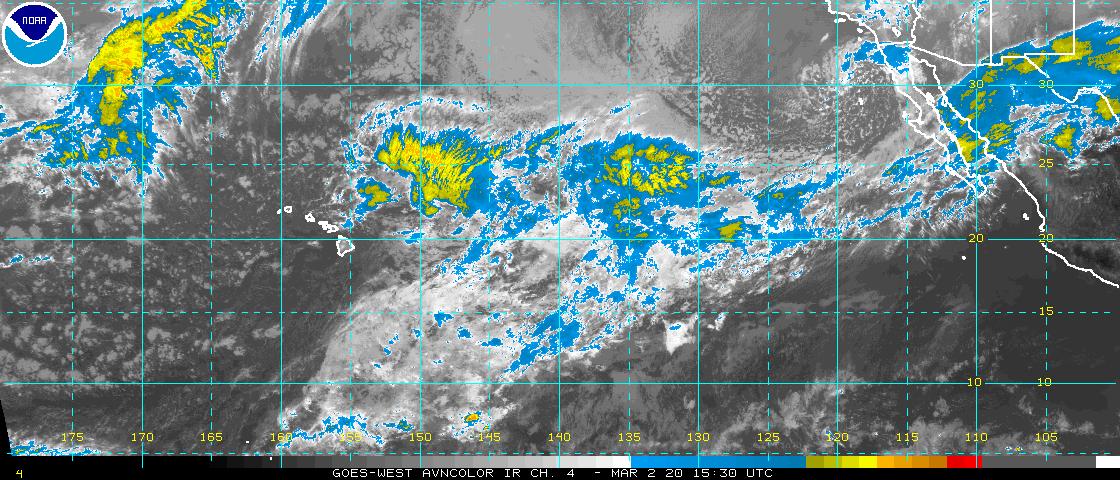
Satellite and Radar Images: To view the cloud conditions we have here in Hawaii, please use the following satellite links, starting off with this Infrared Satellite Image of the islands to see all the clouds around the state during the day and night. This next image is one that gives close images of the islands only during the daytime hours, and is referred to as a Close-up visible image. This next image shows a larger view of the Pacific…giving perspective to the wider ranging cloud patterns in the Pacific Ocean. Finally, here’s a looping IR satellite image, making viewable the clouds around the islands 24 hours a day. To help you keep track of where any showers may be around the islands, here’s the latest animated radar image.
Hawaii’s Mountains – Here’s a link to the live webcam on the summit of near 14,000 foot Mauna Kea on the Big Island of Hawaii. The tallest peak on the island of Maui is the Haleakala Crater, which is near 10,000 feet in elevation. These two webcams are available during the daylight hours here in the islands…and when there’s a big moon rising just after sunset for an hour or two! Plus, during the nights and early mornings you will be able to see stars, and the sunrise too…depending upon weather conditions.
Tropical Cyclone activity in the eastern and central Pacific – Here’s the latest weather information coming out of the National Hurricane Center, covering the eastern north Pacific. You can find the latest tropical cyclone information for the central north Pacific (where Hawaii is located) by clicking on this link to the Central Pacific Hurricane Center. Here’s a tracking map covering both the eastern and central Pacific Ocean. A satellite image, which shows the entire ocean area between Hawaii and the Mexican coast…can be found here.
Aloha Paragraphs

The end of another great day
Typical summertime trade winds will prevail this week here in the islands. These normal winds of summer are strong enough now, that we see small craft wind advisories in our coastal waters around Maui and the Big Island. As the trade winds blow about 95% of the time during the month of July, according to climatology…we’ll see likely no end to their presence into next week at least. Here’s a weather map showing the high pressure system to our north…the source of our trades as we begin this new week.
The usual few windward showers will be carried our way on the trade winds. The leeward beaches will continue to see lots of sunshine, with just an occasional stray shower at times locally. We will continue to see high cirrus moving into the state from the west and southwest, according to this looping satellite image. A trough of low pressure arriving towards the weekend…may increase our windward biased showers a little then.
As noted in the two paragraphs above, there’s nothing unusual about what we expect weatherwise through this new week. Looking a bit further afield, we notice that tropical storm Blanca is active in the eastern Pacific. This storm won’t have any influence here in the islands. Here’s a tracking map, which shows it heading towards Hawaii…but it will dissipate well before getting anywhere near us. Here’s a satellite image giving a good perspective of how far away Blanca is from our Hawaiian islands.
There are still plenty of those same high clouds around Monday evening. These high cirrus clouds will likely provide yet another colorful sunset tonight…keep an eye out this evening. I have the link to the looping satellite image two paragraphs up this page, which show these high clouds moving over the islands. This will cause some filtering of the sunshine today, although we still had quite a warm day…with air temperatures all going up well into the 80F’s at sea level locations. The highest official temperature for the day was 87 degrees at the Kahului, Maui airport.
It’s Monday evening here in Kihei, Maui, as I begin writing this last part of this afternoon’s narrative. Looking out the window here on the south coast, the two main things that I notice are, the gusty trade wind speeds, and the rather thick high cirrus clouds. I would call it partly cloudy, although the sunshine has been able to shine through…although muted. As far as the trade winds go, at around 530pm, the strongest gust that was being recorded, was 39 mph at Maalaea Bay, which was howling at 43 mph earlier in the day. I expect more of those gusty trade winds to be around Tuesday.
~~~ I’m about ready to take the drive back upcountry, back home to Kula. I’d like to get home in time to take a walk, and then settle in on my weather deck for the great sunset that I anticipate to be happening. I’m quite sure that Tuesday’s sunrise will have some good colors as well. I’ll look forward to having your next new weather narrative available for your reading, early Tuesday morning. I hope you have a great Monday night from wherever you happen to be reading from! Aloha for now…Glenn.
Interesting: Coral reef survival is balancing on a knife edge as the combined effects of ocean acidification and ocean warming events threaten to push reefs to the brink of extinction this century, warned a meeting of leading scientists. Organized by ZSL, the International Program on the State of the Ocean (IPSO) and the Royal Society, the meeting identified the level of atmospheric CO2 predicted to result in the demise of coral reefs.
At anticipated rates of emission increase, it is expected that 450 ppm CO2 will be reached before 2050. At that point, corals may be on a path to extinction within a matter of decades. By 2050, the remaining coral reefs could fall victim to ocean acidification. Such a catastrophe would not be confined to reefs, but could start of a domino-like sequence of the fall of other marine ecosystems.
Sir David Attenborough who co-chaired the meeting said “We must do all that is necessary to protect the key components of the life of our planet as the consequences of decisions made now will likely be forever as far as humanity is concerned”.
Scientific evidence shows that we have long passed the point at which the marine environment offers reefs a guaranteed future. “The kitchen is on fire and it’s spreading round the house. If we act quickly and decisively we may be able to put it out before the damage becomes irreversible. That is where corals are now.” said Dr Alex Rogers of ZSL and IPSO.
Interesting2: Previous studies have suggested that Indonesia’s Toba supervolcano, when it erupted about 74,000 years ago, triggered a 1,000-year episode of ice sheet advance, and also may have produced a short-lived "volcanic winter," which drastically reduced the human population at the time. Previous climate model simulations of the eruption have been unable to produce the glaciation, and there are no climate observations to support the volcanic winter.
To investigate additional mechanisms that may have enhanced and extended the effects of the Toba eruption, as well as the volcanic winter, Robock et al. conduct six climate model simulations using state-of-the-art models that include vegetation death effects on radiation budgets, and stratospheric chemistry feedbacks that might affect the lifetime of the volcanic cloud.
The authors use a wide variety of aerosol injection volumes, ranging from 33 to 900 times that of the 1991 Mount Pinatubo injection. They find that none of the models initiate glaciation. Nonetheless, they produce a decade of severe volcanic winter, which would likely have had devastating consequences for humanity and global ecosystems, supporting the idea that the Toba eruption produced a genetic bottleneck in human evolution.
Interesting3: A group of researchers from the British Antarctic Survey have collected individuals from a wide range of species commonly found in Antarctic waters and subjected them to increasing levels of water temperature to learn how each species is prepared to cope with the conditions that they are likely to experience in the future. The study showed that several of these species are already living really close to their upper temperature range, and that further increases caused by global warming could easily provoke serious ecological imbalances in this region.
These results will be presented by Dr. Lloyd S. Peck at the Society of Experimental Biology Annual Meeting in Glasgow on the 30th of June 2009. The researchers found that, for a given species, smaller individuals were able to tolerate higher temperatures compared to larger ones.
Since larger individuals are the ones more likely to have reached sexual maturity, their vulnerability to temperature change could seriously damage population levels within a few generations.
In addition, since active species such as predators fared better than sessile ones when dealing with temperature increase, a disruption in the food chain could add up to the direct effect of global warming to cause disruptions earlier and to greater extents in the Antarctic marine ecosystem.
Interesting4: Like astronomers counting stars in the familiar universe of outer space, chemists in Switzerland are reporting the latest results of a survey of chemical space — the so-called chemical universe where tomorrow’s miracle drugs may reside. The scientists conclude, based on this phase of the ongoing count, that there are 970 million chemicals suitable for study as new drugs.
The study represents the largest publicly available database of virtual molecules ever reported, the researchers say. Jean-Louis Reymond and Lorenz Blum point out that the rules of chemical bonding allow simple elements such as carbon, hydrogen, oxygen, nitrogen and fluorine to potentially form millions of different molecules.
This so-called "chemical universe" or "chemical space" has an enormous potential for drug discovery, particularly for identifying so-called "small molecules" — made of 10 to 50 atoms. Most of today’s medicines consist of these small molecules. Until now, however, scientists had not attempted a comprehensive analysis of the molecules that populate chemical space.
In the report, Reymond and Blum describe development of a new searchable database, GDB-13, that scientists can use in the quest for new drugs. It consists of all molecules containing up to 13 atoms of carbon, nitrogen, oxygen, sulfur, and chlorine under rules that define chemical stability and synthetic feasibility.
The researchers identified more than 970 million possible structures, the vast majority of which have never been produced in the lab. Some of these molecules could lead to the design and production of new drugs for fighting disease, they say.
Interesting5: Some of the world’s highest-profile companies today called on G8 leaders meeting in Italy to agree on a global climate deal by the end of 2009 and to set ambitious targets to cut carbon emissions. Nineteen leading companies — including Johnson & Johnson, Nike, Lafarge, Tetra Pak, Nokia, HP, and The Coca-Cola Company — have partnered with leading global environment organization WWF in a campaign encouraging governments and policy-makers to "Let The Clean Economy Begin."
"Traditionally, governments give businesses environmental targets," said Oliver Rapf, Head, WWF Climate Business engagement. "This time, many of the world’s leading companies are already ahead on the issue, and are urging governments to deliver a strong framework to reduce CO2 emissions globally."
The campaign, which will run across a variety of media, aims to persuade decision-makers at the UN Climate Summit in Copenhagen in December to deliver an ambitious, fair and effective agreement to cut global greenhouse gas emissions. This week’s G8 Summit is a vital step along that path.
Interesting6: The vast amount of carbon stored in the arctic and boreal regions of the world is more than double that previously estimated, according to a study published this week. The amount of carbon in frozen soils, sediments and river deltas (permafrost) raises new concerns over the role of the northern regions as future sources of greenhouse gases.
"We now estimate the deposits contain over 1.5 trillion tons of frozen carbon, about twice as much carbon as contained in the atmosphere", said Dr. Charles Tarnocai, Agriculture and Agri-Food Canada, Ottawa, and lead author.
Dr. Pep Canadell, Executive Director of the Global Carbon Project at CSIRO, Australia, and co-author of the study says that the existence of these super-sized deposits of frozen carbon means that any thawing of permafrost due to global warming may lead to significant emissions of the greenhouse gases carbon dioxide and methane.
Carbon deposits frozen thousands of years ago can easily break down when permafrost thaws releasing greenhouse gases to the atmosphere, according to another recent study by some of the same authors. "Radioactive carbon dating shows that most of the carbon dioxide currently emitted by thawing soils in Alaska was formed and frozen thousands of years ago.
The carbon dating demonstrates how easily carbon decomposes when soils thaw under warmer conditions," said Professor Ted Schuur, University of Florida and co-author of the paper. The authors point out the large uncertainties surrounding the extent to which permafrost carbon thawing could further accelerate climate change.
Interesting7: Climate change is rapidly expanding the size of the world’s tropical zone, threatening to bring disease and drought to heavily populated areas, an Australian study has found. Researchers at James Cook University concluded the tropics had widened by up to 500 kilometers in the past 25 years after examining 70 peer-reviewed scientific articles.
They looked at findings from long-term satellite measurements, weather balloon data, climate models and sea temperature studies to determine how global warming was impacting on the tropical zone. The findings showed it now extended well beyond the traditional definition of the tropics, the equatorial band circling the Earth between the Tropic of Cancer and the Tropic of Capricorn.
Interesting8: A decade ago, swarms of large jellyfish unexpectedly filled the cold waters of the Bering Sea. They clogged nets, attached themselves to fishing lines, and stung the fishermen who hauled in the unintended catch. The area became notorious as "The Slime Bank."
"Area fishermen didn’t want to go there because they caught almost entirely jellyfish," said Richard Brodeur, a fisheries biologist with U.S. National Oceanic and Atmospheric Administration (NOAA) who observed the jellyfish bloom that peaked in 2000.
Although jellyfish populations have since declined off Alaska’s coasts, swarms of hundreds or thousands of the gelatinous creatures are frequently occurring elsewhere, such as in the Gulf of Mexico and in the Black and Mediterranean.
Marine scientists attribute the blooms to a variety of possible factors, including climate change, worsening ocean pollution, and the spread of invasive species. A surge in research is seeking to understand how these swarms may affect seafood industries, coastal power plants, and tourist-lined beaches.
Yet jellyfish still do not receive the attention they deserve, some researchers say. Most fisheries analysts exclude the creatures from models of marine ecosystems, one of the latest trends in sustainable fisheries management. This exclusion may make it more difficult to predict the effects of jellyfish blooms on fisheries.
"The reality is that the jellies are not even in [most] existing ecosystem models," said Monty Graham, a senior marine scientist at the Alabama-based Dauphin Island Sea Lab. "They completely ignore jellies." Ecosystem models typically incorporate a broad range of variables in an effort to generate more detailed population predictions.
These include data on the diets, reproduction rates, and death rates of all interacting species. The United Nations Food and Agriculture Organization suggests that fisheries authorities and the fishing industry implement "ecosystem-based approaches" as part of wider climate change adaptation plans, according to the recent State of World Fisheries and Aquaculture report.
A global study published in January, led by Graham and Daniel Pauly, a marine scientist at the University of British Columbia, found that only about a quarter of the most popular marine ecosystem models explicitly include gelatinous zooplankton such as jellyfish.
And when jellyfish are included, the models often "collapse all things considered gelatinous into a single functional "jellyfish’ group," the study said. By doing so, the models often do not adequately factor the role of jellyfish and related species in the interconnected web of undersea life.
 Email Glenn James: