July 28-29, 2009
Air Temperatures – The following maximum temperatures were recorded across the state of Hawaii Tuesday afternoon:
Lihue, Kauai – 83
Honolulu, Oahu – 88
Kaneohe, Oahu – 83
Kahului, Maui – 86
Hilo, Hawaii – 85
Kailua-kona – 86
Air Temperatures ranged between these warmest and coolest spots near sea level – and on the highest mountains…at 4 p.m. Tuesday afternoon:
Poipu, Kauai – 86F
Lihue, Kauai – 77
Haleakala Crater – 55 (near 10,000 feet on Maui)
Mauna Kea summit – 41 (near 14,000 feet on the Big Island)
Precipitation Totals – The following numbers represent the largest precipitation totals (inches) during the last 24 hours on each of the major islands, as of Tuesday afternoon:
0.63 Mount Waialaele, Kauai
0.97 Manoa Valley, Oahu
0.11 Molokai
0.01 Lanai
0.00 Kahoolawe
1.13 West Wailuaiki, Maui
0.45 Kamuela upper, Big Island
Marine Winds – Here’s the latest (automatically updated) weather map showing a 1030 millibar high pressure system far to the northeast of the islands Wednesday. This high pressure cell, along with its associated ridge to our north, will keep the trade winds blowing through Thursday.
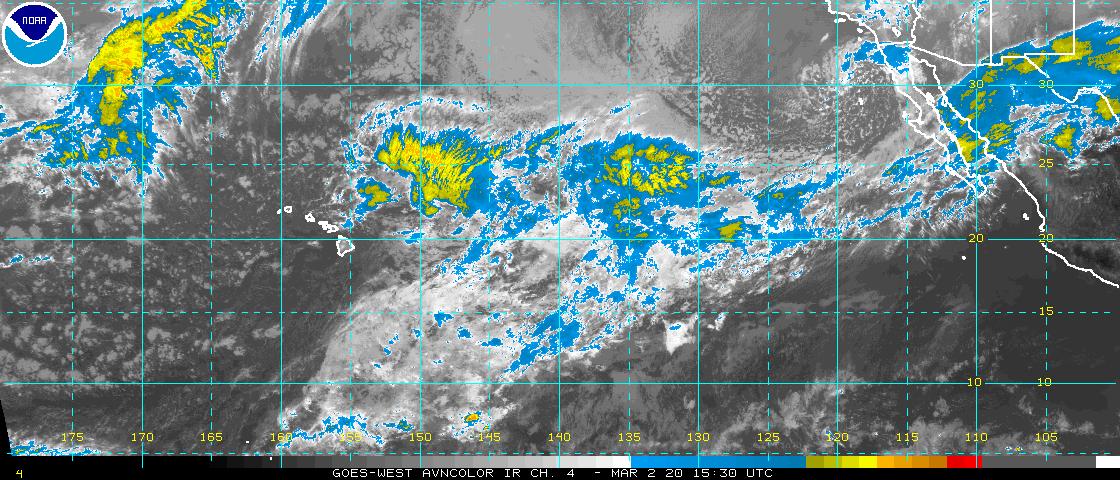
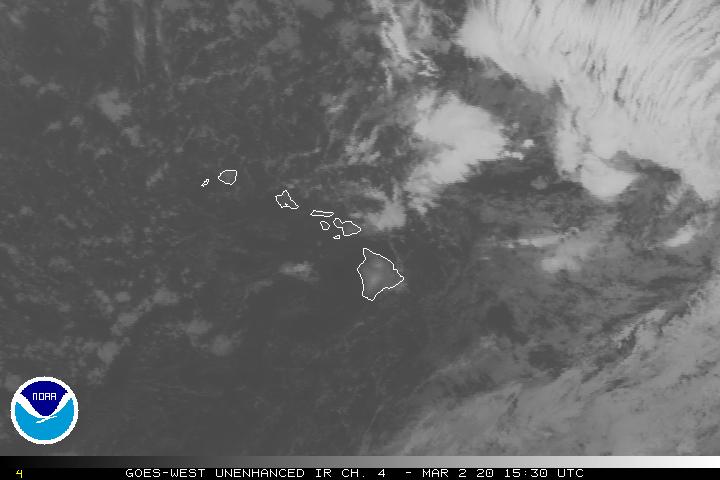
Satellite and Radar Images: To view the cloud conditions we have here in Hawaii, please use the following satellite links, starting off with this Infrared Satellite Image of the islands to see all the clouds around the state during the day and night. This next image is one that gives close images of the islands only during the daytime hours, and is referred to as a Close-up visible image. This next image shows a larger view of the Pacific…giving perspective to the wider ranging cloud patterns in the Pacific Ocean. Finally, here’s a Looping IR satellite image, making viewable the clouds around the islands 24 hours a day. To help you keep track of where any showers may be around the islands, here’s the latest animated radar image.
Hawaii’s Mountains – Here’s a link to the live webcam on the summit of near 14,000 foot Mauna Kea on the Big Island of Hawaii. The tallest peak on the island of Maui is the Haleakala Crater, which is near 10,000 feet in elevation. These two webcams are available during the daylight hours here in the islands…and when there’s a big moon rising just after sunset for an hour or two! Plus, during the nights and early mornings you will be able to see stars, and the sunrise too…depending upon weather conditions.
Tropical Cyclone activity in the eastern and central Pacific – Here’s the latest weather information coming out of the National Hurricane Center, covering the eastern north Pacific. You can find the latest tropical cyclone information for the central north Pacific (where Hawaii is located) by clicking on this link to the Central Pacific Hurricane Center. Here’s a tracking map covering both the eastern and central Pacific Ocean. A satellite image, which shows the entire ocean area between Hawaii and the Mexican coast…can be found here.
Aloha Paragraphs

Beautiful waterfall…on Maui
There will bee some slight day to day variations in wind speeds, but they will continue to blow through the next week…generally in the moderately strong realms. We find small craft wind advisory flags still up in those windiest areas around Maui and the Big Island Tuesday evening. A 1031 millibar high pressure system, far to our northeast, as shown on this weather map…is the source of our gusty breezes. There are really no indications that our trade winds will slow down significantly anytime soon.
The windward sides will see an increase in showers over the next day or two…with the leeward sides finding a possible shower here and there. The high cirrus clouds remain to the south of the islands Tuesday evening. This satellite image shows them in their arc southwest to southeast. An upper level trough of low pressure will be in our area over the next several days. This low will enhance our windward showers. This low may also prompt some afternoon showers to develop along the leeward slopes of the Big Island and Maui…there could even be a thunderstorm on the Big Island slopes Wednesday and Thursday afternoons.
It’s Tuesday evening here in Kihei, Maui, as I begin writing this last part of this evening’s narrative. The showers increased some during the afternoon hours along our windward sides. According to this looping radar image, the majority of the incoming showers are falling from Kauai down to Oahu at the time of this writing. As the sun sets and we move into the night hours, the showers should increase some elsewhere, as they usually do. Meanwhile, as the upper level low, written about above, arrives over the islands Wednesday into Thursday, there are apt to be somewhat more of an increase in showers. Since the trade winds will continue blowing, the majority of the showers will land on the windward coasts and slopes. The daytime heating however, could also trigger a few heavy showers over the leeward slopes during the afternoons on the Big Island and east Maui…perhaps a thunderstorm on the upper Big Island Kona slopes?
~~~ I’m about ready to leave Kihei, for the drive back upcountry to Kula. I can see that there are clouds hanging pretty low up that way, which is fine with me. One of my favorite things is to leave the relatively hot Kihei coast, and drive up into a thick cloud of fog at home. It’s so refreshing to get out of my work clothes, and into my walking stuff…and to get out into the moist fog! I’m not sure if I’ll have that pleasure today, but I love that when it happens. At any rate, I’ll catch up with you again early Wednesday morning, I hope you have a great Tuesday night from wherever you happen to be reading from! Aloha for now…Glenn.
Interesting: The U.N.’s climate panel has been backed over a key question as to how far global warming will drive up sea levels this century, a new study says. The UN experts are right that the oceans are unlikely to rise by an order of meters (many feet) by 2100, as some scientists have feared, it says.
But, its authors caution, low-lying countries and delta areas could still face potentially catastrophic flooding if the upper range of the new estimate proves right. In a landmark report in 2007, the U.N.’s Intergovernmental Panel on Climate Change (IPCC) predicted oceans would rise by 7.2 and 23.6 inches by 2100.
The increase would depend on warming, estimated at between 1.98-11.52 degrees Fahrenheit this century, which in turn depends on how much man-made greenhouse gas is poured into the atmosphere. It based the calculation on thermal expansion of the seas — when a liquid is warmed, it grows in volume.
Harder to calculate, the IPCC admitted, was how far melt water from glaciers and ice sheets on land would boost sea levels. It ventured a provisional calculation, suggesting contributions from those sources could push the upper limit to 76 cms (30.4 inches).
The new paper, led by Mark Siddall of Britain’s University of Bristol, used data from fossilized coral and from ice-core measurements to reconstruct sea-level fluctuations over the past 22,000 years, from the height of the last Ice Age to the balmy era of today.
This century, they calculate, the seas will rise by between seven and 82 cms, all sources included, on the basis of a 1.98-11.52 F warming — an estimated increase that is in the same ballpark as the IPCC’s.
Interesting2: Chicken feathers may help cars use hydrogen fuel in the future. The feathers would not be the fuel, but they could help store it, new research reveals. Hydrogen, the most common element in the universe, has long been touted as a clean and ample energy alternative to fossil fuels.
When hydrogen reacts with oxygen, instead of yielding pollutants as fossil fuels do, it simply generates water. Unfortunately, hydrogen is hard to store and transport. Hydrogen vehicles currently keep it in tanks in either liquid or pressurized gas form.
As a pressurized gas, it takes up roughly 40 times as much space as gasoline, and as a liquid it needs to be kept at extremely low temperatures. "Using currently available technology, if you had a 20-gallon tank and filled it with hydrogen at typical room temperature and pressure, you could drive about a mile," said researcher Richard Wool, director of the Affordable Composites from Renewable Resources program at the University of Delaware in Newark.
Interesting3: Nissan showed off its latest EV prototype today, a slick four-door, five-passenger hatchback that’s good for 100 miles and tells you when and where to charge up. Although it’s just a mule wearing a Tiida body, the car provides the best glimpse yet of the production EV we’ll see for the first time Sunday.
Nissan plans to offer an all-electric vehicle in Japan and the United States next year, then roll it out globally in 2012. "Nissan will be a leader in zero-emission vehicles," Toshiyuki Shiga said in Tokyo, according to Canadian Press. "EV is the answer."
Although most of the major automakers have promised to put EVs on the road within the next few years, Japan’s No. 3 automaker is placing the biggest bet on the technology. CEO Carlos Ghosn has made it clear he believes cars with cords are the future, and he has made developing such vehicles a top priority both within Nissan and Renault, its parent company.
The company reportedly plans to build 100,000 EVs within the next two years. The Department of Energy recently loaned Nissan $1.6 billion to retool its factory in Smyrna, Tennessee, to produce electric cars and the batteries to power them.
Range anxiety — the fear of being stranded by a dead battery — remains one impediment to the mass adoption of electric cars, and Nissan hopes to alleviate such worries with a car that tells you when and where to charge up. Nissan calls it "EV-IT" and says it will work with the car’s navigation system to:
* Show the driving radius within range under the current state of charge.
* Calculate whether the vehicle is within range of a pre-set destination like your home or office.
* Provide information about available charging stations within the current driving range and provide info about those stations.
Interesting4: Recent news reports about scuba divers off San Diego being menaced by large numbers of Humboldt’s or jumbo squid have raised the ire of University of Rhode Island biologist Brad Seibel. As a leading expert on the species who has dived with them several times, he calls the reports "alarmist" and says the squid’s man-eating reputation is seriously overblown.
For years Seibel has heard stories claiming that Humboldt squid will devour a dog in minutes and could kill or maim unsuspecting divers. "Private dive companies in Mexico play up this myth by insisting that their customers wear body armor or dive in cages while diving in waters where the squid are found.
Many also encourage the squid’s aggressive behavior by chumming the waters. I didn’t believe the hype, but there was still some doubt in my mind, so I was a little nervous getting into the water with them for the first time," Seibel said.
Scuba diving at night in the surface waters of the Gulf of California in 2007, Seibel scanned the depths with his flashlight and saw the shadows of Humboldt squid far in the distance. After he got up his nerve, he turned off the light.
When he turned it back on again 30 seconds later, he was surrounded by what seemed like hundreds of the squid, many just five or six feet away from him. Most were in the 3-4 foot size range, while larger ones were sometimes visible in deeper waters.
But the light appeared to frighten them, and they immediately dashed off to the periphery. The URI researcher’s dive was more than just a personal test. It was part of a scientific examination of the species some call "red devil" to learn more about their physiology, feeding behavior and swimming abilities.
Humboldt squid feed in surface waters at night, then retreat to great depths during daylight hours. "They spend the day 300 meters deep where oxygen levels are very low," Seibel said. "We wanted to know how they deal with so little oxygen."
Seibel said that while the squid are strong swimmers with a parrot-like beak that could inflict injury, man-eaters they are not. Unlike some large sharks that feed on large fish and marine mammals, jumbo squid use their numerous small, toothed suckers on their arms and tentacles to feed on small fish and plankton that are no more than a few centimeters in length.
The highlight of Seibel’s research cruise with colleagues from the Monterey Bay Aquarium Research Institute was diving with the impressive animals. Other divers participating were Lloyd Trueblood of URI, Steve Haddock of MBARI, and Alison Sweeney of the University of California, Santa Barbara.
Seibel was surprised by the large number of squid he encountered, which made it easy to imagine how they could be potentially dangerous to anything swimming with them. Their large numbers also made Seibel somewhat pleased that they appeared frightened of his dive light.
Yet he said the animals were also curious about other lights, like reflections off his metal equipment or a glow-in-the-dark tool that one squid briefly attacked. "Based on the stories I had heard, I was expecting them to be very aggressive, so I was surprised at how timid they were. As soon as we turned on the lights, they were gone," he said.
"I didn’t get the sense that they saw the entire diver as a food item, but they were definitely going after pieces of our equipment." According to Seibel, there have been many active discussions among biologists and the dive community about the safety of diving with Humboldt squid.
As a result of his experience, the URI scientist is preparing a formal report with his recommendations for safely diving with the squid, including suggestions to always carry a back-up dive light and to be tethered to a boat.
Any time humans enter the habitat of a large animal, there is potential for dangerous interactions, he said, so divers should use caution. "However, I want to spread the word that they aren’t the aggressive man-eaters as they have been portrayed," Seibel said.
Interesting5: New research suggests that current regulations have failed to remove misleading information from cigarette packaging, revealing that a substantial majority of consumers believe cigarettes are less hazardous when the packs display words such as "silver" or "smooth," lower numbers incorporated into the brand name, lighter colors or pictures of filters. In a study of 603 adults published July 28 in the online edition of the Journal of Public Health, Canadian researchers call for the list of words banned from cigarette packaging to be expanded beyond the current prohibition of "light," "mild" and "low-tar" and suggest that other pack design elements may need to be eliminated to prevent consumers erroneously believing that one brand is less harmful than another.
"Research has already shown that using words such as ‘light,’ ‘mild’ and ‘low tar’ on cigarette packaging misleads consumers into thinking that one brand carries a lower health risk than another and that’s why those words have been outlawed in more than 50 countries, but there has been virtually no independent research on these other packaging tactics to support broader regulation," said the study’s leader, David Hammond, a professor of health studies at the University of Waterloo in Ontario, Canada.
"Our study found that commonly-used words not covered by the bans, as well as other packaging design elements such as color, the use of numbers and references to filters, were just as misleading, which means there’s a loophole that needs to be closed. "Tobacco use is the leading cause of preventable death worldwide.
The World Health Organization estimates that it kills more than 5 million people a year. Smoking is linked to an increasing number of diseases, including heart disease and stroke, respiratory diseases and 10 different forms of cancer. Globally, use of tobacco products is increasing. Smokers who perceive greater risks are more likely to try to quit and to remain abstinent.
Interesting6: Evidence for life on Earth stretches back billions of years, with simple single-celled organisms like bacteria dominating the record. When multi-celled animal life appeared on the planet after 3 billion years of single cell organisms, animals diversified rapidly.
Conventional wisdom has it that animal evolution began in the ocean, with animal life adapting much later in Earth history to terrestrial environments. Now a UC Riverside-led team of researchers studying ancient rock samples in South China has found that the first animal fossils in the paleontological record are preserved in ancient lake deposits, not marine sediments as commonly assumed.
"We know that life in the oceans is very different from life in lakes, and, at least in the modern world, the oceans are far more stable and consistent environments compared to lakes which tend to be short-lived features relative to, say, rates of evolution," said Martin Kennedy, a professor of geology in the Department of Earth Sciences who participated in the research.
"Thus it is surprising that the first evidence of animals we find is associated with lakes, a far more variable environment than the ocean." The study, published in the July 27-31 online edition of the Proceedings of the National Academy of Sciences, raises questions such as what aspects of the Earth’s environment changed to enable animal evolution.
 Email Glenn James: