July 26-27, 2009
Air Temperatures – The following maximum temperatures were recorded across the state of Hawaii Sunday afternoon:
Lihue, Kauai – 84
Honolulu, Oahu – 89
Kaneohe, Oahu – 84
Kahului, Maui – 88
Hilo, Hawaii – 84
Kailua-kona – 86
Air Temperatures ranged between these warmest and coolest spots near sea level – and on the highest mountains…at 6 p.m. Sunday evening:
Barking Sands, Kauai – 85F
Kaneohe, Oahu – 79
Haleakala Crater – 54 (near 10,000 feet on Maui)
Mauna Kea summit – 57 (near 14,000 feet on the Big Island)
Precipitation Totals – The following numbers represent the largest precipitation totals (inches) during the last 24 hours on each of the major islands, as of Sunday afternoon:
0.08 Mount Waialaele, Kauai
0.04 Kahuku, Oahu
0.00 Molokai
0.00 Lanai
0.00 Kahoolawe
0.02 Hana airport, Maui
0.10 Kamuela, Big Island
Marine Winds – Here’s the latest (automatically updated) weather map showing a stronger 1033 millibar high pressure system far to the northeast of the islands Monday. This high pressure cell, along with its associated ridge to our north, will keep the trade winds blowing through Tuesday.
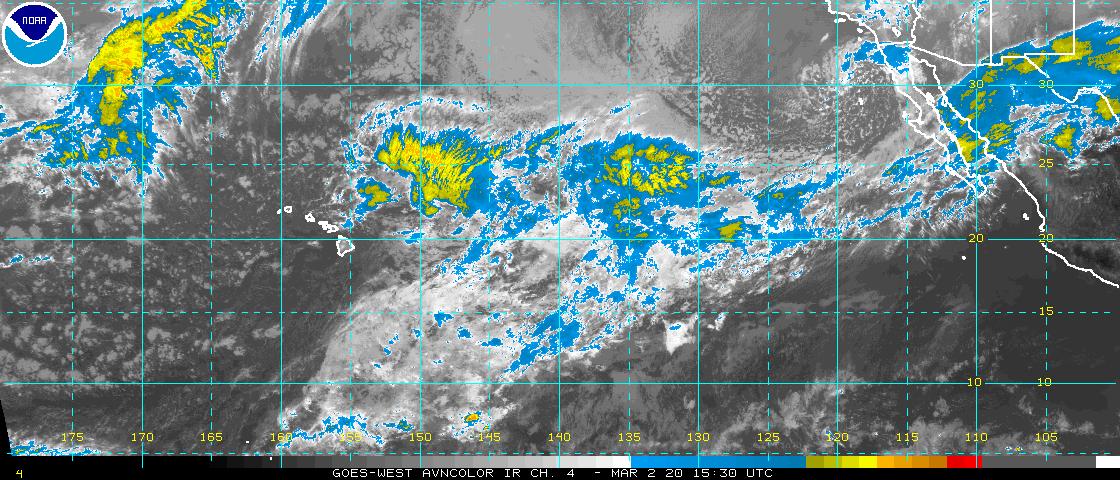
Satellite and Radar Images: To view the cloud conditions we have here in Hawaii, please use the following satellite links, starting off with this Infrared Satellite Image of the islands to see all the clouds around the state during the day and night. This next image is one that gives close images of the islands only during the daytime hours, and is referred to as a Close-up visible image. This next image shows a larger view of the Pacific…giving perspective to the wider ranging cloud patterns in the Pacific Ocean. Finally, here’s a Looping IR satellite image, making viewable the clouds around the islands 24 hours a day. To help you keep track of where any showers may be around the islands, here’s the latest animated radar image.
Hawaii’s Mountains – Here’s a link to the live webcam on the summit of near 14,000 foot Mauna Kea on the Big Island of Hawaii. The tallest peak on the island of Maui is the Haleakala Crater, which is near 10,000 feet in elevation. These two webcams are available during the daylight hours here in the islands…and when there’s a big moon rising just after sunset for an hour or two! Plus, during the nights and early mornings you will be able to see stars, and the sunrise too…depending upon weather conditions.
Tropical Cyclone activity in the eastern and central Pacific – Here’s the latest weather information coming out of the National Hurricane Center, covering the eastern north Pacific. You can find the latest tropical cyclone information for the central north Pacific (where Hawaii is located) by clicking on this link to the Central Pacific Hurricane Center. Here’s a tracking map covering both the eastern and central Pacific Ocean. A satellite image, which shows the entire ocean area between Hawaii and the Mexican coast…can be found here.
Aloha Paragraphs

Nice sunset and sunrise colors now
A fairly normal summertime trade wind weather pattern is gracing the Hawaiian Islands on this last day of the weekend. Looking into the new week ahead, these trade winds will remain active, with small craft wind advisory flags having been raised in those windiest areas around Maui and the Big Island. A stronger 1033 millibar high pressure system, far to our northeast, as shown on this weather map…is the source of our refreshing breezes.
Other than the locally gusty trade winds, and a few windward showers…our weather will be just fine. Meanwhile, we continue to see streaks of high cirrus clouds, and some middle level altocumulus clouds, streaming overhead Sunday evening. There will be a few lower level clouds, dropping a few showers along our windward sides. An upper level trough of low pressure will be to the north of the islands over the next several days…which may enhance our windward showers at times.
It’s Sunday evening here in Kula, Maui, as I begin writing this last part of this morning’s narrative. Sunday was another nice day here in the Aloha state, with lots of sunshine, filtering through the high cirrus clouds. The trade winds are blowing steadily as we end the week, and will remain active well into the new week ahead. By the way, those high and middle level clouds will likely continue to light up beautifully at both sunset and sunrise into Monday…keep an eye out for them. I’ll be out on my weather deck in a little while, looking for those wonderful orange and red colors myself. ~~~ I’ll be back with you next early Monday morning, preparing the next new weather narrative. I hope you have a great Sunday night until then.
Interesting: You drive to the office, sit at a computer all day, drive home and then park yourself on the couch. If that’s your life, leading obesity experts say, the government should be changing your environment and making it possible for you to become more active.
There has been a big reduction in "muscle-power transportation," such as walking or biking to work or to the store, says Russell Pate, an exercise researcher at the University of South Carolina-Columbia.
This is partly because of sprawling communities and long commutes, but he says it’s also because people don’t have safe places to walk.
"If we have safe routes, sidewalks, bike trails that go to destinations that people need to get to, then those trails will be more heavily used," Pate says.
The government’s responsibility to get Americans moving will be discussed at the three-day Weight of the Nation conference next week. Public health advocates, government leaders and obesity researchers will meet in Washington, D.C.
Intersting2: Global health officials stepped up efforts to prepare for quick vaccination against the H1N1 pandemic virus, saying on Friday it appeared now to be affecting older age groups spared earlier in the pandemic. The World Health Organization and the U.S. Centers for Disease Control and Prevention both said they can only estimate how many people have been infected but the swine flu virus was still spreading quickly.
"As the disease expands broadly into communities, the average age of the cases is appearing to increase slightly," the WHO said in a statement. "This may reflect the situation in many countries where the earliest cases often occurred as school outbreaks but later cases were occurring in the community."
The virus has been notable for affecting older children and young adults, groups normally not hard-hit by influenza. The CDC said summer camps and military facilities were affected, but both agencies said there was no evidence the virus was mutating into drug-resistant or more virulent forms.
The CDC broadened its recommendations for seasonal flu vaccine — saying all children over the age of 6 months should get one, in part to lower the overall burden of respiratory disease when autumn and winter come.
WHO said vaccination against H1N1 might start in weeks, even though clinical trials to test the safety, efficacy and needed dosage of H1N1 vaccines have barely started. "Manufacturers are expected to have vaccines for use around September.
A number of companies are working on the pandemic vaccine production and have different timelines," WHO said. At least 50 governments have placed orders or are currently negotiating with pharmaceutical companies to secure supplies of H1N1 vaccines, which are still being developed.
WHO is trying to ensure that health workers in poor countries can be vaccinated so hospitals can stay open if the flu becomes more debilitating as it spreads. Sanofi-Aventis and GlaxoSmithKline have promised to donate 150 million doses to this aim to date.
Interesting3: A habitually shod lifestyle has consequences for the biologically normal anatomy and function of the foot. Kristiaan D’Aout and Peter Aerts from the Biology Department at the University of Antwerp collaborated for their work on the biomechanics of barefoot walking with Dirk De Clercq (University of Gent, Belgium) and with Todd Pataky (University of Liverpool, UK).
This team made the first detailed analysis of foot function in people who have never worn shoes. For this project, they travelled to South India, where many people walk barefoot throughout life, mostly for spiritual or financial reasons.
In this way, the researchers wanted to gain an insight into the biologically normal function of the foot, which evolved for millions of years – unshod.
The research was funded by the Fund for Scientific Research – Flanders, and was based on dynamic measurements of pressure distribution under to foot sole during walking.
It showed that the foot of habitual barefoot walkers differs, both in shape and in function, from that of habitually shod peers.
Barefooters have a relatively wide forefoot and manage at better distributing pressures over the entire surface of the foot sole, resulting in lower (and most likely favorable) peak pressures.
As such, the fundamental scientific results are also important for clinicians and for the design of quality footwear, which should not hamper the foot’s biologically normal function.
Interesting4: How clouds over the ocean affect our climate, and how climate change may be affecting them, is not well known. There is no network of observing stations like on land, and climate models have not been shown to really simulate clouds well.
They may be just too fine a detail for models that cover such large scale phenomenon as oceanic circulation. But clouds over the oceans have been thought be important in our understanding of what drives our climate.
In a study published in the July 24 issue of Science, researchers Amy Clement and Robert Burgman from the University of Miami’s Rosenstiel School of Marine and Atmospheric Science and Joel Norris from Scripps Institution of Oceanography at UC San Diego begin to unravel this mystery.
Using observational data collected over the last 50 years and complex climate models, the team has established that low-level stratiform clouds appear to dissipate as the ocean warms, indicating that changes in these clouds may enhance the warming of the planet.
The result of their analysis was a surprising degree of agreement between two multi-decade datasets that were not only independent of each other, but that employed fundamentally different measurement methods.
One set consisted of collected visual observations from ships over the last 50 years, and the other was based on data collected from weather satellites.
"The agreement we found between the surface-based observations and the satellite data was almost shocking," said Clement, a professor of meteorology and physical oceanography at the University of Miami and winner of the American Geophysical Union’s 2007 Macelwane Award for her groundbreaking work on climate change.
"These are subtle changes that take place over decades. It is extremely encouraging that a satellite passing miles above the earth would document the same thing as sailors looking up at a cloudy sky from the deck of a ship."
Together, the observations and the Hadley Centre model results provide evidence that low-level stratiform clouds, which currently shield the earth from the sun’s radiation, may dissipate in warming climates, allowing the oceans to further heat up, which would then cause more cloud dissipation.
"This is somewhat of a vicious cycle potentially exacerbating global warming," said Clement. "But these findings provide a new way of looking at cloud changes.
This can help to improve the simulation of clouds in climate models, which will lead to more accurate projections of future climate changes."
Interesting5: By the 1970s, people were spewing so much soot, ash, and other tiny particles into the lower atmosphere that climate researchers called the effect the "human volcano." Now it looks like humans are imitating volcanoes in yet another part of the atmosphere.
New research blames this decade’s thickening of the haze in the stratosphere on the burst of coal burning around the world. The chief offender appears to be China. Until now, scientists could see no sign that anything but volcanic eruptions packed enough punch to pollute the stratosphere.
Smokestacks also spew sulfur, creating acid rain and attacking people’s lungs, but no smokestack can send it up through the lower atmosphere and into the stratosphere where it turns into haze.
Or can it? In a paper in press in Geophysical Research Letters, atmospheric scientist David Hofmann of the University of Colorado, Boulder, and colleagues report a human role in stratospheric haze pollution.
Since 1994, National Oceanic and Atmospheric Administration scientists have used lidar to probe stratospheric haze in the skies above Mauna Loa in Hawaii and, since 2000, above Boulder.
Like weather radar, which uses microwaves to measure rain, upward-pointing lidar bounces electromagnetic waves off distant objects–microscopic haze particles in the case of haze.
Both the Mauna Loa and Boulder lidars show a long-term upward trend in stratospheric haze since about 2001 of 4% to 7% per year (blue line in figure), the group reports.
"This trend is quite large," says Hofmann. Volcanoes aren’t to blame, he says, as the most recent major volcanic activity–Mt. Pinatubo’s "eruption of the century" in 1991–occurred long enough ago that any sulfurous gases it blasted into the stratosphere to form haze are long since gone.
So Hofmann turned to humans. Sulfur emitted by coal-burning industries and power plants could spread through the lower atmosphere, he explains, and then less than 1% of it might have been caught in the strong updrafts of tropical storms–the equivalent of a volcano’s plume–that could loft it into the stratosphere.
The world’s 5.2% per year increase in sulfur emissions from 2002 to 2007–mainly from China–could readily account for the increase in stratospheric haze, the group calculates. However, experts in stratospheric circulation caution that there’s an alternative explanation for increasing haze.
Rather than the human-induced increase in pollutant sulfur in the lower atmosphere, the cause could be an acceleration of the updrafts that loft air and any sulfur in it into the stratosphere. The speedup could be natural or another effect of global warming.
Still, Hofmann notes that humans don’t hold a candle to volcanoes when it comes to stratospheric pollution. Even if, as expected, China dramatically increases its coal burning by 2022, the resulting doubling of stratospheric haze would be just 5% of another Pinatubo–resulting in a slight cooling of the stratosphere and a tiny amount of ozone damage. The corrosive effects of China’s coal burning in the lower atmosphere would be another matter.
 Email Glenn James: