July 23-24, 2009
Air Temperatures – The following maximum temperatures were recorded across the state of Hawaii Thursday afternoon:
Lihue, Kauai – 88
Honolulu, Oahu – 90
Kaneohe, Oahu – 84
Kahului, Maui – 90
Hilo, Hawaii – 86
Kailua-kona – 86
Air Temperatures ranged between these warmest and coolest spots near sea level – and on the highest mountains…at 5 p.m. Thursday evening:
Kahului, Maui – 86F
Lihue, Kauai – 78
Haleakala Crater – 54 (near 10,000 feet on Maui)
Mauna Kea summit – 45 (near 14,000 feet on the Big Island)
Precipitation Totals – The following numbers represent the largest precipitation totals (inches) during the last 24 hours on each of the major islands, as of Thursday afternoon:
5.75 Hanalei River, Kauai
5.32 Oahu Forest NWR, Oahu
0.08 Molokai
0.230 Lanai
0.33 Kahoolawe
1.60 West Wailuaiki, Maui
3.48 Pali 2, Big Island
Marine Winds – Here’s the latest (automatically updated) weather map showing that high pressure systems remain active far to the northeast and northwest of the islands Friday. Our winds however will remain light, as a trough of low pressure, now to the west of the state, continues moving away…allowing the trade winds to gradually pick up in speed Saturday.
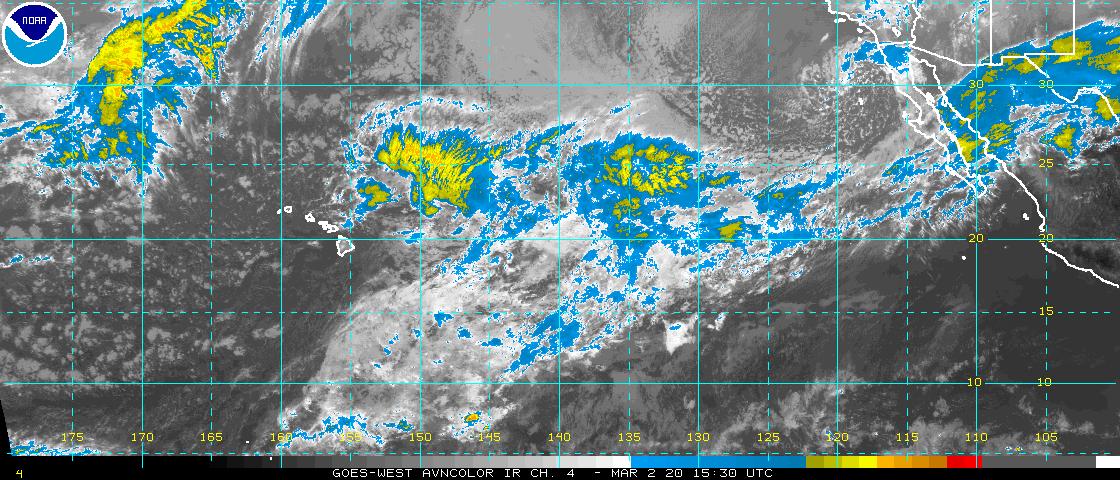
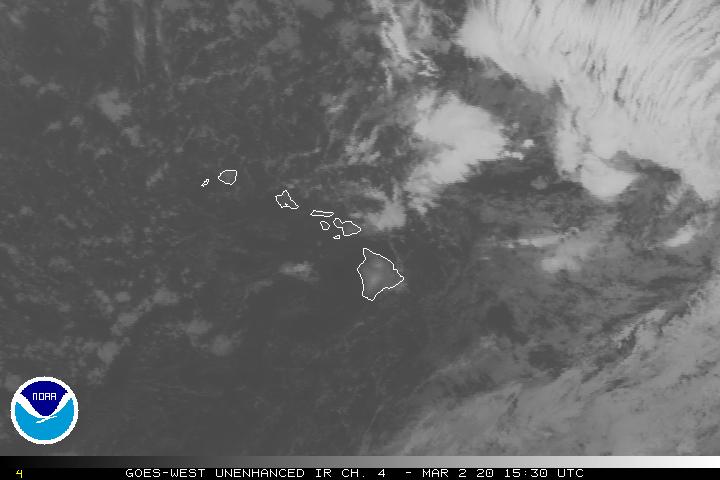
Satellite and Radar Images: To view the cloud conditions we have here in Hawaii, please use the following satellite links, starting off with this Infrared Satellite Image of the islands to see all the clouds around the state during the day and night. This next image is one that gives close images of the islands only during the daytime hours, and is referred to as a Close-up visible image. This next image shows a larger view of the Pacific…giving perspective to the wider ranging cloud patterns in the Pacific Ocean. Finally, here’s a Looping IR satellite image, making viewable the clouds around the islands 24 hours a day. To help you keep track of where any showers may be around the islands, here’s the latest animated radar image.
Hawaii’s Mountains – Here’s a link to the live webcam on the summit of near 14,000 foot Mauna Kea on the Big Island of Hawaii. The tallest peak on the island of Maui is the Haleakala Crater, which is near 10,000 feet in elevation. These two webcams are available during the daylight hours here in the islands…and when there’s a big moon rising just after sunset for an hour or two! Plus, during the nights and early mornings you will be able to see stars, and the sunrise too…depending upon weather conditions.
Tropical Cyclone activity in the eastern and central Pacific – Here’s the latest weather information coming out of the National Hurricane Center, covering the eastern north Pacific. You can find the latest tropical cyclone information for the central north Pacific (where Hawaii is located) by clicking on this link to the Central Pacific Hurricane Center. Here’s a tracking map covering both the eastern and central Pacific Ocean. A satellite image, which shows the entire ocean area between Hawaii and the Mexican coast…can be found here.
Aloha Paragraphs

The beautiful south shore…Oahu, Hawaii
The trough of low pressure, which has greatly slowed down our winds, was located near Kauai Thursday evening. This slack wind flow has brought us into what we call a modified convective weather pattern, with muggy conditions prevailing for a little while longer. Daytime air temperatures will feel very warm, and at times sticky too! During the nights, it will cool off a little, but not as much as usual, while stronger trade winds are blowing. Speaking of the trades, they will wait to return in the next day or two…at which point they’ll bring back relief from the heat.
This trough of low pressure brought localized heavy showers to the state Thursday…especially on Kauai. The trough will keep our atmosphere shower prone for another day or so, with still the chance of localized heavy precipitation at times. The most likely place for these showers to fall, will be over the interior sections during the afternoon hours…although a few heavy showers could break out just about anywhere at any time of day or night. If the trade winds return as expected later Friday or by Saturday, the bias for showers will shift back over to the windward sides then.
This trough of low pressure, causing the showery weather, is aligned more or less northeast to southwest to the south of Kauai Thursday evening. Here’s a weather map, which shows this dashed line trough. While this trough of low pressure is over, or around our area, showers will have an easier time falling. As I’m mentioned many times lately, this summertime precipitation event is good fortune for our islands, as we need every drop now. Summer is always our dry season, so to be on the receiving end of this moisture…is adding a valuable resource to our aquifers and water reservoirs.
In sum, it will be muggy and sultry for the time being, with little in the way of relief from the daytime heat just yet. We can see evidence of this trough of low pressure over us, by clicking on this satellite image…especially in the area around Kauai and Oahu at the time of this writing. There’s plenty of clouds around, with those larger brighter white areas…where the heaviest rains are falling. We can take a look at this looping radar image, so that we can track the rainfall as it crops up over the island chain.
It’s Thursday evening here in Kihei, Maui, as I begin writing this last part of today’s narrative. Wow, what a hot day, with the perfect example being both Honolulu and Kahului, where the mercury climbed all the way up to 90F degrees. Here in Kihei, I’m pretty sure it was at least that hot, and felt several degrees warmer than that! Besides the heat, caused by the excess humidity, and the lack of trade winds, we had showers around too. Most of the heavy stuff fell over and around Kauai, although Oahu was getting into the act late in the afternoon as well. There were showers on Maui at times, with even a thunderstorm or two reported on the Big Island. ~~~ It seems like the trade winds are already trying to get going again, at least that’s how it looks here in Kihei, before I take the drive back upcountry to Kula. There’s not that many clouds out the window here, and I don’t see any rain in my limited view. If I run into anything overly wet, on my drive home, I’ll come back online and let you know. Otherwise, I’ll be back early Friday morning with your next new weather narrative from paradise. I hope you have a great Thursday night from wherever you happen to be reading from! Aloha for now…Glenn.
Interesting: Feeling stressed? Then try savoring the scent of lemon, mango, lavender, or other fragrant plants. Scientists in Japan are reporting the first scientific evidence that inhaling certain fragrances alter gene activity and blood chemistry in ways that can reduce stress levels.
In the new study, Akio Nakamura and colleagues note that people have inhaled the scent of certain plants since ancient times to help reduce stress, fight inflammation and depression, and induce sleep.
Aromatherapy, the use of fragrant plant oils to improve mood and health, has become a popular form of alternative medicine today. And linalool is one of the most widely used substances to soothe away emotional stress. Until now, however, linalool’s exact effects on the body have been a deep mystery.
The scientists exposed lab rats to stressful conditions while inhaling and not inhaling linalool. Linalool returned stress-elevated levels of neutrophils and lymphocytes — key parts of the immune system — to near-normal levels.
Inhaling linalool also reduced the activity of more than 100 genes that go into overdrive in stressful situations. The findings could form the basis of new blood tests for identifying fragrances that can soothe stress, the researchers say.
Interesting2: Increasing numbers of children around the world are suffering from respiratory problems – coughing, wheezing and asthma attacks. Although the key external causes of these diseases were identified a long time ago (traffic and industrial air pollution), it had not previously been possible to distinguish clearly between these two factors so as to have a targeted impact on them.
Researchers at the Helmholtz Centre for Environmental Research (UFZ) and the University of Leipzig carried out research in this area together with colleagues from the University of La Plata and can now confirm that air pollution caused by industry has even more grave effects than vehicle exhaust fumes.
The recently completed study on ‘Combined effects of airborne pollutants as risk factors for environmental diseases’ was conducted as part of a long-standing collaborative venture, supported by the international office of the German Federal Ministry of Education and Research, between the Helmholtz Centre for Environmental Research (UFZ), the University of Leipzig and the University of La Plata in Argentina. The results have been published in several journals, including the Journal of Allergy and Clinical Immunology and Toxicology.
Interesting3: A reduction of as little as five per cent in fisheries catch could result in as much as 30 per cent of the British Columbia coastal ecosystems being protected from overfishing, according to a new study from the UBC Fisheries Centre in Canada. The study, by Natalie Ban and Amanda Vincent of Project Seahorse, proposes modest reductions in areas where fisheries take place, rather than the current system of marine protected areas which only safeguard several commercially significant species, such as rockfish, shrimp, crab, or sea cucumber.
The article is published July 21 in PLoS One. Using B.C.’s coastal waters as a test case, the study affirms that small cuts in fishing – if they happen in the right places – could result in very large unfished areas. For example, a two per cent cut could result in unfished areas covering 20 per cent of the B.C. coast, offered real conservation gains. "The threat of over-fishing to our marine ecosystems is well-documented," says Ban, who recently completed her PhD at the UBC Fisheries Centre.
"Our study suggests a different approach could reduce the impacts on fishers as well as helping us move towards achieving conservation goals." Part of the reason for the research was to open a debate on how to meet conservation goals set during the 2002 World Summit on Sustainable Development, which included establishing a network of marine protected areas by 2012.
"With the current rates of progress, there is no chance of meeting our 2012 targets," says Ban. "Given that fishers recognize the problem of overfishing but often regard marine protected areas as serving only to constrain them, another approach must be found. That’s why we undertook this study."
The research looked at spatial catch data from Fisheries and Ocean Canada for 13 commercial fisheries on Canada’s west coast to show that large areas representing diverse ecoregions and habitats might be protected at a small cost to fisheries.
Interesting4: When Brazilian port workers began inspecting the contents of a cargo ship from the U.K., they were surprised to find more than 1,400 tons of waste, labeled as recyclable plastics, included with the cargo. The waste, packed in 89 shipping containers, was unloaded in three southern Brazilian ports and was said to contain batteries, computer parts, DVDs, cleaning product containers, clothes, shoes, old toys, baby diapers, food remains and medical waste, among other items.
The U.K. and Brazil are both signatories of the Basel Convention, the United Nations treaty that controls the cross-border movement of hazardous waste. An investigation has been launched to determine how the waste was exported and if the companies responsible for the export were in violation of the international treaty.
Interesting5: California’s famously fertile Central Valley — home to a $9 billion industry that provides much of the United States’ supply of fruit and nut crops — may be teetering on the edge of a climate-induced disaster, according to a new study. A team lead by Eike Luedeling of University of California, Davis used a computer simulation of past and future climates in the 400-mile long valley to predict what impact future, human-induced global warming could have on fruit and nut tree farmers.
Fruit trees need cold winter weather almost as much as they need warm summer sunshine. If it doesn’t get cold enough, trees stay dormant later into the spring, and flower erratically. As a result fruit crops may not be fully matured at harvest time, or there may be nothing to pick at all.
Interesting6: The average fuel efficiency of the US vehicle fleet has risen by just 3 miles per gallon since the days of the Ford Model T, and has barely shifted at all since 1991. Those are the conclusions reached by Michael Sivak and Omer Tsimhoni at the University of Michigan Transportation Research Institute in Ann Arbor.
They analyzed the fuel efficiency of the entire US vehicle fleet of cars, motorcycles, trucks and buses from 1923 to 2006. They found that from 1923 to 1935 fuel efficiency hovered around 14 mpg (5.95 km/l), but then fell gradually to a nadir of only 11.9 mpg (5.08 km/l) in 1973.
By 1991, however, the efficiency of the total fleet had risen by 42 per cent on 1973 levels to 16.9 mpg (7.18 km/l), a compound annual rate of 2 per cent. The improvements made up to 1991 were in response to two international events — the 1973 oil embargo by the Organization of Petroleum Exporting Countries (OPEC), and the Iranian Revolution of 1979.
Interesting7: The 2009 hurricane season has been off to a slow start, but experts say the real activity usually doesn’t begin until August. The early season lull doesn’t necessarily mean a weak overall season. Thursday was the one-year anniversary of Hurricane Dolly, which when it struck South Texas became the Rio Grande Valley’s most destructive storm in four decades.
A maturing El Nino in the Pacific Ocean, which tends to depress storm activity, makes the outlook for the rest of the season look promising, the Houston Chronicle reported Thursday. But forecasters say it’s no time to relax and El Nino years can still produce destructive storms. The 2004 season didn’t get its first storm until Hurricane Alex began developing on July 31. After that there were six major hurricanes, including Ivan.
 Email Glenn James: