July 22-23, 2009
Air Temperatures – The following maximum temperatures were recorded across the state of Hawaii Wednesday afternoon:
Lihue, Kauai – 83
Honolulu, Oahu – 89
Kaneohe, Oahu – 84
Kahului, Maui – 79
Hilo, Hawaii – 78
Kailua-kona – 88
Air Temperatures ranged between these warmest and coolest spots near sea level – and on the highest mountains…at 5 p.m. Wednesday evening:
Port Allen, Kauai – 86F
Hilo, Hawaii – 75
Haleakala Crater – 52 (near 10,000 feet on Maui)
Mauna Kea summit – 39 (near 14,000 feet on the Big Island)
Precipitation Totals – The following numbers represent the largest precipitation totals (inches) during the last 24 hours on each of the major islands, as of Wednesday afternoon:
0.29 Mount Waialaele, Kauai
0.16 Manoa Valley, Oahu
0.11 Molokai
0.00 Lanai
0.00 Kahoolawe
2.11 Oheo Gulch, Maui
2.28 Hakalau, Big Island
Marine Winds – Here’s the latest (automatically updated) weather map showing that high pressure systems remain active far to the northeast and northwest of the islands Thursday. Our winds however will be lighter now, as a trough of low pressure moves across the state.
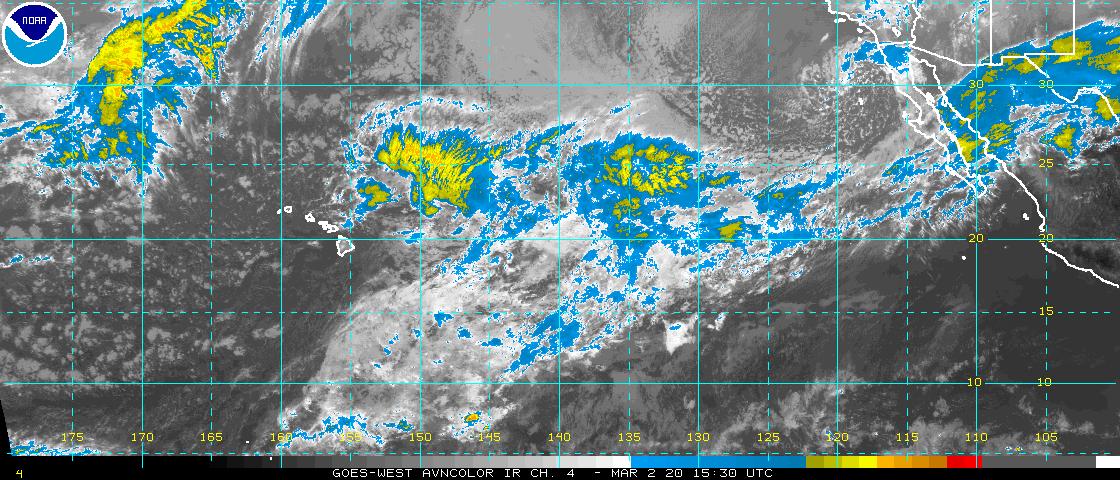
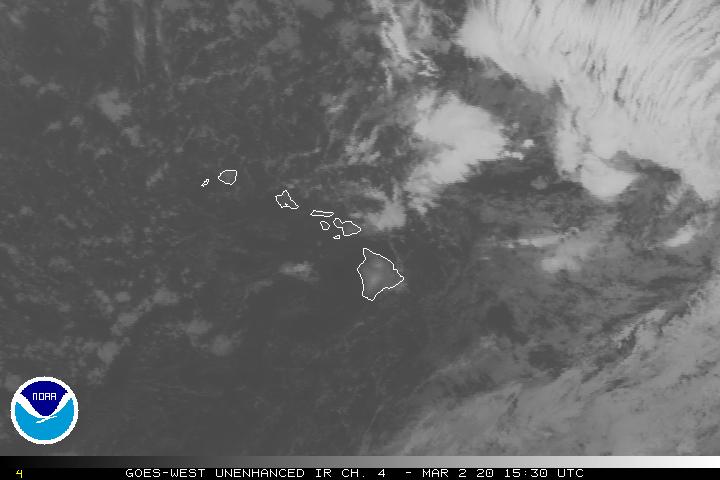
Satellite and Radar Images: To view the cloud conditions we have here in Hawaii, please use the following satellite links, starting off with this Infrared Satellite Image of the islands to see all the clouds around the state during the day and night. This next image is one that gives close images of the islands only during the daytime hours, and is referred to as a Close-up visible image. This next image shows a larger view of the Pacific…giving perspective to the wider ranging cloud patterns in the Pacific Ocean. Finally, here’s a Looping IR satellite image, making viewable the clouds around the islands 24 hours a day. To help you keep track of where any showers may be around the islands, here’s the latest animated radar image.
Hawaii’s Mountains – Here’s a link to the live webcam on the summit of near 14,000 foot Mauna Kea on the Big Island of Hawaii. The tallest peak on the island of Maui is the Haleakala Crater, which is near 10,000 feet in elevation. These two webcams are available during the daylight hours here in the islands…and when there’s a big moon rising just after sunset for an hour or two! Plus, during the nights and early mornings you will be able to see stars, and the sunrise too…depending upon weather conditions.
Tropical Cyclone activity in the eastern and central Pacific – Here’s the latest weather information coming out of the National Hurricane Center, covering the eastern north Pacific. You can find the latest tropical cyclone information for the central north Pacific (where Hawaii is located) by clicking on this link to the Central Pacific Hurricane Center. Here’s a tracking map covering both the eastern and central Pacific Ocean. A satellite image, which shows the entire ocean area between Hawaii and the Mexican coast…can be found here.
Aloha Paragraphs

Showers and rainbow…Hawaii
An approaching trough of low pressure will begin to tamp down our local trade winds…sending us into sultry atmospherics over the next several days. Our refreshing trade winds remained active Wednesday, still providing welcome relief from the summer heat. Forecast charts however continue to show our trades faltering during the upcoming second half of this week. This will bring us into a convective weather pattern, with muggy conditions prevailing into the weekend. Fortunately, these sultry conditions won’t last long, as the cooling trade winds begin to fill back into our Hawaiian Islands weather picture starting Sunday or next Monday.
An area of showers is now moving over the state from the east, which had locally heavy rains falling along the windward sides of both Maui and the Big Island Wednesday. Eventually though, as this moisture combines with the fading trade winds, those showers will likely shift over to the mountains during the afternoon hours. The greatest likelihood of showers will be now through Saturday. If the trade winds return as expected by Sunday or Monday, the emphasis for showers will return to the windward sides then.
This trough of low pressure, causing the showery weather, is aligned more or less northeast to southwest, and will be sliding over the island chain from the east. Here’s a weather map, which shows this dashed line trough just to our east Wednesday evening. This has put the Big Island and Maui under the waterfall first, although we should see rainfall arriving on all the islands over the next couple of days. There will be some heavy precipitation occurring here and there, with the chance of more thunderstorms over the next several days as well.
This atmospheric destabilizing trough stalled just to the east of the Big Island Wednesday, but it will migrate westward again soon. There continues to be some complexity to the current meteorological conditions, so that it will be difficult to pin down exactly what will be happening ahead of time. Lets take a look at this trough of low pressure to our east, but clicking on this satellite image. This area of clouds will be moving from right towards the left, or over the islands. There appears to be some pretty substantial rain mixed into this area of clouds! We can take a look at this looping radar image, so that we can track the rainfall as it moves through the island chain.
It’s Wednesday evening here in Kihei, Maui, as I begin writing this last part of today’s narrative. Wednesday was still quite windy here in the islands, as these breezy winds remained active. At one point during the afternoon, I noted that wind gusts were topping 40 mph at that windy bay at Maalaea, Maui. At around 5pm there were still 38 mph gusts there, along with an active flood advisory over all of the islands of Maui County. The Big Island had just such an advisory earlier in the day. I notced that thunder was being heard at the Hilo airport at around 3pm in the afternoon. I’d say we could expect more of this kind of action as we move into Thursday. ~~~ I’ll be back here early Thursday morning with your next new weather narrative, that is unless I see something that really catches my eye, on my drive back upcountry to Kula. Now that I’m home, and after taking my evening walk, I find pea soup fog here at my place, with a very warm 73F degrees at 645pm. I hope have a great Wednesday night from wherever you happen to be reading from! Aloha for now…Glenn.
Interesting: For three minutes and four seconds on Wednesday morning, an ethereal blue-grey darkness descended on this eternal city of light. To the east across the Ganga, it was like God’s own eye flashing in the sky above, giving pilgrims, bathers and eclipse-watchers in the jam-packed ghats sights they are unlikely to forget in their lifetimes.
While clouds blotted out the view in most other places in India, the century’s most spectacular total eclipse of the Sun was witnessed in full glory in holy Benaras. The eclipse displayed all the classical phases associated with the event. Seconds before the Sun was fully blocked by the lunar disc, a brilliant "diamond ring" formed in the sky.
Moments later, brightness dropped dramatically as totality began, a phase technically called second contact that began at 10 seconds past 6:24 am. A roar went up at the ghats as people gasped and screamed in awe. Some stared in stunned silence while others shook hands with total strangers in fits of joy.
The city was suddenly clothed in a surreal glow of faint light that was eerie, exhilarating and nothing like most had ever seen before. Up in the sky, a soft white halo formed around the black ball of the lunar disc.
This was the Sun’s atmosphere, called corona (meaning a crown), that’s visible from Earth only during a total eclipse. The sight is often called God’s eye, and in Benaras on Wednesday, it appeared just that — a giant eye in the sky with a black "eyeball" and a white "cornea".
Spots of light, called Baily’s beads, appeared around the edges of the Moon’s disc and in photographs clicked by lens men, rarely-seen solar prominences were clearly visible. These are huge masses of fiery matter that get spewed from the Sun’s surface and are pulled back in by its gravity.
Interesting2: Lonesome George, the last remaining giant tortoise of his kind, may soon be a father to the delight of conservationists. Un-hatched eggs have been found in his "bachelor" pen in the Galapagos Islands, his keepers said on Tuesday. For decades, the last known Pinta island tortoise had shown little interest in reproducing.
But at age 90, George is said to be in his sexual prime. Galapagos tortoises were among the species Charles Darwin observed to formulate his theory of evolution in the 19th century. Scientist have been trying to get George to mate since 1993, when they introduced two female tortoises of a different subspecies into his pen.
The Galapagos National Park said the five eggs found on Monday were "in perfect condition" and have been placed in an incubator. "Now we have to wait for the incubation period of 120 days to find out whether they are fertile," it said in a statement.
The 198-pound George stunned conservationists last year by mating for the first time in the 36 years he has been in captivity. But the eggs laid by one of his female companions turned out to be infertile.
Tortoises were hunted for their meat by sailors and fishermen to the point of extinction, while their habitat has been eaten away by goats introduced from the mainland. Some 20,000 giant tortoises still live on the Galapagos.
Interesting3: FedEx increased its North America hybrid truck fleet by 50 percent with today’s announcement of 92 additional retrofitted delivery trucks. The shipping giant now boasts 264 hybrid trucks, which it says is the largest hybrid package delivery fleet in North America. The repurposed vehicles are 44 percent more fuel-efficient that standard FedEx delivery trucks and produce 96 percent fewer particulates and 75 percent fewer smog-causing emissions.
The company turned to Freightliner Custom Chassis Corp. and Eaton Corp. for the delivery truck retrofits performed on 2000 and 2001 model year delivery trucks, which had been driven between 300,000 and 500,000 miles. The retrofitted trucks will be largely deployed in the Los Angeles, San Diego and San Francisco metropolitan areas.
Interesting4: Winter chill, a vital climatic trigger for many tree crops, is likely to decrease by more than 50 percent during this century as global climate warms, making California no longer suitable for growing many fruit and nut crops, according to a team of researchers from the University of California, Davis, and the University of Washington. In some parts of California’s agriculturally rich Central Valley, winter chill has already declined by nearly 30 percent, the researchers found.
"Depending on the pace of winter chill decline, the consequences for California’s fruit and nut industries could be devastating," said Minghua Zhang, a professor of environmental and resource science at UC Davis. Also collaborating on the study were Eike Luedeling, a postdoctoral fellow in UC Davis’ Department of Plant Sciences and UC Davis graduate Evan H. Girvetz, who is now a postdoctoral research associate at the University of Washington, Seattle.
Their study will appear July 22 in the online journal PLoS One. The study is the first to map winter chill projections for all of California, which is home to nearly 3 million acres of fruit and nut trees that require chilling. The combined production value of these crops was $7.8 billion in 2007, according to the California Department of Food and Agriculture.
"Our findings suggest that California’s fruit and nut industry will need to develop new tree cultivars with reduced chilling requirements and new management strategies for breaking dormancy in years of insufficient winter chill," Luedeling said. Most fruit and nut trees from non-tropical locations avoid cold injury in the winter by losing their leaves in the fall and entering a dormant state that lasts through late fall and winter.
In order to break dormancy and resume growth, the trees must receive a certain amount of winter chill, traditionally expressed as the number of winter chilling hours between 32 and 45 degrees Fahrenheit. Each species or cultivar is assumed to have a specific chilling requirement, which needs to be fulfilled every winter.
Insufficient winter chill plays havoc with flowering time, which is particularly critical for trees such as walnuts and pistachios that depend on male and female flowering occurring at the same time to ensure pollination and a normal yield.
 Email Glenn James: