July 20-21, 2009
Air Temperatures – The following maximum temperatures were recorded across the state of Hawaii Monday afternoon:
Lihue, Kauai – 83
Honolulu, Oahu – 88
Kaneohe, Oahu – 84
Kahului, Maui – 87
Hilo, Hawaii – 83
Kailua-kona – 86
Air Temperatures ranged between these warmest and coolest spots near sea level – and on the highest mountains…at 4 p.m. Monday afternoon:
Port Allen, Kauai – 88F
Princeville, Kauai – 79
Haleakala Crater – 54 (near 10,000 feet on Maui)
Mauna Kea summit – missing (near 14,000 feet on the Big Island)
Precipitation Totals – The following numbers represent the largest precipitation totals (inches) during the last 24 hours on each of the major islands, as of Monday afternoon:
0.10 Mount Waialaele, Kauai
0.02 Waimanalo, Oahu
0.00 Molokai
0.00 Lanai
0.00 Kahoolawe
0.02 Hana airport, Maui
0.05 Honaunau, Big Island
Marine Winds – Here’s the latest (automatically updated) weather map showing two 1029 millibar high pressure systems to the northwest of the islands Tuesday. These high pressure cells will keep the trade winds blowing into Wednesday…although gradually becoming lighter.
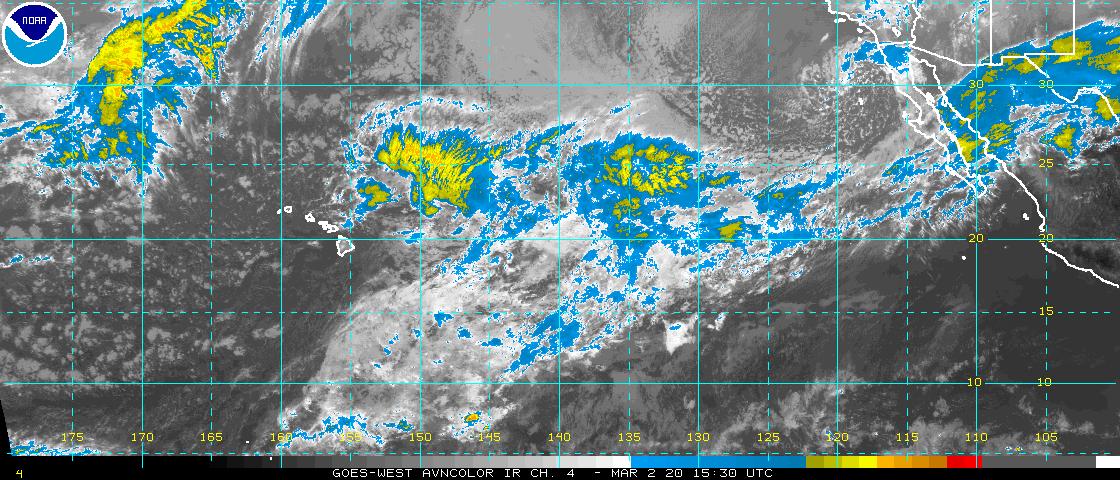
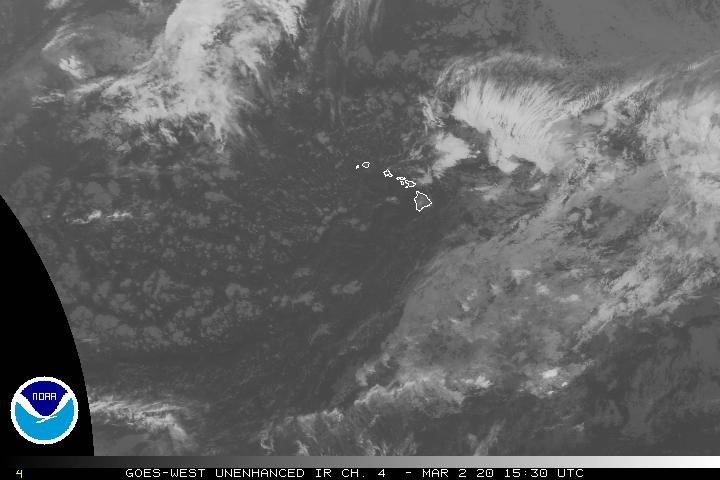
Satellite and Radar Images: To view the cloud conditions we have here in Hawaii, please use the following satellite links, starting off with this Infrared Satellite Image of the islands to see all the clouds around the state during the day and night. This next image is one that gives close images of the islands only during the daytime hours, and is referred to as a Close-up visible image. This next image shows a larger view of the Pacific…giving perspective to the wider ranging cloud patterns in the Pacific Ocean. Finally, here’s a Looping IR satellite image, making viewable the clouds around the islands 24 hours a day. To help you keep track of where any showers may be around the islands, here’s the latest animated radar image.
Hawaii’s Mountains – Here’s a link to the live webcam on the summit of near 14,000 foot Mauna Kea on the Big Island of Hawaii. The tallest peak on the island of Maui is the Haleakala Crater, which is near 10,000 feet in elevation. These two webcams are available during the daylight hours here in the islands…and when there’s a big moon rising just after sunset for an hour or two! Plus, during the nights and early mornings you will be able to see stars, and the sunrise too…depending upon weather conditions.
Tropical Cyclone activity in the eastern and central Pacific – Here’s the latest weather information coming out of the National Hurricane Center, covering the eastern north Pacific. You can find the latest tropical cyclone information for the central north Pacific (where Hawaii is located) by clicking on this link to the Central Pacific Hurricane Center. Here’s a tracking map covering both the eastern and central Pacific Ocean. A satellite image, which shows the entire ocean area between Hawaii and the Mexican coast…can be found here.
Aloha Paragraphs
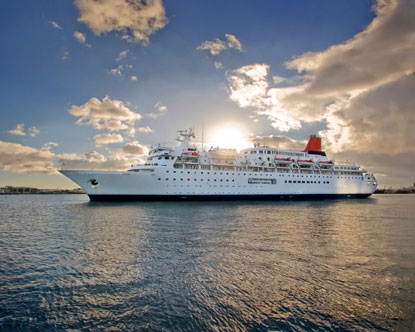
Cruising between the islands
The trade winds will blow through this first part of the week, then falter quite a bit for a few days…gradually returning over the weekend into next week. We find two 1029 millibar high pressure systems to the northwest of the islands Monday evening. These two high pressure cells are the source of our gusty winds…and seem to be trying to merge together. Forecast charts show our trades tapering off considerably during the second half of the work week. This will bring us into a convective weather pattern, with muggy conditions for several days thereafter. Fortunately, these overly moist conditions won’t last long, as the trade winds fill back into our Hawaiian Islands weather picture over the weekend.
The atmosphere over the islands is dry and stable now, and will remain that way into mid-week, at which point a slug of moisture from the deeper tropics will arrive. This moist air mass, combined with the faltering trade winds, will make our air mass more shower prone. The greatest likelihood of showers Wednesday through Friday, will be during the afternoons in the leeward upcountry areas. If the trade winds return as expected, over the weekend, the emphasis for showers will return to the windward sides. Meanwhile, as this satellite image shows, we have waves of high cirrus clouds to our south…which are being carried northward over us.
Our weather here in the in the islands will remain very nice through Tuesday…and probably into the first part of Wednesday too. Showers will be few and far between through Tuesday, and perhaps into part of Wednesday. Thursday and Friday will be a different story though, as a surge of moisture from the tropics works it way over our islands from the east or southeast. This will prime the pump so to speak, setting the stage for a possible increase in showers over and around the mountains generally. This last part of the work week will be a muggy affair, with all that moisture around, and very little wind to provide relief from the heat. The winds may even take on a southeast orientation, which could carry some volcanic haze up over some parts of the islands…time will tell.
It’s Monday evening here in Kihei, Maui, as I begin writing the last part of today’s narrative. This should be an interesting week, not exactly normal in several ways. The unusual aspects are likely to be the slacking off of our trade winds later this week, and the possible increase in showers later on too. Here on Monday, the winds are still blowing, and rainfall is at a minimal to say the least. We still those high cirrus clouds, which will more than likely provide us with a great sunset this evening, and if they’re still around Tuesday morning, like they were Monday morning…beautiful colors then too. ~~~ I’m about ready to leave now, for the trip back upcountry to Kula. I’ll be back early Tuesday morning with your next new weather narrative from paradise! Aloha for now…Glenn.
Interesting: Fish have lost half their average body mass and smaller species are making up a larger proportion of European fish stocks as a result of global warming, a study has found. "It’s huge,” study author Martin Daufresne said. "Size is a fundamental characteristic that is linked to a number of biological functions, such as fecundity – the capacity to reproduce.”
Smaller fish tend to produce fewer eggs. They also provide less sustenance for predators – including humans – which could have significant implications for the food chain and ecosystem. A similar shrinking effect was recently documented in Scottish sheep and Mr Daufresne said it is possible that global warming could have "a significant impact on organisms in general”.
Earlier research has already established that fish have shifted their geographic ranges and their migratory and breeding patters in response to rising water temperatures. It has also been established that warmer regions tend to be inhabited by smaller fish.
Mr Daufresne and his colleagues examined long-term surveys of fish populations in rivers, streams and the Baltic and North Seas and also performed experiments on bacteria and plankton. They found the individual species lost an average of 50 per cent of their body mass over the past 20 to 30 years while the average size of the overall fishing stock had shrunk by 60 per cent.
This was a result of a decrease in the average size-at-age and an increase in the proportion of juveniles and small-sized species, Mr Daufresne said. "It was an effect that we observed in a number of organisms and in a number of very different environments – on fish, on plankton, on bacteria, in fresh water, in salt water – and we observed a global shrinking of size for all the organisms in all the environments.”
While commercial and recreational fishing did impact some of the fisheries studied, it "cannot be considered as the unique trigger” for the changes in size, the study published in the Proceedings of the National Academy of Sciences found. "Although not negating the role of other factors, our study provides strong evidence that temperature actually plays a major role in driving changes in the size structure of populations and communities,” the study concluded.
Interesting2: Consumers may be able to eat longer-lasting, potentially healthier fish fillets if research at Oregon State University makes its way to the supermarket. That’s because OSU scientists have extended the shelf life of lingcod fillets and possibly made them more nutritious by dipping them into an edible, protective coating enriched with fish oil.
"With this coating, you can easily keep the fillets in the display case for two to three more days," said OSU food science professor Yanyun Zhao, the lead researcher in the study. The liquid coating contained chitosan, which comes from crustacean shells and can be made into film for food wrapping to keep out bacteria and fungi and prolong storage life.
What’s unusual about the OSU study is that fish oil was added to the chitosan coating, which wasn’t visible once it dried. After the coating was applied, some fillets were refrigerated for three weeks while others were frozen for three months.
The study, which has been accepted for publication in the journal Food Chemistry and has been published on its Web site, found that the coating tripled the omega-3 fatty acids in the refrigerated and frozen fish when compared against the uncoated fish.
Interesting3: A new study of 30-million-year-old-fossil ‘mega-dung’ from extinct giant South American mammals, published in Palaeontology, reveals evidence of complex ecological interactions and theft of dung-beetles’ food stores by other animals. The dung-beetle has fallen on hard times. Once worshipped by the Ancient Egyptians its status has now slipped to that of unsung and forgotten hero, the butt of scatological jokes.
Yet the dung-beetle is truly heroic. It is a well known ‘fact’ that were it not for the dung-beetle the world would be knee-deep in animal droppings, especially those of large herbivores like cows, rhinos and elephants which, because they eat more food, produce more waste.
By burying that waste dung-beetles not only remove it from the surface, they improve and fertilise the soil and reduce the number of disease-carrying flies that would otherwise infest the dung.
If the modern dung beetle deserves praise for these global sanitation efforts, then the extinct dung beetles of ancient South America deserve a medal. Some 30 million years ago, the continent was home to what is known to palaeontologists as the South America Megafauna, including some truly giant extinct herbivores: bone covered armadillos the size of a small car, ground sloths 6 metres tall and elephant-sized hoofed-mammals unlike anything alive today.
And of course, megafauna would have produced mega-dung. The beetles certainly had their work cut out for them. And although the dung-beetles themselves did not fossilize, scientists know they were fully engaged in business because, amazingly, the results of their activities are preserved as fossil dung balls, some more than 40 million years old, and some as large as tennis balls.
Now palaeontologists in Argentina studying these dung balls have discovered that they have even more to tell us about the ecology of this lost world of giant mammals, but at a rather different scale. In a study published in the latest issue of the journal Palaeontology, Graduate Student Victoria Sánchez and Dr Jorge Genise report traces made by other creatures within fossil dung balls. "Some of these are just the results of chance interactions" explains Dr Sánchez.
"Burrowing bees, for example, dug cells in the ground where the dung balls were buried, and some of these happen to have been dug into the balls. But other traces record the behavior of animals actively stealing the food resources set aside by the dung beetles.
The shapes and sizes of these fossilized burrows and borings in the dung balls indicate that other beetles, flies and earthworms were the culprits. Although none of these animals is preserved in these rocks, the fossil dung balls preserve in amazing detail a whole dung-based ecosystem going on right under the noses of the giant herbivores of 30 million years ago."
Interesting4: Aluminum as a substitute for glass bottles has been inching its way into the consumer experience in the last few years, most notably in the US in the form of beer bottles from Anheuser-Busch and Iron City Beer, a popular regional brand founded in Pittsburgh. Coca-cola has also announced plans to roll out aluminum bottles in this country, though only in limited venues. Now Rexam, one of the world’s largest consumer packaging companies, has developed a lighter, resealable aluminum bottle that it hopes will replace glass bottles for many beverages, including wine.
The conclusion? Locally bottled beers are best served in glass, especially if your town has a strong glass recycling program. On the other hand, if you drink ales that hail from across state or national borders, aluminum cans are the way to go. Presumably this applies to the slightly heavier aluminum bottles, if and when they arrive in bars and supermarkets en masse.
Interesting5: The Los Angeles metropolitan area belches far more methane into its air than scientists had previously realized. If other megacities are equally profligate, urban methane emissions may represent a surprisingly important source of this potent greenhouse gas.
Atmospheric researchers have long had good estimates of global methane emissions, but less is known about exactly where these emissions come from, particularly in urban areas. To fill this void, a research team led by Paul Wennberg, an atmospheric chemist at Caltech in Pasadena, estimated methane emissions for the Los Angeles region, then subtracted all known sources of methane, such as livestock, landfills and sewage.
They ended up with an enormous amount of methane — about 0.14 to 0.34 megatons per year, or up to half of the total emissions that could not be accounted for by known sources. A separate study now underway by Amy Townsend-Small, a bio-geochemist at the University of California at Irvine, may help pinpoint the source.
She has been measuring the carbon isotope composition of methane released from different sources — for example, natural gas and other geologically old methane should be devoid of carbon-14, a relatively short-lived radioactive isotope.
Interesting6: The potential for a huge Pacific Ocean tsunami on the West Coast of America may be greater than previously thought, according to a new study of geological evidence along the Gulf of Alaska coast. The new research suggests that future tsunamis could reach a scale far beyond that suffered in the tsunami generated by the great 1964 Alaskan earthquake.
Official figures put the number of deaths caused by the earthquake at around 130: 114 in Alaska and 16 in Oregon and California. The tsunami killed 35 people directly and caused extensive damage in Alaska, British Columbia, and the US Pacific region.
The 1964 Alaskan earthquake – the second biggest recorded in history with a magnitude of 9.2 – triggered a series of massive waves with run up heights of as much as 12.7 meters in the Alaskan Gulf region and 52 meters in the Shoup Bay submarine slide in Valdez Arm.
The study suggests that rupture of an even larger area than the 1964 rupture zone could create an even bigger tsunami. Warning systems are in place on the west coast of North America but the findings suggest a need for a review of evacuation plans in the region.
The research team from Durham University in the UK, the University of Utah and Plafker Geohazard Consultants, gauged the extent of earthquakes over the last 2,000 years by studying subsoil samples and sediment sequences at sites along the Alaskan coast.
The team radiocarbon-dated peat layers and sediments, and analyzed the distribution of mud, sand and peat within them. The results suggest that earthquakes in the region may rupture even larger segments of the coast and sea floor than was previously thought.
The study published in the academic journal Quaternary Science Reviews and funded by the National Science Foundation, NASA, and the US Geological Survey shows that the potential impact in terms of tsunami generation, could be significantly greater if both the 800-km-long 1964 segment and the 250-km-long adjacent Yakataga segment to the east were to rupture simultaneously.
Interesting7: Rubber sidewalks are all grown up. Once perceived mainly as a safe surface for playgrounds, rubber sidewalks have developed into a means of preserving urban trees, reducing storm water runoff, recycling tires, and curbing greenhouse gas emissions. A company called Rubbersidewalks (what else?) began installing the modular units in 2002, and its rubber sidewalk products now appear in almost 100 cities across the country. Even the U.S. military is getting into the act.
Plans are in the works to install rubber sidewalks at Coast Guard Island in Alameda, California, and they’re being promoted by the Pollution Prevention Program at Aberdeen Proving Ground in Maryland. The Benefits of Rubber Sidewalks for Urban Trees Rubbersidewalks (the company, that is) attributes its core concept to Richard Valeriano, a senior public works inspector for the City of Santa Monica.
The original idea behind a rubber sidewalk was to achieve a flexible surface that would reduce cracking around tree roots. In turn, that would reduce the need to cut or drastically trim trees with overgrown roots. Over the course of several years, city workers noticed that the rubber surface seemed to slow the growth of roots while providing the tree with sufficient water and oxygen, helping to mitigate the problem of root overgrowth at the source. The modular installation system also enables workers to remove sections of sidewalk to inspect tree roots, without the need for pavement-breaking equipment that could damage a tree.
 Email Glenn James: