July 18-19, 2009
Air Temperatures – The following maximum temperatures were recorded across the state of Hawaii Saturday afternoon:
Lihue, Kauai – 84
Honolulu, Oahu – 87
Kaneohe, Oahu – 82
Kahului, Maui – 85
Hilo, Hawaii – 80
Kailua-kona – 86
Air Temperatures ranged between these warmest and coolest spots near sea level – and on the highest mountains…at 5 p.m. Saturday evening:
Barking Sands, Kauai – 86F
Hilo, Hawaii – 74
Haleakala Crater – 45 (near 10,000 feet on Maui)
Mauna Kea summit – 32 (near 14,000 feet on the Big Island)
Precipitation Totals – The following numbers represent the largest precipitation totals (inches) during the last 24 hours on each of the major islands, as of Saturday afternoon:
0.22 Mount Waialaele, Kauai
0.93 Mano Valley, Oahu
0.07 Molokai
0.00 Lanai
0.00 Kahoolawe
3.74 Puu Kukui, Maui
2.77 Waiakea Uka, Big Island
Marine Winds – Here’s the latest (automatically updated) weather map showing large 1031 millibar high pressure systems to the north and northwest of the islands. These high pressure cells will keep the trade winds blowing through Monday.
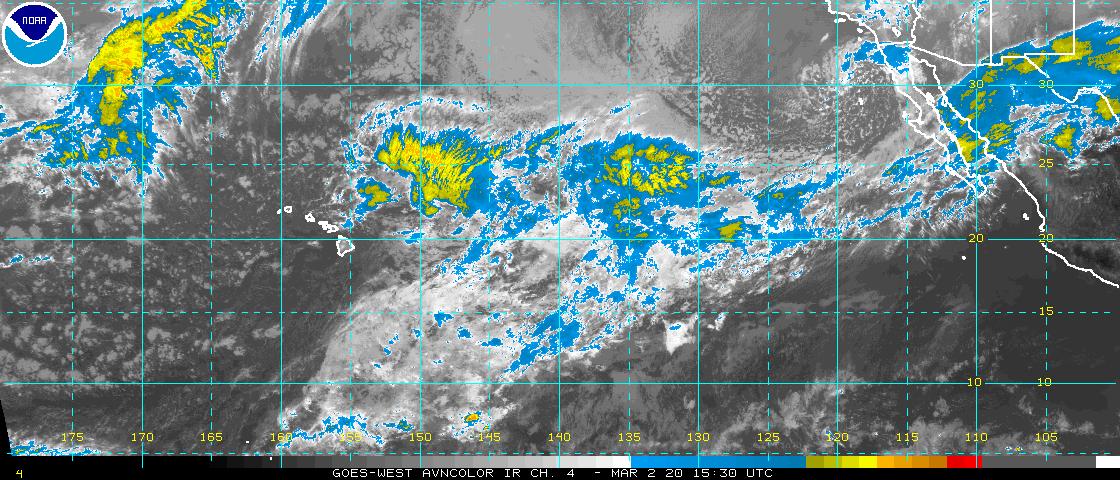
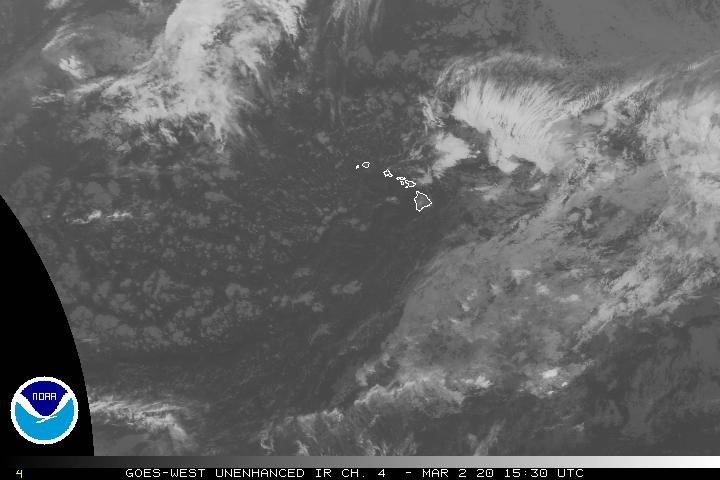
Satellite and Radar Images: To view the cloud conditions we have here in Hawaii, please use the following satellite links, starting off with this Infrared Satellite Image of the islands to see all the clouds around the state during the day and night. This next image is one that gives close images of the islands only during the daytime hours, and is referred to as a Close-up visible image. This next image shows a larger view of the Pacific…giving perspective to the wider ranging cloud patterns in the Pacific Ocean. Finally, here’s a Looping IR satellite image, making viewable the clouds around the islands 24 hours a day. To help you keep track of where any showers may be around the islands, here’s the latest animated radar image.
Hawaii’s Mountains – Here’s a link to the live webcam on the summit of near 14,000 foot Mauna Kea on the Big Island of Hawaii. The tallest peak on the island of Maui is the Haleakala Crater, which is near 10,000 feet in elevation. These two webcams are available during the daylight hours here in the islands…and when there’s a big moon rising just after sunset for an hour or two! Plus, during the nights and early mornings you will be able to see stars, and the sunrise too…depending upon weather conditions.
Tropical Cyclone activity in the eastern and central Pacific – Here’s the latest weather information coming out of the National Hurricane Center, covering the eastern north Pacific. You can find the latest tropical cyclone information for the central north Pacific (where Hawaii is located) by clicking on this link to the Central Pacific Hurricane Center. Here’s a tracking map covering both the eastern and central Pacific Ocean. A satellite image, which shows the entire ocean area between Hawaii and the Mexican coast…can be found here.
Aloha Paragraphs

Windward Oahu…what a great place to walk
As expected the trade winds are on the blustery side of the wind scale this weekend…and will remain that way through the first part of the upcoming new week. We find near 1030 millibar high pressure systems to the north and northwest of the islands Saturday. These two high pressure cells are the source of our locally strong and gusty winds…as shown on this weather map. As these winds have gained some strength overnight, we find small craft wind advisories active over most of our marine areas statewide. The expectation is that these gusty trades will continue through at least the first half of the new week ahead…then taper off some around mid-week.
An area of moisture, which extends over 300 miles east of the islands, will keep off and on showers falling, carried our way on the gusty trades…arriving generally along the windward coasts and slopes into Sunday. In sum, there continues to be lots of clouds upstream of the islands, which will bring this increase in shower activity. This satellite image shows those clouds, and also wisps of high cirrus clouds, which may spread overhead at times too. The forecast calls for drier air arriving later Sunday or by Monday, and remaining somewhat drier until around Wednesday…when another possible area of showers arrives then for a couple of days. ~~~ At least part of these two areas of moisture may consist of former tropical systems Blanca and Dolores, which were active in the eastern Pacific. These remnant showery clouds are being brought to us thanks to the low level trade wind flow.
I had planned on going to see the new Harry Potter film last evening after work, but decided it would still be too crowded. Therefore, I decided to drive upcountry to Pukalani, to what is called the Maikalani Community Lectures…at the Institute for Astronomy. My neighbor, Dr. Jeff Kuhn, is the Director there, and invited me to attend this talk. This lecture is called Helioseismology: Song of the Sun, given by Dr. JD Armstrong. The description of this talk included: "The sun is the dominant influence on the weather, climate, and consequently, all life on our planet. Understanding how the sun works may therefore be essential to our survival. Measuring what happens inside the sun is difficult, so scientists have developed helioseismology, the study of sound waves inside the sun, to probe its interior." This sounded pretty interesting to me, so I went up for that. I must admit however, that most of what was discussed flew right over the top of my head!
I joined Jeff, his wife, and daughter for dinner in Makawao afterwards. This was the fun part of the evening for me, as I rarely go out socializing. It was funny, as soon as we sat down in the dining room of this restaurant, a very nice looking young lady came over to our table, and introduced herself to me. She, and two friends were on vacation from San Francisco, and used to watch my TV weather show, and read this website everyday. At any rate, I walked over and met her friends, and then came back and had a fine dinner, along with a glass of red wine. We had good talks, on a variety of subjects, as we almost always do.
It’s Saturday morning here in Kula, Maui, as I begin writing the last part of this morning’s narrative. I can see all those clouds over on the windward sides this morning. It’s even somewhat cloudy over here on the leeward slopes of the Haleakala Crater. Actually, now that I look over towards the leeward beaches, it looks cloudy there too…although appears to clearing fast over there. This is good, as we can use what water that this area of moisture can bring our way! ~~~ I honestly don’t know what I’ll be doing today, although since it’s Saturday, it’s a day off from work, which gives me a lot of freedom to let things fill in naturally. I’ll be back later in the day with more weather updates, I hope you have a great day until then! One last thing, I was sad to see the passing away of Walter Cronkite, it seems like so many people are leaving us lately. Aloha for now…Glenn.
As it turns out it’s Saturday evening now, and this afternoon I attended a circle of friends for a dear friend, who is dying of lung cancer. Her name is Julie…Dr. Julie Holmes, who I’ve had a long close friendship with on many levels over the years. I’m not really in the space to write much now, as about all I can do is sit here and be with all the memories that I have. I’ll come back on Sunday with more weather information. Aloha…Glenn.
Interesting: It has been assumed that global warming would cause an expansion of the world’s deserts, but now some scientists are predicting a contrary scenario in which water and life slowly reclaim these arid places. They think vast, dry regions like the Sahara might soon begin shrinking. The evidence is limited and definitive conclusions are impossible to reach but recent satellite pictures of North Africa seem to show areas of the Sahara in retreat.
It could be that an increase in rainfall has caused this effect. Farouk el-Baz, director of the Centre for Remote Sensing at Boston University, believes the Sahara is experiencing a shift from dryer to wetter conditions. "It’s not greening yet.
But the desert expands and shrinks in relation to the amount of energy that is received by the Earth from the Sun, and this over many thousands of years," Mr el-Baz told the BBC World Service. "The heating of the Earth would result in more evaporation of the oceans, in turn resulting in more rainfall."
Interesting2: The findings of a major new study are consistent with gradual changes of current systems in the North Atlantic Ocean, rather than a more sudden shutdown that could lead to rapid climate changes in Europe and elsewhere. The research, based on the longest experiment of its type ever run on a "general circulation model" that simulated the Earth’s climate for 21,000 years back to the height of the last Ice Age, shows that major changes in these important ocean current systems can occur, but they may take place more slowly and gradually than had been suggested.
The newest findings, to be published July 17 in the journal Science, are consistent with other recent studies that are moving away from the theory of an abrupt "tipping point" that might cause dramatic atmospheric temperature and ocean circulation changes in as little as 50 years. "Research is now indicating that this phenomenon may happen, but probably not as a sudden threshold we’re crossing," said Peter Clark, a professor of geosciences at Oregon State University.
"For those who have been concerned about extremely abrupt changes in these ocean current patterns, that’s good news. "In the past it appears the ocean did change abruptly, but only because of a sudden change in the forcing," he said. "But when the ocean is forced gradually, such as we anticipate for the future, its response is gradual. That would give ecosystems more time to adjust to new conditions."
The findings do not change broader concerns about global warming. Temperatures are still projected to increase about four to 11 degrees by the end of this century, and the study actually confirms that some of the world’s most sophisticated climate models are accurate.
"The findings from this study, which also match other data we have on recorded climate change, are an important validation of the global climate models," Clark said. "They seem to be accurately reflecting both the type and speed of changes that have taken place in the past, and that increases our ability to trust their predictions of the future."
Interesting3: New evidence for ice-free summers with intermittent winter sea ice in the Arctic Ocean during the Late Cretaceous – a period of greenhouse conditions – gives a glimpse of how the Arctic is likely to respond to future global warming. Records of past environmental change in the Arctic should help predict its future behaviour.
The Late Cretaceous, the period between 100 and 65 million years ago leading up to the extinction of the dinosaurs, is crucial in this regard because levels of carbon dioxide (CO2) were high, driving greenhouse conditions.
But scientists have disagreed about the climate at this time, with some arguing for low Arctic late Cretaceous winter temperatures (when sunlight is absent during the Polar night) as against more recent suggestions of a somewhat milder 15°C mean annual temperature.
Writing in Nature, Dr Andrew Davies and Professor Alan Kemp of the University of Southampton’s School of Ocean and Earth Science based at the National Oceanography Centre, Southampton, along with Dr Jennifer Pike of Cardiff University take this debate a step forward by presenting the first seasonally resolved Cretaceous sedimentary record from the Alpha Ridge of the Arctic Ocean.
The scientists analyzed the remains of diatoms – tiny free-floating plant-like organisms – preserved in late Cretaceous marine sediments. In modern oceans, diatoms play a dominant role in the ‘biological carbon pump’ by which carbon dioxide is drawn down from the atmosphere through photosynthesis and a proportion of it exported to the deep ocean.
Unfortunately, the role of diatoms in the Cretaceous oceans has until now been unclear, in part because they are often poorly preserved in sediments. But the researchers struck lucky. "With remarkable serendipity," they explain, " successive US and Canadian expeditions that occupied floating ice islands above the Alpha Ridge of the Arctic Ocean, recovered cores containing shallow buried upper Cretaceous diatom ooze with superbly preserved diatoms."
This has allowed them to conduct a detailed study of the diatom fossils using sophisticated electron microscopy techniques. In the modern ocean, scientists use floating sediment traps to collect and study settling material. These electron microscope techniques that have been pioneered by Professor Kemp’s group at Southampton have unlocked a ‘palaeo-sediment trap’ to reveal information about Late Cretaceous environmental conditions.
Interesting4: June 2009 was the planet’s second-warmest June ever on record, the National Oceanographic and Atmospheric Administration (NOAA) reported Friday. Only 2005 was warmer. When just ocean areas are included, it was the warmest June ever. Global records began in 1880. "Large portions of each inhabited continent were substantially warmer than average during June 2009," NOAA’s National Climatic Data Center wrote in an online report
"The warmest anomalies were most notable in parts of Africa and most of Eurasia." The main cause for the warmth was the development of El Niño, a warming of tropical Pacific Ocean water that affects weather patterns worldwide. "If El Niño conditions continue to mature as projected by NOAA, global temperatures are likely to continue to threaten previous record highs," noted the report.
Overall, for the first half of the year, 2009 is the fifth-warmest year on record for the Earth, with an average global temperature nearly 1 degree above average. Only 1998, 2002, 2005, and 2007 had a higher average temperature for the first six months of the year.
In 2009, warmer-than-average conditions were recorded across much of the world’s land areas, with the exception of cooler-than-average temperatures across Canada. In the USA, the climate center reported earlier this week that the USA is having its 25th-warmest year on record, with only North Dakota experiencing below-average temperatures.
 Email Glenn James: