July 15-16, 2009
Air Temperatures – The following maximum temperatures were recorded across the state of Hawaii Wednesday afternoon:
Lihue, Kauai – 84
Honolulu, Oahu – 86
Kaneohe, Oahu – 82
Kahului, Maui – 84
Hilo, Hawaii – 84
Kailua-kona – 86
Air Temperatures ranged between these warmest and coolest spots near sea level – and on the highest mountains…at 5 p.m. Wednesday evening:
Port Allen, Kauai – 86F
Kapalua, Maui – 77
Haleakala Crater – 46 (near 10,000 feet on Maui)
Mauna Kea summit – 41 (near 14,000 feet on the Big Island)
Precipitation Totals – The following numbers represent the largest precipitation totals (inches) during the last 24 hours on each of the major islands, as of Wednesday afternoon:
0.56 Mount Waialaele, Kauai
0.94 Oahu Forest NWR, Oahu
0.06 Molokai
0.00 Lanai
0.08 Kahoolawe
0.29 Puu Kukui, Maui
0.73 Honaunau, Big Island
Marine Winds – Here’s the latest (automatically updated) weather map showing a 1023 millibar high pressure system to the northeast of the islands Thursday. This high pressure cell, along with its associated high pressure ridge…will keep the trade winds blowing through Friday.
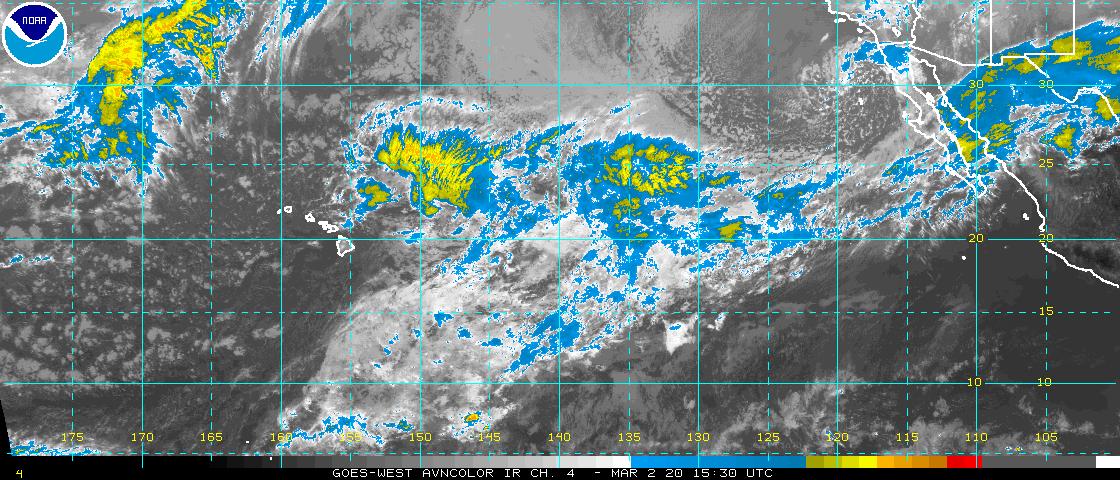
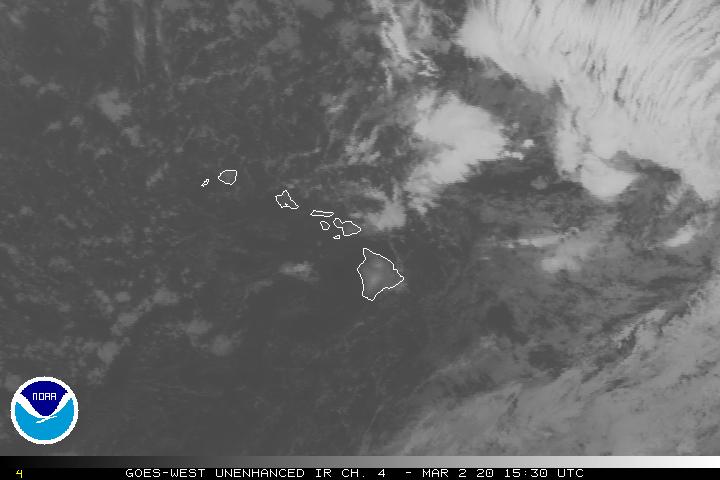
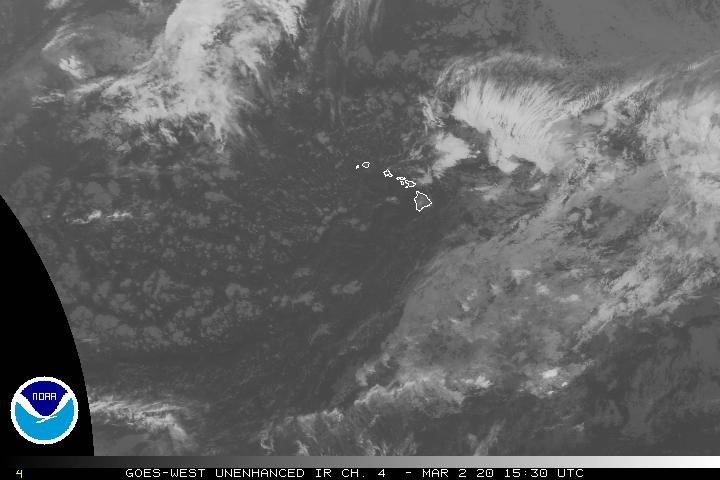
Satellite and Radar Images: To view the cloud conditions we have here in Hawaii, please use the following satellite links, starting off with this Infrared Satellite Image of the islands to see all the clouds around the state during the day and night. This next image is one that gives close images of the islands only during the daytime hours, and is referred to as a Close-up visible image. This next image shows a larger view of the Pacific…giving perspective to the wider ranging cloud patterns in the Pacific Ocean. Finally, here’s a Looping IR satellite image, making viewable the clouds around the islands 24 hours a day. To help you keep track of where any showers may be around the islands, here’s the latest animated radar image.
Hawaii’s Mountains – Here’s a link to the live webcam on the summit of near 14,000 foot Mauna Kea on the Big Island of Hawaii. The tallest peak on the island of Maui is the Haleakala Crater, which is near 10,000 feet in elevation. These two webcams are available during the daylight hours here in the islands…and when there’s a big moon rising just after sunset for an hour or two! Plus, during the nights and early mornings you will be able to see stars, and the sunrise too…depending upon weather conditions.
Tropical Cyclone activity in the eastern and central Pacific – Here’s the latest weather information coming out of the National Hurricane Center, covering the eastern north Pacific. You can find the latest tropical cyclone information for the central north Pacific (where Hawaii is located) by clicking on this link to the Central Pacific Hurricane Center. Here’s a tracking map covering both the eastern and central Pacific Ocean. A satellite image, which shows the entire ocean area between Hawaii and the Mexican coast…can be found here.
Aloha Paragraphs

Windward side Koolau Mountains…Oahu
As one would expect during the summer months here in the tropics, the trade winds are blowing. They are with us now, as they have been all this month, and as they will likely be through the rest of the month. We can thank the high pressure systems, sitting up to the north-northwest, and northeast of us Wednesday evening, for their presence…as shown on this weather map. As this forecast weather map shows, a 1030 millibar high pressure system will be sitting up to the north-northwest of
There’s nothing that should be too surprising as far as precipitation goes, at least through the rest of this work week. There are some clouds upstream of the islands this afternoon, which will keep off and on shower activity arriving along our windward coasts and slopes…there’s no apparent end in this moisture. Perhaps the most dynamic picture that we can look at now is the high cirrus clouds steaming off the tops of thunderstorms over by the International Dateline. This satellite image shows how this icy cloudiness has dipped south of the islands, at least for the moment. If it were to scoot northward, we could begin having our sunset and sunrise colors again.
This time of the year we can sometimes get much needed rainfall from dissipated tropical cyclones, which were spawned in the eastern Pacific…and then slide in our direction, carried by the low level trade wind flow. There was an old tropical cyclone named Blanca, which has dissipated, but may bring in some of its remnant moisture Friday into the weekend. It may be a long shot, since Dolores is so far away now, in the eastern Pacific, but it may eventually bring in some of its remnant moisture as well. While we’re talking about tropical cyclones, or dissipated ones, current tropical storm Carlos continues to mind his manners, with a projected forecast keeping its path well south of the
It’s Wednesday evening here in Kihei, Maui, as I begin writing this last section of today’s narrative. Wednesday was another nice day here in Hawaii, although a bit more cloudy than most of our sun worshippers would have liked. There were some blue patches around, so that I’m quite sure that there was a bit of sun tanning going on despite the somewhat cloudier than normal beaches. ~~~ The trade winds are of course still blowing, with the strongest gusts at both Kahului, Maui, and South Point, on the Big Island of Hawaii. These two typically windier areas were showing gusts to 31 mph at a bit past 5pm. As for rainfall early this evening, despite all the clouds around, there weren’t all that many showers falling. Here’s a looping radar image showing this activity. Looking at this wider angle picture, we see some showers that will take aim on the windward sides tonight into early Thursday morning. The main items in that picture are certainly the abundant high cloudiness to the southwest through southeast! ~~~ I’m about ready to take the drive back upcountry now, to Kula. I’ll be back early Thursday morning with your next new weather narrative from paradise. I hope you have a great Wednesday night until then! Aloha, Glenn.
Interesting: Carlos became a hurricane for about 24 hours over the previous weekend, then powered down to a tropical storm and now atmospheric conditions have enabled him to power back into a hurricane in the Eastern Pacific Ocean. NASA’s Tropical Rainfall Measuring Mission (TRMM) satellite has been capturing images of Carlos since it was born as tropical depression #4E last week.
Scientists at NASA can use TRMM data to provide forecasters a 3-D look at the storm’s cloud heights and rainfall, which is extremely helpful in forecasting. "One of the interesting capabilities of the TRMM satellite is its ability to see through clouds with its Precipitation Radar (PR) and reveal the 3-D structure within storms such as Hurricane Carlos," said Hal Pierce, on the TRMM mission team in the Mesoscale Atmospheric Processes Branch at NASA’s Goddard Space Flight Center, Greenbelt, Md. Pierce created a
He used data captured on July 13 when TRMM also got a "top down" view of the storm’s rainfall, and created a 3-D image that shows thunderstorm tops reaching to almost 15 kilometers (9.3 miles) high in the eastern side of the storm. On Tuesday, July 14, 2009 at 6 a.m. EDT (3 a.m. PDT), Carlos had regained hurricane status as a Category One storm on the Saffir-Simpson Scale with maximum sustained winds near 75 mph.
Carlos was located near latitude 9.7 north and longitude 127.2 west. That’s about 1,465 miles or southwest of the southern tip of Baja California. Carlos continues to move west near 9 mph and has a minimum central pressure of 987 millibars. Carlos is predicted to move to within about 720 miles southeast of the Hawaiian Islands on Saturday, July 18, 2009.
Interesting2: No one knows exactly how much Earth’s climate will warm due to carbon emissions, but a new study suggests scientists’ best predictions about global warming might be incorrect. The study, which appears in Nature Geoscience, found that climate models explain only about half of the heating that occurred during a well-documented period of rapid global warming in Earth’s ancient past.
The study, which was published online July 13, contains an analysis of published records from a period of rapid climatic warming about 55 million years ago known as the Palaeocene-Eocene thermal maximum, or PETM. "In a nutshell, theoretical models cannot explain what we observe in the geological record," said oceanographer Gerald Dickens, a co-author of the study and professor of Earth science at Rice University. "There appears to be something fundamentally wrong with the way temperature and carbon are linked in climate models."
Interesting3: A runaway spurt of global warming 55 million years ago turned Earth into a hothouse but how this happened remains worryingly unclear. Previous research into this period, called the Palaeocene-Eocene Thermal Maximum, or PETM, estimates the planet’s surface temperature blasted upwards by between five and nine degrees Celsius in just a few thousand years. The Arctic Ocean warmed to 23C, or about the temperature of a lukewarm bath.
How PETM happened is unclear but climatologists are eager to find out, as this could shed light on aspects of global warming today. What seems clear is that a huge amount of heat-trapping "greenhouse" gases — natural, as opposed to man-made — were disgorged in a very short time.
The theorized sources include volcanic activity and the sudden release of methane hydrates in the ocean. But all this CO2 can only account for between one and 3.5C of PETM’s warming if the models for climate sensitivity are right, the team found.
There must have been some other factor that stoked temperatures higher. Even though there are big differences between Earth’s geology and ice cover then and now, the findings are relevant as they highlight the risk of hidden mechanisms that add dramatically to warming, says the paper.
Interesting4: Researchers from NOAA’s National Centers for Coastal Ocean Science and the Monterey Bay Aquarium Research Institute (MBARI) have carried out the first remote detection of a harmful algal species and its toxin. Harmful algae blooms (HABs) and marine biotoxins impact the whole marine food web and the human endeavors associated with living marine resources.
HAB events can occur in relatively small areas, many of them have origins in far off-shore oceanic environments. It is believed that climate change is expected to exacerbate HAB events, due to changes in water temperature and ocean circulation, which are influenced by climate.
Because of the scale of these HAB events, NOAA developed a HAP Operational Forecast System, used to develop predictions of the transport and potential development of harmful algae conditions in the Gulf of Mexico. This remote detection system is a major milestone in NOAA’s effort to monitor the type and toxicity of harmful algal blooms (HABs) and forecast their development.
The remote detection system is called the Environmental Sample Processor, or ‘ESP.’ The processor is designed as a fully-functional underwater laboratory, allowing researchers to collect and analyze the algal cells identifying specific toxins and genetic information in order to assess the risk to humans and wildlife.
Interesting5: Biologically speaking, many animals besides dogs bark, according to Kathryn Lord at the University of Massachusetts Amherst, but the evolutionary biologist also says domestic dogs vocalize in this way much more than birds, deer, monkeys and other wild animals that use barks. The reason is related to dogs’ 10,000-year history of hanging around human food refuse dumps, she suggests.
In her recent paper in a special issue of the journal, Behavioral Processes, Lord and co-authors from nearby Hampshire College also provide the scientific literature with its first consistent, functional and acoustically precise definition of this common animal sound. As Lord, a doctoral candidate in organisms and evolutionary biology at UMass Amherst, explains,
“We suggest an alternative hypothesis to one that many biologists seem to accept lately, which seeks to explain dog barking in human-centric terms and define it as an internally motivated vocalization strategy.” In the researchers’ view, however, barking is not a special form of communication between dogs and humans.
“What we’re saying is that the domestic dog does not have an intentional message in mind, such as, ‘I want to play’ or ‘the house is on fire,’” explains Lord. Rather, she and colleagues say barking is the auditory signal associated with an evolved behavior known as mobbing, a cooperative anti-predator response usually initiated by one individual who notices an approaching intruder.
A dog barks because she feels an internal conflict ? an urge to run plus a strong urge to stand her ground and defend pups, for example. When the group joins in, the barks intimidate the intruder, who often flees. “We think dogs bark due to this internal conflict and mobbing behavior, but domestic dogs bark more because they are put, and put themselves into, conflicting situations more often,” she says.
The reason traces back to the first dogs that started hanging around human food dumps about 8,000 to 10,000 years ago. They would have experienced a serious disadvantage if they had run a mile away every time a human or other animal approached.
As Lord explains, “In evolutionary terms, dogs self-selected the behavior of sticking around, overcoming their fear and being rewarded by getting to eat that meal before some other dog got it. Thus these animals allow people to get unusually close. The scared ones die while those less scared stay, eat, survive and reproduce. So they inherit the tendency.”
She adds, “By contrast, wild animals like wolves have a very long flight distance. They hear something and they run before you’d ever see them. Dogs hang around, but now they have committed to holding their ground and the closer an ‘intruder’ gets, the more likely mobbing is to occur rather than running away.”
 Email Glenn James: