July 14-15, 2009
Air Temperatures – The following maximum temperatures were recorded across the state of Hawaii Tuesday afternoon:
Lihue, Kauai – 83
Honolulu, Oahu – 87
Kaneohe, Oahu – 83
Kahului, Maui – 85
Hilo, Hawaii – 83
Kailua-kona – 86
Air Temperatures ranged between these warmest and coolest spots near sea level – and on the highest mountains…at 5 p.m. Tuesday evening:
Barking Sands, Kauai – 85F
Lihue, Kauai – 79
Haleakala Crater – 50 (near 10,000 feet on Maui)
Mauna Kea summit – 43 (near 14,000 feet on the Big Island)
Precipitation Totals – The following numbers represent the largest precipitation totals (inches) during the last 24 hours on each of the major islands, as of Tuesday afternoon:
0.42 Mount Waialaele, Kauai
0.20 Manoa Valley, Oahu
0.02 Molokai
0.00 Lanai
0.08 Kahoolawe
0.61 West Wailuaiki, Maui
1.59 Waiakea Uka, Big Island
Marine Winds – Here’s the latest (automatically updated) weather map showing high pressure systems to the northwest and northeast of the islands Wednesday. These high pressure cells, with their associated high pressure ridges, will keep the trade winds blowing through Thursday.
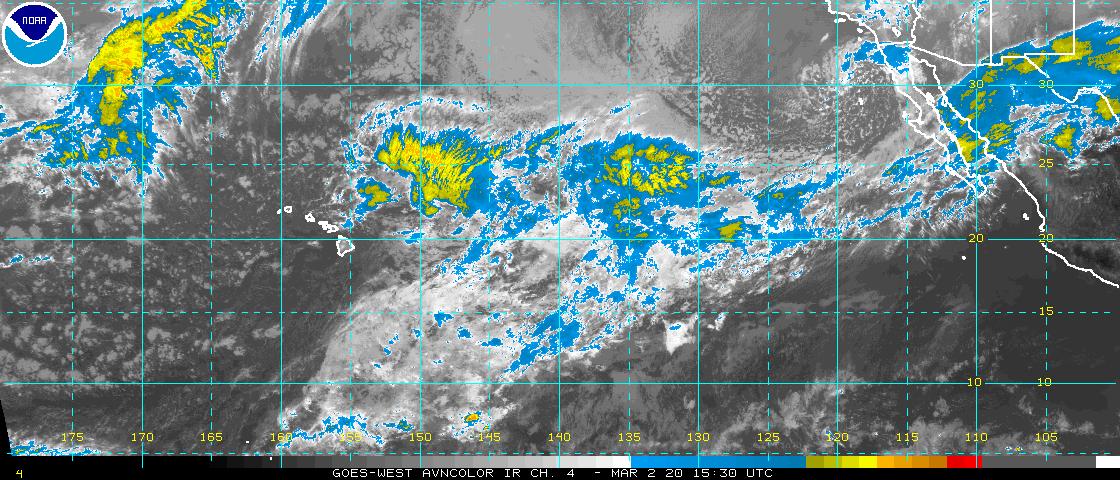
Satellite and Radar Images: To view the cloud conditions we have here in Hawaii, please use the following satellite links, starting off with this Infrared Satellite Image of the islands to see all the clouds around the state during the day and night. This next image is one that gives close images of the islands only during the daytime hours, and is referred to as a Close-up visible image. This next image shows a larger view of the Pacific…giving perspective to the wider ranging cloud patterns in the Pacific Ocean. Finally, here’s a Looping IR satellite image, making viewable the clouds around the islands 24 hours a day. To help you keep track of where any showers may be around the islands, here’s the latest animated radar image.
Hawaii’s Mountains – Here’s a link to the live webcam on the summit of near 14,000 foot Mauna Kea on the Big Island of Hawaii. The tallest peak on the island of Maui is the Haleakala Crater, which is near 10,000 feet in elevation. These two webcams are available during the daylight hours here in the islands…and when there’s a big moon rising just after sunset for an hour or two! Plus, during the nights and early mornings you will be able to see stars, and the sunrise too…depending upon weather conditions.
Tropical Cyclone activity in the eastern and central Pacific – Here’s the latest weather information coming out of the National Hurricane Center, covering the eastern north Pacific. You can find the latest tropical cyclone information for the central north Pacific (where Hawaii is located) by clicking on this link to the Central Pacific Hurricane Center. Here’s a tracking map covering both the eastern and central Pacific Ocean. A satellite image, which shows the entire ocean area between Hawaii and the Mexican coast…can be found here.
Aloha Paragraphs

Lanikai Beach…windward Oahu
There remains no end in sight for our trade winds here in the Hawaiian Islands. Wind speeds will blow generally in the moderately strong category during the days, with a few of those typically windier locations finding somewhat stronger and gusty conditions. These common trade winds will be sourced by high pressure systems to the north-northwest and northeast of our
Computer forecast models suggest that as we grade into the upcoming weekend time frame, our local trade wind speeds should accelerate a little bit. Today through Friday will likely see the small craft wind advisories laying low, although by the weekend, they could show themselves again…especially in those windy channels around Maui and the Big Island. The trade winds remain stronger upwind of the islands, than they are locally, so that the rough and choppy wind swell will keep the east shores active with surf…although considerably less than what would qualify as high surf advisory conditions.
Besides an occasional isolated heavy shower, most areas will remain dry…with the bulk of the moisture falling along the windward sides. There remains a lobe of low pressure aloft over the islands. This is helping to bring an occasional heavy shower, most often over and around the windward coasts and slopes at night. Checking in with this looping radar image Tuesday evening…there aren’t many showers around anyplace. There is a distinct lack of available moisture upstream from the islands, so that we will find less showers falling than the last several nights.
Hurricane Carlos in the eastern Pacific Ocean…is reaching its top strength now, and will become gradually weaker over the next several days. This NHC graphical track map shows where Carlos is, and where he’s headed. Most of the latest guidance shows this tropical system weakening as it moves by well to the south of the
It’s Tuesday evening here in Kula, Maui, as I begin writing this last section of today’s narrative. This evening finds hurricane Carlos is now sporting 90 knot sustained winds, with gusts to near 110 knots…which is impressive. The good thing here is that this hurricane is forecast to drop back down to a tropical storm or less, as it passes well south of the Hawaiian Islands early next week. That second storm, back to the east of Carlos has increased enough to be now be classified as a tropical depression. The long range forecast charts shows what will be called tropical storm Dolores, taking aim on our islands late next week, but it will likely have lost all of its strong winds by then. It may however bring some good rainfall to our islands as the remnant moisture gets carried towards us on the trade winds then.
~~~ It’s a little after 530pm at the time of this writing. The air temperature up here in Kula, I worked from home today, was 72.9F degrees, which is warm. Again, as I pointed out this morning, down at the Kahului airport, it was warmer at the same time, showing 81 degrees. I’m about ready to take my evening walk, and then come back and look for what I expect to be a colorful sunset. The reason I say that, is because we have more high cirrus clouds coming our way from the southwest…as shown on this looping satellite image. I’ll catch up with you again early Wednesday morning, I hope you have a great Tuesday night until then! Aloha for now…Glenn.
Interesting: A team of researchers from the University of Huelva has developed a environmentally friendly lubricating grease based on ricin oil and cellulose derivatives, according to the journal Green Chemistry. The new formula does not include any of the contaminating components used to manufacture traditional industrial lubricants.
"The objective of this research was to develop a product that could be used as a lubricating grease but that was made only from natural materials and was therefore 100% biodegradable", José María Franco, a chemical engineer at the University of Huelva and co-author of the study published recently in Green Chemistry, said.
Environmentally-friendly greases are "oleogels" that use cellulose derivatives from plants and ricin oil (from a bush in the Euphorbiaceae family) as a lubricant base. Franco says these new formulations are "an alternative to traditional lubricating greases, which create pollution that is difficult to combat once discharged into the environment".
Lubricants used in industry are made from non-biodegradable components, such as synthetic oils or petroleum derivatives, and thickeners made with metallic soaps or polyurea derivatives (a family of synthetic polymers). These are currently the best performers, but they also imply more problems from an environmental perspective.
Millions of tons of hydraulic and industrial oils, and others from machinery, are discharged each year into rivers, the sea and fields. Mineral-based oils can contaminate groundwater for more than 100 years, and can prevent the growth of trees and prove toxic to aquatic life.
Only partial solutions have been found to date for this problem, such as substituting mineral oil for vegetable ones, but no alternatives had been found to the metallic thickeners, which are also highly polluting. The new green grease provides an answer, although the scientists admit that "more research is needed" in order to perfect its lubricating and anti-wear performance.
Interesting2: Concern over access to clean water is no longer just an issue for the developing world, as California faces its worst drought in recorded history. According to state’s Department of Water Resources, supplies in major reservoirs and many groundwater basins are well below average. Court-ordered restrictions on water deliveries have reduced supplies from the two largest water systems, and an outdated statewide water system can’t keep up with population growth.
With these critical issues looming large, researchers at the UCLA Henry Samueli School of Engineering and Applied Science are working hard to help alleviate the state’s water deficit with their new mini-mobile-modular (M3) "smart" water desalination and filtration system. In designing and constructing new desalination plants, creating and testing pilot facilities is one of the most expensive and time-consuming steps.
Traditionally, small yet very expensive stationary pilot plants are constructed to determine the feasibility of using available water as a source for a large-scale desalination plant. The M3 system helps cut both costs and time.
"Our M3 water desalination system provides an all-in-one mobile testing plant that can be used to test almost any water source," said Alex Bartman, a graduate student on the M3 team who helped to design the sensor networks and data acquisition computer hardware in the system.
"The advantages of this type of system are that it can cut costs, and because it is mobile, only one M3 system needs to be built to test multiple sources. Also, it will give an extensive amount of information that can be used to design the larger-scale desalination plant."
The M3 demonstrated its effectiveness in a recent field study in the San Joaquin Valley in which it desalted agricultural drainage water that was nearly saturated with calcium sulfate salts, accomplishing this with just one reverse osmosis (RO) stage.
"In this specific field study by our team, in the first part of the reverse osmosis process, 65 percent of the water that was fed in was recovered as drinking water, or potable water," said Yoram Cohen, professor of chemical and biomolecular engineering and lead investigator on the team.
"We can potentially go up to 95 percent recovery using an accelerated chemical demineralization process that was also developed here at UCLA. This first field study with the M3 was a major achievement and the first phase of our high-recovery RO process demonstration program."
Interesting3: Rising levels of smokestack emissions from oceangoing ships will cause an estimated 87,000 deaths worldwide each year by 2012 — almost one-third higher than previously believed, according to the second major study on that topic. The study says that government action to reduce sulfur emissions from shipping fuel (the source of air pollution linked to an increased risk of illness and death) could reduce that toll.
James Winebrake and colleagues note that most oceangoing ships burn fuels with a high sulfur content that averages 2.4 percent. Their smokestacks emit sulfur-containing particles linked to increased risks of lung and heart disease.
A 2007 study by the researchers estimated that about 60,000 people died prematurely around the world due to shipping-related emissions in 2002. The new study estimates that the toll could rise to 87,000 by 2012, assuming that the global shipping industry rebounds from the current economic slump and no new regulation occurs.
Policymakers now are considering limiting ships emissions by either restricting sulfur content in fuel or designating air pollution control areas to reduce air pollution near highly populated coastal areas.
Requiring ships to use marine fuel with 0.5 percent sulfur within 200 nautical miles of shore would reduce premature deaths by about 41,200, the study concludes. Lower sulfur reductions could reduce deaths even further, they say, adding that designated emission control areas will also have a positive impact.
Interesting4: In 2009, the population of inadequately nourished people is projected to exceed 1 billion for the first time according to new estimates published by FAO. It is hard to imagine 1 billion people. Consider for example merely counting them: allowing just 1 second for each, counting day and night, it would take more than 30 years.
The most recent increase in hunger recorded by FAO is not the consequence of poor global harvests but is caused by the world economic crisis that has resulted in lower incomes and increased unemployment leading to reduced access to food by the poor.
If the new journal Food Security needed an early example to justify its breadth of coverage, the FAO report certainly provides it: originating from the International Society for Plant Pathology in a joint venture with Springer, Food Security is subtitled The Science, Sociology and Economics of Food Production and Access to Food.
The second issue of Food Security is now published, and is free online. It documents some of the multiple causes of food insecurity. Topics include desertification, flooding, adaptation of remote communities to modern technology, seasonality of food crops and the corresponding dearth between harvests, lack of iron in traditionally consumed food, resulting in anemia, and taboos that inhibit people from supplementing their diets with nutritious wild fruits that are readily available.
One paper also considers the vulnerability of our crops to acts of agro-terrorism. Conversely, the amelioration of dietary deficits is treated by several authors. Procedures include the establishment of policies that buffer countries against price swings of food materials on the international market, encouragement of domestic agriculture, a framework for deciding whether aid should be given in cash or in kind and construction of a dryer out of simple materials, which can be used to remove water from produce and consequently dramatically prolong its shelf life.
Interesting5: Last July, the City & County of San Francisco launched the first local solar energy incentive program in the nation. The results are in, and, the program is an unequivocal success. In the year since our solar energy incentive program GoSolarSF launched, we have seen a 450% increase in applications for solar installations in San Francisco over the previous year, from 200 to 850. And despite the current recession, 56 applicants met our low-income standards and will receive incentive payments.
And nonprofit and affordable housing organizations are going solar too. Just last week, I joined a local affordable housing developer, our San Francisco Housing Authority and our San Francisco Public Utilities Commission to announce three new solar installations at Hayes Valley North and South and Plaza East public housing in San Francisco.
Interesting6: The Food and Drug Administration believes antibiotics should be used on livestock only to cure or prevent disease and not to promote growth, a common use, said a high-ranking FDA official on Monday. Principal deputy FDA commissioner Joshua Sharfstein said restrictions on livestock use would reduce the opportunity for bacteria to develop resistance to drugs used by humans.
Critics of the heavy antibiotic use in livestock, such as the Union of Concerned Scientists, estimate 70 percent of all antibiotics sold in the United States are used on food animals, mostly in tiny doses that promote weight gain or more efficient feed consumption.
Other groups say livestock’s share of antibiotic use is much lower and the bulk of it goes to fighting or preventing disease. "Purposes other than for the advancement of animal or human health should not be considered judicious use" and not allowed, Sharfstein said in a statement for a House hearing. "Eliminating these uses will not compromise the safety of food.
Interesting7: Major China-based producers and users of palm oil have announced they intend to provide more support for sustainable palm oil, an important boost for efforts to halt tropical deforestation. The public statement, made at the 2nd International Oil and Fats Summit in Beijing on July 9, committed the companies to "support the promotion, procurement and use of sustainable palm oil in China," as well as "support the production of sustainable palm oil through any investments in producing countries."
China is currently the world’s largest importer of palm oil, accounting for one third of all global trade. Increasing demand for palm oil, which is used in everything from soap to chocolate bars, is causing considerable damage to fragile rainforest environments, threatening endangered species like tigers, and contributing to global climate change. Palm oil producers and buyers making the statement included Wilmar International, IOI Corporation, KLK Berhad, Kulim Malaysia Berhad, Asia Agri., Premier Foods PLC and Unilever PLC. Oxfam International, TransAsia Lawyers, and Solidaridad China were signatories.
 Email Glenn James: