July 13-14, 2009
Air Temperatures – The following maximum temperatures were recorded across the state of Hawaii Monday afternoon:
Lihue, Kauai – 83
Honolulu, Oahu – 88
Kaneohe, Oahu – 83
Kahului, Maui – 85
Hilo, Hawaii – 80
Kailua-kona – 85
Air Temperatures ranged between these warmest and coolest spots near sea level – and on the highest mountains…at 5 p.m. Monday evening:
Port Allen, Kauai – 86F
Hilo, Hawaii – 78
Haleakala Crater – 52 (near 10,000 feet on Maui)
Mauna Kea summit – 43 (near 14,000 feet on the Big Island)
Precipitation Totals – The following numbers represent the largest precipitation totals (inches) during the last 24 hours on each of the major islands, as of Monday afternoon:
1.24 Mount Waialaele, Kauai
0.97 Manoa Valley, Oahu
0.15 Molokai
0.02 Lanai
0.00 Kahoolawe
1.76 Puu Kukui, Maui
1.46 Mountain View, Big Island
Marine Winds – Here’s the latest (automatically updated) weather map showing high pressure systems to the north-northwest and northeast of the islands. These high pressure cells, with their associated high pressure ridges, will keep the trade winds blowing through Wednesday.
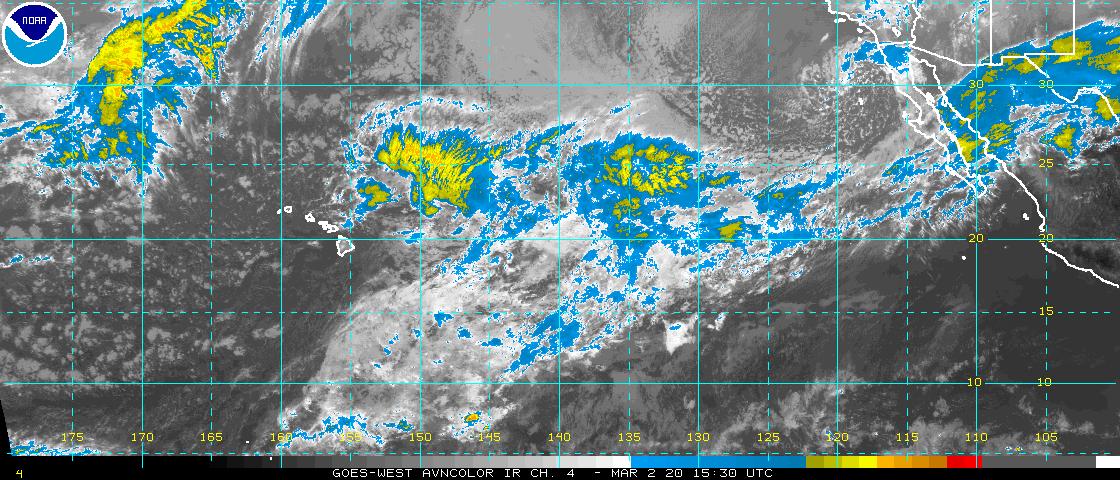
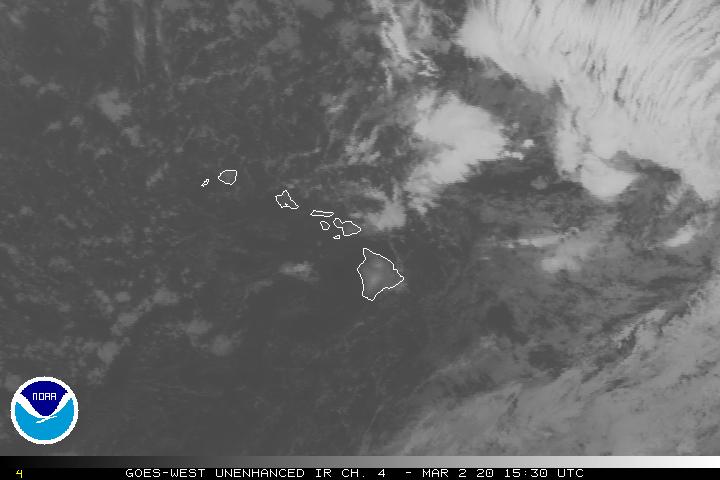
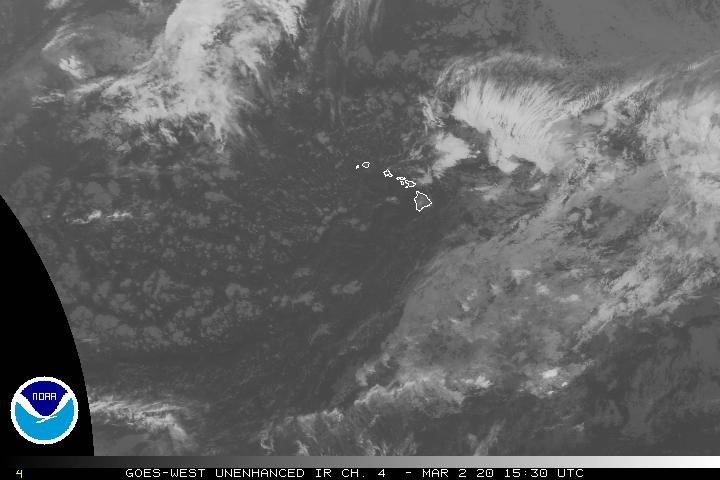
Satellite and Radar Images: To view the cloud conditions we have here in Hawaii, please use the following satellite links, starting off with this Infrared Satellite Image of the islands to see all the clouds around the state during the day and night. This next image is one that gives close images of the islands only during the daytime hours, and is referred to as a Close-up visible image. This next image shows a larger view of the Pacific…giving perspective to the wider ranging cloud patterns in the Pacific Ocean. Finally, here’s a looping IR satellite image, making viewable the clouds around the islands 24 hours a day. To help you keep track of where any showers may be around the islands, here’s the latest animated radar image.
Hawaii’s Mountains – Here’s a link to the live webcam on the summit of near 14,000 foot Mauna Kea on the Big Island of Hawaii. The tallest peak on the island of Maui is the Haleakala Crater, which is near 10,000 feet in elevation. These two webcams are available during the daylight hours here in the islands…and when there’s a big moon rising just after sunset for an hour or two! Plus, during the nights and early mornings you will be able to see stars, and the sunrise too…depending upon weather conditions.
Tropical Cyclone activity in the eastern and central Pacific – Here’s the latest weather information coming out of the National Hurricane Center, covering the eastern north Pacific. You can find the latest tropical cyclone information for the central north Pacific (where Hawaii is located) by clicking on this link to the Central Pacific Hurricane Center. Here’s a tracking map covering both the eastern and central Pacific Ocean. A satellite image, which shows the entire ocean area between Hawaii and the Mexican coast…can be found here.
Aloha Paragraphs

Kona coast…on the Big Island
For the time being, and likely through the better part of this work week, our summertime trade winds will prevail. Wind speeds will blow generally in the moderately strong category during the days, with a few of those typically windier locations finding somewhat stronger and gusty conditions. These common trade winds will be sourced by high pressure systems to the north and northeast of our
Computer forecast models suggest that as we grade into the upcoming weekend time frame, our local trade wind speeds should accelerate to some degree. Today through Thursday will likely see the small craft wind advisories laying low, although by Friday into the weekend, they could show themselves again…especially in those windy channels around Maui and the Big Island. The trade winds remain stronger upwind of the islands, than they are locally, so that the rough and choppy wind swell will keep the east shores active with surf…although considerably less than what would qualify as high surf advisory conditions.
As is often the case during our summer month of July, most of the incoming showers, carried by the trade winds…fall along the windward sides during the night and early morning hours. There remains a lobe of low pressure aloft over the islands. This is having some influence, helping to wring-out an occasional heavy shower, most often over and around the windward coasts and slopes at night. Checking in with this looping radar image, early Monday evening, when shower activity is often not enhanced this early…there wasn’t really anything too exciting going on.
When the sun goes down, and the air mass cools a little, the clouds often thicken, with increasing showers along those north and east facing windward areas. As we pull up our view, using this IR satellite image, we see a few clouds stacked-up along our windward sides, from the
Former tropical cyclone Blanca, which was a tropical storm in the eastern Pacific last week, poses some chance of bringing its remnant moisture our way this weekend. The bulk of these showers, if they hold together through this work week, would be a welcome source of summer rainfall. This time of year, when dry weather often prevails, we can use every drop that finds its way to our rainfall lacking islands.
The big news in terms of active tropical cyclones remains Carlos, which is scooting more or less westward…being classified as a tropical storm. This NHC graphical track map shows where Carlos is, and where it’s headed. Most of the latest guidance shows this tropical storm weakening as it moves by to the south of the
It’s Monday evening here in Kihei, Maui, as I begin writing this last section of today’s narrative. The cirrus clouds, which have been moving through the islands in an off and on manner lately, remain to the south and southwest of the islands Monday evening. However, there are more looming to our southwest, as shown on this satellite image, and may spread overhead at times this week. Looking out the windows here in Kihei, after work, and before I drive back upcountry to Kula…it’s partly cloudy in general. I saw some showers in the Ulupalakua and Keokea area, on the Haleakala slopes earlier in the day. I would image that showers will fill back into the windward sides tonight, and remain active at times into early Tuesday morning. Speaking of which, I’ll meet you back here then, with the next new weather narrative. I hope you have a great Monday night! Aloha for now…Glenn.
Interesting: Attempting to tackle climate change by trapping carbon dioxide or switching to nuclear power will not solve the problem of global warming, according to energy calculations published in the July issue of the International Journal of Global Warming. Bo Nordell and Bruno Gervet of the Department of Civil and Environmental Engineering at Luleå University of Technology in Sweden have calculated the total energy emissions from the start of the industrial revolution in the 1880s to the modern day.
They have worked out that using the increase in average global air temperature as a measure of global warming is an inadequate measure of climate change. They suggest that scientists must also take into account the total energy of the ground, ice masses and the seas if they are to model climate change accurately.
The researchers have calculated that the heat energy accumulated in the atmosphere corresponds to a mere 6.6% of global warming, while the remaining heat is stored in the ground (31.5%), melting ice (33.4%) and sea water (28.5%).
They point out that net heat emissions between the industrial revolution circa 1880 and the modern era at 2000 correspond to almost three quarters of the accumulated heat, i.e., global warming, during that period.
Their calculations suggest that most measures to combat global warming, such as reducing our reliance on burning fossil fuels and switching to renewables like wind power and solar energy, will ultimately help in preventing catastrophic climate change in the long term.
But the same calculations also show that trapping carbon dioxide, so-called carbon dioxide sequestration, and storing it deep underground or on the sea floor will have very little effect on global warming.
Interesting2: H1N1 swine flu attacks the respiratory system in a more sustained way than the standard seasonal virus, research in animals shows. Tests showed swine flu multiplies in greater numbers across the respiratory system, and causes more damage.
And instead of staying in the head like seasonal flu, it penetrates deeper into the respiratory tissues – making it more likely to cause pneumonia. The University of Wisconsin study appears in the journal Nature.
It also suggests that swine flu may mimic the flu virus which caused the great pandemic of 1918, in which millions died. The 1918 virus also had a greater ability than standard flu to cause damage to the respiratory system. The researchers carried out their work on ferrets, monkeys and mice.
They also analyzed samples taken from people who survived the 1918 pandemic and found that they seem to have extra immune protection against the current virus – again suggesting similarities.
However, the Wisconsin team stressed that swine flu produced, in the vast majority of cases, only mild symptoms, and is still sensitive to anti-viral drugs. Professor Ian Jones, a flu expert at the University of Reading, said the latest study provided the complete analysis of the swine flu that researchers had been waiting for.
He said: "For a number of measures it shows that the new virus is more serious than seasonal H1N1 but that, nonetheless, the major outcome to infection is recovery. "For the few cases of severe infection the data should help in the clinical management of hospitalized patients.
Professor Wendy Barclay, an expert in virology at Imperial College London, said: "It must be borne in mind that typical circulating human strains of H1N1 have been associated with rather mild illness in recent years, and that the swine origin H1N1 may be behaving in these animal models more alike the type of H3N2 viruses that caused a pandemic in 1968." Swine flu is estimated to have infected more than a million people worldwide, and to have killed at least 500.
Interesting3: By the year 2050, about 30 million Americans are expected to suffer from Alzheimer’s disease. Experts in the field are trying to determine if sophisticated imaging equipment can help predict the development of the disease.
At 81, Alberta Sabin’s mind is not as sharp as it used to be, and she knows it. She frequently misplaces common items, forgets names and appointments, some of the most frustrating aspects of memory loss, she says. “I had been looking for my cell phone for three days and would you believe I found it laying on the counter in plain sight?,” Sabin says.
“There it was and I thought why didn’t I see it before?” It is that frustration that motivated Sabin to participate in U-M sponsored research designed to better diagnose and treat dementia before it escalates. Sabin is one of millions of Americans who experience memory loss and may eventually be diagnosed with dementia.
“This is an explosive disease,” says Sid Gilman, M.D., director of the Alzheimer’s Disease Research Center at University of Michigan Health System, who conducts research with Sabin and others in her community. “It’s a horrible disease that robs people of their humanity. They forget their families and friends.”
Roughly 50 percent of people who reach 85 will become demented, according to studies conducted by investigators at Rush Medical Center in Chicago. By age 100, the number spikes to 60 percent. Of those who develop dementia, roughly 60 percent will prove to have Alzheimer’s disease.
It’s predicted that the current number of patients with Alzheimer’s disease in the United States is roughly 5 million. By the year 2050, it will grow to about 30 million, presenting a significant financial burden to the health care system.
Interesting4: Honda Motor Co’s new chief executive said on Monday that Japan’s No.2 automaker would speed up the rollout of its hybrid cars as he aims to steer a nimble company that reacts more quickly to changing customer needs. In his first public appearance after taking office last month, Takanobu Ito said Honda would launch the planned CR-Z hybrid sports car next February and a gasoline-electric Fit subcompact by the end of 2010, citing the growing importance buyers place on fuel economy and environmental considerations. "I think everyone is going to go the way of hybrids," the 55-year-old former engineer told a media gathering at Honda’s headquarters in Tokyo.
Interesting5: Twelve European companies on Monday launched a 400-billion-euro (560-billion-dollar) initiative to set up huge solar farms in Africa and the Middle East to produce energy for Europe. The consortium says the massive project could provide up to 15 percent of Europe’s electricity needs by 2050. Engineering giants ABB and Siemens, energy groups E.ON and RWE and financial institutions Deutsche Bank and Munich Re are among companies which signed a protocol in Munich. "Today we have taken a step forward" towards the project’s realization, said Nikolaus von Bomhard, head of the reinsurance giant Munich Re, which hosted the signing.
Interesting6: One of Africa’s most important food crops is likely to become increasingly toxic as a result of carbon emissions. Cassava is a staple for more than half a billion of the world’s poorest people. It is promoted by UN agencies such as the Food and Agriculture Organization as a savior for Africa because it grows well in droughts.
But now research shows that increasing carbon dioxide in the air boosts cyanide levels in its leaves. Cassava leaves and roots both contain glycosides that break down to release toxic hydrogen cyanide when chewed or crushed. Villagers grind cassava roots to make flour, which can be processed to remove cyanide, but leaves are often eaten raw.
The cyanide can cause a condition called konzo that permanently paralyses the legs. One study found that 9 per cent of Nigerians suffer some form of cyanide poisoning from eating cassava.
Interesting7: Electric car sales could jump to 86 percent of U.S. light vehicle sales in 2030 if consumers don’t have to buy batteries themselves, according to a University of California, Berkeley study to be released on Monday. A company called Better Place and emerging rivals plan to offer pay-per-mile plans, similar to cell phone minutes.
A family would buy a car but Better Place would own the battery, offer charging stations, and swap out batteries as needed to extend the driving range. The cost of building charging systems will be more than $320 billion over the next couple of decades, although health-related savings due to less vehicle pollution could be $210 billion, according to the study by economist Thomas Becker. The main benefit to drivers would be cars with price tags and operating costs similar to or less than gasoline models.
Interesting8: Early microbes may have relied on lightning to cook their dinner, say researchers. When lightning strikes sand or sediment, the path followed by the bolt can fuse into a glassy tube called a fulgurite. A new analysis of these remnants suggests that lightning fries the nutrient phosphorus into a more digestible form.
Most phosphorus on Earth exists as oxidised phosphate, but many microbes prefer a rarer, partially oxidized phosphorus – phosphite. Matthew Pasek and Kristin Block of the University of Arizona, Tucson, used an MRI scanner on 10 fulgurites and found that five contained phosphite. The surrounding soil only contained phosphate.
They suggest that the high energy of a lightning strike strips an oxygen atom from phosphate compounds, creating phosphites. "Early life may have used phosphite to form its key biomolecules, like RNA and DNA," says Pasek. Today, anthropogenic influences such as steel corrosion, provide the primary source of phosphites in the environment, but prior to anthropogenic input Pasek and Block believe lightning would have been the main source, producing up to 3000 kilograms of phosphites per year.
 Email Glenn James: