July 10-11, 2009
Air Temperatures – The following maximum temperatures were recorded across the state of Hawaii Friday afternoon:
Lihue, Kauai – 84
Honolulu, Oahu – 88
Kaneohe, Oahu – 82
Kahului, Maui – 85
Hilo, Hawaii – 83
Kailua-kona – 85
Air Temperatures ranged between these warmest and coolest spots near sea level – and on the highest mountains…at 5 p.m. Friday evening:
Port Allen, Kauai – 86F
Hilo, Hawaii – 73
Haleakala Crater – 48 (near 10,000 feet on Maui)
Mauna Kea summit – 43 (near 14,000 feet on the Big Island)
Precipitation Totals – The following numbers represent the largest precipitation totals (inches) during the last 24 hours on each of the major islands, as of Friday afternoon:
0.66 Mount Waialaele, Kauai
0.23 Wheeler Field, Oahu
0.06 Molokai
0.00 Lanai
0.00 Kahoolawe
1.57 Hana airport, Maui
0.76 Pahoa, Big Island
Marine Winds – Here’s the latest (automatically updated) weather map showing a 1028 millibar high pressure system to the northeast of the islands. This high pressure cell, with its associated high pressure ridge, will keep the trade winds blowing through Sunday.
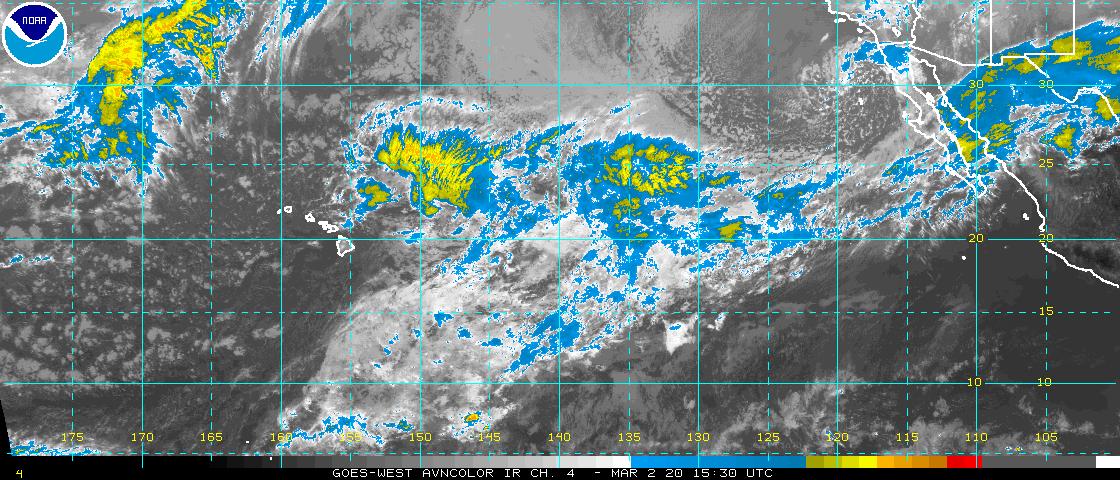
Satellite and Radar Images: To view the cloud conditions we have here in Hawaii, please use the following satellite links, starting off with this Infrared Satellite Image of the islands to see all the clouds around the state during the day and night. This next image is one that gives close images of the islands only during the daytime hours, and is referred to as a Close-up visible image. This next image shows a larger view of the Pacific…giving perspective to the wider ranging cloud patterns in the Pacific Ocean. Finally, here’s a looping IR satellite image, making viewable the clouds around the islands 24 hours a day. To help you keep track of where any showers may be around the islands, here’s the latest animated radar image.
Hawaii’s Mountains – Here’s a link to the live webcam on the summit of near 14,000 foot Mauna Kea on the Big Island of Hawaii. The tallest peak on the island of Maui is the Haleakala Crater, which is near 10,000 feet in elevation. These two webcams are available during the daylight hours here in the islands…and when there’s a big moon rising just after sunset for an hour or two! Plus, during the nights and early mornings you will be able to see stars, and the sunrise too…depending upon weather conditions.
Tropical Cyclone activity in the eastern and central Pacific – Here’s the latest weather information coming out of the National Hurricane Center, covering the eastern north Pacific. You can find the latest tropical cyclone information for the central north Pacific (where Hawaii is located) by clicking on this link to the Central Pacific Hurricane Center. Here’s a tracking map covering both the eastern and central Pacific Ocean. A satellite image, which shows the entire ocean area between Hawaii and the Mexican coast…can be found here.
Aloha Paragraphs

The end of another good work week
Persistent trade winds remaining active through the weekend…into the beginning of the new week ahead. These common summertime trades will blow generally in the moderately strong levels, although those typically windier areas from the Big Island on up to Oahu…will be a bit more blustery. Here’s a weather map showing the very familiar 1028 millibar high pressure system positioned to the northeast of Hawaii Friday evening…the source of our breezy winds.
Showers carried in by these gusty trade winds will spill along the windward sides…becoming a bit more frequent and heavier this weekend. The leeward sides will remain mostly dry, although a few showers may be carried over into those areas by the trade winds at times too. We find what looks to be the tail-end of the latest high cirrus clouds coming up from the deeper tropics….especially over the south part of the state. As these high clouds move away, we should see lots of sunshine available along our leeward beaches this weekend.
We have a new tropical cyclone that’s swirling in the eastern Pacific Friday. It started off as a tropical depression called 04E, and quickly strengthened into tropical storm Carlos. Here’s a track map showing Carlos, in relation to the Hawaiian Islands. Granted, it’s early to be talking about a tropical cyclone so far away, but if you have a chance to click on this track map, you’ll see that it will be a hurricane as it approaches the border (140W longitude) between the eastern, and our central Pacific later next week. Here’s a satellite image of Carlos, in relation to the
Since the work week is over now, I’ll be going to see a new film this evening. I’ve been looking forward to seeing Public Enemies (2009), the new film starring Johnny Depp and Christian Bale, for quite a while. Johnny Depp plays a notorious depression-era gangster named John Dillinger…whose charismatic crime spree made him a folk hero to the masses. The critics are giving this film a strong B grade, while the viewers are rising that to a B+…which is definitely good enough to draw me in! Here’s a trailer for this film, take a look if you have an interest…it’s pretty cool I must admit!
Rather than going to see this film in Kahului, I’m going to go again, like I did last week, to the theater in Kihei. Speaking of which, looking out the window before I leave, it’s still windy out there, as it was pretty much all day. The ocean offshore from Kihei was all frothed-up with white caps this afternoon when I was down that way for my lunch. I’ll be back Saturday morning with your next new weather narrative from paradise. I hope you have a simply lovely Friday night wherever you happen to be spending it! Aloha for now…Glenn.
Interesting: The Indian government has dramatically reduced water supplies in Mumbai. Water supplies have been reduced by 30% in Mumbai, as the region faces the worst drought in History. Homes, hotels and hospitals are surviving on extremely short water supplies due to the late arrival of the Monsoon rain.
Monsoon rain arrived later than normal to the region, and many of the major lakes rely solely on the Monsoon rain. This year so far the amount of rainfall is around 25% of what would normally have fallen by this time of year.
Mumbai is India’s most populated city with around 20 million people, and it’s a commercial film-making hub. Many of the inhabitants have never seen these measures being implemented.
Meteorologist Matt Keife explained that although the monsoonal moisture has moved into the region the rains are intermittent. There have been only a few days with significant rainfall. The lakes will suffer if they recede more due to the lack of heavy rain.
In many areas of the state of Maharashtra, there has been only 25% of the rainfall received compared to 2008. The residents are Mumbai are concerned that they will have to turn to private water companies as the wells feeding the city are below average levels.
Mumbai residents have been urged to use water sparingly as there may only be enough water for three more weeks in one lake. There are another two lakes which hold enough for a sparingly two-month use. Water is being given to each household for only two hours per day, so many people are waking up at the crack of dawn to shower.
Interesting2: International climate talks held in Italy this week ended with little progress. The rich industrial nations wouldn’t promise to cut back their emissions in the near term. And China, India and the rest of the developing world wouldn’t commit to cutting their emissions, ever.
All nations of the world need to act to reduce the risk of a climate catastrophe. But so far, there’s much more posturing than action. China argues that the United States and other rich nations put most of the carbon dioxide into the atmosphere, so they need to act first and most aggressively.
They demand that those nations slash their carbon dioxide emissions by a staggering 40 percent — in just 10 years. "Well, it’s obviously a totally unrealistic position, and it is not just the Chinese, it is the developing countries in general," says Eileen Claussen, president of the Pew Center on Global Climate Change, who was once a diplomat.
She regards this demand as little more than an over-the-top bargaining tactic. "I think, honestly, that doesn’t work, and it does create a backlash, because people think that they’re just not serious." But, Claussen says, China actually is serious about climate change.
The government believes it’s a real risk. But the country also feels it can’t wean itself from cheap fossil fuels just yet. Ken Lieberthal of the Brookings Institution says China is still struggling to pull hundreds of millions of people out of poverty.
Interesting3: Like most thoroughfares in booming cities of the developing world, Bogotá’s Seventh Avenue resembles a noisy, exhaust-coated parking lot — a gluey tangle of cars and the rickety, smoke-puffing private minibuses that have long provided transportation for the masses. But a few blocks away, sleek red vehicles full of commuters speed down the four center lanes of Avenida de las Américas. The long, segmented, low-emission buses are part of a novel public transportation system called bus rapid transit, or B.R.T.
It is more like an above-ground subway than a collection of bus routes, with seven intersecting lines, enclosed stations that are entered through turnstiles with the swipe of a fare card and coaches that feel like trams inside. Versions of these systems are being planned or built in dozens of developing cities around the world — Mexico City, Cape Town, Jakarta, Indonesia, and Ahmedabad, India, to name a few — providing public transportation that improves traffic flow and reduces smog at a fraction of the cost of building a subway.
Interesting4: Some cold medicines will shave a day off your suffering from the common cold, but they often produce unpleasant side effects. A new study shows, for the first time, that the doctor’s empathy may be an even better way to speed recovery.
People recover from the common cold faster if they believe their doctor shows greater compassion toward their illness, according to a University of Wisconsin School of Medicine and Public Health study, published in the July issue of Family Medicine.
The study, conducted in primary care clinics in southern Wisconsin, involved 350 participants who had one of three types of encounters with doctors: no interaction at all, a standard encounter with discussion of medical history and present illness, or an advanced interaction where the doctor asked more questions and seemed to show more concern for the patient.
Patients then rated doctors on a questionnaire which asked if the doctor made them feel at ease, allowed them to tell their story, listened to what they had to say, understood their concerns, acted positive, explained things clearly, helped them take control, and helped them create a plan of action.
Interesting5: Children and adults who build castles and dig in the sand at the beach are at greater risk of developing gastrointestinal diseases and diarrhea than people who only walk on the shore or swim in the surf, according to researchers from the University of North Carolina at Chapel Hill and the Environmental Protection Agency. People who playfully bury their bodies in the sand are at even greater risk, according to the study published online recently in the American Journal of Epidemiology.
It also shows children, who are more likely than adults to play with and possibly get sand in their mouths, stand the greatest chance of becoming ill after a day at the beach.
“Beach sand can contain indicators of fecal contamination, but we haven’t understood what that means for people playing in the sand,” said Chris Heaney, Ph.D., a postdoctoral epidemiology student at UNC’s Gillings School of Global Public Health and lead author of the study.
“This is one of the first studies to show an association between specific sand contact activities and illnesses.” The study is based on interviews with more than 27,000 people who visited seven freshwater and marine beaches in the agency’s National Epidemiological and Environmental Assessment of Recreational Water Study (NEEAR) between 2003 and 2005 as well as in 2007.
All beaches in the study had sewage treatment plant discharges within seven miles, although the source of sand pollution was unknown and could have included urban runoff as well as wild and domestic animal contamination. Water quality at the beaches was within acceptable limits, Heaney said.
“We have known for some time that swimming in waters polluted by fecal contamination can result in illness, but few previous studies have focused on sand,” said Tim Wade, Ph.D., an EPA epidemiologist and the study’s senior author.
“People should not be discouraged from enjoying sand at the beach, but should take care to use a hand sanitizer or wash their hands after playing in the sand.” People were asked about their contact with sand on the day they visited the beach (digging in the sand or whether they were buried in it).
Then, 10 to 12 days later, participants were telephoned and asked questions about any health symptoms they had experienced since the visit. Researchers found evidence of gastrointestinal illnesses, upper respiratory illnesses, rash, eye ailments, earache and infected cuts.
Diarrhea and other gastrointestinal illnesses were more common in about 13 percent of people who reported digging in sand, and in about 23 percent of those who reported being buried in sand. “A lot of people spend time at the beach, especially in the summer,” Heaney said.
“And while we found that only a small percentage of people who played at the beach became ill later – less than 10 percent in any age group, for any amount of exposure – it’s important to look at the situation more closely.
If we find evidence that shows exposure to sand really does lead to illness, then we can look for the sources of contamination and minimize it. That will make a day at the beach a little less risky.”
 Email Glenn James: