June 29-30, 2009
Air Temperatures – The following maximum temperatures were recorded across the state of Hawaii Monday afternoon:
Lihue, Kauai – 82
Honolulu, Oahu – 88
Kaneohe, Oahu – 82
Kahului, Maui – 84
Hilo, Hawaii – 82
Kailua-kona – 85
Air Temperatures ranged between these warmest and coolest spots near sea level – and on the highest mountains…at 4 p.m. Monday afternoon:
Port Allen, Kauai – 88F
Hilo, Hawaii – 80
Haleakala Crater – 59 (near 10,000 feet on Maui)
Mauna Kea summit – 52 (near 14,000 feet on the Big Island)
Precipitation Totals – The following numbers represent the largest precipitation totals (inches) during the last 24 hours on each of the major islands, as of Monday afternoon:
0.43 Kapahi, Kauai
0.69 Oahu Forest NWR, Oahu
0.03 Molokai
0.00 Lanai
0.00 Kahoolawe
0.31 Puu Kukui, Maui
0.05 Kealakekua, Big Island
Marine Winds – Here’s the latest (automatically updated) weather map showing a 1030 millibar high pressure system far to the northeast of the islands. This high pressure cell, and another very weak high far to the east, won’t be near enough to provide much more than light trade winds. The trade winds will remain active Tuesday and Wednesday…although may be overridden by sea breezes during the days locally.
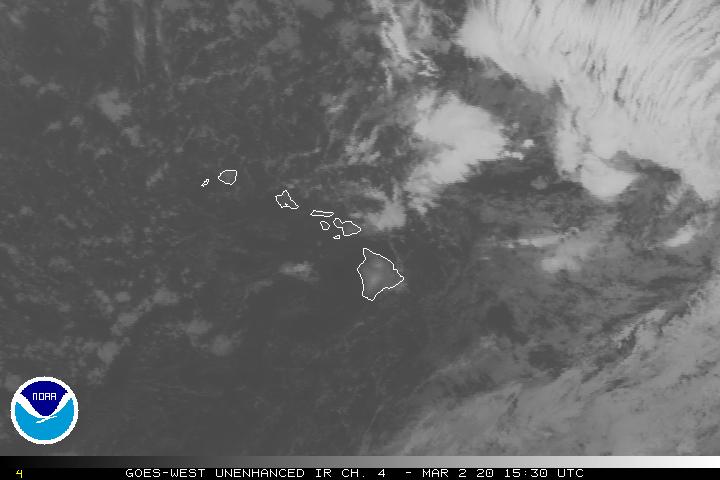
Satellite and Radar Images: To view the cloud conditions we have here in Hawaii, please use the following satellite links, starting off with this Infrared Satellite Image of the islands to see all the clouds around the state during the day and night. This next image is one that gives close images of the islands only during the daytime hours, and is referred to as a Close-up visible image. This next image shows a larger view of the Pacific…giving perspective to the wider ranging cloud patterns in the Pacific Ocean. Finally, here’s a looping IR satellite image, making viewable the clouds around the islands 24 hours a day. To help you keep track of where any showers may be around the islands, here’s the latest animated radar image.
Hawaii’s Mountains – Here’s a link to the live webcam on the summit of near 14,000 foot Mauna Kea on the Big Island of Hawaii. The tallest peak on the island of Maui is the Haleakala Crater, which is near 10,000 feet in elevation. These two webcams are available during the daylight hours here in the islands…and when there’s a big moon rising just after sunset for an hour or two! Plus, during the nights and early mornings you will be able to see stars, and the sunrise too…depending upon weather conditions.
Aloha Paragraphs

The perfect beach…Hawaii
An unusual light trade wind regime will take over during this new week, with stronger trade winds not expected until Friday into the weekend. The latest forecast charts continue to show that trade wind speeds will relax in strength this week, remaining lighter than normal…especially by Wednesday. As we move into the 4th of July holiday weekend, the slack trade winds will pick up again gradually, helping to ventilate whatever fireworks smoke that is around then.
The windward sides will find a few showers, although as the trade winds calm down…showers will shift over to the leeward upcountry areas during the afteroon hours. As we move into the second half of this new week, some of those afternoon showers may become locally heavy…especially over Maui and the Big Island. The gradually strengthening trade winds Friday into this coming weekend, should bring the shower activity back around to the windward sections.
It’s Monday evening here in Kihei, Maui, as I begin writing this last paragraph of this evening’s narrative. The trade winds did become lighter already today, although here in Kihei, it was actually quite gusty during the afternoon hours. While I was down near the beach during lunch, there were wind caps on the ocean surface just offshore. The waves had gotten smaller, but already starting later Tuesday…should come up again along our leeward beaches.
~~~ Looking out the window here in Kihei, I see more clouds over the Haleakala Crater, and overhead here on the leeward side…than I do towards the often cloudy windward sides. This is often the case when the trade winds begin to die back in strength. Here’s a satellite image which shows the next batch of high cirrus clouds approaching from the west. As the trade winds weaken even more over the next several days, we’re going to be feeling the heat…hopefully the daytime sea breezes will provide some relief from the hot daytime temperatures.
~~~ I’m about ready to take the drive back upcountry, back up to Kula. It takes some time to get back up to the 3,000+ foot level on the slopes of the Crater, but it’s definitely worth the drive, at least for me. I love the cooler air temperatures up there, which provide great sleeping weather in my humble opinion. I’ll take a walk when I get home, maybe play a little ping pong, and even hit a few golf balls into a cup on my rug! At any rate, I hope you have a great Monday night, and that you might join me here again on Tuesday! Aloha for now…Glenn.
Interesting: Controlling road traffic in congested areas is difficult to say the least, a point to which any drive-time urban commuter might testify. An organic approach to traffic lights might help solve the problem and avoid traffic jams and gridlock, according to research published this month in the International Journal of Autonomous and Adaptive Communications Systems.
According to Holger Prothmann of the Karlsruhe Institute of Technology, and colleagues there and at Leibniz Universität Hannover, Germany, so-called "organic" computing can model even very complex systems. In recent years, they explain organic computing has emerged as a possible solution to a wide range of problems involving complex, autonomous systems that have sensors and controllers.
In the case of an urban traffic system, the sensors would be closed-circuit TV cameras mounted on road gantries and other places while the controllers, or actuators, would be traffic lights, which can effectively start and stop the flow of traffic.
Interesting2: A good partner relationship can act as a buffer for those exposed to work-related stress. "The relationship reduces the negative effects of this kind of stress on our health. But poor relationships will amplify the negative effects," say Ann-Christine Andersson Arntén in a new doctoral dissertation from the University of Gothenburg, Sweden.
"A positive approach and successful stress-management techniques also help to reduce the negative effects of work-related stress," explains Ann-Christine Andersson Arntén, who will be presenting her dissertation in psychology. But when there are stressful experiences both at work and in the relationship, the risk of burn-out and poor health increases dramatically.
About 900 persons took part in her survey. Those who felt they had a good relationship experienced that they enjoyed better health than those who had a more problematic relationship. Women with a poorly-functioning relationship experienced more anxiety, mental stress reactions and sleeping difficulties than women who had a good relationship.
Men who had a mediocre relationship had a higher incidence of depression, anxiety, psychological and somatic stress reactions than men with worse or better relationships. One explanation can be that people living with a mediocre relationship take more responsibility to improve the relationship, while those with poor relationships just admit it, and don’t feel they can do anything about it.
Interesting3: Swine flu has infected as many as 1 million Americans, U.S. health officials said, adding that 6 percent or more of some urban populations are infected. The estimate voiced by a government flu scientist was no surprise to the experts who have been closely watching the virus.
"We knew diagnosed cases were just the tip of the iceberg," said Dr. William Schaffner, a Vanderbilt University infectious diseases expert who was in Atlanta for the meeting of a vaccine advisory panel.
Lyn Finelli, a flu surveillance official with the Centers for Disease Control and Prevention, made the 1 million estimate in a presentation to the vaccine panel. The number is from mathematical modeling, based on surveys by health officials.
Interesting4: The Sahara Desert is crossing the Mediterranean, according to Italian environmental protection group Legambiente which warns that the livelihoods of 6.5 million people living along its shores could be at risk. "Desertification isn’t limited to Africa," said Legambiente Vice President Sebastiano Venneri.
"Without a serious change of direction in economic and environmental policies, the risk will become concrete and irreversible." A recent report by Legambiente estimated that 74 million acres of fertile land along the Mediterranean were turning to desert as the result of overexploited land and water resources.
Legambiente said that southern Italy was at severe risk in addition to the islands of Sicily and Sardinia where 11% of all arable land showed signs of drying up. ”Semi-arid coastal regions like southern Italy are prone to the effects of desertification due to farmers’ dependence on water from underground aquifers instead of rainfall,” said Legambiente spokesman Giorgio Zampetti.
According to Zampetti, pumping too much fresh water out of these underground deposits can result in seawater leaking in to replace it, effectively poisoning the groundwater. As an example of the long-term consequences, Legambiente pointed to Egypt where it said brackish groundwater had compromised half the country’s farmland.
"The south of Italy isn’t the only part of the country at risk," added Zampetti. "Aquifers around the Po Delta in northern Italy have also begun showing signs of saltwater contamination." Experts said that the Po River, which is Italy’s longest waterway and nearly dries up in parts when industrial consumption peaks, is one of the most visible examples of desertifying climate change in Italy.
Italy is not the only country in Europe losing fertile land. Legambiente estimated that desertification affects more than a fifth of the Iberian Peninsula with early indicators also present along the French Riviera.
Interesting5: Desperate to halt the erosion of Louisiana’s coast, officials there are talking about breaking Mississippi River levees south of New Orleans to restore the nourishing flow of muddy water into the state’s marshes. But in a new analysis, scientists at Louisiana State University say inland dams trap so much sediment that the river no longer carries enough to halt marsh loss, especially now that global warming is speeding a rise in sea levels.
As a result, the loss of thousands of additional square miles of marshland is "inevitable," the scientists report in Monday’s issue of Nature Geoscience. The finding does not suggest it would be pointless to divert the muddy water into the marshes, one of the researchers, Harry H. Roberts, said in an interview.
"Any meaningful restoration of our coast has to involve river sediment," said Dr. Roberts, a coastal scientist. But he said officials would have to choose which parts of the landscape could be saved and which must be abandoned, and to acknowledge that lives and businesses would be disrupted.
Instead of breaking levees far south of New Orleans, where relatively few people live, Dr. Roberts said, officials should consider diversions much closer to New Orleans, possibly into the LaFourche, Terrebonne or St. Bernard basins.
"It’s going to be an excruciating process to decide where that occurs," Dr. Roberts said of the levee-breaking. Sediment carried by the Mississippi built up the marshes of Louisiana over thousands of years, but today inland dams trap at least half of it, Dr. Roberts said. He pointed out that there were 8,000 dams in the drainage basin of the Mississippi.
Interesting6: For the first time since territorial days, rain will be free for the catching here, as more and more thirsty states part ways with one of the most entrenched codes of the West. Precipitation, every last drop or flake, was assigned ownership from the moment it fell in many Western states, making scofflaws of people who scooped rainfall from their own gutters. In some instances, the rights to that water were assigned a century or more ago.
Now two new laws in Colorado will allow many people to collect rainwater legally. The laws are the latest crack in the rainwater edifice, as other states, driven by population growth, drought, or declining groundwater in their aquifers, have already opened the skies or begun actively encouraging people to collect.
 Email Glenn James: