











May 7-8, 2009
Air Temperatures – The following maximum temperatures were recorded across the state of Hawaii Thursday afternoon:
Lihue, Kauai – 80
Honolulu, Oahu – 83
Kaneohe, Oahu – 81
Kahului, Maui – 88
Hilo, Hawaii – 84
Kailua-kona – 84
Air Temperatures ranged between these warmest and coolest spots near sea level – and on the highest mountains…at 4 p.m. Thursday afternoon:
Kapalua, Maui – 88F
Kaneohe, Oahu – 79
Haleakala Crater – 54 (near 10,000 feet on Maui)
Mauna Kea summit – 36 (near 14,000 feet on the Big Island)
Precipitation Totals – The following numbers represent the largest precipitation totals (inches) during the last 24 hours on each of the major islands, as of Thursday afternoon:
1.83 Kapahi, Kauai
0.05 Oahu Forest NWR, Oahu
0.00 Molokai
0.00 Lanai
0.00 Kahoolawe
0.40 West Wailuaiki, Maui
0.25 Kahua Ranch, Big Island
Weather Chart – Here’s the latest (automatically updated) weather map shows high pressure systems located far to the NE and NNW of the islands now. A stalled and dissipating frontal boundary will be lifting out soon. We will see light trade winds locally, stronger at times around Maui and the Big Island.
Satellite and Radar Images: To view the cloud conditions we have here in Hawaii, please use the following satellite links, starting off with the Infrared Satellite Image of the islands to see all the clouds around the state during the day and night. This next image is one that gives close images of the islands only during the daytime hours, and is referred to as a Close-up visible image. This next image shows a larger view of the Pacific…giving perspective to the wider ranging cloud patterns in the Pacific Ocean. Finally, here’s a looping IR satellite image, making viewable the clouds around the islands 24 hours a day. To help you keep track of where any showers may be around the islands, here’s the latest animated radar image.
Hawaii’s Mountains – Here’s a link to the live webcam on the summit of near 14,000 foot Mauna Kea on the Big Island of Hawaii. The tallest peak on the island of Maui is the Haleakala Crater, which is near 10,000 feet in elevation. These two webcams are available during the daylight hours here in the islands…and when there’s a big moon rising just after sunset for an hour or two! Plus, during the nights and early mornings you will be able to see stars, and the sunrise too…depending upon weather conditions.
Aloha Paragraphs
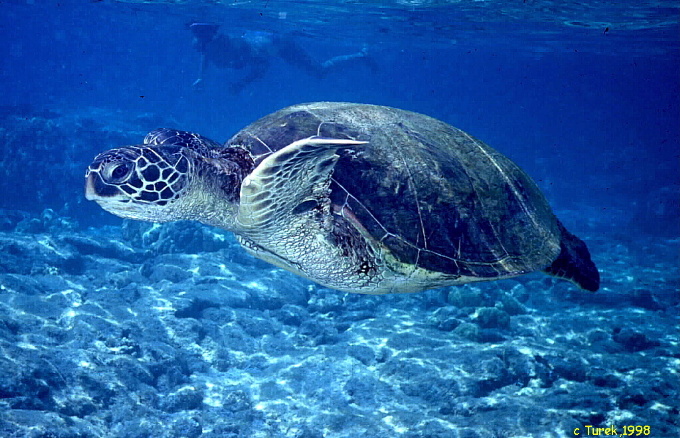
Hawaiian Green Sea Turtle…in clear blue water
We’ll finally begin to see the return of the trade winds, they won’t be very strong, although they may attain moderate strength over the Big Island, and perhaps Maui County…over the next couple of days. The best chance of this happening will be now through the first half of the upcoming weekend. These easterly breezes may not be quite strong enough to ventilate our atmosphere of the hazy conditions completely, but should help some. The computer models suggest that our winds may back down again starting Sunday, allowing the return of light southeast winds…and perhaps another round of more haze then.
As the trade winds will be back around locally, we may see some slight increase in windward biased showers, and a few locally during the afternoons…over the interior sections. The chance of showers may increase modestly, but the intensities will remain generally on the light side, with many areas remaining completely dry. There really isn’t any expectation of more widespread, or heavy rains well into the future. We are definitely getting into our dry late spring season, which of course leads into typically dry summer months.
It’s early Thursday evening as I begin writing this last section of today’s weather narrative. Looking out the window here in Kihei, Maui before I take off for the drive back upcountry, I see partly cloudy conditions. The sky actually is showing a little blue color for a change though, thanks to the light trade winds which are blowing now. This is finally allowing some slight clearing of the vocanic haze, although there is still too much of it around. Speaking of the trade winds, the Kahului airport at around 5pm, was showing light, near 15 mph trades blowing. Speaking of that airport, the high temperature there today was a pretty remarkable 88F degrees!
The record high temperature for today, which occurred back in 2003, was a hot 90 degrees, so we came fairly close to breaking it at least. The Kapalua area, on the upper west side of Maui, hit 88 degrees at 4pm Thursday afternoon, as well. ~~~ One more thing, and I’m home in Kula now, I wanted to let you know that it’s still very voggy here on Maui. Also, I wanted to tell you that South Point down on the Big Island, was having trade wind gusts to 35 mph this afternoon. I just looked at the wind speeds around the Big Island at around 7pm, and another place there, this time a location called Upolu Point, was experiencing 45 mph trade wind gusts! This is really good news as far as having the trade winds hopefully soon blow this haze away! Kden, or ok then for you folks who live outside of the islands, I’m just about out of here. I’ll be back early Friday morning with your next new weather narrative. I hope you have a great Thursday night wherever you happen to be spending it! Aloha for now…Glenn.
Interesting: A new study from Northwestern University shows what many mothers already know: their babies are a lot smarter than others may realize. Though only five months old, the study’s cuties indicated through their curious stares that they could differentiate water in a glass from solid blue material that looked very much like water in a similar glass.
The finding that infants can distinguish between solids and liquids at such an early age builds upon a growing body of research that strongly suggests that babies are not blank slates who primarily depend on others for acquiring knowledge.
That’s a common assumption of researchers in the not too distant past. "Rather, our research shows that babies are amazing little experimenters with innate knowledge," Susan Hespos said. "They’re collecting data all the time." Hespos, an assistant professor of psychology at Northwestern, is lead author of the study, which will appear in the May 2009 issue of Psychological Science.
In a test with one group of infants in the study, a researcher tilted a glass filled with blue water back and forth to emphasize the physical characteristics of the substance inside. Another group of babies looked at a glass filled with a blue solid resembling water, which also was moved back and forth to demonstrate its physical properties.
Next all the infants were presented with test trials that alternated between the liquid or solid being transferred between two glasses. According to the well-established looking-time test, babies, like adults, look significantly longer at something that is new, unexpected or unpredictable.
Interesting2: Cod bycatch was at least 70 per cent higher than target levels on the southern Grand Banks near Canada, holding back recovery of one of the world’s best known fisheries following its spectacular collapse and closure in the early 1990s. Information provided to WWF-Canada also said that European Union boats were responsible for the largest proportion of the overrun in bycatch.
Excessive bycatch of cod has undermined a moratorium imposed in 1994, peaking in 2003, when bycatch amounts were estimated to be over 80 per cent of the remaining cod stock. WWF pushed for a 2008 cod recovery strategy that included setting a bycatch reduction target of 40 per cent for southern Grand Banks cod at the September 2007 annual meeting of the Northwest Atlantic Fisheries Organization (NAFO).
The 40 per cent target was equivalent to a fishing mortality of 420 tons, estimated to be the maximum the population could withstand to still have some chance of recovery. Unofficial 2008 fishing year statistics however show a total of 713 tons of bycatch, with EU boats taking 444 tons – with these figures taking no account of what is believed to be considerable amounts of misreporting and illegal fishing.
Before the results of the 2008 fishing year became available, NAFO stated in a press release that they had “adopted a resolution to implement its commitment to an ecosystem-based fisheries management approach”, an approach contradicted by NAFO increasing the total allowable catches (TACs) for fisheries with high levels of cod bycatch.
Evidence of an increase in young cod in the population was also ignored. “Cod and other fish stocks can never recover as long as NAFO refuses to see the urgency of the bycatch problem and acknowledge that voluntary measures are not working,” said Dr. Robert Rangeley, Vice President Atlantic, WWF-Canada.
“If NAFO’s Scientific Council starts working on solutions at their June meeting then it will be the responsibility of the Fisheries Commission, in September, to impose strict management measures that will give cod recovery a chance.” WWF is now calling on NAFO to take steps that will benefit the ecosystem health and the fisheries of the Grand Banks.
This is entirely consistent with the Ecosystem management approach adopted in the newly revised NAFO Convention. Measures should include the adoption of an effective recovery plan for southern Grand Banks cod that sets long-term recovery goals, immediate bycatch reduction targets, gear-based solutions and closures to protect spawning and nursery areas. The adopted measures will need to be backed by monitoring and enforcement, to be effective.
Interesting3: The U.S. Fish and Wildlife Service today announced that it is launching a full status review to determine whether the American pika, a small, alpine-dwelling relative of the rabbit that is imperiled by global warming, warrants the protections of the Endangered Species Act. The decision comes in response to a scientific petition submitted by the Center for Biological Diversity in October 2007 seeking protection for the species, followed by an August 2008 lawsuit against the Service for failing to respond to the petition.
As a result of today’s decision, the pika will become the first mammal considered for protection under the Act due to global warming in the continental United States outside of Alaska. The Service’s decision comes under court order 16 months after the legal deadline. The Service is now required to decide whether the pika will be designated as an endangered species by February 1, 2010.
"We are pleased that the Fish and Wildlife Service has decided to take the pika’s plight seriously," said Greg Loarie, an attorney with Earthjustice, which is representing the Center in the case. "The pika’ shrinking habitat is a harbinger of what may happen to many species if we don’t address global warming now."
Interesting4: The Galapagos Islands rank right up there with the Amazon and the Serengeti as one of the richest and best known, yet fragile and threatened, ecosystems in the world. Now, the Ecuadoran government is looking to a range of alternative energy resources to make sure it stays that way.
Recognized by the UN as a World Heritage Site for its rare and unique marine and terrestrial fauna and flora, booming eco-tourism in the Galapagos, ironically, has added to the challenges and problems faced by those looking to restore and protect the island’s native species and ecological balance.
The Ecuadoran government has turned to wind and solar power as a means of realizing its goals. Along with a range of international aid organizations and private sector businesses, it’s working to eliminate the use of fossil fuels on the Galapagos Islands by 2015 The Ecuadoran government’s projects in the Galapagos clearly demonstrate the significant long- and short-term advantages and benefits renewable energy resources and technology can provide.
As project participants expect to demonstrate, a diversified base of clean, renewable energy systems can reliably and economically supply electrical power needs with a much smaller physical footprint, and with little or no environmental risk and damage as compared to their fossil fuel counterparts.
Interesting5: U.S. sales of organic products, both food and non-food, reached $24.6 billion by the end of 2008, growing an impressive 17.1 percent over 2007 sales despite tough economic times, according to the Organic Trade Association (OTA), which today made available final results from its 2009 Organic Industry Survey. While the overall economy has been losing ground, sales of organic products reflect very strong growth during 2008. "Organic products represent value to consumers, who have shown continued resilience in seeking out these products," said Christine Bushway, OTA’s Executive Director.
The survey, conducted by Lieberman Research Group on behalf of OTA, measured the growth of U.S. sales of organic foods and beverages as well as non-food categories such as organic fibers, personal care products and pet foods during 2008. Results show organic food sales grew in 2008 by 15.8 percent to reach $22.9 billion, while organic non-food sales grew by an astounding 39.4 percent to reach $1.648 billion. As a result, organic food sales now account for approximately 3.5 percent of all food product sales in the United States.
Interesting6: New research coming out of the United Kingdom (U.K.) suggests that the amount of salt in seawater is varying in direct response to man-made climate change. Working with colleagues to sift through data collected over the past 50 years, Peter Stott, head of climate monitoring and attribution at the Met Office in Exeter, England, studied whether or not human-induced climate change could be responsible for rises in salinity that have been recorded in the subtropical regions of the Atlantic Ocean, areas at latitudes immediately north and south of Earth’s tropics.
By comparing the data to climate models that correct for naturally occurring salinity variations in the ocean, Stott has found that man-made global warming — over and above any possible natural sources of global warming, such as carbon dioxide given off by volcanoes or increases in the heat output of the sun — may be responsible for making parts of the North Atlantic Ocean more salty.
Salinity levels are important for two reasons. First, along with temperature, they directly affect seawater density (salty water is denser than freshwater) and therefore the circulation of ocean currents from the tropics to the poles.
These currents control how heat is carried within the oceans and ultimately regulate the world’s climate. Second, sea surface salinity is intimately linked to Earth’s overall water cycle and to how much freshwater leaves and enters the oceans through evaporation and precipitation. Measuring salinity is one way to probe the water cycle in greater detail.
Interesting7: The sun kicked up a whopping storm Tuesday and more yesterday, as seen by the orbiting STEREO-B spacecraft. The activity is hidden from our terrestrial view, so scientists are eager for a better look. They think two sunspot regions are involved. Today astronomers are waiting to see if a sunspot rotates into view, as expected.
Sunspots are dark regions where strong magnetic activity puts a lid on the release of energy below. When it blows, it’s like the cork popping off a champagne bottle, and a solar flare and space storm of charged particles is produced.
Scientists are presently wondering if the recent quietude, which has lasted longer than normal in a natural 11-year cycle of high and low activity, means much. One worry — not much of a worry, the experts say — is the potential for a Little Ice Age.
More likely, astronomers figure, the cycle will return to a high point with a vengeance in 2012, potentially kicking up storms that could bring modern technology to its knees.
 Email Glenn James: