











May 4-5, 2009
Air Temperatures – The following maximum temperatures were recorded across the state of Hawaii Monday afternoon:
Lihue, Kauai – 79
Honolulu, Oahu – 84
Kaneohe, Oahu – 80
Kahului, Maui – 84
Hilo, Hawaii – 82
Kailua-kona – 84
Air Temperatures ranged between these warmest and coolest spots near sea level – and on the highest mountains…at 4 p.m. Monday afternoon:
Kapalua, Maui – 86F
Kaneohe, Oahu – 78
Haleakala Crater – 57 (near 10,000 feet on Maui)
Mauna Kea summit – 45 (near 14,000 feet on the Big Island)
Precipitation Totals – The following numbers represent the largest precipitation totals (inches) during the last 24 hours on each of the major islands, as of Monday afternoon:
0.03 Hanapepe, Kauai
0.03 Maunawili, Oahu
0.00 Molokai
0.00 Lanai
0.00 Kahoolawe
0.02 Oheo Gulch, Maui
0.22 Pahoa, Big Island
Weather Chart – Here’s the latest (automatically updated) weather map shows a 1022 millibar high pressure system located far to the ENE of the islands now. This high will remain weak, and with its associated ridge extending WSW over Kauai, it will keep our winds generally light southeasterlies through Wednesday…with daytime onshore blowing sea breezes.
Satellite and Radar Images: To view the cloud conditions we have here in Hawaii, please use the following satellite links, starting off with the Infrared Satellite Image of the islands to see all the clouds around the state during the day and night. This next image is one that gives close images of the islands only during the daytime hours, and is referred to as a Close-up visible image. This next image shows a larger view of the Pacific…giving perspective to the wider ranging cloud patterns in the Pacific Ocean. Finally, here’s a looping IR satellite image, making viewable the clouds around the islands 24 hours a day. To help you keep track of where any showers may be around the islands, here’s the latest animated radar image.
Hawaii’s Mountains – Here’s a link to the live webcam on the summit of near 14,000 foot Mauna Kea on the Big Island of Hawaii. The tallest peak on the island of Maui is the Haleakala Crater, which is near 10,000 feet in elevation. These two webcams are available during the daylight hours here in the islands…and when there’s a big moon rising just after sunset for an hour or two! Plus, during the nights and early mornings you will be able to see stars, and the sunrise too…depending upon weather conditions.
Aloha Paragraphs
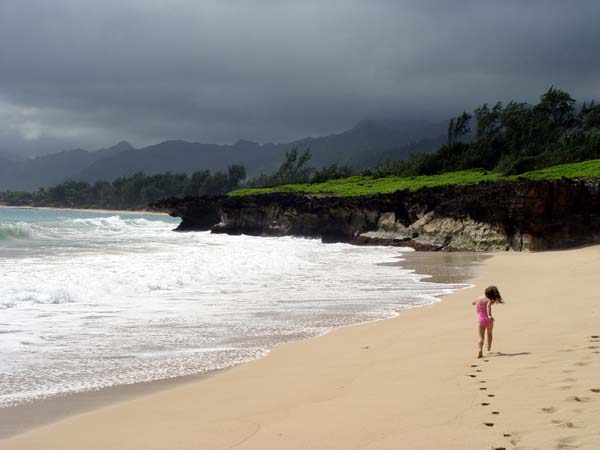
Totally having fun on the beach!
Light winds will continue, with daytime onshore sea breezes, and offshore land breezes at night, through Tuesday…followed by light trade winds Wednesday. The winds further offshore are light from the southeast direction, which is bringing hazy weather (volcanic in origin) to our islands, which will continue Tuesday. Light trade winds will begin again Wednesday and Thursday, lasting through the rest of the week…blowing the haze away then.
Clear mornings will give way to localized afternoon clouds, but they will generally be dry ones…other than a few very light showers over the mountains. We should begin to see a modest increase in showers starting around the middle of this week, especially along the windward sides during the night and early morning hours…as the trade winds return. There should be lots of sunshine along the beaches, especially during the morning hours.
As noted above, the light southeast breezes are carrying volcanic haze up over the smaller islands. The source of this vog is the volcanic vents on the Big Island. This will keep our atmosphere hazy through the next couple of days. It will take the returning trade winds around Wednesday, to ventilate this bad air quality away. The daytime heating, coupled with the light winds, will generate lots of afternoon clouds…mostly around the mountains.
It’s early Monday evening as I begin writing this last section of today’s weather narrative. The main headline weather news today, as it will continue to be on Tuesday…will be the hazy atmospherics here in the islands. Looking out the window here in Kihei, before I take the drive back home to Kula, I see extensive volcanic haze. The sea breezes are blowing, which is carrying moisture upcountry, where it looks mostly cloudy over the mountains. It may be hazy right into Wednesday, when the trade winds are scheduled to begin blowing again. These trade winds aren’t going to be very strong however, so it might be until Thursday before we’re back into our usual good visibilities. ~~~ I’ll be back again early Tuesday morning with your next new weather narrative from paradise, yes it is still paradise, even with our temporary hazy weather conditions! I hope you have a good Monday night wherever you happen to be spending it. Aloha for now…Glenn.
Interesting: A new explanation for the cause of changes in the chemical makeup of the oceans through recent Earth history is put forward in a paper published in Nature. Scientists from the Universities of Southampton and Bristol suggest that adjustments in ocean chemistry through recent geological time are driven by variations in the intensity of chemical breakdown of continental rocks by rain and ground water.
These changes are, in turn, controlled by the profound changes in the Earth’s climate, and in particular the Ice Ages, that have occurred over the past 2-3 million years. The elements that give seawater its distinctive saltiness are mostly supplied in dissolved form by rivers.
Rivers, in turn, receive these elements from runoff that has reacted with and partially dissolved rocks, a process known as chemical weathering. Another major source of dissolved material to seawater is submarine “black smoker” hydrothermal systems.
Movement of seawater through young, hot rocks at the mid-ocean ridges causes leaching of some elements from sea-floor basalts, as well as the precipitation out of solution of some constituents of seawater. Thus, these hydrothermal systems are both a source of dissolved material to the oceans and also a means by which some others are lost.
The other major output of dissolved material from the oceans is to marine sediments, which are principally made up of the shells of dead marine organisms. Imbalances in these inputs and outputs cause changes in the chemical make-up of the oceans through time.
Dr Vance explains, “Chemical weathering rates have been periodically perturbed in recent Earth history because the ice-sheets and glaciers produced during the great ice ages have physically ground rock up to smaller and smaller grain sizes. In the succeeding hotter and wetter ‘interglacial’ periods, this ground up rock is very susceptible to chemical weathering.”
All chemical reactions occur faster if the substrate is finer grained because there is more surface area for reaction to take place – this is why school chemical experiments use iron filings instead of a block of steel!
Interesting2: Fried, raw, baked or even distilled into beer or wine, bananas are a staple in the East African country of Rwanda, where approximately two million tons of the fruit are grown annually. Though much of the fruit is used, the majority of the skins leaves and stems are left behind as waste. Scientists at the University of Nottingham are developing ways to use the banana waste to produce fuel.
Using minimal tools and technology, PhD student Joel Chaney has developed a method of producing simple banana briquettes that can be burnt as fuel. "A big problem in the developing world is firewood," Chaney tells Science Daily. "Huge areas of land are deforested every year, which leads to the land being eroded. People need fuel to cook and stay warm but they can’t afford the more expensive types, like gas."
In additional to the resource depletion and erosion, collecting firewood can be a long process, with villagers spending hours traveling to and collecting forest wood for fuel. To turn the banana waste into burnable briquettes, the banana skins and leaves are first mashed to a pulp and then mixed with sawdust or sun dried banana stems to create a moldable material.
The pulp is compressed into a brick shape and baked in an oven, or sun dried for a few days if an oven is not available. Once dried, the bricks form an ideal fuel for cooking. Similar to biochar, the technology of using waste to create a fuel source is a growing trend that could represent a solution to environmental challenges worldwide.
Interesting3: Women may be more vulnerable than men to the cancer-causing effects of smoking tobacco, according to new results reported this week at the European Multidisciplinary Conference in Thoracic Oncology (EMCTO), Lugano, Switzerland. Swiss researchers studied 683 lung cancer patients who were referred to a cancer centre in St Gallen between 2000 and 2005 and found women tended to be younger when they developed the cancer, despite having smoked on average significantly less than men.
"Our findings suggest that women may have an increased susceptibility to tobacco carcinogens," report Dr Martin Frueh and colleagues. Dr Enriqueta Felip from Val d’Hebron University Hospital in Barcelona, Spain, conference co-chair, notes that the results support a growing awareness that smoking presents greater risks to women than men.
"In the early 1900s lung cancer was reported to be rare in women, but since the 1960s it has progressively reached epidemic proportions, becoming the leading cause of cancer deaths among women in the United States," Dr Felip said.
"Lung cancer is not only a man’s disease, but women tend to be much more aware of other cancers, such as breast cancer," she said. "Several case-control studies seem to suggest that women are more vulnerable to tobacco carcinogens than men."
Interesting4: When British consumers are compelled to buy energy-efficient light bulbs from 2012, they will save up to 5m tons of carbon dioxide a year from being pumped into the atmosphere. In China, however, a heavy environmental price is being paid for the production of “green” light bulbs in cost-cutting factories.
Large numbers of Chinese workers have been poisoned by mercury, which forms part of the compact fluorescent light bulbs. A surge in foreign demand, set off by a European Union directive making these bulbs compulsory within three years, has also led to the reopening of mercury mines that have ruined the environment.
Doctors, regulators, lawyers and courts in China – which supplies two thirds of the compact fluorescent bulbs sold in Britain – are increasingly alert to the potential impacts on public health of an industry that promotes itself as a friend of the earth but depends on highly toxic mercury.
Interesting5: As part of his environmental agenda, President Barack Obama announced in March he would order a review of a regulation approved late last year by the Bush administration that severely weakened the Endangered Species Act. The prior administration turned its back on animals and plants in December by giving federal agencies permission to ignore input from the U.S. Fish and wildlife Service and National Marine Fisheries Service when constructing dams, highways, parking lots and other projects.
The reasoning was that many federal agencies have their own scientists, but those individuals don’t necessarily specialize in wildlife and habitat issues. Thankfully, that wrong-headed regulation has now been reversed.
As announced last week by Interior Secretary Ken Salazar and Commerce Secretary Gary Locke, federal agencies will again have to adhere to the protection of endangered species the way they did before the Bush administration. That means consulting with federal fish and wildlife experts before shovels go into the ground.
Interesting6: The Southern Hemisphere has been mostly spared in the swine flu epidemic. That could change when winter starts in coming weeks with no vaccine in place, leaving half the planet out in the cold. So far, the most affected nations have been in North America and Europe, which are heading into summer. But flu is spread more easily in the winter, and it’s already fall down south.
Experts fear public health systems could be overwhelmed — especially if swine flu and regular flu collide in major urban populations. "You have this risk of an additional virus that could essentially cause two outbreaks at once," Dr. Jon Andrus said at the Pan American Health Organization’s headquarters in Washington. There’s also a chance that the two flus could collide and mutate into a new strain that is more contagious and dangerous.
"We have a concern there might be some sort of re-assortment and that’s something we’ll be paying special attention to," World Health Organization spokesman Dick Thompson said. Flu spreads more readily during the winter because people congregate indoors as the weather gets colder, increasing the opportunity for the virus to hop from person to person, said Raina MacIntyre, public health director at the University of New South Wales in Australia.
Colder temperatures also may make it easier for the virus to infect people. "The highest peaks of influenza activity occur in winter," MacIntyre said. "For us in the Southern Hemisphere, it’s particularly concerning." And while New Zealand is the only southern nation with confirmed swine flu cases, "it’s almost inevitable that it will come to Australia," she said.
Health officials in Brazil also say it’s a near-certainty swine flu will hit Latin America’s largest nation, where there are 25 suspected cases but none confirmed so far. Humans have only limited natural immunity to this new blend of bird, pig and human viruses, but the strain has killed relatively few people in its current form compared to traditional flu, which kills about 36,000 people each year in the U.S. and more than 250,000 worldwide.
 Email Glenn James: