











May 11-12, 2009
Air Temperatures – The following maximum temperatures were recorded across the state of Hawaii Monday afternoon:
Lihue, Kauai – 80
Honolulu, Oahu – 87
Kaneohe, Oahu – 80
Kahului, Maui – 86
Hilo, Hawaii – 83
Kailua-kona – 84
Air Temperatures ranged between these warmest and coolest spots near sea level – and on the highest mountains…at 4 p.m. Monday afternoon:
Honolulu, Oahu – 85F
Kaneohe, Oahu – 77
Haleakala Crater – 54 (near 10,000 feet on Maui)
Mauna Kea summit – 45 (near 14,000 feet on the Big Island)
Precipitation Totals – The following numbers represent the largest precipitation totals (inches) during the last 24 hours on each of the major islands, as of Monday afternoon:
0.24 Mount Waialaele, Kauai
0.02 Waianae Valley, Oahu
0.00 Molokai
0.00 Lanai
0.00 Kahoolawe
0.03 Oheo Gulch, Maui
0.49 Kealakekua, Big Island
Weather Chart – Here’s the latest (automatically updated) weather map shows a 1026 millibar high pressure system located far NE of the islands. This high pressure cell has a ridge running southwest from its center, to a point northwest of Kauai. The placement of this ridge will provide gradually diminishing wind speeds…varying between east and southeast through Wednesday.
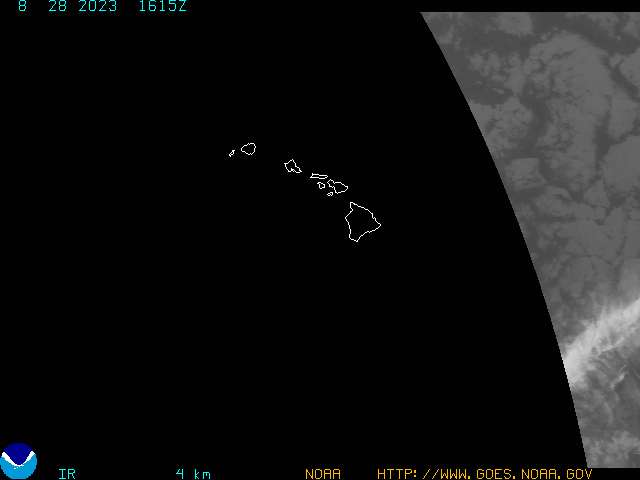
Satellite and Radar Images: To view the cloud conditions we have here in Hawaii, please use the following satellite links, starting off with the Infrared Satellite Image of the islands to see all the clouds around the state during the day and night. This next image is one that gives close images of the islands only during the daytime hours, and is referred to as a Close-up visible image. This next image shows a larger view of the Pacific…giving perspective to the wider ranging cloud patterns in the Pacific Ocean. Finally, here’s a looping IR satellite image, making viewable the clouds around the islands 24 hours a day. To help you keep track of where any showers may be around the islands, here’s the latest animated radar image.
Hawaii’s Mountains – Here’s a link to the live webcam on the summit of near 14,000 foot Mauna Kea on the Big Island of Hawaii. The tallest peak on the island of Maui is the Haleakala Crater, which is near 10,000 feet in elevation. These two webcams are available during the daylight hours here in the islands…and when there’s a big moon rising just after sunset for an hour or two! Plus, during the nights and early mornings you will be able to see stars, and the sunrise too…depending upon weather conditions.
Aloha Paragraphs

Hawaii’s Gold Dust Day Gecko…in Kona
The recent brisk trade wind flow have become lighter now…varying in direction between east and southeast. A high pressure ridge is located a couple of hundred miles northwest of Kauai Monday night. This weather map shows a 1027 millibar high pressure system far to northeast of our islands…with the ridge extending southwest. A cold front to our northwest will push the ridge even closer to the islands, with gradually lighter winds in the process. This week will have light winds in general, with an increasing amount of volcanic haze moving over the smaller islands perhaps later in the week.
We’ll find a few showers, although with the overlying atmosphere quite dry and stable…no heavy precipitation is expected. These few showers will occur on the north and east facing windward sides…and perhaps a few light ones in the upcountry areas during the afternoons too. A late season cold front will approach the islands by the weekend, and make it as far into the state as Kauai. The latest computer output suggests however, that our area will remain on the dry side even then, taking us into next week…which is pretty normal for this time of year.
As noted in the two paragraphs above, we’ll be dealing with lighter winds, and fairly dry conditions this week…along with some haze eventually too probably. Looking at this looping radar image, we see that there are a few showers around late in the day Monday, mostly over the ocean offshore from the island of Kauai. It appears that the showers are being carried along in the easterly trade winds around the Big Island…and south of there. The winds are already shifting towards the southeast over the ocean to the north of Oahu and Kauai.
It’s early Monday evening as I begin writing this last section of today’s weather narrative. Monday was a perfectly fine day here in the islands, with lots of sunshine, and warm to very warm air over our coastal sections. Kahului, Maui rose to 86F degrees during the afternoon…topping out at 87 at the Honolulu airport. The winds were lighter today, compared to the last several days, which gave a bit of a muggy feel to the atmosphere. Looking out the window here in Kihei, before taking the drive back upcountry to Kula, it’s mostly sunny! Checking out this satellite image, we see very few clouds around the islands, with a fairly substantial area of high cirrus clouds shooting by to the south of our islands. It wouldn’t take much of a shift northward, to put those sun dimming high clouds over us, we’ll have to keep an eye on them. ~~~ Ok, I’m about ready to jump in my car now, and really can’t wait to get home. I want to get out there and stretch my legs, take a few deep breaths outside of this air conditioned office. After that, it will be time to eat some of that red sauce pasta that I made last night…yum! I’ll be back here early Tuesday morning with your next new weather narrative. Actually, I’m back just before going to bed, and found during my evening walk that the volcanic haze was starting to thicken up, I’ll let you know what I find in the morning, in terms of this vog. I hope you have a great Monday until then! Aloha for now…Glenn.
Interesting: More children will end up hospitalized over the next decade because of respiratory problems as a result of projected climate change, according to a new study from Mount Sinai School of Medicine. The lead author of this research is Perry Elizabeth Sheffield, MD, Pediatric Environmental Health Fellow in the Department of Community and Preventive Medicine and the Department of Pediatrics at Mount Sinai School of Medicine.*
Mount Sinai worked with Natural Resources Defense Council and the Columbia University Mailman School of Public Health on this eye-opening research that finds a direct connection between air pollution and the health of children. Ozone has many known negative respiratory health effects to which children are particularly vulnerable.
An important projected consequence of climate change is the increase in ground-level ozone. Urban areas such as the New York City metropolitan area are at a higher risk of increasing temperature compared to rural areas. However, while more ozone is formed in higher temperatures, the downwind suburban areas are predicted in some of the models to experience higher ozone levels.
For this study, Dr. Sheffield and her colleagues created a model describing future projected rates of respiratory hospitalizations for children less than two years of age using baseline NYC metropolitan area hospitalization rates from publicly available corresponding state Department of Health databases.
These hospitalization rates were then compared to a previously developed dose-response relationship between ozone levels and pediatric respiratory hospitalizations, and the expected New York City eight-hour daily maximum ozone levels for the 2020s, as projected by a regional climate model created by the NY Climate and Health Project, supported by a grant from the US Environmental Protection Agency.
Two separate future scenarios were used. The two scenarios differed by the amount of projected ozone precursor emissions (chemicals that are converted to ozone by light and heat). In both scenarios, ozone levels rise by 2020. The study found that by 2020, respiratory hospitalizations are projected to rise between four and seven percent for children under two years old because of projected air pollution (ozone) increases.
The scenario with increased ozone precursors showed less of an overall increase in hospital admissions because of a paradoxical reduction in ozone due to the effects of air pollutant interactions, sometimes referred to as the scavenger molecule effect. These are likely conservative estimates because population was held constant, a single dose response function was used for the entire area, and most counties were not weighted by race and ethnicity.
Interesting2: Thousands of small electric scooters, bicycles and wheelchairs throughout Europe and Asia are powered by LifePO4 –- a material used in advanced lithium-ion batteries developed by Université de Montréal researchers. "It’s a revolutionary battery because it is made from non-toxic materials abundant in the Earth’s crust. Plus, it’s not expensive,’" says Michel Gauthier, an invited professor at the Université de Montréal Department of Chemistry and co-founder of Phostech Lithium, the company that makes the battery material.
"This battery could eventually make the electric car very profitable." The theory will soon be tested, since the 100 percent electric Microcar that’s set to debut in Europe this year will be and powered by the LifePO4 battery. Phostech Lithium’s production plant in St. Bruno, Quebec, produces the black LifePO4 powder, which is shipped across the world in tightly sealed barrels.
"The theoretical principle behind the battery was patented by a University of Texas professor in 1995. However, without the work of local chemists such as Nathalie Ravet, we couldn’t have developed it," says Phostech Lithium engineer Denis Geoffroy.
Süd-Chemie, a leading specialty chemistry company based in Germany, first invested in Phostech Lithium in 2005. Now, just four years later, Süd-Chemie’s total Canadian investments have reached $13 million and it stands as the 100% owner of Phostech Lithium. Phostech’s St. Bruno plant began to produce LiFePO4 in 2006 with 20 employees and a 400 metric-ton capacity.
Since then, Phostech has nearly doubled its staff. "It is a battery that is much more stable and much safer," says Dean MacNeil, a professor at the Université de Montréal’s Department of Chemistry and new NSERC-Phostech Lithium Industrial Research Chair in Energy Storage and Conversion. "In addition, it recharges much faster than previous batteries."
Interesting3: Meat eating quality and healthiness are closely related to the amount and type of fat. During the last decade there has been extensive selection towards leaner genotypes which has resulted in reduction of not only undesirable subcutaneous fat, but also in a dramatic decrease in desirable intramuscular fat (commonly known as “marbling” fat).
Intramuscular fat has the key input in meat tenderness and juiciness and a low level of intramuscular fat is associated with dry and unpalatable pork. The challenge which the pig producing industry is facing now is how to increase intramuscular fat without increasing subcutaneous fat?
A project which has recently started at the Institute of Biosensing Technology in collaboration with the Centre for Research in Biomedicine at the University of the West of England (UWE) aims to identify the genes controlling subcutaneous and intramuscular fat deposition.
The end-aim of this work is to provide data which could form a basis for developing a genetic test for intramuscular fat and which could assist pig breeders in genetic selection.
The project is entitled ‘Genetic control of fat partitioning in pigs’ and it is funded by the Genesis Faraday BBSRC Industrial CASE Studentship award. The Genesis Faraday Partnership supports industry-relevant research in the area of genetics and genomics of farm animals and this is the first Genesis Faraday BBSRC CASE Studentship awarded to UWE.
The project is undertaken by PhD student Duncan Marriott under supervision of Dr Olena Doran, Coordinator of Institute of Biosensing Technology. Duncan is a Biology graduate with an MSc in Meat Science and five years experience as a research technician at the University of Bristol’s School of Clinical Veterinary Science and he has an excellent combination of skills and experience to carry out the project.
Duncan Marriott explains, “Pigs need to be leaner to produce healthy meat but to carry sufficient intramuscular fat to maintain good eating quality. The project will be conducted on a number of commercial pig breeds, which differ in intramuscular fat content. My challenge is to identify the genes controlling both the intramuscular and subcutaneous fat content in different breeds.” Olena Doran adds,
“Pork is one of the most consumed meats in Europe and producers are keenly seeking to find ways of producing meat containing high levels of intramuscular fat. The fact that this work is supported by a Genesis Faraday BBSRC CASE Studentship award with a major animal health company as a partner will ensure that the results of this research will have a direct impact to the industry.
Interesting4: Gov. David A. Paterson last week signed an Executive Order to phase out New York State’s purchase and use of bottled water at state agency facilities. The action makes New York the second state in the country to eliminate the purchase and use of bottled water.
The Executive Order will phase out the expenditure of state funds for the purchase of single serve bottles and larger, cooler-sized bottles for water consumed at agency facilities.
The measure requires each executive agency to develop and implement a plan to phase out expenditures for bottled water and provide alternative water sources such as ordinary tap water fountains and dispensers.
"Taxpayers have spent billions of dollars to ensure that we have clean drinking water supplies," said Paterson. "If we are going to make such significant investments, we should reap the benefits and use that water. Our efforts will serve as an example for local governments, businesses, and residents to follow."
Interesting5: A massive iceberg with enough freshwater in it to fill Sydney Harbor 135 times over is about to break off the Mertz glacier in Antarctica. The iceberg will be 75 kilometers long and contains 750,000 giga-liters of ice. Scientists are not sure if it is a natural event or if global warming is to blame. But a joint Australian and French team hope to find out.
The Mertz Glacier is near Commonwealth Bay in East Antarctica. It flows into the southern ocean for 140 kilometers before it drops icebergs into the sea. A large crack has formed about half way along the Mertz Glacier, which means it is going to drop a very large iceberg. French glaciologist Benoit Legresy is measuring the break-up.
"Just at the moment, it’s undergoing a massive calving event which promises to release an iceberg which will be between 20 to 25 kilometers wide and 75 kilometers long by about 400 to 500 meters thick," he said. The iceberg contains enough fresh water to fill Sydney Harbor 135 times – that is 30 per cent of the world’s annual water consumption.
When it breaks off, the iceberg won’t melt straight away because it could take up to 30 years for the currents to move it to water that is warm enough to melt the ice. The scientists realized the large iceberg was forming when they looked at satellite pictures of the Mertz Glacier and saw two large cracks. When the cracks kept getting bigger Benoit Legresy decided to measure the break-up.
Interesting6: California is in its third year of drought, and many farmers in the state’s crop-rich Central Valley are looking at dusty fields, or worse, are cutting down their orchards before the trees die. Hardest hit is Westlands, the biggest irrigated region in the country, where much of the nation’s fruit, nuts and produce come from.
This year, farmers have been told they are getting only a small fraction of the water they need. Farmers throughout this region echo the sentiment that politics, not the drought, is the problem. Most of California gets its water from a huge estuary called the Delta, where two big rivers join in the center of the valley.
But so much water was being pumped out of the Delta that a tiny smelt there, an endangered species, is disappearing. So late last year, a federal judge ruled that the amount of water being delivered to the south had to be sharply cut back.
In April, in a sweltering tin shed in the middle of the Westland’s water district, about 200 farmers gathered to hear what Tom Birmingham had to say about the crisis. Birmingham is the executive director of the irrigation district. Yes, the drought is a problem, he says, but he believes the much bigger problem is that court ruling.
 Email Glenn James:
Dodobird Fishie Says:
I luv Hawaiian geckos!!!!!!!!!!!!!1~~~Hi Dodbird, I’ll try and remember to use a gecko as the picture on this narrative page soon! Aloha, Glenn