April 9-10, 2009
Air Temperatures – The following maximum temperatures were recorded across the state of Hawaii Thursday afternoon:
Lihue, Kauai – 72
Honolulu, Oahu – 77
Kaneohe, Oahu – 73
Kahului, Maui – 74
Hilo, Hawaii – 71
Kailua-kona – 78
Air Temperatures ranged between these warmest and coolest spots near sea level – and on the highest mountains…at 5 p.m. Thursday evening:
Barking Sands, Kauai – 77F
Kahului, Maui – 68
Haleakala Crater – 39 (near 10,000 feet on Maui)
Mauna Kea summit – 28 (near 14,000 feet on the Big Island)
Precipitation Totals – The following numbers represent the largest precipitation totals (inches) during the last 24 hours on each of the major islands, as of Thursday afternoon:
1.72 Mount Waialaele, Kauai
0.15 Nuuanu Upper, Oahu
0.01 Molokai
0.01 Lanai
0.03 Kahoolawe
0.50 West Wailuaiki, Maui
0.31 Glenwood, Big Island
Weather Chart – Here’s the latest (automatically updated) weather map showing a 1033 millibar high pressure system more or less to the north the islands. This high pressure cell will keep our trade winds light to moderately strong Friday and Saturday…lighter in those more protected places.
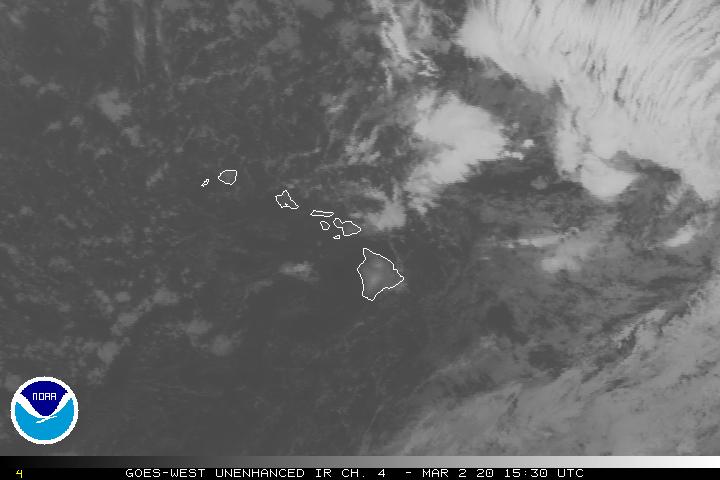
Satellite and Radar Images: To view the cloud conditions we have here in Hawaii, please use the following satellite links, starting off with the Infrared Satellite Image of the islands to see all the clouds around the state during the day and night. This next image is one that gives close images of the islands only during the daytime hours, and is referred to as a Close-up visible image. This next image shows a larger view of the Pacific…giving perspective to the wider ranging cloud patterns in the Pacific Ocean. Finally, here’s a looping IR satellite image, making viewable the clouds around the islands 24 hours a day. To help you keep track of where any showers may be around the islands, here’s the latest animated radar image.
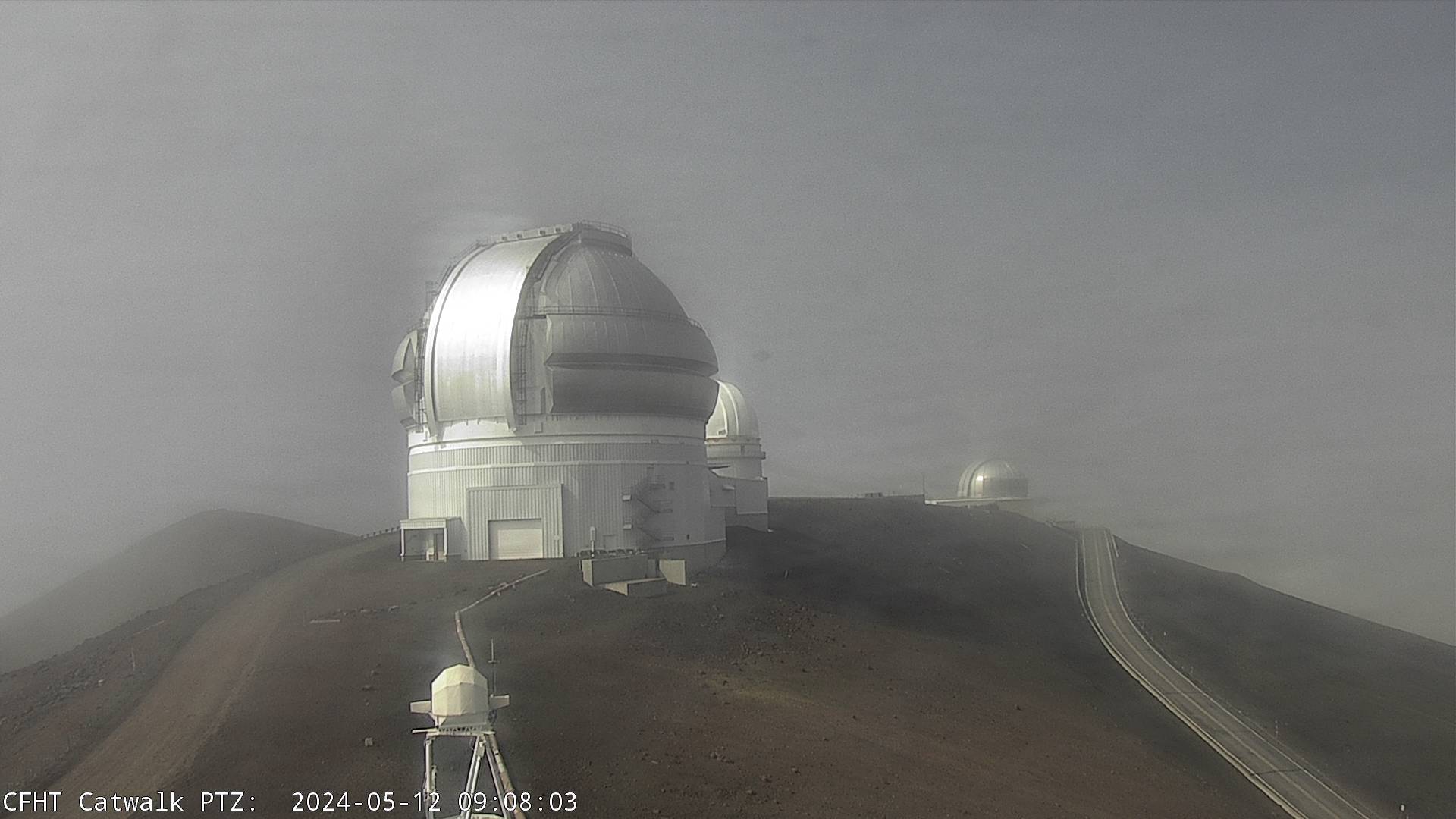
Hawaii’s Mountains – Here’s a link to the live webcam on the summit of near 14,000 foot Mauna Kea on the Big Island of Hawaii. The tallest peak on the island of Maui is the Haleakala Crater, which is near 10,000 feet in elevation. These two webcams are available during the daylight hours here in the islands…and when there’s a big moon rising just after sunset for an hour or two! Plus, during the nights and early mornings you will be able to see stars, and the sunrise too…depending upon weather conditions.
Aloha Paragraphs

The incredibly beautiful windward side of Oahu
Slightly lighter trade winds will blow Friday through the weekend…and then strengthen some again as we push into early next week. The source of our trade wind weather pattern Thursday night is a 1033 millibar high pressure system to the north of the Hawaiian Islands…as shown on this weather map. The winds have become light enough Thursday night, that the NWS forecast office in Honolulu is keeping the small craft wind advisory active through the major channels from Oahu southward…and those windiest coastal zones around Maui and the Big Island.
A mix of high, middle, and lower level clouds will keep the island chain cloudier than usual for the next couple of days. Looking at this satellite image, we continue to see a large, and thick area of high clouds moving right over us from the southwest. These high clouds will dim and filter our Hawaiian sunshine greatly during the days. These high clouds won’t bring precipitation, although the middle level clouds are dropping light rain at times. We’ll also see a few windward biased showers at times too, cooler than normal with all these clouds.
The name of the game now will be cloudy skies…which of course means a distinct lack of our famous Hawaiian sunshine. We’re going to be seeing lots more of this tropical moisture riding northward over our islands into the weekend. Here’s a looping satellite image which shows the extent of this high level cloudiness moving by overhead. The middle level clouds, called altocumulus are dropping some light snow at times atop the summits on the Big Island…here’s a link to Mauna Kea. The NWS is keeping a winter weather advisory active atop those highest elevations.
It’s early Thursday evening as I begin writing this last section of today’s weather narrative. It was cloudy all day Thursday, with not even a second’s worth of sunshine breaking through here on Maui. As a matter of fact, light rain fell most of the day over Maui County in general. As this looping radar image shows, the central islands seem to be acting like a magnet for these showers falling from the middle level cloudiness Thursday evening/night. I would expect more of the same as we move into Good Friday, with perhaps some relief from the cloudy and locally showery conditions later this coming weekend. ~~~ I’m going to drive over to Kahului from Kihei, where I’m writing these words. I’ve decided to see a new film called Fast & Furious (2009), starring Vin Diesel and Paul Walker, among others. I’m back to my old ways again this evening, opting for a classic supercharged action flick! "When a crime brings them back to L.A., fugitive ex-con Dom Toretto reignites his feud with agent Brian O’Conner. But as they are forced to confront a shared enemy, Dom and Brian must give in to an uncertain new trust if they hope to out manuever him. And from convoy heists to precision tunnel crawls across international lines, two men will find the best way to get revenge: push the limits of what’s possible behind the wheel." – In checking out the trailer, I see that there is the usual adventure, and thrilling content geared around fast cars, violence…and cute girls of course. Here’s the trailer for you to check out yourself, if you have any interest in plugging into this kind of film for a few seconds. ~~~ I’ll be back Friday morning with my opinion about this film, along with your next new weather narrative. I hope you have a great Thursday night! Aloha for now…Glenn.
Interesting: Though greenhouse gases are invariably at the center of discussions about global climate change, new NASA research suggests that much of the atmospheric warming observed in the Arctic since 1976 may be due to changes in tiny airborne particles called aerosols. Emitted by natural and human sources, aerosols can directly influence climate by reflecting or absorbing the sun’s radiation. The small particles also affect climate indirectly by seeding clouds and changing cloud properties, such as reflectivity.
A new study, led by climate scientist Drew Shindell of the NASA Goddard Institute for Space Studies, New York, used a coupled ocean-atmosphere model to investigate how sensitive different regional climates are to changes in levels of carbon dioxide, ozone, and aerosols.
The researchers found that the mid and high latitudes are especially responsive to changes in the level of aerosols. Indeed, the model suggests aerosols likely account for 45 percent or more of the warming that has occurred in the Arctic during the last three decades. The results were published in the April issue of Nature Geoscience.
Though there are several varieties of aerosols, previous research has shown that two types — sulfates and black carbon — play an especially critical role in regulating climate change. Both are products of human activity. Sulfates, which come primarily from the burning of coal and oil, scatter incoming solar radiation and have a net cooling effect on climate. Over the past three decades, the United States and European countries have passed a series of laws that have reduced sulfate emissions by 50 percent.
While improving air quality and aiding public health, the result has been less atmospheric cooling from sulfates. At the same time, black carbon emissions have steadily risen, largely because of increasing emissions from Asia. Black carbon — small, soot-like particles produced by industrial processes and the combustion of diesel and biofuels — absorb incoming solar radiation and have a strong warming influence on the atmosphere.
Interesting2: Thirty-four-million years ago, Earth changed profoundly. What happened, and how were Earth’s animals, plants, oceans, and climate affected? Focusing on the end of the Eocene epoch and the Eocene-Oligocene transition, a critical but very brief interval in Earth’s history, GSA’s latest Special Paper provides new answers to these questions.
According to the book’s editors, Christian Koeberl of the University of Vienna and Alessandro Montanari of the Observatorio Geologico di Coldigioco in Italy, the end of the Eocene and the Eocene-Oligocene (E-O) transition mark the most profound oceanographic and climatic changes of the past 50 million years of Earth’s history.
Earth experienced global cooling beginning in the middle Eocene, with a sharp temperature drop of about two degrees Celsius in the Late Eocene. This drop was characterized by an increase in marine oxygen isotope values and significant floral and faunal turnovers.
The global climate changes are commonly attributed to the expansion of the Antarctic ice cap following its gradual isolation from other continental masses. However, as examined in this volume, multiple extraterrestrial bolide impacts, possibly related to a comet shower that lasted more than two million years, may have played an important role in deteriorating the global climate.
Interesting3: An unsettled weather pattern will persist across central Italy the next couple of days. Heavier rain this weekend could bring new problems to the area devastated by the recent earthquake. A dying storm system will be responsible for showers and thunderstorms today into Friday. These days will not be entirely wet. The spotty nature of the showers will promote dry and even sunny parts to each day.
The lightning produced by any thunderstorm poses a danger to those left homeless by the earthquake or those continuing to comb through the wreckage in search of survivors. There is an isolated threat of the thunderstorms dropping hail. Drenching downpours from the showers and thunderstorms could cause the region’s damaged buildings to become even more unstable.
Gusty winds from the thunderstorms pose the same concern. Daytime temperatures today into Friday will be generally comfortable, averaging around 60°F. The 17,700 people living in tents across the region will have to endure chilly overnight lows. Temperatures will drop into the low to mid-40s F.
The weather will worsen this weekend with the arrival of a storm from the United Kingdom. More widespread rain will fall late Saturday into Sunday. One to two inches of rain is expected over the weekend. Cooler air will also accompany the wet weather. The rain and cool air will further create miserable conditions for those living in tents. There is also concern that enough rain could fall to make the region more susceptible to landslides in the event of even a minor earthquake.
Interesting4: You’ve probably been there. In a doctor’s office, being advised to do what you dread – exercise. You get that feeling in your gut, acknowledging that, indeed, you should exercise but probably won’t. Now imagine that the doctor is your optometrist. Don’t clean your glasses. You read that right. Eye exercises are used to treat a variety of vision disorders, according to Dr. Janice Wensveen, clinical associate professor at the University of Houston’s College of Optometry.
Patient reactions to this quite common prescription range between surprise and relief, she said, but doing the therapy can improve their performance at school and work. "They’re curious, especially when we tell them, instead of putting a Band-Aid on it like we do with glasses or contact lenses, we’re actually going to solve your problem. You’re going to be cured, and that’s something we don’t very often do," she said.
The standard at-home prescription is known as "pencil push-up therapy," said Wensveen, who practices at the University Eye Institute’s Vision Therapy Clinic in the Family Practice Service. "Patients visually follow a small letter on a pencil as they moved the pencil closer to the nose. The goal is to be able to keep the letter clear and single until it touches your nose."
Not surprisingly, she said, many patients don’t follow through once they’re out the door. "You can imagine that, in the doctor’s office, it sounds great, and you can do it. You think, ‘Wow, this can help me?’ But you get home, and you do it. You think, ‘This is really dumb.’ You do it once, and you never do it again," she said.
Interesting5: New research on infrasound from volcanic eruptions shows an unexpected connection with jet engines. Researchers at Scripps Institution of Oceanography at UC San Diego speeded up the recorded sounds from two volcanoes and uncovered a noise very similar to typical jet engines. These new research findings provide scientists with a more useful probe of the inner workings of volcanic eruptions. Infrasound is sound that is lower in frequency than 20 cycles per second, below the limit of human hearing.
The study led by Robin Matoza, a graduate student at Scripps Oceanography, will be published in an upcoming issue of the journal Geophysical Research Letters, a publication of the American Geophysical Union (AGU). Matoza measured infrasonic sound from Mount St. Helens in Washington State and Tungurahua volcano in Ecuador, both of which are highly active volcanoes close to large population centers.
"We hypothesized that these very large natural volcanic jets were making very low frequency jet noise," said Matoza, who conducts research in the Scripps Laboratory for Atmospheric Acoustics. Using 100-meter aperture arrays of microbarometers, similar to weather barometers but sensitive to smaller changes in atmospheric pressure and low-frequency infrasonic microphones, the research team tested the hypothesis, revealing the physics of how the large-amplitude signals from eruptions are produced.
Jet noise is generated by the turbulent flow of air out of a jet engine. Matoza and colleagues recorded these very large-amplitude infrasonic signals during the times when ash-laden gas was being ejected from the volcano. The study concluded that these large-scale volcanic jets are producing sound in a similar way to smaller-scale man-made jets.
Interesting6: Adding to the growing evidence that a person’s waist size is an important indicator of heart health, a study led by investigators at Beth Israel Deaconess Medical Center (BIDMC) has found that larger waist circumference is associated with increased risk of heart failure in middle-aged and older populations of men and women.
The findings, published online in the April 7 Rapid Access Report of the journal Circulation: Heart Failure, showed that increased waist size was a predictor of heart failure even when measurements of body mass index (BMI) fell within the normal range.
"Currently, 66 percent of adults in the United States are overweight or obese," explains Emily Levitan, ScD, the study’s first author and a Research Fellow in the Cardiovascular Epidemiology Research Unit at BIDMC. "Knowing that the prevalence of heart failure increased between 1989 and 1999, we wanted to better understand if and how this increase in obesity was contributing to these rising figures."
A life-threatening condition that develops when the heart can no longer pump enough blood to meet the body’s needs, heart failure (also known as congestive heart failure) is usually caused by existing cardiac conditions, including high blood pressure and coronary artery disease.
Heart failure is the leading cause of hospitalization among patients 65 and older, and is characterized by such symptoms as fatigue and weakness, difficulty walking, rapid or irregular heartbeat, and persistent cough or wheezing.
Interesting7: The Environmental Protection Agency is reconsidering whether to compel dry cleaners to phase out a cancer-causing chemical used in tens of thousands of operations nationwide, according to court documents filed late last week. The issue of whether to ban perchloroethylene, a hazardous air pollutant linked to cancer and neurological damage, has been the source of a long-running fight between environmental groups and the federal government.
In July 2006, the Bush administration ordered dry cleaners located in residential buildings to phase out the toxic solvent by 2020 but did not impose the same rules on the 28,000 other cleaners that do not operate in such mixed-use buildings. Instead, the EPA required these operators to use devices to detect leaks and to reduce emissions by conducting the wash and dry cycles in the same machine.
The Sierra Club challenged the rules in court, and on Friday the EPA asked the U.S. Court of Appeals for the D.C. Circuit to postpone arguments on the case so it could reconsider the regulations on policy and legal grounds. EPA spokesman Dale Kemery said in an e-mail that the agency and the Justice Department made the request "so that the agency’s new leadership may review the rule."
He added that they asked the court to leave the 2006 rule in place while the review is under way. Between 1996 and 2006, dry cleaners reduced emissions of perchloroethylene, also known as perc, from 25,000 tons to 10,000 tons a year by replacing older dry cleaning machines and improving their efficiency, according to EPA data.
Interesting8: The Kyoto Box is made from cardboard and can be used for sterilizing water or boiling or baking food. The Kenyan-based inventor hopes it can make solar cooking widespread in the developing world, supplanting the use of wood which is driving deforestation.
Other finalists in the $75,000 competition included a device for streamlining lorries, and a ceiling tile that cools hot rooms. Organized by Forum for the Future, the sustainable development charity founded by Jonathan Porritt, the competition aims to support concepts that have "moved off the drawing board and demonstrated their feasibility" for reducing greenhouse gas emissions, but have not gained corporate backing.
"The Kyoto Box has the potential to transform millions of lives and is a model of scalable, sustainable innovation," said Peter Madden, the forum’s chief executive. It is made from two cardboard boxes, which use reflective foil and black paint to maximize absorption of solar energy.
Interesting9: Leatherback turtles are ancient creatures with a modern problem: Plastic. A new study looked at necropsy reports of more than 400 leatherbacks that have died since 1885 and found plastic in the digestive systems of more than a third of the animals. Besides plastic bags, the turtles had swallowed fishing lines, balloon fragments, spoons, candy wrappers and more. Plastic was probably not the cause of death in most cases. Nevertheless, the study is an important wake-up call for a growing garbage problem.
"Eating something that is plastic can’t be good for you, whether it leads to death or not," said Mike James, a marine biologist at Dalhousie University in Halifax, Nova Scotia. "It’s not what they should be eating. And it’s kind of scary that it is showing up in their diet to the extent that it is."
Leatherback turtles are critically endangered and highly charismatic creatures. They are big, weighing 1,000 pounds or more, with shells that can measure more than 6 feet across. These peaceful creatures have had the same basic body plan for 150 million years.
Leatherbacks are also popular for what they eat: namely, large quantities of jellyfish. The problem is that plastic bags look a lot like jellyfish, and plastic often ends up in the oceans, piling up in areas where currents — and turtles — converge. That led James to wonder how much often the turtles were swallowing plastic in their hunt for yummy jellyfish.
Collecting the data was a painstaking process. James and colleagues spent two years searching far and wide for turtle necropsy reports. They scanned the literature, and they asked people to dig up old field-notebooks. For every report found, they had to make sure that a complete necropsy had been performed and that the entire GI tract had been opened.
The researchers ended up with a sample size of 408 turtles, stranded at some point during the last 125 years. Of those, 138 — or 34 percent — contained plastic. Alongside the rise in plastic production, there has been a sharp rise in plastic-containing turtles since the 1950s. That finding isn’t surprising, given the leatherback’s jellyfish-based diet, said Christopher Sasso, a research fisheries biologist with the National Marine Fisheries Service in Miami.
But the numbers are alarming. Plastic can block a turtle’s gut, causing bloating, interfering with digestion, and leading to a slow, painful death. "I can’t imagine it’s very comfortable," he said. "Their guts weren’t designed to digest plastic."
There are vast fields of trash floating in the world’s oceans, Sasso added. And leatherback turtles travel thousands of miles each year, giving them even more opportunities to come in contact with it. "This is an animal that has survived many extinction events," James said, "And now it’s got all these anthropogenic hazards to face."
That’s where people come in. Simple choices — like putting balloons and picnic supplies in the trash and using canvas instead of plastic grocery bags — can help leatherbacks and other marine creatures survive long into the future. "Of all the problems the environment faces, this one is not impossible to address," James said. "We don’t need to have everything packaged in plastic. There are alternatives."
 Email Glenn James: