April 8-9, 2009
Air Temperatures – The following maximum temperatures were recorded across the state of Hawaii Wednesday afternoon:
Lihue, Kauai – 74
Honolulu, Oahu – 78
Kaneohe, Oahu – 75
Kahului, Maui – 76
Hilo, Hawaii – 75
Kailua-kona – 80
Air Temperatures ranged between these warmest and coolest spots near sea level – and on the highest mountains…at 4 p.m. Wednesday afternoon:
Barking Sands, Kauai – 77F
Lihue, Kauai – 71
Haleakala Crater – 48 (near 10,000 feet on Maui)
Mauna Kea summit – 34 (near 14,000 feet on the Big Island)
Precipitation Totals – The following numbers represent the largest precipitation totals (inches) during the last 24 hours on each of the major islands, as of Wednesday afternoon:
1.10 Mount Waialaele, Kauai
0.40 Oahu Forest NWR, Oahu
0.01 Molokai
0.00 Lanai
0.09 Kahoolawe
1.25 West Wailuaiki, Maui
0.58 Mountain View, Big Island
Weather Chart – Here’s the latest (automatically updated) weather map showing a 1033 millibar high pressure system more or less to the north the islands. This high pressure cell will keep our trade winds moderately strong Thursday and Friday…lighter in those more protected places.
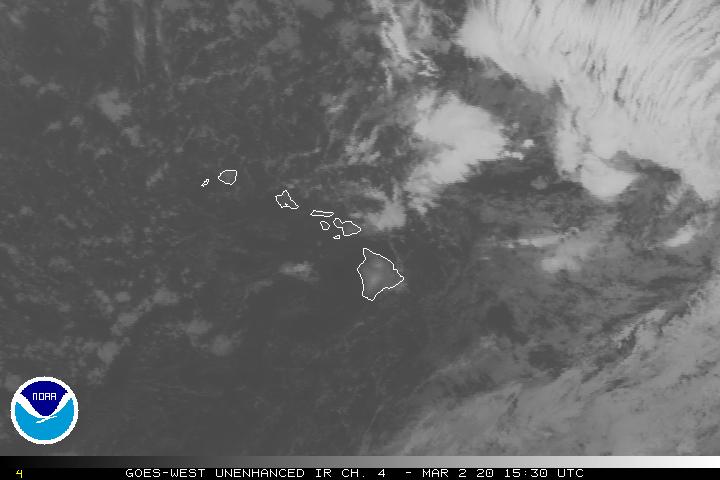
Satellite and Radar Images: To view the cloud conditions we have here in Hawaii, please use the following satellite links, starting off with the Infrared Satellite Image of the islands to see all the clouds around the state during the day and night. This next image is one that gives close images of the islands only during the daytime hours, and is referred to as a Close-up visible image. This next image shows a larger view of the Pacific…giving perspective to the wider ranging cloud patterns in the Pacific Ocean. Finally, here’s a looping IR satellite image, making viewable the clouds around the islands 24 hours a day. To help you keep track of where any showers may be around the islands, here’s the latest animated radar image.
Hawaii’s Mountains – Here’s a link to the live webcam on the summit of near 14,000 foot Mauna Kea on the Big Island of Hawaii. The tallest peak on the island of Maui is the Haleakala Crater, which is near 10,000 feet in elevation. These two webcams are available during the daylight hours here in the islands…and when there’s a big moon rising just after sunset for an hour or two! Plus, during the nights and early mornings you will be able to see stars, and the sunrise too…depending upon weather conditions.
Aloha Paragraphs

Cloudy skies in the islands
Little change in the expectations of continued trade winds through this week, blowing more or less in the moderately strong realms…right on into next week. The source of our breezy trade winds Wednesday night is a 1033 millibar high pressure system to the north of the Hawaiian Islands…as shown on this weather map. The NWS forecast office in Honolulu is keeping the small craft wind advisory flags up across all of our marine coastal and channel waters. There continues to be no end to the trade wind flow across our tropical latitudes, which is quite common during the spring season here in the islands.
We have moved into what will be rather cloudy skies through the rest of the week, lots of it being the high cirrus variety…with still some showers along our windward sides at times. Looking at this satellite image, we now see a large, and rather thick area of high clouds having moved right over us from the southwest. These high clouds will dim and filter our Hawaiian sunshine greatly through Friday or Saturday…thinning some by Sunday. These high clouds won’t bring precipitation, although the trade winds will carry some shower bearing clouds to our north and east facing windward coasts and slopes.
As noted in the two paragraphs above, our trade winds will continue, and were pretty much completely cloudy now. We’re going to be seeing lots more of this tropical moisture riding northward over our islands into the weekend. Here’s a looping satellite image which shows the extent of this high level cloudiness moving by overhead. We’ve seen the last of our sunny weather for the time being, but before anyone gets too upset, we should see our sunshine returning, at least partially, as we move into the upcoming weekend time frame.
It’s early Wednesday evening as I begin writing this last section of today’s weather narrative. It’s the end of another good day of weather reporting. The main topic now is, and will continue to be…the dense canopy of high cirrus clouds. Becoming a second string player now, will be the moderately strong trade winds. Slightly below this fairly normal wind flow, will be the occasional passing showers along our windward sides. These three weather features will remain our headline weather news through the rest of this week. ~~~ Looking out the window here in Kihei, Maui, before I cruize back upcountry, I see absolutely cloudy skies out there, with not even the slightest sign of sunshine. I know that not everyone is all that happy with this situation, although we should all practice taking a deep breath, and relax into it, that…or just bite the bullet so to speak. The cloudy skies, and the locally breezy trade winds, still have folks talking about the coolness of our weather here in the islands…which is true. ~~~ As we have all this high cloudiness around now, the fact that our April full moon will occur at 458am Thursday morning, won’t do us much good…as it will be muted, as will our sunshine for the time being as well. I will be back early Thursday morning, to present you with your next new weather narrative from this cloudy paradise of Hawaii. I hope you have a great Wednesday night wherever you happen to be hanging out! Aloha for now…Glenn.
Interesting: Bananas are a staple crop of Rwanda. The fruit is eaten raw, fried and baked — it even produces banana beer and wine. Around 2 million tons are grown each year but the fruit is only a small percentage of what the plant produces. The rest — skins, leaves and stems — is left to rot as waste. Now scientists at The University of Nottingham are looking at ways to use that waste to produce fuel, developing simple methods of producing banana briquettes that could be burnt for cooking and heating. PhD student Joel Chaney in the Faculty of Engineering has developed a method of producing the briquettes using minimal tools and technology, which could be used in communities all over Africa.
First, the banana skins and leaves are mashed to a pulp in a hand-operated domestic meat mincer. This pulp is mixed with sawdust to create a mouldable material — in Rwanda it would be mixed with sun dried banana stems, ensuring the whole plant is used. Then, the pulp mix is compressed into briquette shapes and baked in an oven at 105 degrees. Again, in Africa the fuel would be left for a few days to dry in the sun. Once dried, the briquettes form an ideal fuel, burning with a consistent steady heat suitable for cooking. Joel has tested this himself by cooking fried banana fritters, which is similar to “red-red” a popular Ghanaian dish.
“A big problem in the developing world is firewood,” said Joel. “Huge areas of land are deforested every year, which leads to the land being eroded. People need fuel to cook and stay warm but they can’t afford the more expensive types, like gas. “As well as the environmental damage this causes, it also takes a lot of time. Women can spend four or five hours a day just collecting firewood. If an alternative fuel could be found they could spend this time doing other things — even generating an income. “Using waste to create fuel is key to sustainable development, and this method could be easily transferred across Africa.”
Interesting2: Whale sharks — giants of the fish world that strike terror only among tiny creatures like the plankton and krill they eat — are imperiled by over-fishing of the species in parts of its ocean range. That threat is underscored in a new study from geneticists led by Jennifer Schmidt, University of Illinois at Chicago associate professor of biological sciences, reported online April 7 in the journal PLoS One.
Schmidt and her colleagues studied the DNA of 68 whale sharks from 11 locations across the Indian and Pacific Oceans and the Caribbean Sea — an area that covers most of the shark’s known range. Results showed little genetic variation between the populations, which indicates migration and interbreeding among far-flung populations of the big fish.
"Our data show that whale sharks found in different oceans are genetically quite similar, which means that animals move and interbreed between populations," said Schmidt. "From a conservation standpoint, it means that whale sharks in protected waters cannot be assumed to stay in those waters, but may move into areas where they may be in danger."
A tropical fish that can grow 50 feet or longer and weigh over 20 tons, a whale shark’s range can span oceans. They do not breed until they are about 25 to 30 years old, so it will take a long time for the species to recover from recent population declines. Whale sharks are listed as threatened, but not every country protects them. The large animals are especially prized by fishermen for meat and fins used in soup.
Interesting3: A new study by researchers from UC Santa Barbara’s National Center for Ecological Analysis and Synthesis (NCEAS) sheds light on how threats to the world’s endangered coral reef ecosystems can be more effectively managed. In a recent issue of the journal Coral Reefs, lead authors Kimberly A. Selkoe and Benjamin S. Halpern, both of NCEAS, explain how their maps of the Northwestern Hawaiian Islands (NWHI) –– a vast area stretching over 1,200 miles –– can be used to make informed decisions about protecting the world’s fragile reefs. Coral reef ecosystems are at risk due to the direct and indirect effects of human activities.
This study was designed to help natural resource managers make decisions on issues such as surveillance priorities, granting of permits for use, and discernment of which areas to monitor for climate change effects. "Our maps of cumulative human impact are a powerful tool for synthesizing and visualizing the state of the oceans," said first author Selkoe, who is also affiliated with Hawaii Institute of Marine Biology at the University of Hawaii. "The maps can aid in strategically zoning uses of oceans in an informed way that maximizes commercial and societal benefits while minimizing further cumulative impact."
"President (George W.) Bush declared the Northwestern Hawaiian Islands a National Monument in 2006, in part because it is one of the last places in the oceans that have not been heavily altered by human activities," said Halpern. "Our maps of cumulative human impact on these islands show that, despite their extreme isolation, humans are already significantly impacting this special place, and that many of the key threats, such as those associated with climate change, are not mitigated with Monument designation. We must continue to act to protect these islands and coral atolls if we hope to preserve them for future generations."
The authors studied 14 threats specific to NWHI. The threats, all generated by humans, included alien species, bottom fishing, lobster trap fishing, ship-based pollution, ship strike risks, marine debris, research diving, research equipment installation, and wildlife sacrifice for research. Human-induced climate change threats were also studied, including increased ultraviolet radiation, seawater acidification, the number of warm ocean temperature anomalies relevant to disease outbreaks and coral bleaching, and sea level rise.
Risk of increased rates of coral disease due to warming ocean temperature was found to have the highest impact, along with other climate-related threats. However, the authors noted that climate issues cannot be resolved by managers at the regional level. It was noted that threats related to ship traffic are most easily managed by regional management.
Interesting4: The race is on to develop smaller, more powerful and more solid batteries for devices like laptop computers, cell phones, GPS receivers and other portable devices. Scientists at MIT are taking the opposite approach, developing large, eco-friendly stationary batteries made entirely from liquid metal that would store large amounts of power from wind farms or solar cells or serve as backup power sources for hospitals.
"Since these batteries won’t be in someone’s hand or in a car, we don’t have to make them crash-worthy, idiot-proof, and it doesn’t have to operate at around body temperature," said Don Sadoway, a scientist at the Massachusetts Institute of Technology who, along with graduate student David Bradwell and fellow professor Gerbrand Ceder, is developing the molten metal battery.
Interesting5: Plastic bags account for 50 percent of the plastic trash in Washington, D.C.’s Anacostia River. In order to decrease the amount of plastic bags in the Anacostia, the D.C. Council proposed legislation that would put a five cents tax on disposable shopping bags. Eleven council members co-introduced it, and according to a Washington Post article, that almost guarantees it will become law.
Social service groups and plastic bag manufacturers have joined forces in opposing the legislation, arguing that the tax will be a hardship for poor people. "I have no qualms about cleaning up the Anacostia River," said former Ward 8 council member Sandy Allen.
"That little five cents may sound small, but on a continued basis” it eats into the income." Restaurant owner Andy Shallal accused the plastic bag manufacturers of "race-baiting and class-baiting." The legislation’s author, Council member Tommy Wells, said, "The approach I’m taking is really to get into your head, not into your pocket."
A provision in the legislation creates a fund from the tax revenue to clean up the Anacostia and provide reusable bags to "district residents, with priority to assisting seniors and low-income residents." D.C. stores would be allowed to keep a penny for each bag, and the other four cents would go to the fund.
In 2002, Ireland instituted a plastic bag tax of 20 cents per bag, called the PlasTax. Last year the tax increased to 33 cents. The PlasTax was a response to 1.2 million shopping bags, 316 per person, consumed yearly in Ireland. The taxes raised from the PlasTax go into the Green Fund, which finances environmental projects.
During the first three months the amount of shopping bags used by consumers decreased 90 percent and raised $3.45 million. After one year the plastic bag use decreased by 94 percent, and raised $9.6 million. The PlasTax also got rid of one of Ireland’s largest imports as only 21 percent of plastic bags were manufactured in Ireland.
Interesting6: It seemed like a symbolic tipping point for the nation in August when, in the midst of record high gasoline prices and a presidential campaign, the Santa Barbara County Board of Supervisors abandoned its longtime opposition to offshore oil drilling. With offshore oil drilling platforms in the distance, children played in the surf early this year in Santa Barbara County, California.
But six months later, with oil prices less than half what they were last summer, the board met on the issue again on Tuesday and reverted to its traditional stance, approving a resolution against offshore drilling in federal waters by a 3-to-2 vote. "I just feel this is not our future," said Supervisor Doreen Farr, who voted for the resolution. Santa Barbara’s longstanding antipathy to drilling traces back to a huge 1969 oil spill off the city’s coast that helped galvanize the environmental movement.
Ms. Farr, who won election to the board in November, replaced Brooks Firestone, who in August cast the decisive vote in favor of drilling. At the time, Mr. Firestone, who did not seek re-election, cited the importance of drilling to the economy and to reducing the nation’s dependence on foreign energy sources. Tuesday’s resolution was proposed by two supervisors from the city of Santa Barbara, Janet Wolf and Salud Carbajal.
Ms. Farr’s district encompasses part of the city but stretches north and east into the county’s agricultural areas. Two other supervisors from inland areas, Joseph Centeno and Joni Gray, have consistently favored an end to federal moratoriums on drilling. President George W. Bush lifted one moratorium last year. Also in 2008, Congress let a separate moratorium lapse.
Interesting7: Scientists have discovered a link between increased lightning and the strongest winds in hurricanes, a study reports online this week in the British journal Nature Geoscience. Lead author Colin Price of Tel Aviv University in Israel and colleagues found a significant increase in lightning about a day before the most intense winds in the hurricanes they studied. The authors say this bit of advance warning could lead to better intensity forecasts.
Price and his team tracked the wind speeds of all Category 4 and 5 hurricanes, typhoons and cyclones around the world from 2005 to 2007 and compared them with global lightning data. (Category 4 storms have sustained wind speeds of 131 mph and above.) "Of the 58 hurricanes analyzed, only two showed no significant correlation between lightning and wind speed," the authors report.
Though hurricane track predictions have become significantly more accurate in recent decades, the accuracy of hurricane intensity forecasts have remained about the same. "One of our biggest challenges is in providing skillful intensity prediction in our one- to five-day forecasts," Chris Landsea, science and operations officer at the National Hurricane Center in Miami, said in an e-mail. "So any method for assisting NHC in these predictions is welcome."
Price says real-time lightning data have become far more accessible in recent years and can now be monitored continuously at any location around the globe. Other scientists agree that the study has merits but say additional research is needed to determine whether a link exists. "Can the authors’ observations be translated into improved forecasts of hurricane intensity?
Perhaps, but not without much more work," meteorologist John Brown of the National Oceanic and Atmospheric Administration in Boulder, Colo., said in an e-mail. Joe Golden, also an NOAA meteorologist, agrees: "This study is heavy on statistics and weak on the physical linkages between lightning and hurricanes."
 Email Glenn James: