April 28-29, 2009
Air Temperatures – The following maximum temperatures were recorded across the state of Hawaii Tuesday afternoon:
Lihue, Kauai – 76
Honolulu, Oahu – 82
Kaneohe, Oahu – 79
Kahului, Maui – 81
Hilo, Hawaii – 75
Kailua-kona – 81
Air Temperatures ranged between these warmest and coolest spots near sea level – and on the highest mountains…at 4 p.m. Tuesday afternoon:
Poipu, Kauai – 81F
Kaneohe, Oahu – 70
Haleakala Crater – 46 (near 10,000 feet on Maui)
Mauna Kea summit – 36 (near 14,000 feet on the Big Island)
Precipitation Totals – The following numbers represent the largest precipitation totals (inches) during the last 24 hours on each of the major islands, as of Tuesday afternoon:
0.34 Kokee, Kauai
0.04 Makua Range, Oahu
0.03 Molokai
0.00 Lanai
0.00 Kahoolawe
0.06 Kaupo, Gap, Maui
0.20 Pali 2, Big Island
Weather Chart – Here’s the latest (automatically updated) weather map showing a weak 1017 millibar high pressure system just to our NE. The placement of this anticyclone will keep north to northeast breezes around through Thursday.
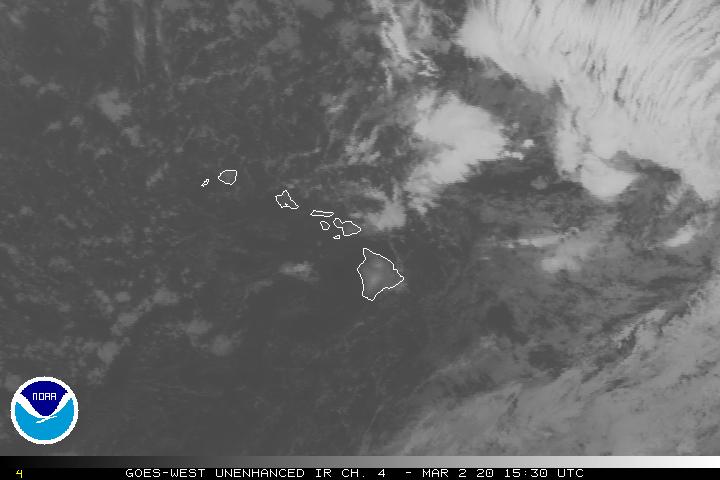
Satellite and Radar Images: To view the cloud conditions we have here in Hawaii, please use the following satellite links, starting off with the Infrared Satellite Image of the islands to see all the clouds around the state during the day and night. This next image is one that gives close images of the islands only during the daytime hours, and is referred to as a Close-up visible image. This next image shows a larger view of the Pacific…giving perspective to the wider ranging cloud patterns in the Pacific Ocean. Finally, here’s a looping IR satellite image, making viewable the clouds around the islands 24 hours a day. To help you keep track of where any showers may be around the islands, here’s the latest animated radar image.
Hawaii’s Mountains – Here’s a link to the live webcam on the summit of near 14,000 foot Mauna Kea on the Big Island of Hawaii. The tallest peak on the island of Maui is the Haleakala Crater, which is near 10,000 feet in elevation. These two webcams are available during the daylight hours here in the islands…and when there’s a big moon rising just after sunset for an hour or two! Plus, during the nights and early mornings you will be able to see stars, and the sunrise too…depending upon weather conditions.
Aloha Paragraphs

Hawaiian Stilts…Hanapepe, Kauai
The winds around the state were pretty light Tuesday, with light south Kona winds ahead of the front…with light north to NE breezes in its wake. Winds from the northerly direction usually bring slightly cool air into the state, and can get a bit gusty in places. It doesn’t look like the winds will be much of an issue this week however, remaining on the light side in general…except those few places that find somewhat moderately strong breezes blowing. As we get into the later part of the week, fairly normal trade winds will replace the north to NE breezes, with favorably inclined conditions continuing on into next week.
It’s early Tuesday evening as I begin writing this last section of today’s weather narrative. The cloud band, although not bringing many showers with it, definitely brought cloudier skies to our islands Tuesday. Here on Maui, the first half of the day was pristine, with hardly a cloud in the sky! Then, during the afternoon hours, we saw lots of clouds moving overhead. If you had a chance to glance at that looping satellite image above, you saw that there’s actually lots of clouds to the west, north, and east of the Aloha state. The brighter, and whiter ones, are high cirrus clouds, which don’t drop rainfall, so we aren’t worrying about them. We may see a few showers around now through Wednesday, but as mentioned above, the rest of the week, and even into early next week, should be quite dry. ~~~ I’m about ready to hit the road, for the drive upcountry towards Kula. Looking out the window here in Kihei, before I leave, I see partly cloudy conditions, although see no signs of showers at the moment. It will be so nice to get back up into that cooler air in Kula, where I’ll get outside for my evening walk. I’ll be back early Wednesday morning with your next new weather narrative, I hope you have a great Tuesday night until then! Aloha for now…Glenn.
Interesting: Levees and floodwalls surrounding New Orleans — no matter how large or sturdy — cannot provide absolute protection against overtopping or failure in extreme events, says a new report by the National Academy of Engineering and the National Research Council. The voluntary relocation of people and neighborhoods from areas that are vulnerable to flooding should be considered as a viable public policy option, the report says. If relocation is not feasible, an alternative would be to elevate the first floor of buildings to at least the 100-year flood level.
The report is the fifth and final one to provide recommendations to the Interagency Performance Evaluation Task Force (IPET), formed by the U.S. Army Corps of Engineers to examine why New Orleans’ hurricane-protection system failed during Hurricane Katrina and how it can be strengthened. The previous four reports by the NAE and Research Council examined various draft volumes of the IPET.
This report reviews the 7,500-page IPET draft final report, reflects upon the lessons learned from Katrina, and offers advice for how to improve the hurricane-protection system in the New Orleans area. Although some of the report’s recommendations to enhance hurricane preparedness have been widely acknowledged for years, many have not been adequately implemented, said the committee that wrote the report.
For instance, levees and floodwalls should be viewed as a way to reduce risks from hurricanes and storm surges, not as measures that completely eliminate risk. As with any structure built to protect against flooding, the New Orleans hurricane-protection system promoted a false sense of security that areas behind the structures were absolutely safe for habitation and development, the report says. Unfortunately, there are substantial risks that never were adequately communicated to the public and undue optimism that the 350-mile structure network could provide reliable flood protection, the committee noted.
Interesting2: When most people think about the Olympic Games, they envision blazing torches, gold medals, and triumphant athletes. But a handful of scientists saw the 2008 Beijing Olympics as a once-in-a-lifetime opportunity to find out what happens when a major industrial city suddenly cuts back on air pollution. The first analysis of this "experiment" concludes that China’s efforts produced only a slight improvement in Beijing’s air quality.
Beijing sits in a soupy haze of pollution from nearby factories, coal-fired power plants, and traffic that increases dramatically by the day, making the city one of the most air polluted in the world. China spent billions of dollars trying to control emissions that could hinder athlete’s performances on game day.
From 20 July to 20 September 2008, the Chinese government temporarily closed factories and regulated the number of cars on the road in Beijing and in nearby areas, all with the hopes of curbing aerosols–fine particles suspended in the atmosphere.
China tried a similar traffic strategy in 2006 during a 3-day political summit and achieved 40% to 60% reductions in aerosol concentrations, according to one study. But this study covered only a short period and concentrated on aerosols at ground level, not throughout the larger atmosphere. For the 2008 Olympics, Chinese officials called for reductions of 60% to 70% in automobile emissions and up to 30% in industrial emissions.
To find out how successful they were, atmospheric scientist Jan Cermak of the Swiss Federal Institute of Technology Zurich and a colleague used satellite data to measure the overall amount of particulates hanging over Beijing from 1 August through 19 September for each year from 2002 through 2008.
This technique allowed them to analyze aerosol concentrations in the atmosphere from top to bottom but didn’t allow them to decipher exactly where they were in that space. But just monitoring aerosols isn’t enough, because weather also affects air pollution’s severity–a rainy day can flush pollutants from the air, whereas a windy day can bring in pollutants from far-off industrial areas or carry them out of the city.
So the researchers also collected data on wind speed and direction, rainfall, and relative humidity. They then applied these relationships to predict what air pollution would have been in 2008 without any emission controls.
Interesting3: The Galapagos Islands, renowned for rare animals that inspired Charles Darwin’s theory of evolution, may have to create special shelters to save species from global warming and rising sea levels. Scientists who met there last week decided the indigenous penguin needs "condos" built in cooler, higher areas to nest more safely, Giuseppe Di Carlo, marine climate-change manager at Conservation International, said in an interview.
Shadier bushes would protect plants and animals such as birds and tortoises that produce too many of the same sex in hotter weather. "The challenge that we’re facing is a high rate of extinction," Di Carlo said from the conference. "This will have consequences for the islands’ human population as the economy here is based almost entirely on tourism and fishing."
Interesting4: It has the ability to reach speeds of 102mph, race around a 38 mile mountainous course and is powered by batteries which can be charged from a standard household socket. It’s Kingston University’s new, green motorbike. Designed by six final-year engineering students, the bike is set to make history by competing in the world’s first zero-emissions Grand Prix this summer.
The Kingston team will join 24 eco-bikes from America, India, Italy, Germany and Austria on the start line at the 2009 Isle of Man TTXGP. Work on the bike began last October, under the guidance of course director for motorsport and motorcycle engineering Paul Brandon. The motorbike, which has gone through many designs, will run on non-fossil fuel but will still be able to clock-up an average 70 mph around the course.
“Being green doesn’t have to mean slow,” Mr Brandon said. “There are too many skeptics, when it comes to electric vehicles but we all need to reduce our CO2 output and this initiative is taking a huge leap in that direction. The ideas we and others put to the test on the racing circuit are the ones most likely to become commonplace on the road.” The bike is run from a custom-built, 72-volt battery and the team estimates it will reach speeds of 102 at the fastest downhill section of the 38 mile course.
“The energy density of batteries is far less than that of petrol or diesel so how we manage the energy we carry is critical to our success in the race,” Mr Brandon added. “The bike we have designed has a whole vehicle efficiency of 90 per cent, so we are only wasting 10 per cent of what we carry. By comparison a petrol-based vehicle wastes 70 per cent of the energy it carries.”
Interesting5: An area of an Antarctic ice shelf almost the size of New York City has broken into icebergs this month after the collapse of an ice bridge widely blamed on global warming, a scientist said Tuesday. "The northern ice front of the Wilkins Ice Shelf has become unstable and the first icebergs have been released," Angelika Humbert, glaciologist at the University of Muenster in Germany, said of European Space Agency satellite images of the shelf.
Humbert told Reuters about 270.3 square mile of ice — bigger than Singapore or Bahrain and almost the size of New York City — has broken off the Wilkins this month and shattered into a mass of icebergs. She said ice had cracked up in recent days from the Shelf, the latest of about 10 shelves on the Antarctic Peninsula to retreat in a trend linked by the U.N. Climate Panel to global warming.
The new icebergs added to ice that broke up earlier this month with the shattering of an ice bridge apparently pinning the Wilkins in place between Charcot island and the Antarctic Peninsula. Nine other shelves — ice floating on the sea and linked to the coast — have receded or collapsed around the Antarctic peninsula in the past 50 years, often abruptly like the Larsen A in 1995 or the Larsen B in 2002.
The trend is widely blamed on climate change caused by heat-trapping gases from burning fossil fuels, according to David Vaughan, a British Antarctic Survey scientist who landed by plane on the Wilkins ice bridge with two Reuters reporters in January. Humbert said by telephone her estimates were that the Wilkins could lose a total of 800 to 3,000 sq kms of area after the ice bridge shattered.
The Wilkins shelf has already shrunk by about a third from its original 16,000 sq kms when first spotted decades ago, its ice so thick would take at least hundreds of years to form. Temperatures on the Antarctic Peninsula have warmed by up to 5.4 Fahrenheit this century, Vaughan said, a trend climate scientists blame on global warming from burning fossil fuels in cars, factories and power plants.
 Email Glenn James: