April 27-28, 2009
Air Temperatures – The following maximum temperatures were recorded across the state of Hawaii Monday afternoon:
Lihue, Kauai – 75
Honolulu, Oahu – 79
Kaneohe, Oahu – 76
Kahului, Maui – 78
Hilo, Hawaii – 75
Kailua-kona – 82
Air Temperatures ranged between these warmest and coolest spots near sea level – and on the highest mountains…at 5 p.m. Monday evening:
Kailua-kona – 79F
Hilo, Hawaii – 69
Haleakala Crater – 48 (near 10,000 feet on Maui)
Mauna Kea summit – 36 (near 14,000 feet on the Big Island)
Precipitation Totals – The following numbers represent the largest precipitation totals (inches) during the last 24 hours on each of the major islands, as of Monday afternoon:
0.01 Hanapepe, Kauai
0.04 Makua Range, Oahu
0.00 Molokai
0.00 Lanai
0.00 Kahoolawe
0.00 Maui
0.05 Glenwood, Big Island
Weather Chart – Here’s the latest (automatically updated) weather map showing several low pressure systems to the north through east of the Big island…with a weakening cold front pushing down into the state very slowly. Winds will be light and variable Tuesday, although gradually picking up modestly from the north to NE in the wake of the dissipating frontal boundary.
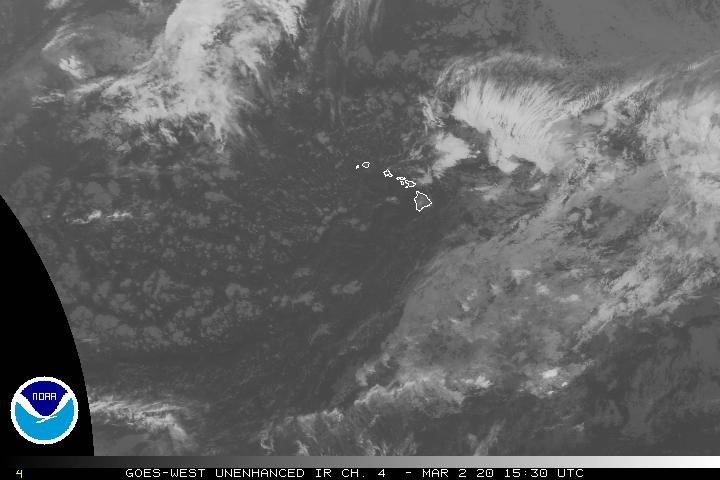
Satellite and Radar Images: To view the cloud conditions we have here in Hawaii, please use the following satellite links, starting off with the Infrared Satellite Image of the islands to see all the clouds around the state during the day and night. This next image is one that gives close images of the islands only during the daytime hours, and is referred to as a Close-up visible image. This next image shows a larger view of the Pacific…giving perspective to the wider ranging cloud patterns in the Pacific Ocean. Finally, here’s a looping IR satellite image, making viewable the clouds around the islands 24 hours a day. To help you keep track of where any showers may be around the islands, here’s the latest animated radar image.
Hawaii’s Mountains – Here’s a link to the live webcam on the summit of near 14,000 foot Mauna Kea on the Big Island of Hawaii. The tallest peak on the island of Maui is the Haleakala Crater, which is near 10,000 feet in elevation. These two webcams are available during the daylight hours here in the islands…and when there’s a big moon rising just after sunset for an hour or two! Plus, during the nights and early mornings you will be able to see stars, and the sunrise too…depending upon weather conditions.
Aloha Paragraphs

Should be a nice sunset Monday evening!
Artist Credit: Steven Welch
Monday was another nice day, with morning sunshine, which gave way to afternoon clouds locally…although with very few showers fell anywhere. Winds qualifited as light and variable for the most part, with onshore flowing sea breezes. This light wind regime will last through Tuesday, ahead of an approaching weak cold front. As the frontal boundary moves into the state Tuesday through Wednesday, winds will remain light. In the wake of the cold front, our winds should become light to moderately strong northeast winds again, gradually becoming trade winds Friday into the weekend. While the winds are out of the northeast direction, they will keep our area cooler than would normally be expected this time of year.
The cold front mentioned in the first paragraph won’t be a big deal, although may be the most interesting weather feature this week. This late season frontal cloud band will push into this light wind reality, bringing its clouds and showers…generally to the windward sides of the islands. As the light to moderately strong NE winds pick up in the wake of the dissipated cold front, we’ll see a few windward biased showers falling through the rest of the week…although with the air mass remaining dry and stable, they won’t amount to much.
It’s early Monday evening as I begin writing this last section of today’s weather narrative.
We have a few changes up ahead, on our weather horizon. A weakening cold front will make an appearance first on Tuesday, and then linger into Wednesday…as it pushes down towards Maui County. Here’s a satellite image so you can see the leading edge of the approaching cold front. Opening up our view a bit more, using this larger satellite view, we can see a rather large line of cirrus clouds to our south, and another batch to our north, associated with the approaching cold front. ~~~ I’m about ready to leave Kihei, for the drive upcountry to Kula, Maui. Looking out the window, before I get out into my car, I see what looks like partly cloudy conditions. High clouds will likely give a nice sunset Monday evening, at least in most areas around the state. I’ll be back early Tuesday morning with your next new weather narrative, I hope you have a great Monday night! Aloha for now…Glenn.
Interesting: Sixteen nations are responsible for 80 percent of the world’s greenhouse gas emissions. Now those nations, dubbed the "major emitters," are sending representatives to a conference beginning Monday in Washington, D.C., to see if they can work together to slow the pace of climate change. The Obama administration has moved quickly to deal with climate change in the international arena.
It has joined the United Nations talks that will take place in Copenhagen later this year and are aimed at developing a climate-change treaty. It is working one-on-one with China — which recently surpassed the U.S. as the world’s largestcarbon emitter. And in the meetings that start Monday, the Obama administration is convening the 16 nations that contribute most to climate change.
"It was originally started by the Bush administration so they would appear to be doing something when they weren’t really doing anything," says Timothy Wirth, who served in the Clinton administration as a climate envoy. He now runs a nonprofit group called the United Nations Foundation. Plastic bag manufacturers working with the American Chemistry Council have set a goal to increase the recycled content of plastic bags to 40 percent by 2015.
The Full Circle Recycling Initiative, developed by the Progressive Bag Affiliates of the American Chemistry Council, would require a $50 million investment from industry members to increase the collection of bags and update manufacturing processes. The Initiative also aims to have 25 percent of that 40 percent content come from postconsumer recycled plastic.
To achieve the two goals, plastic bag makers would need to use 470 million pounds of recycled plastic (300 million pounds of which is postconsumer) annually, the equivalent of 36 billion bags. In 2007, the latest year there are figures available for plastic bag recycling, 830 million pounds of plastic bags and plastic wrap were recycled.
Interesting2: In car-crazy California, a new fuel standard ordered by state officials to curb greenhouse gases could dramatically change how vehicles run. It also could have a huge effect on cost. The petroleum industry and some economists say the new standard adopted by the state Air Resources Board on Thursday will cost motorists billions, because blending gasoline will become considerably more complicated.
But state officials and environmentalists say the "low-carbon fuel standard" will actually save Californians money by reducing oil consumption and ushering in a competitive new era of biofuels and electric vehicles. The stakes are enormous. The price of fuel can have a significant impact on the state’s economic health. When gas hit $4.50 last summer, it severely hurt tourism and caused delivery companies to impose fuel surcharges.
Interesting3: The Colorado River system supplies water to tens of millions of people and millions of acres of farmland, and has never experienced a delivery shortage. But if human-caused climate change continues to make the region drier, scheduled deliveries will be missed 60-90 percent of the time by the middle of this century, according to a pair of climate researchers at Scripps Institution of Oceanography, UC San Diego.
"All water-use planning is based on the idea that the next 100 years will be like the last 100," said Scripps research marine physicist Tim Barnett, a co-author of the resort. "We considered the question: Can the river deliver water at the levels currently scheduled if the climate changes as we expect it to. The answer is no."
Even under conservative climate change scenarios, Barnett and Scripps climate researcher David Pierce found that reductions in the runoff that feeds the Colorado River mean that it could short the Southwest of a half-billion cubic meters (400,000 acre feet) of water per year 40 percent of the time by 2025. (An acre foot of water is typically considered adequate to meet the annual water needs of two households.)
By the later part of this century, those numbers double. The paper, "Sustainable water deliveries from the Colorado River in a changing climate," appears in the April 20 edition of the journal Proceedings of the National Academy of Sciences.
The analysis follows a 2008 study in which Barnett and Pierce found that Lake Mead, the reservoir on the Colorado River created by Hoover Dam, stood a 50-percent chance of going dry in the next 20 years if the climate changed and no effort was made to preserve a minimum amount of water in the reservoir.
The new study assumes instead that enough water would be retained in the reservoir to supply the city of Las Vegas, and examines what delivery cuts would be required to maintain that level.
Interesting4: Astronomers have found the most distant signs of water in the Universe to date. The water vapor is thought to be contained in a jet ejected from a super massive black hole at the centre of a galaxy, named MG J0414+0534. Dr John McKean of the Netherlands Institute for Radio Astronomy (ASTRON) will be presenting the discovery at the European Week of Astronomy and Space Science in Hatfield on Wednesday 22nd April.
The water emission is seen as a maser, where molecules in the gas amplify and emit beams of microwave radiation in much the same way as a laser emits beams of light. The faint signal is only detectable by using a technique called gravitational lensing, where the gravity of a massive galaxy in the foreground acts as a cosmic telescope, bending and magnifying light from the distant galaxy to make a clover-leaf pattern of four images of MG J0414+0534.
The water maser was only detectable in the brightest two of these images. Dr McKean said, "We have been observing the water maser every month since the detection and seen a steady signal with no apparent change in the velocity of the water vapor in the data we’ve obtained so far.
This backs up our prediction that the water is found in the jet from the super massive black hole, rather than the rotating disc of gas that surrounds it." The radiation from the water maser was emitted when the Universe was only about 2.5 billion years old, a fifth of its current age.
Interesting5: The Wildlife Conservation Society announced today a study showing that some coral reefs off East Africa are unusually resilient to climate change due to improved fisheries management and a combination of geophysical factors. WCS announced the results of the study at the International Coral Reef Initiative (ICRI), which is meeting this week in Phuket, Thailand.
The study, published in the online journal Aquatic Conservation: Marine and Freshwater Ecosystems, provides additional evidence that globally important "super reefs" exist in the triangle from Northern Madagascar across to northern Mozambique to southern Kenya and, thus, should be a high priority for future conservation action.
Authors of the study include Tim McClanahan and Nyawira Muthiga of the Wildlife Conservation Society, Joseph Maina of the Coral Reef Conservation Project, Albogast Kamukuru of the University of Dar es Salaam’s Department of Fisheries Science and Aquaculture, and Saleh A.S. Yahna of the University of Dar es Salaam’s Institute of Marine Sciences and Stockholm University’s Department of Zoology.
The study found that Tanzania’s corals recovered rapidly from the 1998 bleaching event that had wiped out up to 45 percent of the region’s corals. Along with monitoring Tanzania’s reefs, WCS helps coral conservation in this region through training of park staff in protected areas. The authors attribute the recovery of Tanzania’s coral reefs due in part to direct management measures, including closures to commercial fishing.
Areas with fishery closures contained an abundance of fish that feed on algae that can otherwise smother corals, while the few sites without any specific management measures remain degraded; one site had experienced a population explosion of sea urchins—pests that feeds on corals.
Interesting6: The potential for an outbreak of the phenomenon commonly called "red tide" is expected to be "moderately large" this spring and summer, according to researchers with the Woods Hole Oceanographic Institution (WHOI) and North Carolina State University (NCSU). This advisory is based in part on a regional seafloor survey of quantities of Alexandrium fundyense — the algae notorious for producing a toxin that accumulates in clams, mussels, and other shellfish and can cause paralytic shellfish poisoning (PSP) in humans who consume them.
The survey maps are used with computer models that simulate different scenarios of weather and oceanographic conditions to indicate where and in what abundance the toxic cells might be expected in 2009.
The researchers found concentrations of Alexandrium cysts — the dormant seed-like stage of the algae’s life cycle — in the Gulf of Maine to be 40 percent lower than the historically high levels observed prior to last year’s bloom, but still higher than the level preceding a major regional bloom in spring 2006 that closed shellfish beds from Canada to Massachusetts Bay.
The Alexandrium survey has been conducted each fall since 2004 as part of several research and event response projects funded by the National Oceanic and Atmospheric Administration (NOAA) Center for Sponsored Coastal Ocean Research (CSCOR). Fall concentrations of Alexandrium cysts are one of the indicators of the magnitude of a potential bloom in spring.
Interesting7: You know the scenario: 65 million years ago, a big meteor crash sets off volcanoes galore, dust and smoke fill the air, dinosaurs go belly up. One theory holds that cold, brought on by the Sun’s concealment, is what did them in, but a team of paleontologists led by Pascal Godefroit, of the Royal Belgian Institute of Natural Sciences in Brussels, argues otherwise.
Some dinosaurs (warm-blooded, perhaps) were surprisingly good at withstanding near-freezing temperatures, they say. Witness the team’s latest find, a diverse stash of dinosaur fossils laid down just a few million years before the big impact, along what’s now the Kakanaut River of northeastern Russia.
Even accounting for continental drift, the dinos lived at more than 70 degrees of latitude north, well above the Arctic Circle. And they weren’t lost wanderers, either. The fossils include dinosaur eggshells — a first at high latitudes, and evidence of a settled, breeding population. It’s true the Arctic was much warmer back then, but it wasn’t any picnic.
The size and shape of fossilized leaves found with the bones enabled Godefroit’s team to estimate a mean annual temperature of 50 degrees Fahrenheit, with wintertime lows at freezing. Yet there is more than one way to skin a dino. All that dust in the atmosphere must have curtailed photosynthesis everywhere, weakening the base of the food chain and inflicting starvation, and finally extinction, upon the dinosaurs.
Interesting8: In developed nations, the Internet is now a staple, like TV and running water. Well, okay, so sometimes the connection goes down, or you have to load another plug-in to watch that video. But here’s a stat that suggests changes ahead: Only 5 percent of Africans use the Web. Globally, only 23 percent of people are online.
Some say mobile access will change all that. "The Web as I envisaged it, we have not seen it yet. The future is still so much bigger than the past," said Tim Berners-Lee who, despite what Al Gore said, was the main creative force behind the whole thing. Final thought: In 1994, there were about 500 web sites. Now there are more than 80 million.
 Email Glenn James: