











April 17-18, 2009
Air Temperatures – The following maximum temperatures were recorded across the state of Hawaii Friday afternoon:
Lihue, Kauai – 75
Honolulu, Oahu – 81
Kaneohe, Oahu – 78
Kahului, Maui – 83
Hilo, Hawaii – 77
Kailua-kona – 80
Air Temperatures ranged between these warmest and coolest spots near sea level – and on the highest mountains…at 5 p.m. Friday evening:
Kapalua, Maui – 79F
Lihue, Kauai – 71
Haleakala Crater – 54 (near 10,000 feet on Maui)
Mauna Kea summit – 36 (near 14,000 feet on the Big Island)
Precipitation Totals – The following numbers represent the largest precipitation totals (inches) during the last 24 hours on each of the major islands, as of Friday afternoon:
0.04 Kapahi, Kauai
0.06 Kaneohe MCB, Oahu
0.04 Molokai
0.08 Lanai
0.02 Kahoolawe
0.06 Kahakuloa, Maui
0.28 Waiakea Uka, Big Island
Weather Chart – Here’s the latest (automatically updated) weather map showing a 1031 millibar high pressure system located far to the east-northeast of the islands, and another 1018 millibar high to the west-northwest. These high pressure cells will spin out light winds from the SE through Sunday. Winds coming in from this direction first hit the Big Island, which then spreads, putting the smaller islands in a wind shadow.
Satellite and Radar Images: To view the cloud conditions we have here in Hawaii, please use the following satellite links, starting off with the Infrared Satellite Image of the islands to see all the clouds around the state during the day and night. This next image is one that gives close images of the islands only during the daytime hours, and is referred to as a Close-up visible image. This next image shows a larger view of the Pacific…giving perspective to the wider ranging cloud patterns in the Pacific Ocean. Finally, here’s a looping IR satellite image, making viewable the clouds around the islands 24 hours a day. To help you keep track of where any showers may be around the islands, here’s the latest animated radar image.
Hawaii’s Mountains – Here’s a link to the live webcam on the summit of near 14,000 foot Mauna Kea on the Big Island of Hawaii. The tallest peak on the island of Maui is the Haleakala Crater, which is near 10,000 feet in elevation. These two webcams are available during the daylight hours here in the islands…and when there’s a big moon rising just after sunset for an hour or two! Plus, during the nights and early mornings you will be able to see stars, and the sunrise too…depending upon weather conditions.
Aloha Paragraphs
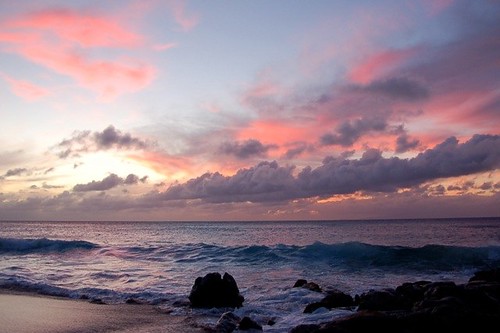
Nice sunset here in the islands
Low pressure troughs to the north of the islands are the culprit in tamping down our winds at the moment, leaving us in a light wind weather pattern. The lack of our usual breezy trade winds will keep our overlying atmosphere on the muggy side during the days, especially in the lower elevations. Along with the slack winds, we will see hazy conditions become a part of our
It won’t take too long on both Saturday and Sunday mornings, for thickening clouds to begin forming in the upcountry areas…which will spread coastward locally later during the afternoons. We’ll begin to see those afternoon cumulus clouds dropping a few generally light showers in the interior upcountry areas today, although nothing spectacular by any means. A trough of low pressure, with its cold air aloft, will turn some of those afternoon showers heavier as we move into the weekend. The returning trade winds next week, will allow showers to return again to the windward coasts and slopes.
This well established convective weather pattern will last through the upcoming weekend…but turn back over control to our more normal trade winds, as we move into the new work week ahead. The convection, in this convective weather pattern, means that air rises, rather than moving by in a horizontal manner…like when we have the trade winds blowing. The daytime heating, along with the onshore flowing sea breezes, will transport moisture up the volcanic slopes. This moisture will condense out into clouds over the upcountry interior areas. These clouds won’t be all that showery Friday, but as noted above, by the weekend should become more generous.
The nights and early morning hours will find the least amount of clouds, then quickly filling back in over the islands during the days. Besides the lower level clouds, which will form over and around the islands, we’ve also have quite a bit of the higher cirrus variety around lately too. As this looping satellite image shows these high icy clouds streaking our way from the deeper tropics to the southwest. It looks very likely that we’ll be seeing more of this stuff moving over us into the weekend. Expanding our view, with this satellite image of the greater central Pacific a bit more, we can see considerably more of this cirrus taking aim on our islands now. As we look at this looping radar image, we see that hardly anything is happening in terms of precipitation Friday night
.
It’s early Friday evening as I begin writing this last section of today’s weather narrati
ve. I’ve decided to do two activities after work tonight, rather than my usual one…which is going to see a new film. Yes, I’m going to branch out and hit the dance floor after seeing my film! First the film, it’s called State of Play (2009), starring Russell Crowe and Rachel McAdams, among others. This is the opening night, so I hope it’s not sold out! At any rate, a reporter uncovers a deadly conspiracy when a star congressman’s mistress is brutually murdered. It’s being billed as a dramatic film, with of course the usual violence, sexual references, and drug content. So, this doesn’t sound like a film for everyone! Here’s a trailer in case you are interested. ~~~ Then I’m going to do something I haven’t done in a long while, and that’s to go dancing. There’s a dance place in Paia, over on the windward side, although the music doesn’t actually get started until 10 or 1030pm…which is late for me. Anyway, I may be getting up a little later Saturday morning than normal, depends on when I get home, and what shape I’m in then! See you in the morning, have a great Friday night whatever you happen to be doing. Aloha for now…Glenn.
Interesting: More consumer products are claiming to be environmentally responsible, but nearly all of them make at least one claim that is unverifiable, according to a recent study. TerraChoice, an environmental marketing agency with offices in Ottawa and Philadelphia, says more than 98 per cent of the products it surveyed committed at least one of the "seven sins of greenwashing."
"The good news is that the growing availability of green products shows that consumers are demanding more environmentally responsible choices, and that marketers and manufacturers are listening," TerraChoice president Scott McDougall said in a release. "The bad news is that some marketers are exploiting consumers’ demand for third-party certification by creating fake labels or false suggestions of third-party endorsement."
Interesting2: The long-awaited, often-advertised Peapod will be available for order on Earth Day, April 22. Coincidentally, the 22nd also is Administrative Assistant’s Day. We expect to see a lot of greenies and maybe some secretaries tooling around in their $12,500 Peapods at no more than 25 miles an hour.
While the Peapod prototype had clear driver and passenger doors that looked like a Dyson vacuum cleaner, the production version (shown above) of the neighborhood electric vehicle resembles George Jetson’s Deux Chevaux.
Company director and brand guru Peter E. Arnell, whose initials inspired the company’s name, told Treehugger.com the car’s appearance was inspired by "Japanese bullet trains, storm troopers from the film Star Wars, space helmets and turtles."
There’s also a very prominent "smile" to the car’s grill, but what else would you expect from a man whose firm devised Pepsi’s new logo with the Cheshire grin and laughably pretentious backstory? The feel-good vibe continues with a glance at the in-dash iPod (sold seperately).
Edmunds says every trip concludes with a carbon-footprint analysis, while another app tells you exactly how much money you’ve saved by leaving the family truckster at home. Arnell says the Peapod isn’t a neighborhood electric vehicle, even if the National Highway Transportation Safety Board and his company’s own website do.
Arnell callls it a Mobi, a new category he’s "branded" in much the same way automakers branded 4x4s "SUVS." Regardless of what you call it, the Peapod tops out as 25 mph as required by law for NEVs.
Interesting3: A coalition of associations and entities affected by the impact of introduction of gray wolves into Wyoming filed a 60-day notice of intent to sue the federal government about its refusal to delist wolves in Wyoming. The intent to sue was filed April 3 after the U.S. Fish & Wildlife Service published the delisting rules in the Federal Register.
The coalition is comprised of the Wyoming Wool Growers Association, Wyoming Stock Growers Association, Wyoming Farm Bureau Federation, Wyoming Association of Conservation Districts, Rocky Mountain Farmers Union, Wyoming Association of County Predatory Animal Boards, Niobrara County Predatory Animal Board, Wyoming Outfitters & Guides Association, Cody Country Outfitters and Guides Association and Sportsmen for Fish & Wildlife Wyoming.
The Wolf Coalition served notice of intent to sue Interior Secretary Ken Salazar, USFWS Acting Director Rowan Gould and Stephen Guertin, USFWS Acting Regional Director for the Mountain Region. The coalition intends to seek injunctive relief for violation of the Endangered Species Act and its related regulations and policies.
The Wolf Coalition attorney Harriet Hageman said claims arise from the USFWS rejection of the Wyoming Wolf Management Plan, its failure to delist the gray wolf population in Wyoming and its decision to proceed with delisting in Montana, Idaho and parts of Oregon and Washington
Interesting4: The Tecnalia Health and Quality of Life Unit is taking part in the Companionable project, the aim of which is to contribute to the enhancement of the quality of life of elderly and disabled persons using robotized solutions designed to operate in intelligent homes. The initiative, part of the European Union 7th Framework Program, combines for the first time the use of robot in intelligent domestic environments, with the goal of creating a companion that assists people in their own home and helps them to be independent in their everyday lives. Amongst other aspects, this tool provides a control for recognizing emotional states, social and health services support and for videoconferencing with family members or professional careers.
The main lines of research of Companionable involve the development of technologies to create a system that is conscious of its surroundings, with networks of sensors and communications, and the development and design of a mobile robot for therapeutic treatment and care support. The project has set itself the goal of developing a system which is aware of the presence of persons within an intelligent and domotic household, and which interacts with them in a natural and intuitive form.
Interesting5: Heading into a period of the Martian year prone to major dust storms, the team operating NASA’s twin Mars rovers is taking advantage of eye-in-the-sky weather reports. On April 21, Mars will be at the closest point to the sun in the planet’s 23-month, elliptical orbit. One month later, the planet’s equinox will mark the start of summer in Mars’ southern hemisphere. This atmospheric-warming combination makes the coming weeks the most likely time of the Martian year for dust storms severe enough to minimize activities of the rovers.
"Since the rovers are solar powered, the dust in the atmosphere is extremely important to us," said Bill Nelson of NASA’s Jet Propulsion Laboratory, Pasadena, Calif., chief of the engineering team for Spirit and Opportunity. Unexplained computer reboots by Spirit in the past week are not related to dust’s effects on the rover’s power supply, but the dust-storm season remains a concern. Spirit received commands Tuesday to transmit more engineering data in coming days to aid in diagnosis of the reboots.
After months of relatively clear air, increased haze in March reduced Spirit’s daily energy supply by about 20 percent and Opportunity’s by about 30 percent. Widespread haze resulted from a regional storm that made skies far south of the rovers very dusty. Conditions at the rovers’ sites remained much milder than the worst they have endured.
In July 2007, nearly one Martian year ago, airborne dust blocked more than 99 percent of the direct sunlight at each rover’s site. The rovers point cameras toward the sun to check the clarity of the atmosphere virtually every day. These measurements let the planning team estimate how much energy the rovers will have available on the following day.
Observations of changes in the Martian atmosphere by NASA’s Mars Reconnaissance Orbiter, which reached Mars in 2006, and NASA’s Mars Odyssey, which reached Mars in 2001, are available to supplement the rover’s own skywatch. The Mars Color Imager camera on Mars Reconnaissance Orbiter sees the entire planet every day at resolution comparable to weather satellites around Earth.
Interesting6: Sea levels could rise by a "catastrophic" 10 feet by the end of the century – putting millions of people at risk of flooding with coastal cities such as London, New York, Tokyo and Calcutta submerged, according to a new study. The melting of the vast ice sheets in Antarctica and Greenland caused water to pour into the world’s oceans at an alarming rate at the end of the last period of global warming, the study shows.
Analysis of fossilized coral reefs off the Gulf of Mexico found many died during this time – known to climatologists as an "interglacial" – and were replaced by new reefs on higher ground. This happened over a long-term ecological timescale and was caused by a rapid jump in sea level of between 6.5ft and 9.8ft (two to three meters) that occurred around 121,000 years ago, say the researchers.
The findings published in Nature raise concerns that current climate change could yield similar quick ice loss and disastrous sea-level rise in the near future. Dr Paul Blanchon, a marine scientist of the National University of Mexico in Cancun, said his study shows there was a spell of swift melting during the warmest part of the last interglacial.
With growing evidence for contributions from the Antarctic and Greenland ice sheets to sea-level rise, the findings confirm the potential that continuing rapid ice loss could cause disastrous sea-level rise by 2100. Dr Blanchon said this is also bad news for modern coral reefs which are already suffering because of human activity.
He said: "Knowing the rate at which sea level reached its high-stand during the last interglacial period is fundamental in assessing if such rapid ice-loss processes could lead to future catastrophic sea-level rise. "The best direct record of sea level during this high-stand comes from well-dated fossil reefs in stable areas. "Here we present a complete reef-crest sequence for the last interglacial high-stand from the stable north-east Yucatan peninsula in Mexico.
"The abrupt demise of the lower-reef crest allows us to infer that this occurred on an ecological timescale and was triggered by a two-to-three meter jump in sea level. "We constrain this jump to have occurred 121,000 years ago and conclude it supports an episode of ice-sheet instability during the terminal phase of the last interglacial period."
The prediction is not as high as those from some scientists who have warned sea levels may rise as much as 16 feet (five meters) by the end of the century. But a rise of even a meter could have major implications for low-lying countries whose economies are not geared up to build sophisticated sea defense systems, such as Bangladesh.
Interesting7: A new kind of tree could cool the planet by removing a major greenhouse gas from the planet’s atmosphere. What researchers are calling artificial trees, actually towers filled with various materials that adsorb carbon dioxide from the air, could play a major role in reducing climate change — if they prove profitable. "This is an industry still in its infancy," said Billy Gridley of Global Research Technologies, LLC, the company creating the C02-scrubbing towers. "This will eventually rival the size of today’s energy markets.
Interesting8: An asteroid is hurtling toward the planet and threatens to destroy life as we know it. What can humankind do, other than cower? Tie the thing down, suggests aerospace engineer David French of North Carolina State University. He has proposed a way to divert asteroids and other threatening objects by attaching a long tether and ballast.
Done right, "you change the object’s center of mass, effectively changing the object’s orbit and allowing it to pass by the Earth, rather than impacting it," French said in a statement. In March an asteroid passed by Earth at a distance of just about 49,000 miles.
NASA’s Near Earth Object Program has identified more than 1,000 "potentially hazardous asteroids." None is on a collision course with Earth but asteroids have struck before and almost certainly will again, scientists agree.
"For example, about 65 million years ago, a very large asteroid is thought to have hit the Earth in the southern Gulf of Mexico, wiping out the dinosaurs, and, in 1907, a very small airburst of a comet over Siberia flattened a forest over an area equal in size to New York City," French said.
"The scale of our solution is similarly hard to imagine." His idea, to be presented in September at an American Institute of Aeronautics and Astronautics conference, calls for using a tether somewhere between 600 miles and 60,000 miles long to change the trajectory of any object headed toward Earth.
"Nuclear weapons are an intriguing possibility, but have considerable political and technical obstacles. Would the rest of the world trust us to nuke an asteroid? Would we trust anyone else?" Frenach asked.
"And would the asteroid break into multiple asteroids, giving us more problems to solve?" Other solutions that have been proposed include crashing a spacecraft into the asteroid, focusing the Sun’s energy to deflect it, or using a laser to break it up.
Interesting9: For Arctic peoples, global warming is not just transforming their land, it is also poisoning their food. Mercury levels in seals and beluga whales eaten by Inuit in northern Canada have reached levels that would be considered unsafe in fish. Now, Gary Stern of Canada’s Department of Fisheries and Oceans in Winnipeg, Manitoba, and colleagues have found that seal meat contains more mercury in low-ice years, suggesting the problem will only get worse.
The team sampled ringed seals caught by traditional hunters in the western Canadian Arctic between 1973 and 2007. Mercury levels were higher after summers with less sea ice. They think this is because Arctic cod flourishes in low-ice years. Because Arctic cod is higher up the food chain than the seals’ other food, their tissues accumulate more mercury (Environmental Science and Technology.
Arctic residents may well be exposed to other pollutants, too. Melting ice releases chemicals such as DDT and PCBs that leached from the atmosphere decades ago and became entombed in ice and permafrost, warns Philippe Grandjean of Harvard University.
As the ice melts, its contaminants flow into streams, rivers and the Arctic Ocean. It may already be too late to prevent a surge of pollutants from polar ice, says Grandjean. However, he notes, policy-makers can try to prevent the same thing happening again by reducing pollutants still in use, such as flame retardants.
 Email Glenn James: