April 1-2, 2009
Air Temperatures – The following maximum temperatures were recorded across the state of Hawaii Wednesday afternoon:
Lihue, Kauai – 75
Honolulu, Oahu – 79
Kaneohe, Oahu – 75
Kahului, Maui – 77
Hilo, Hawaii – 74
Kailua-kona – 82
Air Temperatures ranged between these warmest and coolest spots near sea level – and on the highest mountains…at 4 p.m. Wednesday afternoon:
Kailua-kona – 80F
Princeville, Kauai – 70
Haleakala Crater – 43 (near 10,000 feet on Maui)
Mauna Kea summit – 32 (near 14,000 feet on the Big Island)
Precipitation Totals – The following numbers represent the largest precipitation totals (inches) during the last 24 hours on each of the major islands, as of Wednesday afternoon:
1.64 Mount Waialaele, Kauai
1.12 Poamoho 2, Oahu
0.01 Molokai
0.00 Lanai
0.00 Kahoolawe
2.92 Puu Kukui, Maui
3.40 Glenwood, Big Island
Weather Chart – Here’s the latest (automatically updated) weather map showing a expansive 1037 millibar high pressure system far to the northeast of the islands. Our trade winds will be locally strong and gusty Thursday and Friday…lighter in those more protected places.
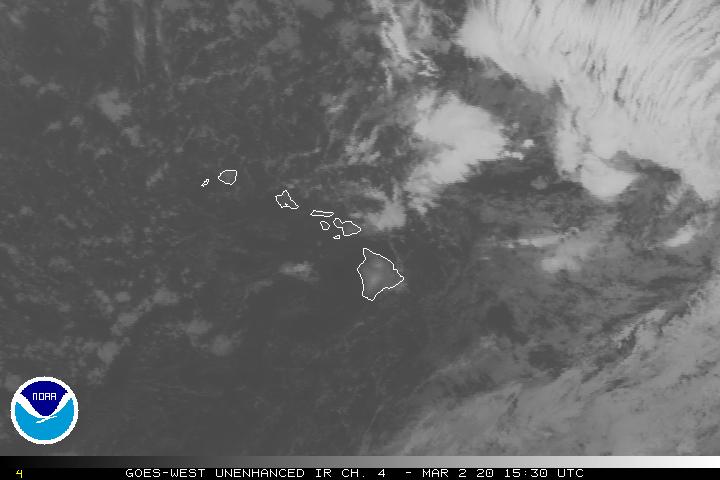
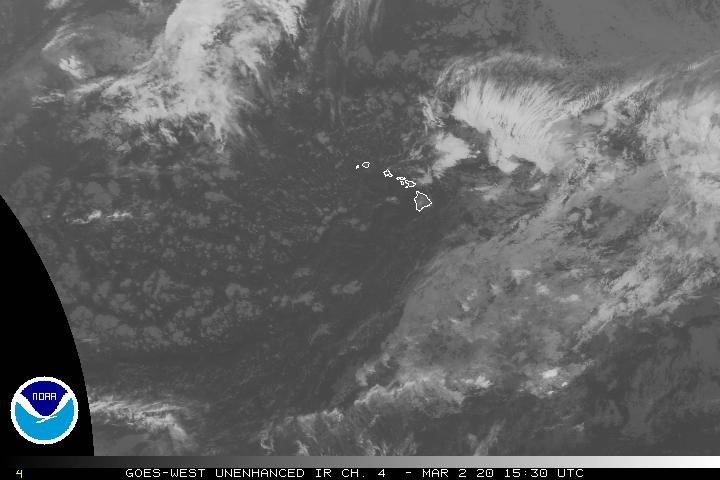
Satellite and Radar Images: To view the cloud conditions we have here in Hawaii, please use the following satellite links, starting off with the Infrared Satellite Image of the islands to see all the clouds around the state during the day and night. This next image is one that gives close images of the islands only during the daytime hours, and is referred to as a Close-up visible image. This next image shows a larger view of the Pacific…giving perspective to the wider ranging cloud patterns in the Pacific Ocean. Finally, here’s a looping IR satellite image, making viewable the clouds around the islands 24 hours a day. To help you keep track of where any showers may be around the islands, here’s the latest animated radar image.
Hawaii’s Mountains – Here’s a link to the live webcam on the summit of near 14,000 foot Mauna Kea on the Big Island of Hawaii. The tallest peak on the island of Maui is the Haleakala Crater, which is near 10,000 feet in elevation. These two webcams are available during the daylight hours here in the islands…and when there’s a big moon rising just after sunset for an hour or two! Plus, during the nights and early mornings you will be able to see stars, and the sunrise too…depending upon weather conditions.
Aloha Paragraphs

A perfect double rainbow…Maui
Photo Credit: Google.com
Despite day to day changes in our trade wind speeds…they will continue to be on the stiff side through the rest of this week, into next week. An expansive 1038 millibar high pressure system, remains the source of our locally strong and gusty winds Wednesday night. These winds are definitely strong enough to keep small craft wind advisories active over all of Hawaii’s channel and coastal waters. A high surf advisory for the east facing shores is active as well, due to the rough surf breaking along those beaches.
The trade winds continue to bring passing showers to the windward sides…and along the leeward sides locally at times too. These showers will be moving along rapidly, under the influence of the strong and gusty winds. Meanwhile, the high cirrus clouds, and the middle level altocumulus clouds, are just about gone for the time being. Looking at this satellite image, we can see that they have thinned greatly, at least compared to Wednesday morning. We may see yet another batch of high cirrus coming our way later this weekend.
It was fun to keep track of the trade wind gusts again Wednesday, as they continued to dominate our Hawaiian Island weather picture. These trade winds were still quite gusty at around 5pm Wednesday evening, with these numbers (mph) the strongest on each of the individual islands:
Kauai: 32
Oahu: 46
Molokai: 35
Lanai: 43
Kahoolawe: 44
Maui: 42
Big Island: 37
The winds early Wednesday evening were still way up there, especially on the islands of Kahoolawe, Maui and Oahu. The impressive 46 mph gust on the north shore of Oahu, is pretty gnarly for the evening hours! These winds will be lighter again early Thursday morning…when I am back around to give the next update.
The high clouds are almost totally gone early Wednesday evening, although the trade winds are still ramped up but good. These are the classic weather conditions when we have such a well established trade wind weather pattern on our hands. If you have a second, take a quick look at this weather map, where you will see that very large 1038 millibar high pressure system to the north-northeast of our islands. This high’s nature makes it spin out strong trade winds over our tropical region…it just has to do it!
It’s early Wednesday evening here in Kihei, Maui, as I begin composing this last paragraph of today’s weather narrative from paradise. Looking out the window here on the south coast, before getting in my car for the drive home upcountry to Kula…it’s partly cloudy. Those pesky high and middle level clouds kept our Hawaiian sunshine in check most of the day, but began clearing during the afternoon hours. As this larger view satellite image shows, we will be in the clear, at least terms of the high clouds for a day or two…probably. I don’t see any high clouds that will be zooming in to take the place of these departing ones right away. The computer models do show a trough of low pressure arriving to our west later this coming weekend…which may pump more of those high clouds in our direction then. ~~~ We finally saw some nice sunshine beaming down today, at least this afternoon. The winds are still strong enough though, that we’re not seeing air temperatures climbing back into the lower 80F’s just yet. Although, the Kona coast did rise to a warm 82 degrees Wednesday afternoon, which was the one exception around the state. ~~~ I’m out of here as the saying goes, but I’ll be back again early Thursday morning. I trust that you will have a great Wednesday night wherever you happen to be spending it! Aloha for now…Glenn.
Interesting: New research shows that for millions of years carbon dioxide has been stored safely and naturally in underground water in gas fields saturated with the greenhouse gas. The findings – published in Nature April 1 – bring carbon capture and storage a step closer. Politicians are committed to cutting levels of atmospheric carbon dioxide to slow climate change. Carbon capture and storage is one approach to cut levels of the gas until cleaner energy sources are developed.
But the risks around the long-term storage of millions of cubic meters of carbon dioxide in depleted gas and oil fields has met with some concern, not least because of the possibility of some of the gas escaping and being released back to the atmosphere. Until now, researchers couldn’t be sure how the gas would be securely trapped underground.
Naturally-occurring carbon dioxide can be trapped in two ways. The gas can dissolve in underground water – like bottled sparkling water. It can also react with minerals in rock to form new carbonate minerals, essentially locking away the carbon dioxide underground. Previous research in this area used computer models to simulate the injection of carbon dioxide into underground reservoirs in gas or oil fields to work out where the gas is likely to be stored. Some models predict that the carbon dioxide would react with rock minerals to form new carbonate minerals, while others suggest that the gas dissolves into the water. Real studies to support either of these predictions have, until now, been missing.
To find out exactly how the carbon dioxide is stored in natural gas fields, an international team of researchers – led by the University of Manchester – uniquely combined two specialized techniques. They measured the ratios of the stable isotopes of carbon dioxide and noble gases like helium and neon in nine gas fields in North America, China and Europe. These gas fields were naturally filled with carbon dioxide thousands or millions of years ago.
They found that underground water is the major carbon dioxide sink in these gas fields and has been for millions of years. Dr Stuart Gilfillan, the lead researcher who completed the project at the University of Edinburgh said: "We’ve turned the old technique of using computer models on its head and looked at natural carbon dioxide gas fields which have trapped carbon dioxide for a very long time."
Interesting2: Disaster experts including meteorologists and seismologists have identified the types of catastrophic events the United States is most likely to face, quantifying the risk of earthquakes, urban hurricanes, wildfires and major floods. Tsunamis, hurricanes, tornadoes, earthquakes … Nature’s fickle, and devastating forces are sometimes a surprise. But scientists are not waiting for the next big one. Another hurricane season is here, and while we hold our breath hoping for a less-destructive season than last year, scientists are stepping up to the challenge of looking at how the United States will stand up to all types of natural disasters.
A monster wave strikes the resort beaches of Thailand … Amid the chaos, a vacationing couple from Tiny Town, Colorado, survives by climbing a tree, while brad was able to catch the destruction on his video camera. "It looked like the white water was stacked up about 30 feet when Bradley said ‘Run,’" Stephanie Hanks says. Her husband, Brad, adds, "All I could think of was that wave coming down on us." On December 26, 2004, the Indian Ocean’s tsunami shocked everyone. But scientists say there is no reason for surprise. No place on earth is without risk.
"In terms of the potential top five disasters that could affect the U.S., a lot depends on what sort of probability we want to talk about," disaster expert Ilan Kelman, of the National Center for Atmospheric Research in Boulder, Colo., tells DBIS. At NCAR, disaster experts identified the types of events the United States is most likely to face. For example, earthquakes on the west coast; urban hurricanes in the east could hit Miami, New York, or Washington, D.C., and cities along the Gulf of Mexico like Houston and New Orleans; wildfires near large cities; and major floods.
But none of these are predictions, only educated guesses based on what experts already know. Only one thing is for certain, according to Kelman. "One thing that we’ve learned about nature is that it always has surprises," he says Stephanie and Brad’s surprise was the caring and closeness of people in the aftermath of a tsunami. According to the United Nations International Strategy for Disaster Reduction in Geneva, last year there was an 18-percent increase or 360 natural disasters compared to only 305 the year before. They attribute the rise to the growing number of floods and droughts.
Interesting3: Recent research has predicted that climate change may expand the scope of human infectious diseases. A new review, however, argues that climate change may have a negligible effect on pathogens or even reduce their ranges. The paper has sparked debate in the ecological community. In a forum in the April issue of Ecology, Kevin Lafferty of the U.S. Geological Survey’s Western Ecological Research Center suggests that instead of a net expansion in the global range of diseases, climate change may cause poleward range shifts in the areas suitable for diseases as higher latitudes become warmer and regions near the equator become too hot.
The newly suitable areas for diseases will tend to be in more affluent regions where medicines are in widespread use and can more readily combat the diseases, Lafferty says. He cites model estimations that the most dangerous kind of malaria will gain 23 million human hosts outside of its current range by the year 2050, but will lose 25 million in its current range. "The dramatic contraction of malaria during a century of warming suggests that economic forces might be just as important as climate in determining pathogen ranges," Lafferty says.
Mercedes Pascual of the University of Michigan sees the situation very differently. Pascual is the lead author of one of five Forum papers published in response to Lafferty. Although she agrees that disease expansion in some areas could be accompanied by retraction in others, she emphasizes that disease range does not always correlate with the number of humans infected. In regions of Africa and South America, for example, humans have historically settled in high latitudes and altitudes.
If climate change makes these areas more fit for mosquito breeding and for pathogen development, she writes, then a number of infections could expand. She notes that scientists are already seeing evidence of this pattern. "It would be very unfortunate if the conclusions in Lafferty’s paper were taken as evidence that climate change does not matter to infectious diseases," Pascual says. "Range shifts will matter and should be better understood."
Interesting4: Cleaning fluids used in hospitals may pose a health risk to both staff and patients. A pilot study has found that potentially hazardous chemicals are contained in a selection of agents used in several different hospitals. The study was conducted at the University of Massachusetts Lowell Sustainable Hospitals Program and led by Anila Bello. Other team members were Margaret Quinn and Don Milton, also from the University of Massachusetts Lowell, and Melissa Perry, from the Harvard School of Public Health. They investigated the cleaning materials and techniques used in six Massachusetts hospitals. Bello said,
"Cleaning products may impact worker, and possibly patient, health through air and skin exposures. Because the severity of cleaning exposures is affected by both product formulation and cleaning technique, a combination of product evaluation and workplace exposure data is needed to develop strategies that protect people from cleaning hazards."
Cleaning products are complex mixtures of many chemicals including disinfectants, surfactants, solvents, and fragrances. These ingredients are representative of different chemical classes and have a very wide range of volatilities and other chemical properties. According to Bello, "The ingredients of concern identified in our study included quaternary ammonium chlorides or "quats" that can cause skin and respiratory irritation. Some products contained irritant glycol ethers that can be absorbed through the skin, as well as ethanolamine – another respiratory and dermatological irritant.
We also found several alcohols such as benzyl alcohol, ammonia and several phenols, all of which can exert harmful effects on the body". As well as the composition of cleaning agents, the authors found that the way the products were used affected exposure levels. Some tasks were associated with higher exposures than others; the most hazardous exposure scenarios occur when several cleaning tasks are performed in small and poorly ventilated spaces, such as bathrooms. The authors conclude, "Hazardous exposures related to cleaning products are an important public health concern because these exposures may impact not only cleaning workers, but also other occupants in the building".
Interesting5: During a power outage in California in the 1990s, alarmed residents reportedly called in to report a strange, cloudy shape in the nighttime sky. It turned out to be the Milky Way- seen for the first time. For those of us who live in urban or suburban areas, an overabundance of artificial nighttime light, or light pollution, is nothing new. But light pollution isn’t just a bane to astronomers and an annoyance to the rest of us: studies show that it also poses real health risks, including some increased rates of cancer.
A recent study done in Israel headed by Richard Stevens, a professor and cancer epidemiologist at the University of Connecticut Health Center, and published in Chrono-biology International, has shown some disturbing trends between women exposed to large amounts of artificial night light and breast cancer.
Stevens’ team overlaid satellite photos to measure nighttime artificial light levels with a map detailing the distribution of breast cancer cases. Those women living in the brightest areas (as defined by being able to read at outdoors at midnight) had a 73% higher risk of developing breast cancer than those living in areas with the least outdoor lighting.
These results correlate with an earlier study done in 2005 that showed women who worked night shifts in hospitals also had higher incidences of breast cancer. The report, published in Cancer Research, suggests that melatonin-or rather the lack of it-may be the cause. Melatonin is an essential hormone that our bodies make at night while we sleep. It requires darkness and plays a critical role in regulating our internal clocks.
For women, the light-sensitive hormone is particularly important since scientists suspect that melatonin helps to reduce estrogen levels-higher estrogen levels being a factor in developing breast cancer. And melatonin levels drop precipitously in the presence of artificial light.
This research helps to explain two stark facts that epidemiologists have long known: breast cancer rates are three to five times higher in industrialized countries and, that breast cancer rates are 20 to 50 percent less in blind women. Furthermore, a study released in February by University of Haifa researchers, found elevated risks of prostate cancer in countries with the highest levels of artificial light.
 Email Glenn James: