February 4-5, 2009
Air Temperatures – The following maximum temperatures were recorded across the state of Hawaii Wednesday afternoon:
Lihue, Kauai – 71
Honolulu, Oahu – 77
Kaneohe, Oahu – 76
Kahului, Maui – 74
Hilo, Hawaii – 74
Kailua-kona – 81
Air Temperatures ranged between these warmest and coolest spots near sea level, and on the highest mountains…at 4 p.m. Wednesday afternoon:
Kailua-kona – 80F
Hilo airport – 70
Haleakala Crater – 48 (near 10,000 feet on Maui)
Mauna Kea summit – 37 (near 14,000 feet on the Big Island)
Precipitation Totals – The following numbers represent the largest precipitation totals (inches) during the last 24 hours on each of the major islands, as of Wednesday afternoon:
2.32 Mount Waialaele, Kauai
1.18 Oahu Forest NWR, Oahu
0.25 Molokai
0.00 Lanai
0.00 Kahoolawe
1.29 West Wailuaiki, Maui
3.13 Laupahoehoe, Big Island
Weather Chart – Here’s the latest (automatically updated) weather map showing a relatively close 1030 millibar high pressure system to the north of the Hawaiian Islands Thursday. Our winds will remain out of the trade wind direction…locally gusty, becoming slightly lighter Friday.
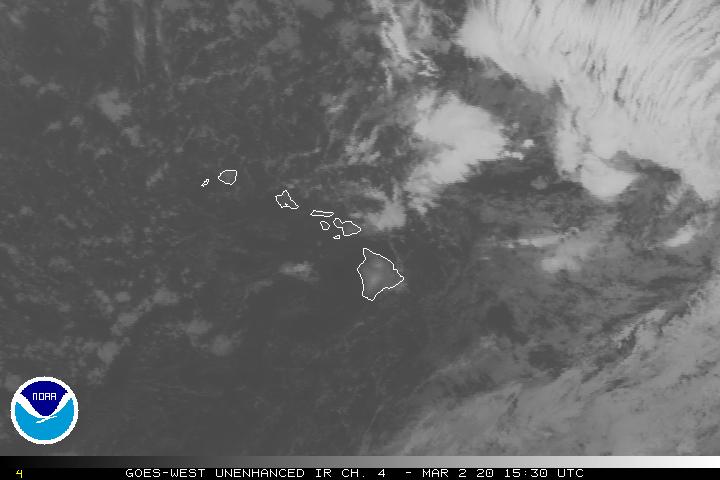
Satellite and Radar Images: To view the cloud conditions we have here in Hawaii, please use the following satellite links, starting off with the Infrared Satellite Image of the islands to see all the clouds around the state during the day and night. This next image is one that gives close images of the islands only during the daytime hours, and is referred to as a Close-up visible image. This next image shows a larger view of the Pacific…giving perspective to the wider ranging cloud patterns in the Pacific Ocean. Finally, here’s a looping IR satellite image, making viewable the clouds around the islands 24 hours a day. To help you keep track of where any showers may be around the islands, here’s the latest animated radar image.
Hawaii’s Mountains – Here’s a link to the live webcam on the summit of near 14,000 foot Mauna Kea on the Big Island of Hawaii. The tallest peak on the island of Maui is the Haleakala Crater, which is near 10,000 feet in elevation. These two webcams are available during the daylight hours here in the islands…and when there’s a big moon rising just after sunset for an hour or two! Plus, during the nights and early mornings you will be able to see stars, and the sunrise too…depending upon weather conditions.
Aloha Paragraphs

Dolphins offshore from the Kona coast
Photo Credit: flickr.com
The breezy trade winds will remain a part of our weather here in the islands…right on into the weekend. The small craft advisories, which were previously all encompassing, have been scaled back Wednesday across Hawaii’s coastal and channel waters now. The computer models have all come into alignment, over continued trade winds…as we move into the weekend time frame. The winds will be strongest through Thursday, with some moderation beginning Friday into the weekend and beyond.
The windward sides will continue to see a few passing showers at times, with continued generally cloudy to partly cloudy conditions elsewhere. The gusty nature of our trade wind flow, will occasionally blow a few stray showers over into the leeward sides…on the smaller islands. Otherwise, in terms of cloud cover, it appears that the trough of low pressure near the islands aloft, will keep a pretty steady stream of high and middle level clouds around into Friday. This will keep our Hawaiian sunshine subdued for the time being…with more sunshine this expected this weekend generally.
It’s Wednesday evening here in Kihei, Maui, as I begin writing this last section of today’s narrative. We can’t seem to shake the cloudy skies, which have prevailed for this entire week so far. The largest part of this overcast consists of high cirrus clouds, and middle level altocumulus clouds, streaming across our area from the deeper tropics to our southwest…like a conveyor belt! A low pressure trough continues to funnel this moisture over us, which in turn greatly reduces our available sunshine. Here’s a satellite image, so you can see the nature of all this cloudiness. Meanwhile, here’s a looping radar image as well, so that you can see where the showers are falling. The majority of these clouds were located to the south of Kauai and the Big Island, over the ocean Wednesday evening.
~~~ The clouds and sunshine were contesting Wednesday, briefly that is, over which would dominate here in the islands. The clouds won, by far, as mostly cloudy skies took over after a few morning breaks in the overcast. Looking out the window here in Kihei, before taking the drive upcountry to Kula, it’s cloudy. It should be noted that the overcast seems thinner, which is actually letting more light through, than has been the case the last two evenings when I’ve left. The last two evenings I’ve been able to take a nice walk when I get home, last evenings was a foggy one. Just thinking about getting out from behind this desk, and away from this computer screen, is exciting! I have a nice red sauce pasta dinner to heat up after my walk, and before I settle in on the couch for some reading, or a telephone conversation. Tomorrow is another day, as the old adage goes, and I’m already looking forward to all the weather work it will entail. I hope you have a great Wednesday night, and that you will join me here again on Thursday, when I’ll have the next new weather narrative from paradise waiting for your arrival! Aloha for now…Glenn.
Interesting: The largest snake the world has ever known — as long as a school bus and as heavy as a small car — ruled tropical ecosystems only 6 million years after the demise of the fearsome Tyrannosaurus Rex, according to a new discovery published in the journal Nature. Partial skeletons of a new giant, boa constrictor-like snake named "Titanoboa" found in Colombia by an international team of scientists and now at the University of Florida are estimated to be 42 to 45 feet long, the length of the T-Rex "Sue" displayed at Chicago’s Field Museum, said Jonathan Bloch, a UF vertebrate paleontologist who co-led the expedition with Carlos Jaramillo, a paleo-botanist from the Smithsonian Tropical Research Institute in Panama. Researchers say the extinct snake was even larger than the wildest dreams of directors of modern horror movies. "Truly enormous snakes really spark people’s imagination, but reality has exceeded the fantasies of Hollywood," said Bloch, who is studying the snake at the Florida Museum of Natural History on the UF campus. "The snake that tried to eat Jennifer Lopez in the movie ‘Anaconda’ is not as big as the one we found." Jason Head, a paleontologist at the University of Toronto in Mississauga and the paper’s senior author, described it this way: "The snake’s body was so wide that if it were moving down the hall and decided to come into my office to eat me, it would literally have to squeeze through the door." Besides tipping the scales at an estimated 1.25 tons, the snake lived during the Paleocene Epoch, a 10-million-year period immediately following the extinction of the dinosaurs 65 million years ago, Bloch said.
The scientists also found many skeletons of giant turtles and extinct primitive crocodile relatives that likely were eaten by the snake, he said. "Prior to our work, there had been no fossil vertebrates found between 65 million and 55 million years ago in tropical South America, leaving us with a very poor understanding of what life was like in the northern Neo-tropics," he said. "Now we have a window into the time just after the dinosaurs went extinct and can actually see what the animals replacing them were like." Size does matter because the snake’s gigantic dimensions are a sign that temperatures along the equator were once much hotter. That is because snakes and other cold-blooded animals are limited in body size by the ambient temperature of where they live, Bloch said. "If you look at cold-blooded animals and their distribution on the planet today, the large ones are in the tropics, where it’s hottest, and they become smaller the farther away they are from the equator," he said. Based on the snake’s size, the team was able to calculate that the mean annual temperature at equatorial South America 60 million years ago would have been about 91 degrees Fahrenheit, about 10 degrees warmer than today, Bloch said. The presence of outsized snakes and turtles shows that even 60 million years ago the foundations of the modern Amazonian tropical ecosystem were in place, he said.
Interesting2: The existing infrastructure for responding to maritime accidents in the Arctic is limited and more needs to be done to enhance emergency response capacity as Arctic sea ice declines and ship traffic in the region increases, according to new report released today by the University of New Hampshire and the National Oceanic and Atmospheric Administration. The report details findings from a panel of experts and decision-makers from Arctic nation governments, industry and indigenous communities convened by the Coastal Response Research Center, a UNH-NOAA partnership housed at the university. The panel, which included representatives from the U.S. Coast Guard and U.S. Arctic Research Commission, assessed the potential threat of maritime accidents in the Arctic and the ability of nations in the region to respond effectively to vessels in distress, oil spills and other situations. “The reduction of polar sea ice and the increasing worldwide demand for energy will likely result in a dramatic increase in the number of vessels that travel Arctic waters,” said Nancy Kinner, UNH co-director of the CRRC and a professor of civil and environmental engineering. “As vessel traffic increases, disaster scenarios are going to become more of a reality.”
Interesting3: One’s happiness might seem like a personal subject, but a Kansas State University researcher says employers should be concerned about the well-being of their employees because it could be the underlying factor to success. Thomas Wright, Jon Wefald Leadership Chair in Business Administration and professor of management at K-State, has found that when employees have high levels of psychological well-being and job satisfaction, they perform better and are less likely to leave their job — making happiness a valuable tool for maximizing organizational outcomes. "The benefits of a psychologically well work force are quite consequential to employers, especially so in our highly troubled economic environment," Wright said. "Simply put, psychologically well employees are better performers. Since higher employee performance is inextricably tied to an organization’s bottom line, employee well-being can play a key role in establishing a competitive advantage."
Happiness is a broad and subjective word, but a person’s well-being includes the presence of positive emotions, like joy and interest, and the absence of negative emotions, like apathy and sadness, Wright said. An excessive negative focus in the workplace could be harmful, such as in performance evaluations where negatives like what an employee failed to do are the focus of concentration, he said. When properly implemented in the workplace environment, positive emotions can enhance employee perceptions of finding meaning in their work. In addition, studies have shown that being psychologically well has many benefits for the individual, Wright said. Employees with high well-being tend to be superior decision makers, demonstrate better interpersonal behaviors and receive higher pay, he said. His recent research also indicates that psychologically well individuals are more likely to demonstrate better cardiovascular health.
Interesting4: There’s an emerging star in the super-food world. Plums are rolling down the food fashion runway sporting newly discovered high levels of healthy nutrients, say scientists at Texas AgriLife Research. Plainly, “blueberries have some stiff competition,” said Dr. Luis Cisneros, AgriLife Research food scientist." Stone fruits are super fruits with plums as emerging stars." Far from fruit snobbery, the plum is being ushered in after Cisneros and Dr. David Byrne, AgriLife Research plant breeder, judged more than 100 varieties of plums, peaches and nectarines and found them to match or exceed the much-touted blueberries in antioxidants and phyto-nutrients associated with disease prevention. The duo acknowledge that blueberries remain a good nutritional choice.
But Byrne said their findings are plum good news, especially in tight economic times, because one relatively inexpensive plum contains about the same amount of antioxidants as a handful of more expensive blueberries. “People tend to eat just a few blueberries at a time – a few on the cereal or as an ingredient mixed with lots of sugar,” Cisneros said. “But people will eat a whole plum at once and get the full benefit.” Discovery of the plum’s benefits – along with that of fellow stone fruits, the peach and the nectarine – came after the researchers measured at least five brands of blueberries on the market. Against those numbers, the team measured the content of more than 100 different types of plums, nectarines and peaches.
Interesting5: In a sharp break with the policy of the previous administration, US Energy Secretary Steven Chu used his first major interview to warn of catastrophe if drastic action is not taken to curb global warming. Speaking to the Los Angeles Times Wednesday, Chu warned that farms and vineyards in California, which is the nation’s leading agricultural producer, could vanish by the end of the century as a rise in temperatures destroys the Sierra snowpack that is the source of most of the state’s water. "I don’t think the American public has gripped in its gut what could happen," he said. "We are looking at a scenario where there’s no more agriculture in California."
With California already struggling with a three-year drought, Chu warned that the water shortage would not just affect agriculture. "I don’t actually see how they can keep their cities going" either, he said. Chu said that he sees public education as a key part of the administration’s strategy to fight global warming – along with billions of dollars for alternative energy research and infrastructure, a national standard for electricity from renewable sources and legislation to limit greenhouse gas emissions. He compared the situation to a family buying an old house and being told by an inspector that it must pay a hefty sum to rewire it or risk an electrical fire that could burn everything down. "I’m hoping that the American people will wake up," Chu said, and pay the cost of rewiring.
Interesting6: The oldest fossilized evidence of animals has been unearthed in Oman and reveals that tiny sea sponges were abundant 635 million years ago, long before most of the planet’s other major animal groups evolved, according to a new analysis. This early life hardly looked like us, but some of the so-called demo-sponges can be sizable today. Demo-sponges still make up 90 percent of all sponges on Earth and 100 percent of Earth’s largest sponges, including barrel sponges, which can be larger than an old-style phone booth.
The ancient demo-sponges — probably measuring across no more than the width of a fork tine — were pinned down via fossilized steroids, called steranes, which are characteristic of the cell membranes of the sponges, rather than via direct fossils of the sponges themselves. "The fact that we can detect sponge steranes at all suggests that by the Cryogenian Period [about 850 to 635 million years ago] demo-sponges were ecologically prominent and there were abundant demo-sponges living on the shallow sea floor," said geochemist Gordon D. Love of the University of California, Riverside, who headed up the analysis detailed in the Feb. 5 issue of the journal Nature.
 Email Glenn James: