











February 26-27, 2009
Air Temperatures – The following maximum temperatures were recorded across the state of Hawaii Thursday afternoon:
Lihue, Kauai – 73
Honolulu, Oahu – 77
Kaneohe, Oahu – 75
Kahului, Maui – 76
Hilo, Hawaii – 74
Kailua-kona – 85
Air Temperatures ranged between these warmest and coolest spots near sea level – and on the highest mountains…at 4 p.m. Thursday afternoon:
Kailua-kona – 78F
Lihue, Kauai – 71
Haleakala Crater – 45 (near 10,000 feet on Maui)
Mauna Kea summit – 32 (near 14,000 feet on the Big Island)
Precipitation Totals – The following numbers represent the largest precipitation totals (inches) during the last 24 hours on each of the major islands, as of Thursday afternoon:
0.14 Mount Waialeale, Kauai
0.16 Aloha Tower, Oahu
0.01 Molokai
0.00 Lanai
0.00 Kahoolawe
1.55 West Wailuaiki, Maui
0.73 Honokaa, Big Island
Weather Chart – Here’s the latest (automatically updated) weather map showing a very strong 1050 millibar high pressure system located far to the north-northwest of the islands. This high pressure system will cause strong and gusty northeast winds Friday and Saturday.
Satellite and Radar Images: To view the cloud conditions we have here in Hawaii, please use the following satellite links, starting off with the Infrared Satellite Image of the islands to see all the clouds around the state during the day and night. This next image is one that gives close images of the islands only during the daytime hours, and is referred to as a Close-up visible image. This next image shows a larger view of the Pacific…giving perspective to the wider ranging cloud patterns in the Pacific Ocean. Finally, here’s a looping IR satellite image, making viewable the clouds around the islands 24 hours a day. To help you keep track of where any showers may be around the islands, here’s the latest animated radar image.
Hawaii’s Mountains – Here’s a link to the live webcam on the summit of near 14,000 foot Mauna Kea on the Big Island of Hawaii. The tallest peak on the island of Maui is the Haleakala Crater, which is near 10,000 feet in elevation. These two webcams are available during the daylight hours here in the islands…and when there’s a big moon rising just after sunset for an hour or two! Plus, during the nights and early mornings you will be able to see stars, and the sunrise too…depending upon weather conditions.
Aloha Paragraphs
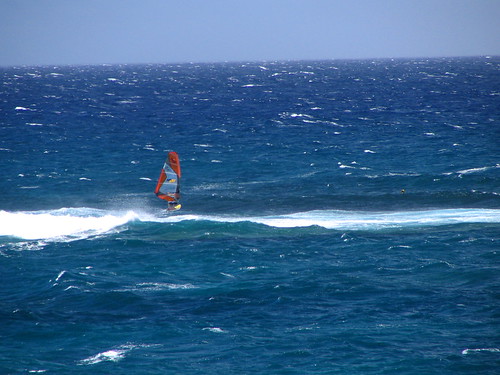
Windy, windy, windy! Looking at this latest weather map, we find an unusually strong, 1054 millibar high pressure system in the area north-northwest of Hawaii Thursday night. These blustery winds, with their associated wind chill, will keep cooler than normal weather in place. The NWS in Honolulu has small craft wind advisories active across all of Hawaii’s coasts and channel waters, along with a high surf advisory for surf breaking along our east facing beaches…being generated by these gusty winds.
There will be just a few showers along the windward sides…most frequent during the night and early morning hours. Since there is so much wind around, a few light sprinkles will get carried over into the leeward sides at times too. The majority of whatever clouds that around, will be passing quickly along the windward sides. The leeward beaches will be quite sunny, although with all the windy weather, they won’t be at their optimum right now. There don’t seem to be any organized rain makers on our horizon, so generally windy and dry weather will prevail well into the future.
Far and way, the primary weather influence now, through the next week, will be all this "air in a hurry." The following numbers represented the strongest gusts (mph) on each of the islands at around 8pm Thursday evening:
Kauai: 33
Oahu: 40
Molokai: 39
Maui: 32
Kahoolawe: 42
Lanai: 45
Big Island: 38
It’s early Thursday evening here in Kihei, Maui, as I begin writing this last section of today’s weather narrative. Looking out the window here in Kihei, before I take the drive home to Kula, there are a few clouds around, but nothing much. As a matter of fact, looking up towards the Haleakala Crater, there isn’t one cloud up that way! It’s unusual to see such clear skies on the mountain. Down here in the lowlands today, when I went to lunch, it was very windy. I actually saw several people who sort of got pushed back, or at least held up by a strong gust…while walking down the street! It was windy enough that I heard people talking about it in the health food store.
We will need to get used to these stronger than normal winds, which easily qualify as blustery. The reason for this (perhaps forced) familiarity, is that they will be accompanying us through the next week, if not longer. If we look at this 24 hour forecast weather map, we see still a very hefty 1050 millibar high pressure cell far to the north of
~~~ I’ll be back online later this evening, if for no other reason than to update the strongest wind reports, that you will find up this page a little ways. I enjoy keeping track of these top gusts, and somehow think its fun to share those strong wind numbers with all of you. As soon as I get home I’ll be quickly changing into my tennis shoes, and then out onto the road. I love getting outside to walk around, look at stuff, maybe say hi to someone that I see along the way. I hope you have a great Thursday night, from wherever you happen to be reading from. I’ll be back early Friday morning with your next new weather narrative, filled with all kinds of news about the gusty winds that continue to come our way. Aloha for now…Glenn.
~~~ One more thing, did you happen to notice the wonderful planetary configuration just after sunset Thursday? Wow, there was a crescent moon, that was positioned below the planet Venus, which was looking very large and bright! I hope I remember to tell you about this again Friday, so you can go out and check it out yourself…or just try to remember to look please. My wind chimes are going off tonight, as its windy, and the air temperature, at right around 8pm…is 53F degrees already. That ensures that it will be another night with temperatures nose diving into the 40’s again. If the winds calm down up here, it will sink into the lower 40’s.
Interesting: The Greenland and Antarctica ice sheets are melting, but the amounts that will melt and the time it will take are still unknown, according to Richard Alley, Evan Pugh professor of geosciences, Penn State. In the past, the Greenland ice sheet has grown when its surroundings cooled, shrunk when its surroundings warmed and even disappeared completely when the temperatures became warm enough.
If the ice sheet on Greenland melts, sea level will rise about 23 feet, which will inundate portions of nearly all continental shores. However, Antarctica, containing much more water, could add up to another 190 feet to sea level. "We do not think that we will lose all, or even most, of Antarctica’s ice sheet," said Alley.
"But important losses may have already started and could raise sea level as much or more than melting of Greenland’s ice over hundreds or thousands of years," Alley told attendees Feb 16 at the annual meeting of the American Association for the Advancement of Science. Warming is expected to cause more precipitation on Greenland and Antarctica, adding snow.
Previously, many scientists suggested that this would offset increasing melting. However, recent studies show that the ice sheets on both Greenland and in Antarctica are melting faster than the snow is replacing the mass. A number of things can contribute to the increased rate of melting in Greenland and Antarctica. Large lakes of water on the ice in Greenland pose a problem.
This water, by wedging open a crack or crevasse in the ice, quickly flows through to the bottom, melting the bottom of the ice sheet and causing it to move more rapidly toward the ocean. Observers have seen lakes on the Greenland ice sheet drain at the speed of Niagara Falls.
All ice sheets spread due to their large mass, but friction from the rocks beneath slows the ice’s motion. Water beneath the ice allows the ice to move more rapidly.
Interesting2: Climate change will not be taken seriously until the media highlights its significance, say researchers at the University of Liverpool. Dr Neil Gavin, from the School of Politics and Communication Studies, believes the way the media handles issues like climate change shapes the public’s perception of its importance. Limited coverage is unlikely to convince readers that climate change is a serious problem that warrants immediate and decisive action.
Researchers found that the total number of articles on climate change printed over three years was fewer than one month’s worth of articles featuring health issues. The articles offered mixed messages about the seriousness and imminence of problems facing the environment. Dr Gavin explains: “Our research suggests that the media is not treating these issues with the seriousness that scientists would say they deserve.
The research company lpsos-MORI found that 50% of people think the jury is still out on the causes of global warming. The limited amount of media coverage – which tends to be restricted to the broadsheets – means that this statistic is unlikely to alter in the short-term. “Climate change, therefore, may not be high enough on the media agenda to stimulate the sort of public concern that prompts concerted political action.
The media may well continue to focus its attention on health, the economy or crime, thereby drawing public attention away from the issue of climate change. “This is more likely when resources are stretched, government popularity is on the wane, or where more pressing, non-climate-related issues force the government to direct expenditure or invest its political capital and energy elsewhere.”
He added: “Even if the British Government wanted to push climate change further up the media agenda, it is not necessarily in a position to shape the debate that takes place in the media.
Interesting3: If you are a fish eater, it’s likely that the salmon you had for dinner was not caught in the wild, but was instead grown in a mesh cage submerged in the open water of oceans or bays. Fish farming, a relatively inexpensive way to provide cheap protein to a growing world population, now supplies, by some estimates, 30 percent of the fish consumed by humans.
Two hundred and twenty species of finfish and shellfish are now grown in farms. Intuitively, it seems a good idea—the more fish grown in pens, the fewer need be taken from wild stocks in the sea. But marine aquaculture can have some nasty side effects, especially when the pens are set near sensitive coastal environments.
All those fish penned up together consume massive amounts of commercial feed, some of which drifts off uneaten in the currents. And the crowded fish, naturally, defecate and urinate by the tens of thousands, creating yet another unpleasant waste stream.
The wastes can carry disease, causing damage directly. Or the phosphate and nitrates in the mix may feed an algae bloom that sucks the oxygen from the water, leaving it uninhabitable, a phenomenon long associated with fertilizer runoff.
It has been widely assumed that the effluent from pens would be benignly diluted by the sea if the pens were kept a reasonable distance from shore, said Jeffrey Koseff, a professor of civil and environmental engineering and co-director of Stanford’s Woods Institute for the Environment.
But early results from a new Stanford computer simulation based on sophisticated fluid dynamics show that the icky stuff from the pens will travel farther, and in higher concentrations, than had been generally assumed, Koseff said. "What we’ve basically debunked is the old adage that ‘The solution to pollution is dilution,’ " he said. "It’s a lot more complicated."
Interesting4: ESA’s Venus Express spacecraft has observed an eerie glow in the night-time atmosphere of Venus. This infrared light comes from nitric oxide and is showing scientists that the atmosphere of Earth’s nearest neighbour is a temperamental place of high winds and turbulence.
Unfortunately, the glow on Venus cannot be seen with the naked eye because it occurs at the invisible wavelengths of infrared. ESA’s Venus Express, however, is equipped with the Visible and Infrared Thermal Imaging Spectrometer (VIRTIS) instrument, which can see these wavelengths.
VIRTIS has made two unambiguous detections of the so-called nightglow for nitric oxide at Venus. This is the first time such infrared detections have been made for any planet and provide a new insight into Venus’s atmosphere.
“The nightglow can give us a lot of information,” says Antonio García Muñoz, who was at the Australian National University when the research was carried out; he is now located at the Instituto de Astrofísica de Canarias, Tenerife, Spain. "It can provide details about the temperature, wind direction, composition and chemistry of an atmosphere."
Interesting5: We all do things to impress others—exaggerate our accomplishments, downplay our faults, even fib on surveys. A new study in the Journal of Consumer Research sheds light on why we don’t tell the strict truth about ourselves in surveys and what, if anything, can be done about it.
"The tendency of people to portray themselves in a more favorable light than their thoughts or actions, called socially desirable responding, is a problem that affects the validity of statistics and surveys worldwide," writes author Ashok K. Lalwani (University of Texas at San Antonio).
When asked about their own behavior in relation to materialism, compulsive buying, drug and alcohol addiction, cigarette smoking, shoplifting, gambling, prostitution, and intolerant attitudes, people tend to answer in a less than candid manner.
The research teased out two separate forms of "socially desirable responding," and found that people’s cultural orientations lead them to different forms. For example, people from cultures that have a "collectivist orientation" (China, Korea, India, Taiwan, Singapore, Japan) are more likely to engage in impression management, which is "a deliberate, strategic presentation of a socially approved image of the self."
Impression management is "a conscious, active and deliberate attempt to fake good behavior in front of a real or imagined audience," writes Lalwani. That need to give the "right" answer can be reduced by keeping survey participants "cognitively busy" by playing background music during surveys, he found.
In contrast, consumers with an individualist cultural orientation (the United States, Canada, France, United Kingdom, Australia, Germany) are more likely to engage in self-enhancement, which is "a spontaneous tendency to present an internalized, unrealistically positive view of the self." This behavior is so unconscious that there is little that can be done to curtail it.
The study can help researchers evaluate the validity of survey responses in light of people’s tendency toward socially desirable responding. It also helps consumers predict their own behavior and potentially modify it.
Interesting6: Early humans had feet like ours and left lasting impressions in the form of 1.5 million-year-old footprints, some of which were made by feet that could wear a size 9 men’s shoe. The findings at a Northern Kenya site represent the oldest evidence of modern-human foot anatomy. They also help tell an ancestral story of humans who had fully transitioned from tree-dwellers to land walkers.
"In a sense, it’s like putting flesh on the bones," said John Harris, an anthropologist with the Koobi Fora Field School of Rutgers University. "The prints are so well preserved." Harris and other colleagues report in the Feb. 27 issue of the journal Science on finding several footprint trails within two sedimentary rock layers.
An upper sedimentary layer included two trails of two prints each, one group of seven prints, and a variety of isolated prints. The lower layer had a trail of two prints and a single isolated print likely from a smaller, juvenile human. The researchers identified the footprints as probably belonging to a member of Homo ergaster, an early form of Homo erectus.
Such prints include modern foot features such as a rounded heel, a human-like arch and a big toe that sits parallel to other toes. By contrast, apes have more curved fingers and toes made for grasping tree branches. The earliest human ancestors, such as Australopithecus afarensis, still possessed many ape-like features more than 2 million years ago — the well-known specimen represents one such example.
Interesting7: Bacteria found in people’s spit does not vary much around the world, a surprising finding that could provide insights into how diet and cultural factors affect human health, researchers said on Thursday. Because the human body harbors 10 times more bacterial cells than human cells, scientists are trying to understand more about the bacteria we carry. The human mouth is a major gateway for bacteria into the body and it contains a diverse array of microbial species.
Yet scientists know little about this diversity and how it relates to diet, environment, health and disease, they added. "We are interested in this because by studying the bacteria we can get more insights into human populations than we would get from just studying the human DNA," Mark Stoneking of the Max Planck Institute in Leipzig, Germany, who led the study, said in a telephone interview.
In their study published in Genome Research, the team sequenced bacteria found in saliva samples taken from 120 healthy volunteers from North America, South America, Western Europe, Eastern Europe, Africa and Asia. Not surprisingly, they observed considerable diversity of bacterial life in the overall saliva micro-biome, both within and between individuals.
But when comparing samples from different geographic areas they found not much variation, suggesting that bacteria within the mouth of a person’s neighbor is likely to be just as different as someone on the other side of the world. The findings could help better understand human migrations and populations as well as providing background for future studies looking at the influence of diet, cultural factors and disease on differences in saliva bacteria.
 Email Glenn James:

