February 2-3, 2009
Air Temperatures – The following maximum temperatures were recorded across the state of Hawaii Monday afternoon:
Lihue, Kauai – 74
Honolulu, Oahu – 80
Kaneohe, Oahu – 77
Kahului, Maui – 80
Hilo, Hawaii – 78
Kailua-kona – 87
Air Temperatures ranged between these warmest and coolest spots near sea level, and on the highest mountains…at 4 p.m. Monday afternoon:
Kailua-kona – 79F
Lihue, Kauai – 70
Haleakala Crater – 48 (near 10,000 feet on Maui)
Mauna Kea summit – 36 (near 14,000 feet on the Big Island)
Precipitation Totals – The following numbers represent the largest precipitation totals (inches) during the last 24 hours on each of the major islands, as of Monday afternoon:
0.76 Mount Waialaele, Kauai
0.86 Oahu Forest NWR, Oahu
0.09 Molokai
0.00 Lanai
0.00 Kahoolawe
1.72 West Wailuaiki, Maui
1.45 Hilo airport, Big Island
Weather Chart – Here’s the latest (automatically updated) weather map showing a relatively close 1032 millibar high pressure system to the north-northwest of the Hawaiian Islands Tuesday. Our winds will remain out of the trade wind direction…gusty into Wednesday.
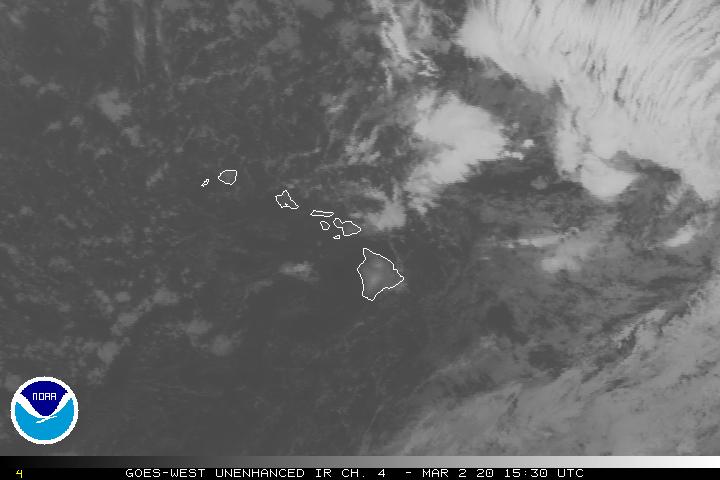
Satellite and Radar Images: To view the cloud conditions we have here in Hawaii, please use the following satellite links, starting off with the Infrared Satellite Image of the islands to see all the clouds around the state during the day and night. This next image is one that gives close images of the islands only during the daytime hours, and is referred to as a Close-up visible image. This next image shows a larger view of the Pacific…giving perspective to the wider ranging cloud patterns in the Pacific Ocean. Finally, here’s a looping IR satellite image, making viewable the clouds around the islands 24 hours a day. To help you keep track of where any showers may be around the islands, here’s the latest animated radar image.
Hawaii’s Mountains – Here’s a link to the live webcam on the summit of near 14,000 foot Mauna Kea on the Big Island of Hawaii. The tallest peak on the island of Maui is the Haleakala Crater, which is near 10,000 feet in elevation. These two webcams are available during the daylight hours here in the islands…and when there’s a big moon rising just after sunset for an hour or two! Plus, during the nights and early mornings you will be able to see stars, and the sunrise too…depending upon weather conditions.
Aloha Paragraphs

Gusty – showery weather windward sides
Photo Credit: flickr.com
Strong and gusty trade winds are blowing across all the islands Monday evening, and will continue through mid-week…after which they will calm down some into the weekend. This boost in wind speeds has triggered a small craft wind advisory in all of the Hawaiian coastal and channel waters going into Tuesday. As we move into the second half of the week, our winds will become somewhat lighter…as a cold front moves by to our north during the Saturday-Sunday time frame. It looks like, at least from this vantage point, that our trade winds will remain active right into next week.
Clouds have spread across all of the islands, both at the surface…and at higher levels of the atmosphere as well. These clouds, at least the lower level ones, will be dropping showers locally. The windward sides will see the largest share of these trade wind showers, although with the stronger winds blowing, the leeward sides will see some on the smaller islands too. Weather conditions will improve by Thursday, especially along the south and west facing shores. The computer models continue to show easterly to southeast winds this weekend, perhaps drawing tropical moisture up into the state then. As the trade winds return after the weekend, most of the showers will shift back over to the windward sides.
It’s Monday evening here in Kihei, Maui, as I begin writing this last section of today’s narrative. As pointed out above, our weather is going through some changes into Tuesday. Actually, looking at satelite imagery, and out the window here in Kihei this afternoon…I should say has gone through changes. Our winds have accelerated, our clouds have increased, along with an uptick in passing showers along the windward sides especially. These inclement weather conditions will prevail into Wednesday, with gradually improving conditions Thursday onward. Here’s a satellite image, so you can keep an eye on the clouds moving through the state. You will notice quite a few high level cirrus clouds still streaming across island skies, which are blocking the lower level clouds quite effectively. Here’s a looping radar image as well, so that we can see the showers being carried in on the cool northeast wind flow.
~~~ It’s cloudy, windy, and locally showery here in the islands now. The satellite image above shows the degree of cloudiness that has moved over all the islands. The radar imagery too shows that there aren’t all that many showers around yet, although windward Maui is getting its fair share. These showers will increase a bit more, and will stretch over to the leeward sides at times locally. As far as the winds, at least early Monday evening, the strongest winds that I saw was the rather robust 36 mph gust at windy Maalaea Bay…here on Maui. Wait a second, hold your horses for a second, now I see a top gust of 42 mph on the small island of Lanai! This air in a hurry will be sticking around for the next couple of days, so that we may find even stronger gusts blowing on Tuesday!
~~~ I’m about ready to jump in the car, for the drive upcountry to Kula. I’ll keep my eyes peeled for anything unusual during that drive, and if something catches my eye, I’ll come back online at home, that is after I take my brisk walk…and let you know what it was. Otherwise, I’ll be back very early Tuesday morning with your next new weather narrative from paradise…even if it is a little bit on the inclement side at the moment. I hope you have a great Monday night until then! Aloha for now…Glenn.
Interesting: There were no reports of injuries or damage from the eruption of Mount Asama, which is about 90 miles northwest of Tokyo. The volcano erupted at 1:51 a.m. (11:51 p.m. EST) Monday, belching out a plume that rose about a mile high, according to Japan’s Meteorological Agency. The plume was still roiling over the volcano’s crater late Monday. Chunks of rock from the explosion were found about 3,300 feet away from the volcano. Ash was detected over a wide area, including central Tokyo. In the town of Karuizawa, southeast of the volcano, the ash was thick enough to obscure road markings in some areas, town official Noboru Yanagishi said. "Some people said they heard a strange noise in the morning when the eruption occurred," he said.
Interesting2: Japan denied on Monday accusations by a U.S.-based hard-line anti-whaling group that Japanese whaling ships had used weapons against activists on inflatable boats near Antarctica. The Sea Shepherd Conservation Society said in a statement that two crew members were injured when Japanese whalers used water cannon, concussion grenades, acoustic weapons and threw brass and lead balls at Sea Shepherd boats. The group said on Sunday that it had spotted the Japanese whaling fleet and was closing in on them. "If our crew can hit them, then they would be better off quitting the research vessel and joining a professional baseball team," said Shigeki Takaya, an assistant director of the Far Seas Fisheries Division at Japan’s fisheries ministry.
Interesting3: With arctic sea ice melting like ice cubes in soda, scientists want to protect a region they say will someday be the sole remaining frozen bastion of a disappearing world. Spanning the northern Canadian archipelago and western Greenland, it would be the first area formally protected in response to climate change, and a last-ditch effort to save polar bears and other animals. "All the indications are of huge change, and a huge response is needed if you want to have polar bears beyond 2050," said Peter Ewins, the World Wildlife Fund’s Director of Species Conservation. National Parks have proven to be one of the most important ways to protect and preserve natural areas and wildlife. First established in the United States in 1916, national parks have since been adopted internationally. But protecting an area outside of a single country’s borders could prove to be difficult. The arctic sea ice is composed of vast plains of three- to nine-foot-thick ice that cover the top of the northern hemisphere. Though, some of the ice melts each summer, much of it remains frozen year-round — or, at least, it used to. Summer melts are accelerating, and winter re-freezing can no longer make up the difference.
Every summer now seems to be accompanied by news of unprecedented ice loss and more waters open for the first time in known history. "When the (Ice Age) glaciers retreated, there was ice left in different spots around the world. Those isolated pockets of biodiversity were called refugia," said Stephanie Pfirman, an environmental science professor at Barnard College. "The same is likely to happen in the Arctic." If current greenhouse gas emission trends continue, the proposed protected region will be the only area with year-round ice, according to the Intergovernmental Panel on Climate Change. "The IPCC reports published over the last few years pretty much agree that even if we switched off our carbon power stations and SUVs tomorrow, we’d have significant shrinkage of ice-dominated ecosystems to the middle of the century — and in reality, it could be faster than that," Ewins said. Protecting the ice won’t be easy: a warming Arctic means new shipping routes and newly-accessible natural resources, from oil to diamonds and uranium. But this isn’t the first time humanity has chosen between material wealth and icy treasure.
Interesting4: The biggest snowstorm in 18 years hit southeastern England, including London, on Monday. By late in the afternoon, local time, as much as 8 inches of snow blanketed parts of London. The heavy snow produced massive travel problems in the sprawling capital city. Bus service was stopped, and some subway lines also had service suspended. Numerous accidents were reported on area roadways; these led to road closures and backed-up traffic. The snow severely affected air travel to and from the city’s several airports. At Heathrow, a jet slid into a grassy area while moving to a terminal after landing; there were no injuries. All flights at Heathrow were cancelled for several hours. The storm also forced widespread school closings.
Interesting5: A century from now, Spain and Italy will be enduring baking, parched summers while residents of central and north-west Europe will be experiencing what we now think of as Mediterranean warmth. Reindert Haarsma and his team from the Royal Netherlands Meteorological Institute in De Bilt used existing computer models to study changes in weather patterns resulting from the expected global warming. These indicated that summer temperatures in southern Europe would rise by 2 to 3 °C compared with today’s, and that lack of rain would dry up the soils. The hot, dry air above these arid soils would then rise and expand, creating a low-pressure zone over the region. Winds circulating anticlockwise around this zone would feed continental air to more northerly areas, raising temperatures there too.
Interesting6: Heightened support from the Obama Administration and the new Congress on environmental issues, strong green elements in the proposed stimulus and anticipated regulatory changes are fueling optimism for green investment, according to Allianz Global Investors. That’s the assessment of results from the latest survey of American investors for the asset management firm, which says Americans see a "golden age" coming for green investing. In addition to expecting broad policy change from Washington, D.C., investors increasingly perceive firms that seek to address environmental issues as strong investment opportunities, the company said. "The need for pollution control, clean water and energy efficiency is not going away," Brian Gaffney, managing director and CEO of Allianz Global Investors Distributors, said in a statement. "Investors perceive there is real opportunity here and they want to capitalize on it." Gaffney said investors’ positive outlook on the environmental technology sector reflects their perception of the area as a long-term opportunity. "Investors understand that robust demand for innovation and solutions will fuel growth, and consequently profits, for years to come," he said.
Interesting7: Rising sea levels are causing salt water to flow into India’s biggest river, threatening its ecosystem and turning vast farmlands barren in the country’s east, a climate change expert warned Monday. A study by an east Indian university in the city of Kolkata revealed surprising growth of mangroves on the Ganges river, said Pranabes Sanyal, the eastern India representative of the National Coastal Zone Management Authority (NCZMA). "This phenomenon is called extension of salt wedge and it will salinate the groundwater of Kolkata and turn agricultural lands barren in adjoining rural belts," said Sanyal, an expert in global warming. Sea levels in some parts of the Bay of Bengal were rising at 3.14 mm annually against a global average of 2 mm, threatening the low-lying areas of eastern India. Climate experts warned last year that as temperatures rise, the Indian subcontinent — home to about one-sixth of humanity — will be badly hit with more frequent and more severe natural disasters such as floods and storms and more disease and hunger.
 Email Glenn James: