January 9-10, 2009
Air Temperatures – The following maximum temperatures were recorded across the state of Hawaii Friday afternoon:
Lihue, Kauai – 77
Honolulu, Oahu – 79
Kaneohe, Oahu – 80
Kahului, Maui – 83
Hilo, Hawaii – 78
Kailua-kona – 80
Air Temperatures ranged between these warmest and coolest spots near sea level, and on the highest mountains…at 5 p.m. Friday evening:
Port Allen, Kauai – 79F
Hilo, Hawaii – 73
Haleakala Crater – 52 (near 10,000 feet on Maui)
Mauna Kea summit – 41 (near 14,000 feet on the Big Island)
Precipitation Totals – The following numbers represent the largest precipitation totals (inches) during the last 24 hours on each of the major islands, as of Friday afternoon:
0.24 Kapahi, Kauai
1.27 Poamoho 2, Oahu
0.02 Molokai
0.00 Lanai
0.00 Kahoolawe
0.05 Kaupo Gap, Maui
0.18 Glenwood, Big Island
Weather Chart – Here’s the latest (automatically updated) weather map showing a 1037 millibar high pressure system far to the northeast of the Hawaiian Islands…having moved out of range to provide trade winds. An approaching cold front will veer our winds around to the south and southwest Saturday…becoming locally stronger and gusty into Sunday.
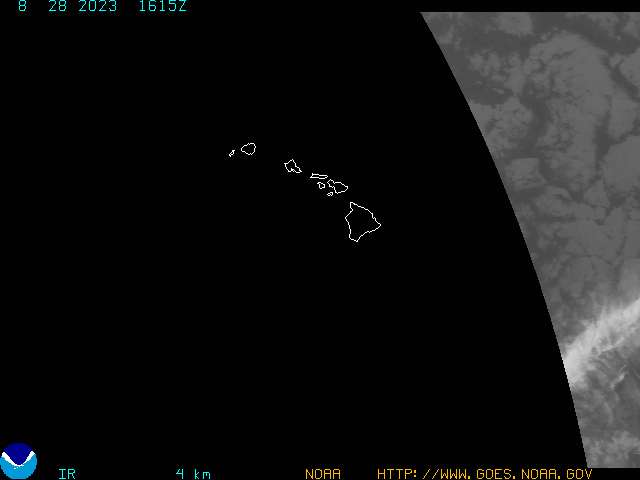
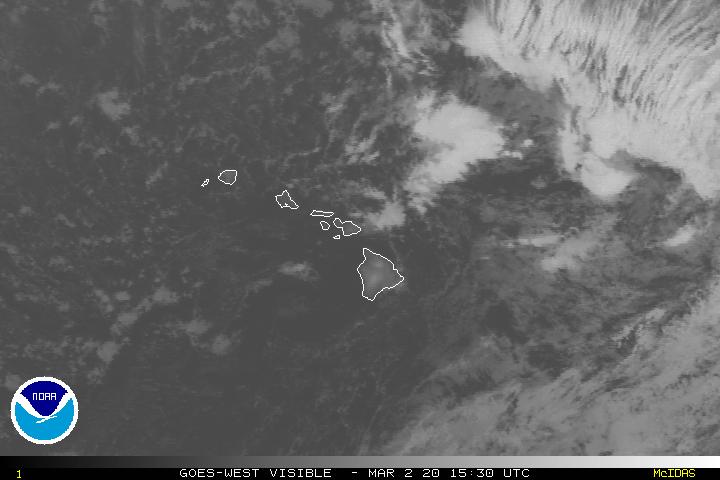
Satellite and Radar Images: To view the cloud conditions we have here in Hawaii, please use the following satellite links, starting off with the Infrared Satellite Image of the islands to see all the clouds around the state during the day and night. This next image is one that gives close images of the islands only during the daytime hours, and is referred to as a Close-up visible image. This next image shows a larger view of the Pacific…giving perspective to the wider ranging cloud patterns in the
Aloha Paragraphs

Upcountry Maui…towards Ulupalakua
Photo Credit: flickr.com
Our winds have shifted to the southeast, and will soon veer around to the south and southwest…called Kona winds here in the islands. As we get into the weekend, our winds will become stronger from the south and southwest, ahead of a vigorous cold front, becoming locally strong and gusty later Saturday into Sunday, ahead of the cold front. Winds will swing around to the west and northwest after the frontal passage, with no sign of returning trade winds through most, if not all of the new week ahead.
Saturday will start off pretty good, and remain quite nice most of the day…although it will be getting windier as we go forward. A fast moving Pacific cold front will arrive over Kauai late Saturday, pushing down through Oahu, Maui County, and perhaps stalling before getting to the Big Island…although maybe not? Some of these frontal showers will be locally quite heavy, along with a few possible thunderstorms! The computer models suggest that we could see a second, or even a third frontal passage during the next week.
It’s early Friday evening here in Kihei, Maui, as I start writing this last section of today’s narrative. Clouds were few and far between during the day Friday. Those few clouds will clear back Friday night, with generally decent weather for most of Saturday. The thing we will start to notice is the increase in south to southwest Kona winds as we move through the first part of the weekend. Kauai will see the onset of heavy rains Saturday night, with the very well advertised cold front carrying its rainfall down through the rest of the island chain Sunday. It’s quick and steady travel down through the Aloha state, will limit flooding problems. If it were to unexpectedly stall or slow its forward motion, and if there were more than the expected number of thunderstorms…then we could experience flooding problems develop.
~~~ Looking ahead to next week, we will have unusual westerly to northwesterly winds blowing, as the trade winds remain absent from our Hawaiian Island weather picture. This puts us into what is called the Prevailing Westerly flow, similar to what the middle latitudes have year round. This zonal flow of air, from west to east, will keep changeable weather conditions around, with another cold front or two, coming our way through next week.
~~~ Friday was a work day for this Maui weatherman. I fly out to Phoenix Saturday night, where I’ll be attending the American Meteorological Society Annual Meeting for five days. I then fly to Long Beach on the way back home, for a five day visit with my family. Then I get back to Maui January 21st, and back to work on the 22nd…including being back here to start my daily narratives again. While I am gone, you can find the latest weather forecasts using links on the left hand margin of this, and all the pages on this website. By the way, I’ll be taking a laptop computer with me, so I’ll be able to come back here occasionally, while I am away…and let you know what’s going on in Phoenix, and with all us weather geeks at the conference there!
~~~ Friday night is gorgeous here in the islands! The near full moon is rising to the east, at least around sunset, and it looks huge! There are hardly any clouds around, so that its one of those exceptionally nice nights. I wish I could take a picture of that moon beaming down, as it truly is spectacular! The fullest aspect of this moon will occur Saturday night, and it will be the largest and brightest full moon of 2009…so get out there and take a look!
I couldn’t find any new films that appealed to me, so I’m just going home, to start getting ready for my trip to the mainland.
I’ll be back Saturday morning with some more updates, and the very latest news about this approaching cold front. I hope you have a great Friday night wherever you happen to be spending it! Aloha for now…Glenn.
Note:
Scientists say
Interesting: Three hundred and thirty-one days, plus a final frantic fortnight: not very long, really, to put together the most complex and vital agreement the world has ever seen. But that’s all the time there is: in 331 days from now, on 7 December, the UN Climate Conference will open in Copenhagen and the world community will try to agree on a solution to the gravest threat it has ever faced: global warming. Between 10,000 and 15,000 officials, advisers, diplomats, campaigners and media personnel from nearly 200 countries, almost certainly joined by limousine-loads of heads of state and government from America’s President Barack Obama down are expected to meet in the Danish capital in one of the most significant gatherings in history.
If that sounds like exaggeration, we need only glance at some historical comparisons. The Copenhagen meeting will have a far broader reach and potential impact on the world than the Congress of Vienna, say, the 1814-1815 assembly which attempted to reorder Europe after the Napoleonic wars, or the Paris peace conference of 1919, which tried to construct a new global order after the First World War, or the 1945 meetings at Yalta and Potsdam which tried to do the same after the Second World War. For they were all dealing with national boundaries, politics and political structures, phenomena which of course are vital in human terms, but ephemeral and changeable. Copenhagen will be dealing with something fundamental to life on earth: the stability of the biosphere.
Interesting2: Japan’s government-supported whaling fleet is out in the Southern Ocean killing hundreds of minke whales and other species in the name of science (but also for meat), and once again being harassed by the animal-rights crusaders — and now Animal Planet celebrities — aboard the Sea Shepherd Conservation Society vessel Steve Irwin. Japan has asked Australia to deny the Steve Irwin the right to land and refuel, saying the campaigners are little more than eco-terrorists. The latest dispute is over an incident Tuesday in which the activists showed up following a distress call as the whaling fleet searched for a missing crew member. Japan’s Institute for Cetacean Research — which campaigners claim has an Orwellian name hiding its function as a meat processing business —
issued a release claiming the anti-whaling group tried to disrupt the search, while the activists say they were just trying to help. Paul Watson, the founder of Sea Shepherd, insists that the only terrorists in these disputes are the ones using explosive-tipped harpoons. But he has come in for a lot of criticism for tactics that include ramming whaling vessels. Amid the shouting over tactics, there has been little progress on a larger issue: When whale species, like the minke, are no longer rare, can they be both admired and eaten — as North Americans do with bison — or is it simply wrong to kill whales at all?
Interesting3: Harvard University is flying a specially equipped jet between the North Pole and South Pole to test the atmosphere for variations in global-warming gases, aiming to improve computer models for predicting climate change. A modified Gulfstream V took off today from Colorado bound for the Arctic as part of a three-year mission dubbed Hippo, said David Hosansky, a spokesman for the National Center for Atmospheric Research, a collaborator in the Harvard-led project based in Boulder, Colorado. The plane will later turn south via New Zealand toward Antarctica. The aircraft will cruise over mountains, seas, forests and cities at various altitudes to test concentrations of carbon dioxide, methane and other heat-trapping greenhouse gases to find where they are being released and absorbed at exceptional rates.
The findings will be produced in greater detail than any study to date, scientists said “When we finish up, we’ll have a completely new picture about how greenhouse gases are entering the atmosphere and being removed from the atmosphere both by natural processes and by humans,” Steven Wofsy, professor of atmospheric and environmental science at Cambridge, Massachusetts-based Harvard said in a video posted on the National Science Foundation Web site. The United Nations said in 2007 that warmer temperatures globally are caused largely by man-made CO2 and other gases that hold on to the sun’s energy in the atmosphere. Scientists are trying to better understand where the gases originate and how well oceans and forests absorb them. Current computer models for predicting the earth’s future climate have been questioned by some climatologists for how they handle little-understood heat transfers such as those done by low- level clouds over oceans.
Interesting4: Fasten your seat belts — we’re faster, heavier, and more likely to collide than we thought. Astronomers making high-precision measurements of the Milky Way say our home Galaxy is rotating about 100,000 miles per hour faster than previously understood. That increase in speed, said Mark Reid, of the Harvard-Smithsonian Center for Astrophysics, increases the Milky Way’s mass by 50 percent, bringing it even with the Andromeda Galaxy. "No longer will we think of the Milky Way as the little sister of the Andromeda Galaxy in our Local Group family." The larger mass, in turn, means a greater gravitational pull that increases the likelihood of collisions with the Andromeda galaxy or smaller nearby galaxies.
Our Solar System is about 28,000 light-years from the Milky Way’s center. At that distance, the new observations indicate, we’re moving at about 600,000 miles per hour in our Galactic orbit, up from the previous estimate of 500,000 miles per hour. The scientists are using the National Science Foundation’s Very Long Baseline Array (VLBA) radio telescope to remake the map of the Milky Way. Taking advantage of the VLBA’s unparalleled ability to make extremely detailed images, the team is conducting a long-term program to measure distances and motions in our Galaxy. They reported their results at the American Astronomical Society’s meeting in Long Beach, California.
Interesting5: Rapidly warming climate is likely to seriously alter crop yields in the tropics and subtropics by the end of this century and, without adaptation, will leave half the world’s population facing serious food shortages, new research shows. To compound matters, the population of this equatorial belt – from about 35 degrees north latitude to 35 degrees south latitude – is among the poorest on Earth and is growing faster than anywhere else. "The stresses on global food production from temperature alone are going to be huge, and that doesn’t take into account water supplies stressed by the higher temperatures," said David Battisti, a University of Washington atmospheric sciences professor.
Battisti is lead author of the study in the Jan. 9 edition of Science. He collaborated with Rosamond Naylor, director of Stanford University’s Program on Food Security and the Environment, to examine the impact of climate change on the world’s food security. "This is a compelling reason for us to invest in adaptation, because it is clear that this is the direction we are going in terms of temperature and it will take decades to develop new food crop varieties that can better withstand a warmer climate," Naylor said. "We are taking the worst of what we’ve seen historically and saying that in the future it is going to be a lot worse unless there is some kind of adaptation."
Interesting6: Climate researchers have shown that big volcanic eruptions over the past 450 years have temporarily cooled weather in the tropics—but suggest that such effects may have been masked in the 20th century by rising global temperatures. Their paper, which shows that higher latitudes can be even more sensitive to volcanism, appears in the current issue of Nature Geoscience. Scientists already agree that large eruptions have lowered temperatures at higher latitudes in recent centuries, because volcanic particles reflect sunlight back into space. For instance, 1816, the year following the massive Tambora eruption in Indonesia, became known as "The Year Without a Summer," after low temperatures caused crop failures in northern Europe and eastern North America. More extensive evidence comes in part from tree rings, which tend to grow thinner in years when temperatures go down.
This is one of the first such studies to show how the tropics have responded, said lead author Rosanne D’Arrigo, a scientist at the Tree Ring Lab at Columbia University’s Lamont-Doherty Earth Observatory. "This is significant because it gives us more information about how tropical climate responds to forces that alter the effects solar radiation," said D’Arrigo. The other authors were Rob Wilson of Lamont and the University of St. Andrews, Scotland; and Alexander Tudhope of the University of Edinburgh, Scotland. Along with tree rings, the researchers analyzed ice cores from alpine glaciers, and corals, taken from a wide area of the tropics. When things cool, not only do trees tend to grow less, but isotopes of oxygen in corals and glacial ice may shift. All showed that low-latitude temperatures declined for several years after major tropical eruptions. The samples, spanning 1546 to 1998, were taken from Nepal down through Indonesia and across the Indian and Pacific oceans; the ice cores came from the Peruvian Andes. The researchers used materials they collected themselves, as well as samples from the archives of other scientists.
Interesting7: Rocks on Mars are in some areas scattered in a strangely uniform fashion, puzzling scientists for years. Now they’ve figured it out. Researchers had thought the rocks were picked up and carried downwind by extreme high-speed winds thought to occur on Mars in the past. Although Mars is a windy planet, its atmosphere is very thin, so it would be difficult for the wind to carry the small rocks, which range in size from a quarter to a softball, said Jon Pelletier, a geoscientist at the University of Arizona in Tucson. Pelletier and his colleagues now think the rocks are constantly on the move, rolling into the wind, not away from it, and creating a natural feedback system that results in their tidy arrangement. Here’s what they think happens: Wind removes loose sand in front of the rocks, creating pits there and depositing that sand behind the rocks, creating mounds.
The rocks then roll forward into the pits, moving into the wind. As long as the wind continues to blow, the process is repeated and the rocks move forward. The rocks protect the tiny sand mounds from wind erosion. Those piles of sand, in turn, keep the rocks from being pushed downwind and from bunching up with one another. "You get this happening five, 10, 20 times then you start to really move these things around," Pelletier said. "They can move many times their diameter." The process is nearly the same with a cluster of rocks. However, with a cluster of rocks, those in the front of the group shield their counterparts in the middle or on the edges from the wind, Pelletier said. Because the middle and outer rocks are not directly hit by the wind, the wind creates pits to the sides of those rocks. And so, instead of rolling forward, the rocks roll to the side, not directly into the wind, and the cluster begins to spread out. The research is published in the January issue of the journal Geology.
 Email Glenn James: