January 8-9, 2009
Air Temperatures – The following maximum temperatures were recorded across the state of Hawaii Thursday afternoon:
Lihue, Kauai – 76
Honolulu, Oahu – 80
Kaneohe, Oahu – 77
Kahului, Maui – 81
Hilo, Hawaii – 74
Kailua-kona – 79
Air Temperatures ranged between these warmest and coolest spots near sea level, and on the highest mountains…at 4 p.m. Thursday afternoon:
Kahului, Maui – 79F
Hilo, Hawaii – 73
Haleakala Crater – 54 (near 10,000 feet on Maui)
Mauna Kea summit – 37 (near 14,000 feet on the Big Island)
Precipitation Totals – The following numbers represent the largest precipitation totals (inches) during the last 24 hours on each of the major islands, as of Thursday afternoon:
1.69 Mount Waialaele, Kauai
0.55 Poamoho 2, Oahu
0.02 Molokai
0.00 Lanai
0.00 Kahoolawe
0.48 West Wailuaiki, Maui
0.80 Laupahoehoe, Big Island
Weather Chart – Here’s the latest (automatically updated) weather map showing a 1035 millibar high pressure system far to the northeast of the Hawaiian Islands…having moved out of range to provide trade winds. Winds will shift to the southeast Friday, and become lighter. An approaching cold front will veer our winds around to the south and southwest later Saturday…becoming locally stronger and gusty.
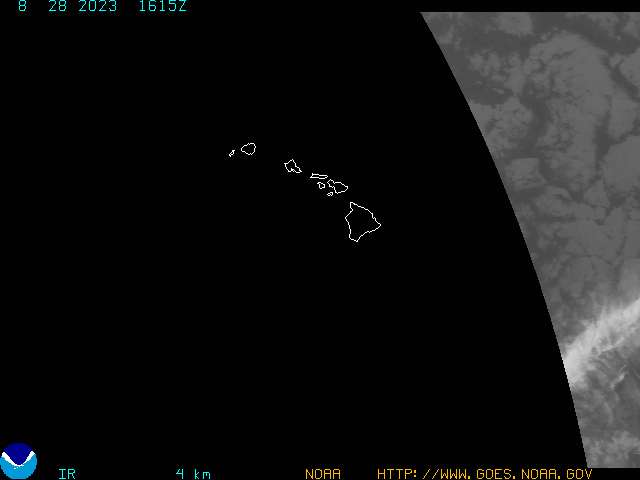
Satellite and Radar Images: To view the cloud conditions we have here in Hawaii, please use the following satellite links, starting off with the Infrared Satellite Image of the islands to see all the clouds around the state during the day and night. This next image is one that gives close images of the islands only during the daytime hours, and is referred to as a Close-up visible image. This next image shows a larger view of the Pacific…giving perspective to the wider ranging cloud patterns in the
Aloha Paragraphs

Black Sand Beach…Maui
Photo Credit: flickr.com
Our local winds will be shifting to the southeast Friday…then strengthening south to southwest Kona winds Saturday. As an approaching cold front approaches the state, a high pressure ridge will migrate down over the islands, or to the south of the Big Island. We’ll see lighter breezes, along with possible volcanic haze, as the winds come up from the southeast direction Friday. As we get into the weekend, our winds will become stronger from the south and southwest, ahead of a wet cold front, becoming locally strong and gusty then…especially around Kauai and Oahu.
Showers around the state will be quite light, limited in general to the interior sections Friday afternoon…then wetter as a cold front arrives Saturday night into Sunday. As our winds get lighter Friday, we may see a few convective showers over the mountains during the afternoon hours. As we move into the weekend, a rather fast moving cold front will arrive over Kauai later Saturday, pushing down through Oahu, Maui County, and the Big Island through the day Sunday…into the night. Some of these showers will be locally quite heavy, along with a few possible thunderstorms!
It’s early Thursday evening here in Kihei, Maui, as I start writing this last section of today’s narrative. Fair weather conditions prevailed Thursday, and will tag along through most of Friday, with just a few showers falling here and there. The daytime hours will be quite sunny, esecially along the beaches, and warm too. During the day Friday, it will be somewhat warmer than normal, after a somewhat cooler than normal beginning to the day. We could see some increase in volcanic haze Friday, as the winds pick up vog from the Big Island, carrying it to the other islands. ~~~ Saturday will be alright too, although the winds, ahead of the well advertised cold front, will increase from the south and southwest. These Kona winds should become rather gusty as we move through the day. Our local weather will get wet as the cold front quickly moves down through the island chain Saturday night through Sunday. There will be locally heavy precipitation, with even a thunderstorm locally during this frontal passage. It wouldn’t be out of the question to see some localized flooding, although because the frontal cloud band will be fast moving, it should limit serious flooding problems. ~~~ This weekend will have unusually high tides, some of the highest of the year. At the same time, we will have a high surf advisory level northwest swell arriving later Saturday or Sunday. As these two features combine, there could be some localized coastal flooding as well. Saturday night will also find the January full moon, which turns out to be the largest of the year 2009! ~~~ I‘ve been forgetting to talk about something that’s been catching my eye lately, as I drive down to the health food store in Kihei for lunch. The pasturelands around Ulupalakua, all the way down to Kihei and Wailea, are a lush green! The hills above Kihei, Wailea, and down towards Makena, are covered with a thick padding of green grass…having been seriously watered by the heavy off and on rains during the second half of last month. It’s really pretty incredible to see so much green grass, along with the Kiawe trees all leafed out in green leaves too! ~~~ There’s a lot of blue skies out there now, as I get ready to jump in my car, for the drive upcountry to Kula. Speaking of upcountry, it’s going to be chilly up there Thursday night into early Friday morning. I would anticipate air temperatures in the 40F’s in Kula, and the 50’s in Pukalani and Makawao…perhaps grab that extra blanket before bedding down. I hope you have a warm and snug Thursday night wherever you happen to be spending it! I’ll be back early Friday morning with your next new weather narrative from paradise. Aloha for now…Glenn.
Note: I forget to mention how many of you visited this website during the month of December. You must excuse me for bringing this to your attention, but it impressed me! Ready, ok, 411,313 page impressions…which is the number of times all of the various webpages on this website, were viewed by all of you! So far this month, it’s a little slower, but already there have been 93,702 page impressions. The real reason that I wanted to display these numbers, was to say thanks to all of you for visiting Hawaii Weather Today…as much as you do! By the way, while you are here, don’t be afraid to check out the links on the left side of all the pages, and the google links around too. Aloha, Glenn
Interesting: A US airline has completed the first test flight of a plane partly powered by biofuel derived from algae. The 90-minute flight by a Continental Boeing 737-800 went better than expected, a spokesperson said. One of its engines was powered by a 50-50 blend of biofuel and normal aircraft fuel. Wednesday’s test is the latest in a series of demonstration flights by the aviation industry, which hopes to be using biofuels within five years. The flight was the first by a US carrier to use an alternative fuel source, and the first in the world to use a twin-engine commercial aircraft (rather than a four-engine plane) to test a biofuel blend. The flight from Houston’s Bush Intercontinental Airport completed a circuit over the Gulf of Mexico, and pilots carried out a series of tests at 38,000ft (11.6km), including a mid-flight engine shutdown. "The airplane performed perfectly," test pilot Rich Jankowski told the Houston Chronicle newspaper. "There were no problems. It was textbook."
Continental Airlines chief executive Larry Kellner described the biofuel as a "drop-in fuel", which meant that no modification to the aircraft or its engines was required. The fuel is also understood to meet and exceed specifications necessary for jet fuel, including a flash point and a freezing point appropriate for use in aircraft. "The challenge will be to produce it in an efficient way in the quantities we need," Mr Kellner said. The biofuel used in the demonstration flight was a blend of two different types of alternative oils – algae and jatropha. Jatropha is a plant that can grow successfully in poor soils and marginal land, yet it yields four times more fuel per hectare than soybean. However, algae is viewed by many as a key fuel for the future because it is fast growing, does not compete with food crops for arable land, and yields up to 30 times more fuel than standard energy crops. But despite advances in the technology, biofuels derived from algae have yet to be proven as commercially competitive.
Interesting2: While the England continues to be hit by cold weather, parts of Australia are in the grip of a summer heat wave, which has seen temperatures soar to 108F in some places. Many parts of southern Australia are entering their 11th consecutive day of temperatures over 104F. The heat has originated from the deserts further inland, and has been transported by hot, dry winds which blow across the southern deserts in summer. In the south west of the country, Perth continues to bake under temperatures of 95F, more than 8F above their average maximum temperature for this time of year. Towards the east, a state of emergency has been declared near Sydney, after days of extreme heat sparked numerous of wild fires. Forecasters at the Australian Bureau of Meteorology expect little respite over the next few days, with the heat set to continue across southern Australia. It is not until the end of the week that things start to cool down, with temperatures becoming closer to average for the time of year.
Interesting3: The Centers for Disease Control and Prevention is working with public health officials in 42 states to determine the cause of an outbreak of a particular type of salmonella called Typhimurium. According to CDC sources, at least 388 people have been infected with this strain since September 3, and approximately 69 people have been hospitalized. The CDC has not identified what food or foods might be causing this outbreak. It is also not yet releasing a list of states involved in the investigation, which they say is ongoing. CDC officials and state public health workers are conducting case control studies, which means they’re tracking down people who have been infected as early as September to determine what they may have consumed, to find a common cause.
The Food and Drug Administration and the U.S. Department of Agriculture are in contact with the CDC, but without a determination of the cause of the outbreak, their involvement is limited. The youngest and oldest patients and chronically ill people with compromised immune systems are at highest risk for severe complications, according to the National Institutes of Health. Until a cause of the outbreak is confirmed, the CDC is recommending the following: Consumers should thoroughly cook meats, poultry and eggs. They should also avoid consuming raw or unpasteurized milk and other dairy products. Produce should be thoroughly washed as well. Avoid cross-contamination of uncooked meats and produce to prevent spreading any potential salmonella. Frequent washing of hands during food preparation can also help reduce cross-contamination.
Interesting4: In an alarming, yet little noticed series of recent studies, scientists have determined that Canada’s 1.2 million square miles of forests have become so stressed from damage caused by global warming, insect infestations and persistent fires that they have crossed an ominous line and now pump out more carbon dioxide than they take in. The trees make up more than 7 percent of Earth’s total forest lands and have been dubbed the "lungs of the planet" because they could always be depended upon to suck in vast quantities of carbon dioxide, naturally cleansing the world of some of the harmful heat-trapping gas. But rising temperatures are slowly drying out forest lands, leaving trees more susceptible to fires, which release huge amounts of carbon into the atmosphere, Canadian officials say. Higher temperatures also are accelerating the spread of the deadly mountain pine beetle, which has devastated tens of thousands of square miles of trees. Bitterly cold Canadian winters used to kill off much of the pine beetle population each year, naturally keeping it in check.
But the milder winters of recent years have allowed the insect to proliferate. The problem has become so serious that Canada’s federal government effectively wrote off the nation’s forests in 2007 as officials submitted their plans to abide by the international Kyoto Protocol, which requires participating nations to reduce their greenhouse gas emissions. And the grim reality is stoking a new debate over commercial logging, one of Canada’s biggest industries. Environmentalists contend that the extreme stresses on Canada’s forests, particularly the old-growth northern forest, mean that logging ought to be sharply curtailed to preserve the remaining trees — and the carbon stored within them — for as long as possible. But some government scientists say a logging moratorium is no solution to the global warming problem and would in fact increase carbon emissions over the long term because wood products are essential for construction, furniture and other uses. The wood would have to be replaced with other man-made materials, such as plastic, steel or concrete, which require the burning of even more fossil fuels, and therefore increase carbon emissions during their manufacturing processes.
Interesting5: Acting Prime Minister Julia Gillard says there is no reason to ban an anti-whaling ship from docking at an Australian port. The Sea Shepherd Conservation Society ship Steve Irwin has suspended its chase of a Japanese whaling fleet in Antarctic waters and is heading towards Hobart to refuel. Japan plans to ask Australian to block the vessel from entering the country, saying Sea Shepherd’s "pirate-like" and violent actions must be rejected. The Japan Whaling Association has said both Australia and New Zealand should bar the Steve Irwin from their ports. But Ms Gillard said there were no grounds to ban the Steve Irwin from docking in Hobart, although the vessel is yet to request to do so. "We have not received an impending vessel request from the Steve Irwin," she told reporters in Melbourne on Thursday.
"Should such a request be received, then the Steve Irwin will be permitted to dock at an Australian port. "There is insufficient reason to prevent the Steve Irwin from doing that." Ms Gillard reiterated the need for the vessel to refrain from dangerous activities on the high seas. "What we have said to the Steve Irwin is … that when the Steve Irwin is in the Southern Ocean, that is obviously a dangerous stretch of water, it’s very far removed from land. "We want people when they are on that stretch of water to conduct themselves in a way which ensures that they stay safe and others are safe." The Japanese whaling fleet plans to kill about 1,000 whales this summer, using a loophole in a 1986 global whaling moratorium that allows "lethal research" on the ocean giants.
Interesting6: Nearly one-fifth of the world’s coral reefs have already succumbed to the combined onslaught of global warming, water pollution, and overfishing. Without immediate measures to mitigate climate change and reduce the local pressures on reefs, the world is set to lose another 15% of coral reefs over the next 10−20 years and 20% over 20−40 years. Those are the main conclusions of a new report, produced jointly by a handful of government agencies and nongovernmental organizations from around the world, including the U.S. National Oceanic and Atmospheric Administration (NOAA). The report brings some “sobering news,” said Clive Wilkinson, the report’s editor, as he introduced the study at a reception held at the National Aquarium in Washington, D.C., on December 9, 2008. “It is clear that human activities continue to degrade coral reefs.”
However, not all coral reefs are doomed. The 372 coral reef scientists and managers from 96 countries who contributed to the report also conclude that 46% of the world’s coral reefs are beyond the reach of most threats, with the exception of climate change. This past year, 2008, was the International Year of the Reef. The review is the latest in a series of scientific papers and agency reports that have documented the sad plight of corals in the past year. For nearly four decades, scientists have been documenting the health of corals. The recent flurry of studies is the result of collaborations among scientists, environmental advocates, and natural resource managers attempting to understand the issue on a global scale.
Interesting7: An international research team led by Newcastle University (UK) has identified a new line of bacteria they believe will add flavor to some of the world’s most exclusive cheeses. It’s an age-old tradition that dates back at least 8,000 years but it seems we still have much to learn about the bacteria responsible for turning milk into cheese. The team used DNA fingerprinting techniques to identify eight previously undiscovered microbes on the French cheese Reblochon. One of France’s great mountain cheeses, Reblochon is a ‘smear-ripened’ cheese where the surface of the cheese is washed with a salt solution containing bacteria. This process helps to spread the bacteria across the surface of the cheese, ripening it from the outside in.
Other popular smear-ripened cheeses on the Christmas cheeseboard include Port de Salut, Livarot, Taleggio, Limburger and the Irish cheese Gubbeen. The team have named the microbes Mycetocola reblochoni after the cheese they were first discovered in. Project lead Professor Michael Goodfellow of Newcastle University said: “It has always been thought the bacteria cheese makers were putting in at the start of the process gave Reblochon its distinctive flavor. “What our research actually showed was this new group of bacteria – the reblochoni – were responsible for the ripening process, influencing the taste, texture and smell of the cheese.”
 Email Glenn James: